zenpundit.com » Patterns

Archive for the ‘Patterns’ Category

Intelligence vs the Artificial

Friday, January 16th, 2015

[ by Charles Cameron — who believes that detours are the spice of life ]
.

Craig Kaplan:

Craig Kaplan

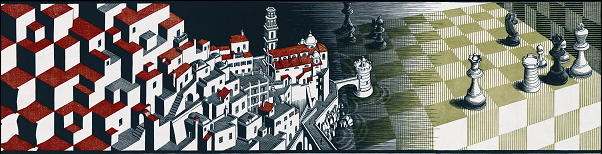
Maurits Escher:

M Escher

**

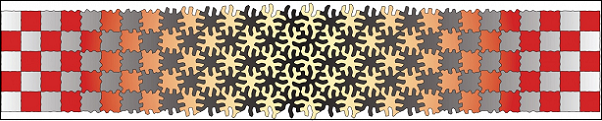
There’s a fasacinating article about Craig Kaplan and his work with tiling that I came across today, Crazy paving: the twisted world of parquet deformations — I highly recommend it to anyone interested in pattern — and I highly recommend anyone uninterested in pattern to get interested!

Kaplan himself is no stranger to Escher’s work, obviously enough — he’s even written a paper, Metamorphosis in Escher’s Art — the abstract reads:

M.C. Escher returned often to the themes of metamorphosis and deformation in his art, using a small set of pictorial devices to express this theme. I classify Escher’s various approaches to metamorphosis, and relate them to the works in which they appear. I also discuss the mathematical challenges that arise in attempting to formalize one of these devices so that it can be applied reliably.

I mean Kaplan no dishonor, then, when I say that his algorithmic tilings, as seen in the upper panel above, still necessarily lack something that his mentor’s images have, as seen in the lower panel — a quirky willingness to go beyond pattern into a deeper pattern, as when the turreted outcropping of a small Italian town on the Amalfi coast becomes a rook in the game of chess

**

Comparing one with the other, I am reminded of the differences between quantitative and qualitative approaches to understanding, of SIGINT and HUMINT in terms of the types of intelligence collected — and at the philosophical limit, of the very notions of quantity and quality.

Enantiodromia: the French Revolution

Thursday, January 1st, 2015

[ by Charles Cameron — abstraction and pattern recognition as devices to evade one’s foibles, preferences, analytic assumptions ]
.

Robespierre facial reconstruction
Robespierre, forensic reconstruction

**

The itaicized portion of the quote below just happens to be a concise statement of the pattern known as enantiodromia [1, 2, 3] — and the puzzlement it represents to linear (as opposed to loopish) thinkers:

Since the collapse of Jacobin rule after Robespierre’s execution in Thermidor Year II, debate has raged over how an event that began with the promise of liberty and fraternity degenerated so rapidly into fifteen months of mass imprisonment and death.

**

The quote above is from The World Turned Upside Down, a review of Jonathan Israel‘s Revolutionary Ideas: An Intellectual History of the French Revolution from the Rights of Man to Robespierre by Hugh Gough in the Dublin Review of Books. Here’s the full para:

Anyone looking for a neat explanation of the French revolutionary terror faces the problem of choice. Since the collapse of Jacobin rule after Robespierre’s execution in Thermidor Year II, debate has raged over how an event that began with the promise of liberty and fraternity degenerated so rapidly into fifteen months of mass imprisonment and death. During 1793 and 1794 around three hundred thousand people were jailed, many of them dying from disease and neglect, a further seventeen thousand were guillotined or shot and a quarter of a million killed in civil wars, of which the Vendée was by far the most deadly. After Thermidor the revolution’s opponents argued that terror on such a scale was inherent in the entire revolutionary project from the outset, part of a “genetic code” of violence and intolerance deeply embedded in the revolutionary gene. The revolution’s supporters, on the other hand, defended terror as the product of difficult circumstances, a regrettable but necessary expedient to combat the threats posed to the republic by civil war and military invasion.

**

Dichotomy.

The two sides of the debate are separated by their political associations with the events in question. Take away the sentiment-engagers — bread vs cake, revolution, Bastille, Marseillaise, the guillotine, the tricoteuses, the American revolution, Marx, whatever — thus viewing the image as simply one of contending forces, preferring neither one to the other, and the paradox resolves itself into a simple self-biting circle: the oppressed press back until they are themselves the pressors.

Jung knew this archetypal pattern — but I suspect he is little known in the history silo, and has indeed been expelled from the silo of the psychologists.

Somewhere in back of the event is a pattern, and when sufficiently abstracted the pattern will illustrate with commendable impartiality the forces in play in the whole.

For the analyst, that impartiality, that wholistic perspective, is pure gold.

For myself, it was Reason enthroned in Notre Dame that truly set my teeth on edge.

**

Image source:

  • Robespierre’s likely appearance, a forensic reconstruction
  • **

    And a Happy New Year to us all!

    Spirals: plus ça change

    Tuesday, December 31st, 2013

    [ by Charles Cameron — a striking image from the Cassini probe, a “spiral” staircase ]
    .

    Spirals, which are close to concentric circles and close to ellipses, can also be “squared” or “oblonged” — pattern recognition is not always neat in its observation of definitions, and this can as easily be a cognitive feature as a bug:

    Besides, Plus ça change, plus c’est la même chose could almost be the motto for pattern recognition, emphasizing the naturally cross-disciplinary, cross-silo nature of analogical cognitive strategies.

    **

    The top panel image is of the North Pole of Saturn, as recently captured by NASA’s Cassini mission. As blog-friend Bryan Alexander notes at Infocult, NASA says of this image, which it calls The Maelstrom:

    The vortex at Saturn’s north pole — seen here in the infrared — takes on the menacing look of something from the imagination of Edgar Allan Poe.

    Gaming the Connections: from Sherlock H to Nada B

    Sunday, December 29th, 2013

    [ by Charles Cameron — the game of Connect the Dots in play and practice ]
    .

    CIA's (now ret'd) Nada Bakos examines the Al Qaida board in the HBO docu, Manhunt

    .

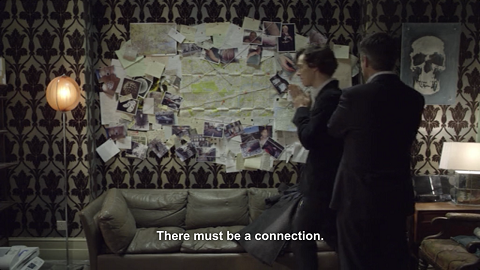
    Manhunt, the HBO documentary, does what (not having been there and seen that at the time) appears to be a decent job of recreating some of the cognitive stratregies employed by CIA officers in the OBL hunt. The one I’m interested in here is the building of a “link chart” or cognitive map — law enforcement “evidence board” — the idea being (a) to note known connections visibly, and (b) to encourage the mind to make intuitive leaps that reveal previously unknown connections between nodes… or “dots”.

    Sophisticated software does this sort of thing algorithmically with regard to (eg) network connections via phone-calls, but the human mind is still better than AI at some forms of pattern recognition, and that’s the aspect that interests me here.

    Aside:

    For more on the cognitive significance of the link chart in Manhunt, see my post Jeff Jonas, Nada Bakos, Cindy Storer and Puzzles.

    **

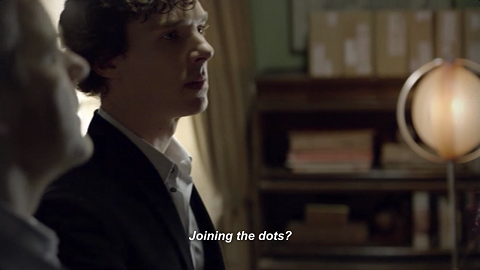
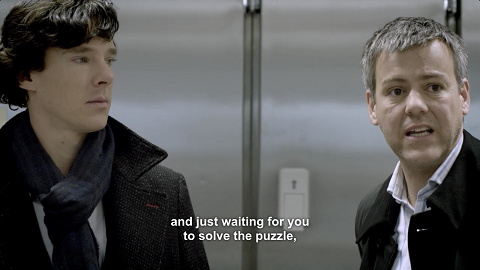
    Benedict Cumberbatch‘s Sherlock lays out the way it works —

    **

    Okay, so one way to visualize connections is to make a fairly random collage of relevant photos, names, dates and places, and tie it together with links of string or ribbon. That’s the equivalent of what in HipBone games terms we’d call a “free-form” game, and it works well for the “divergent”, initial brainstorming phase of thought. But it does little to bottle its own energy, to focus down, to force the mind — in the no less powerful “convergent” phase — into perceiving even more links than occur spontaneously in building the link chart in question.

    HipBone‘s preformatted boards take the cognitive process to that second stage. They work on one of the most powerful ingredients in creativity: constraint. Business writer Dave Gray of Communication Nation puts it like this:

    Creativity is driven by constraints. When we have limited resources — even when the limits are artificial — creative thinking is enhanced. That’s because the fewer resources you have, the more you are forced to rely on your ingenuity.

    But that premise doesn’t just hold true for business problem-solving — it’s at the heart of creative thinking at the Nobel level, too, in both arts and sciences. Consider mathematician Stanley Ulam, writing in his Adventures of a Mathematician:

    When I was a boy I felt that the role of rhyme in poetry was to compel one to find the unobvious because of the necessity of finding a word which rhymes. This forces novel associations and almost guarantees deviations from routine chains or trains of thought. It becomes paradoxically a sort of automatic mechanism of originality…

    Here’s how the poet TS Eliot puts it:

    When forced to work within a strict framework the imagination is taxed to its utmost – and will produce its richest ideas.

    A Hipbone Gameboard such as the Waterbird, Dartboard, or Said Symphony board is chosen precisely to challenge the mind with third, fourth and fifth rounds of “creative leaps” — thus adding both divergent and convergent cognitive styles to this form of graphical analysis.

    That’s my point here — and a plug for HipBone-Sembl style thinking.

    **

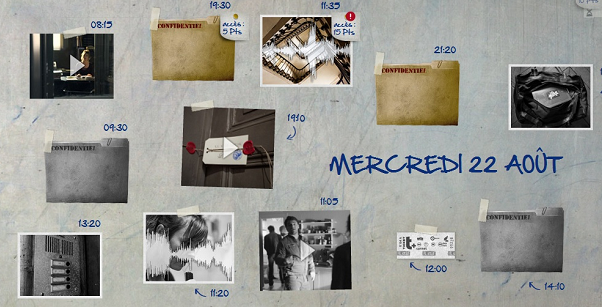
    I can’t resist adding a couple of instances in which the meme of “connecting the dots” via a link chart or evidence board has crept from TV series that I enjoyed into the world of games — this first one based on the terrific French detective series, Engrenages, retitled Spirals for British consumption:
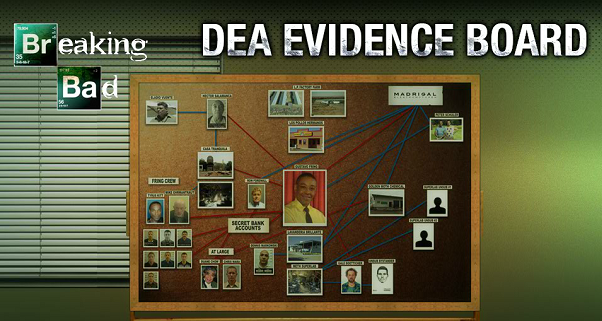
    — and this one for fans of the US TV series, Breaking Bad:
    Matrioshka forensics

    Sunday, December 29th, 2013

    [ by Charles Cameron — it still takes a live human to see what the human eye cannot see but the machine can ]
    .

    This would appear to be (one version of) the state of the art in facial recognition:

    Image within image within image — the gentleman on the right is more or less recognizable as a reflection in the eye of the gentleman on the left — thus giving new potential meaning to the phrase “you are the apple of my eye” (cf Zechariah 2:8, also Oberon in Midsummer Night’s Dream III.ii.102 ff., and Stevie Wonder, You Are The Sunshine Of My Life).

    **

    Or — to switch disciplines while remaining with the matrioshka form, because such patterns are of interest to the inquiring mind — as Gary Snyder puts it in his marvelous poem, One Should Not Speak to a Skilled Hunter:

    The secret.
    and the secret hidden deep in that.

    **

    For another version of the state of the art in facial recognition, see: Where’s Ms. Waldo?. Aloha!


    Switch to our mobile site