zenpundit.com » language

Archive for the ‘language’ Category

Unholy: perhaps it’s a useful word

Friday, January 30th, 2015

[ by Charles Cameron — when religion casts a long and violent shadow ]
.
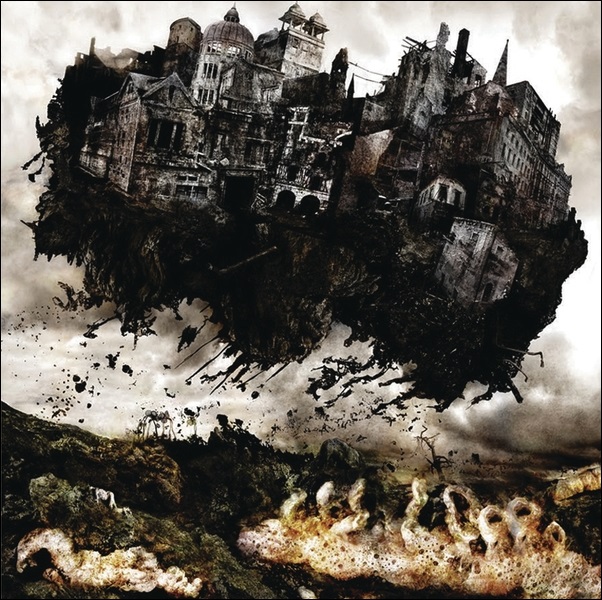
unholy cover
cover art for the Unholy album, New Life behind Closed Eyes

**

Unholy may prove to be a very useful word, I think.

It’s not secular, it’s not irreligious, it doesn’t lack for some sort of supernatural influence — in fact it fits right in with the metaphysical implications of such Biblical phrases as (Revelation 12.7):

there was war in heaven: Michael and his angels fought against the dragon; and the dragon fought and his angels

and (Ephesians 6.12):

we wrestle not against flesh and blood, but against principalities, against powers, against the rulers of the darkness of this world, against spiritual wickedness in high places

**

Because, I am arguing, it is neither secular nor irreligious, it fits perfectly, I’d say, the kinds of situation we’re in so freuqnetly, globally, of religiously motivated group violence.

The word jihad — besides focusing entirely on Islamic variants, when in fact Buddhist, Hindu and Christian militians are also in evidence — concedes too much to those who regard their warfare as holy, divinely sanctioned, while other terms make things sound secular and almost normal, as if politics without the religious booster was all we are talking about.

BrutaL and spiritual, spiritual and brutal on both sides — in the Central African Republic, for instance:

It was March 2013 when the predominantly Muslim rebel coalition Séléka swept into the riverside capital, Bangui, from the northeast. President François Bozizé fled as a vicious campaign of looting, torture and murder got underway. Séléka leader Michel Djotodia soon proclaimed himself the successor; he would later lose control of his ranks and an attempt that fall to disband them would do little to stop the atrocities.

At the same time, groups of militias called anti-balaka had begun to form and train and retaliate against Séléka. Their name in the local Sango language means “anti-machete”; their fighters are comprised of ex-soldiers, Christians and animists, who think magic will protect them. They’re adorned with amulets to ward off attacks and fight with hunting rifles, poison-tipped arrows and machetes.

Amulets and machetes.. warriors and angels.

**

Maybe we should say “unholy warriors” and “unholy wars” rather than “holy warriors” or “jihadis” — and “unholy monks” for the Burmese mobsters in saffron robes.

And I’d reserve the use of the term for situations in whiuch at least one side in a conflict openly avows religious motivation. Someone making a treaty someone else feels is foolish or dangerous simply doesn’t meet the bar.

**

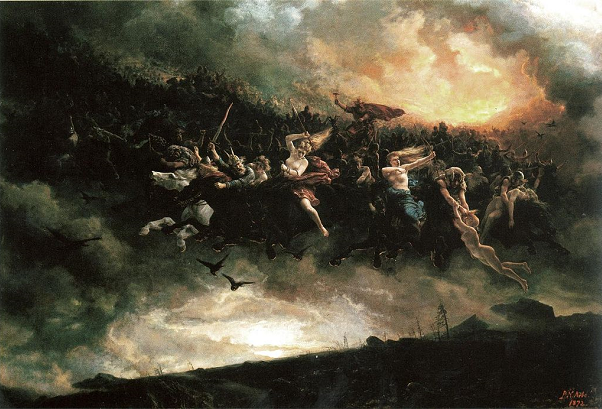
It’s worth considering the Unholy CD cover art alongside two other recent images:
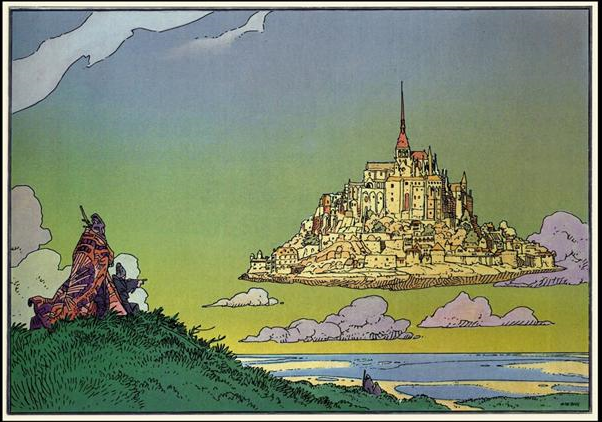
Moebius Floating City

and:

Wild-Hunt-602

And about that top image from the Unholy album, just so you know:

UNHOLY present their Prosthetic Records debut, a metal massacre fueled with down-tuned guitars, double bass and deep grooves akin to the sounds of Entombed, Crowbar and later Carcass, with members having been in bands like Santa Sangre, Another Victim and Path Of Resistance.
Pinker, Blake and Moebius

Thursday, January 29th, 2015

[ by Charles Cameron — looks like I’ll have an “Author’s blog” up soon to accompany a book I’m working on, and it’ll be called “Seeing Double” — which is what this post is about ]
.

Steven Pinker, I’m sorry to say, appears to be one of those

One can imagine a world in which oracles, soothsayers, prophets, popes, visionaries, imams, or gurus have been vouchsafed with the truth which only they possess and which the rest of us would be foolish, indeed, criminal, to question. History tells us that this is not the world we live in. Selfproclaimed truthers have repeatedly been shown to be mistaken — often comically so — by history, science, and common sense.

The characters I’m interested in here are the visionaries — and my point is that truth as fact is not the only truth there is.

**

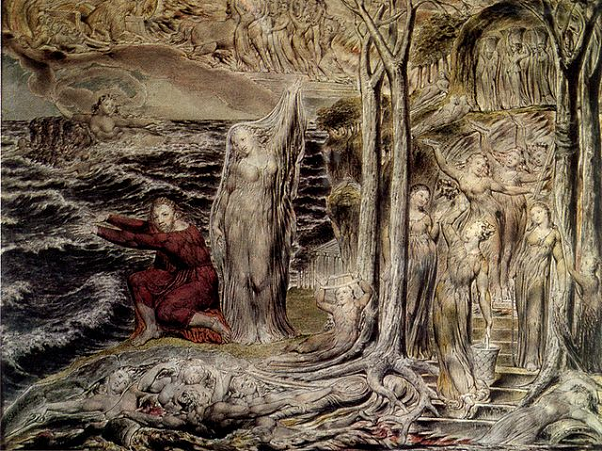
Can “history, science and common sense” really detract from the “truth” of this image by Blake?

Blake_De_antro_nympharum_Tempera_Arlington_Court_Devon

or this, by Moebius?

Moebius Floating City

**

Pinker is interesting — that single para of his just gave me a chance to rant — so let me return you to his whole piece.

I have other disagreements with him, no doubt, but he’s a mind to be engaged with.

Brief brief: of binding and loosing

Tuesday, January 27th, 2015

[ by Charles Cameron — really just a note to myself, but you may read it over my shoulder ]
.

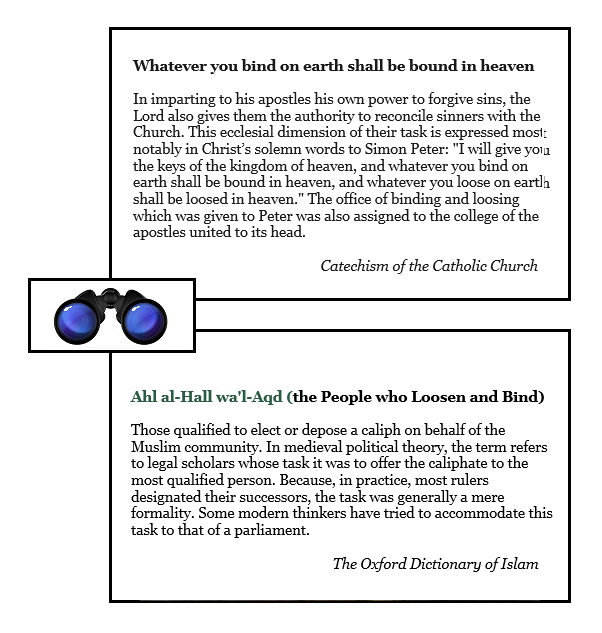
Joas Wagemakers, blogging on Jihadi-Salafi views of the Islamic State at the Washington Post, was talking about the “caliphate” today, and as usual, I went off on my own DoubleQuoting tangent:

SPEC DQ bind and loose

**

Here’s Wagemakers’s para that triggered the above:

In 2014 the Islamic State of Iraq and Syria set itself apart from most other radical Islamist groups by actually settling in a certain territory and establishing a state there. The group even declared a caliphate on June 29 and changed its name simply to the Islamic State (IS). Even al-Qaeda, which has long had similar ambitions to establish a caliphate encompassing all Muslims, has never achieved this. In its justification for the announcement of its caliphate, IS has made use of classical Islamic concepts: its leader, Abu Bakr al-Baghdadi, had been vetted by a group of scholars described as “the people who loosen and bind” (ahl al-hall wa-l-aqd), was found by them to be a pious Muslim ruler who fit all the criteria for a caliph and was therefore worthy of believers’ oath of allegiance (baya).

Do I detect an echo here, between the two phrases — or is the concept of loosing and binding so basic to human experience that it crops up all over?

It’s a question at the intersection of two of my fields of special interest — depth psychology and cultural anthro — see for example Anthony Stevens, writing under the subtitle Archetypes versus cultural transmission:

Essentially, the theory can be stated as a psychological law: whenever a phenomenon is found to be characteristic of all human communities, it is an expression of an archetype of the collective unconscious. It is not possible to demonstrate that such universally apparent phenomena are exclusively due to archetypal determinants or entirely due to cultural diffusion, because in all probability both are involved. However, the likelihood is that there will be a strong bias for those phenomena which are archetypally determined to diffuse more readily and more lastingly than those that are not.

**

Now go read Wagemakers.

King

Tuesday, January 20th, 2015

[ by Charles Cameron — my bilingual six-letter DoubleQuote for the day ]
.

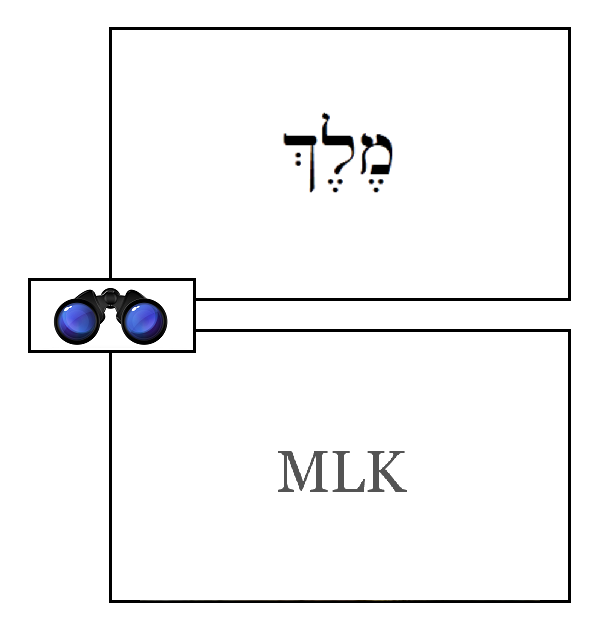
SPEC DQ MLK Melek

in the upper panel, in Hebrew, the word MeLeK. I’ve put the three consonants in capitals down here, and the vowels in lower case, but it’s a three letter word as you can see above, and the letters are (from right to left) MLK.

Which is interesting.

Because in translation, it means, as does the lower panel: King.

Creating a web-based format for debate and deliberation: discuss?

Friday, December 12th, 2014

[ by Charles Cameron — Talmud, hypertext, spider webs, Indra’s net, noosphere, rosaries, renga, the bead game, Xanadu, hooks-and-eyes, onward! ]
.

Let me firmly anchor this post and its comments, which will no doubt shift and turn as the wind wishes, in discussion of the possibility of improving on current affordances for online deliberation.

Let’s begin here:

**

There are a variety of precursor streams to this discussion: I have listed a few that appeal to me in the sub-head of this post and believe we will reach each and all of them in some form and forum if this discussion takes off. And I would like to offer the immediate hospitality of this Zenpundit post and comment section to make a beginning.

Greg’s tweet shows us a page of the Talmud, which is interesting to me for two reasons:

  • it presents many voices debating a central topic
  • it does so using an intricate graphical format
  • The script of a play or movie also records multiple voices in discourse, as does an orchestral score — but the format of the Talmudic score is more intricate, allowing the notation of counterpoint that extends across centuries, and provoking in turn centuries of further commentary and debate.

    What can we devise by way of a format, given the constraints of screen space and the affordances of software and interface design, that maximizes the possibility of debate with respect, on the highly charged topics of the day.

    We know from the Talmud that such an arrangement is possible in retrospect (when emotion can be recollected in tranquility): I am asking how we can come closest to it in real time. The topics are typically hotly contested, patience and tolerance may not always be in sufficient supply, and moderation by humans with powers of summary and editing should probably not be ruled out of our consdierations. But how do we create a platform that is truly polyphonic, that sustains the voices of all participants without one shouting down or crowding out another, that indeed may embody a practic of listening..?

    Carl Rogers has shown us that the ability to express one’s interlocutor’s ideas clearly enough that they acknowledge one has understood them is a significant skill in navigating conversational rapids.

    The Talmud should be an inspiration but not a constraint for us. The question is not how to build a Talmud, but how to build a format that can host civil discussion which refines itself as it grows — so that, to use a gardening metaphor, it is neither overgrown nor too harshly manicured, but manages a carefully curated profusion of insights and —

    actual interactions between the emotions and ideas in participating or observing individuals’ minds and hearts

    **

    Because polyphony is not many voices talking past one another, but together — sometimes discordant, but attempting to resolve those discords as they arrive, and with a figured bass of our common humanity underwriting the lot of them.

    And I have said it before: here JS Bach is the master. What he manages with a multitude of musical voices in counterpoint is, in my opinion, what we need in terms of verbal voices in debate.

    I am particularly hoping to hear from some of those who participated in tweeted comments arising from my previous post here titled Some thoughts for Marc Andreessen & Adam Elkus, including also Greg Loyd, Callum Flack, Belinda Barnet, Ken (chumulu) — Jon Lebkowsky if he’s around — and friends, and friends of friends.

    What say you?


    Switch to our mobile site