Archive for the ‘blog-friends’ Category
Tuesday, January 22nd, 2013
[ By Charles Cameron — cross-tagging some useful resources from natsec bloggers with another from a bright historian friend ]
.

.
Daveed Gartenstein-Ross‘s Globe and Mail piece The War’s in Mali, But the Danger is International from almost a week ago gave a global context to the conflict, while his more recent Al Qaeda in the Islamic Maghreb and Al Qaeda’s Senior Leadership on Gunpowder & Lead addresses the issue of relations between AQIM and AQ senior leadership.
Zeroing in, we have a 4-part series on the jihadist actors in Mali from Andrew Lebovich, posting on Jihadica:
Primer on Jihadi Players in Algeria and Mali, Pt. 1: AQIM
Primer on Jihadi Players in Algeria and Mali, Pt. 2: Belmokhtar & Those Who Sign with Blood
Primer on Jihadi Players in Algeria and Mali, Pt. 3: Movement for Tawhid and Jihad in West Africa
— and there’s one more in the series still to come which has now been posted:
Primer on Jihadi Players in Algeria and Mali, Pt. 4 (Final): Ansar al-Din
**
And by way of cross-fertilization of immediacy with history, here’s the key Mali para from The Slightly-More-Longue Duree by my friend, Swarthmore historian Tim Burke, on Easily Distracted:
I would never for a moment want to fall back on a pure restatement of ibn Khaldun’s famous interpretation of the history of northern Africa (and the world) and say, “See, this is just pastoralist nomads versus settled agriculturalists and city-dwellers”. But there is a much more specific history that has considerable depth and antiquity to it that involves relationships between Berber-speaking Tuareg pastoralists, Fulani pastoralists, and the settled agricultural societies of the Niger River; between North African states and Sahelian states; between cities and their rural hinterlands; between Islamic cultures and non-Islamic ones. That all matters not just as contemporary sociology but as deep and structurally recurrent history, as a series of patterns and concepts that can be consciously recited by contemporary combatants but that also can be the structural priors of how they mobilize for and imagine conflicts.
Tim’s conclusion:
To talk about deeper histories is not to explain current conflicts as destiny, or to put aside a whole host of material, economic, geopolitical and cultural issues with much more immediate explanatory weight. But somehow I feel as if we have to give people struggling to understand what’s happening (and what to do about it) the permission to consider all of the history, as well as the guidance to help them to weigh its importance in context.
Posted in africa, analytic, blog-friends, blogosphere, Charles Cameron, historians, historiography, history, islam.insurgency, national security, Uncategorized | Comments Off on Mali: the wider context, the right now and the longue durée
Saturday, January 12th, 2013
[ by Charles Cameron — disentangling religion / politics braids in Pakistan and elsewhere ]
.
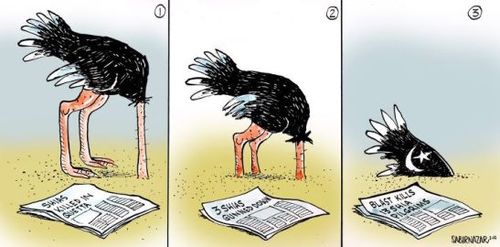
image credit: Pakistani cartoonist and artist Sabir Nazar
.
Blog-friend Omar Ali writes:
The state will make a genuine effort to stop this madness. Shias are still not seen as outsiders by most educated Pakistani Sunnis. When middle class Pakistanis say “this cannot be the work of a Muslim” they are being sincere, even if they are not being accurate.
The “madness” he’s discussing is the extensive killing of Shia Muslims by Sunni Muslims in Pakistan, and I’d recommend both his own article on 3 Quarks Daily and Bahukutumbi Raman‘s on Raman’s strategic analysis as offering detailed background for a topic I addressed from a different angle in Ashura: the Passion of Husayn.
**
It’s Dr. Ali’s final sentence in the quote above that interests me, though, as you’ve probably deduced already from the title of this post:
When middle class Pakistanis say “this cannot be the work of a Muslim” they are being sincere, even if they are not being accurate.
I haven’t quite known how to say this succinctly before, but I think Dr Ali hits a whole array of nails on the head.
Religions are mostly preached to whoever listens — and those who listen can be a pretty diverse lot, particularly across continents and centuries. The upshot is that religions generally wind up being interpreted in a variety of ways to suit the wide variety of human temperaments and situations.
Et voilà! Members of a religion who see it as a force for peace will tend to say of those who dismay them by using it as a cover for violence, “this cannot be the work of a member of my faith” — and they are being sincere, their understanding of their own religion is as peaceable as they say it is.
They are being sincere — even if they are not being accurate, and their religion as a “big tent” across cultures, classes, continents and centuries, also includes sincere people whose views are radically and violently opposed to theirs.
**
If Walt Whitman can say it, you’d better believe it can be said of religions with a billion or more adherents:
Do I contradict myself? Very well, then I contradict myself, I am large, I contain multitudes.
Posted in blog-friends, Charles Cameron, pakistan, poetry, politics, Religion, Uncategorized | 5 Comments »
Wednesday, December 12th, 2012
An excellent post from Adam Elkus – strongly recommended!
….The report makes a lot of comments about the rise of individual autonomy, the empowering of regional network-cities, and technology’s acceleration of the power of non-state actors. Wired interpreted part of this as signaling a decline of the state, which has been a popular theme since Martin van Creveld’s work on theTransformation of War. I think that is an accurate characterization of the parts of the 2030 report that talk about the empowerment of non-state actors and the rise of international networks. I’m less interested in the report, though, than in the general narrative of state decline in national security policy discourse.
We’ve heard that states are in decline, and both benign and malign networks and private actors are on the rise. This isn’t a new theme—if you look back a few decades the rise of multinational corporations and the multilaterals prompted a similar debate about sovereignty and power in the modern world. The state-centric defense practitioner is enjoined to move beyond caring about states and embrace a new reality.
…. What we have been dealing with, however, is an unfortunate tendency to write the non-state actor and transnational network out of the last few centuries of history. But he (or she) stubbornly refuses to go away. We can talk about some of the reasons why this might be the case in the international environment but it is also worth talking about why we often assume much more coherence and cohesion in our domestic environment than reality may justify.
….In Charles Tilly’s book Democracy, he argues that four processes are necessary to create and sustain a democratic state: the growth of state capacity by suppressing alternative sources of power, the reduction of categorical inequalities, and the integration of strong tie-based trust networks into public life. Warlords and kingpins that predate make it difficult for rights to be guaranteed. Categorical inequality lessens the ability of the people to meaningfully control their own destiny. And strong trust networks that cannot express themselves in political and social life also have the potential for predation and the erosion of state authority. Tilly casts these processes as never-ending in scope, and states are capable of backsliding on any one of them.
Very rich food for thought.
Trust networks are an interesting way to look at broader social networks and discern, at times, the presence of modularity (and therefore specialized skills, capacities, knowledge etc.) within a looser network structure (weak ties and links vs. highly interconnected sets of hubs with strong ties). We tend to graph these things in simple diagrams, like concentric circles with “al Qaida hard core” in the center, but really, they are more akin to clumping or clotting or uneven aggregation within a less dense field of connections.
Adam is also right that the irregular, the illegal, the tribal, the secret society, the rebellious peasant was largely ignored by nationalistic historians in the late 19th and early to mid 20th century – and when they came back in vogue in the 1960’s with revisionist, labor, social, cultural etc. schools of historians, they tended to groan under the heavy yoke of dogmatic Marxist class analysis and then later the radical academic obsessions with race, gender and sexual orientation “oppression”. Too seldom, were these people and their doings found to be interesting in themselves so much as puppets for a very tortured, abstract passion play to exorcise demons and pursue petty grudges against other scholars.
In any event, Adam is worth reading in full.
Posted in A.E., analytic, blog-friends, blogosphere, Failed State, government, historians, history, ideas, intellectuals, IR, markets, military, military history, national security, network theory, networks, non-state actors, Patterns, Perception, politics, primary loyalties, revolution, security, social networks, social science, society, state building, state failure, theory, transnational criminal organization, tribes, uncertainty, war | 10 Comments »
Tuesday, December 4th, 2012
To Lexington Green and James Bennett, for finishing their new book, America 3.0 – due out (I think) in 2013 published by Encounter Books.
A political vision for an era desperately short on imagination and needing statecraft of inspiration.
Posted in 21st century, Adaptability, America, analytic, authors, blog-friends, book, chicago boyz, conservativism, contemplative, creativity, critical thinking, culture, democracy, freedom, futurism, government, historiography, history, ideas, innovation, insight, intellectuals, leadership, legitimacy, lexington green, liberty, Patterns, Perception, philosophy, politics, primary loyalties, psychology, reading, reform, republican party, resilience, revolution, security, social science, society, strategy, symbolism, synthesis, theory, uncertainty, Writing | 2 Comments »
Tuesday, November 13th, 2012

The Rise of Siri by Shlok Vaidya
Shlok Vaidya has launched his first novel, dystopian techno-thriller in e-Book format entitled The Rise of Siri. Having been the recipient of a late draft/early review copy, I can say Shlok on his first time out as a writer of sci-fi has crafted a genuine page turner.
Companion site to the book can be found here – The Rise of Siri.com
Blending military-security action, politics, emerging tech and high-stakes business enterprise, the plot in The Rise of Siri moves at a rapid pace. I read the novel in two sittings and would have read it straight through in one except I began the book at close to midnight. Set in a near-future America facing global economic meltdown and societal disintegration, Apple led by CEO Tim Cook and ex-operator Aaron Ridgeway, now head of Apple Security Division, engages in a multi-leveled darwinian struggle of survival in the business, political and even paramilitary realms, racing against geopolitical crisis and market collapse , seeking corporate salvation but becoming in the process, a beacon of hope.
Vaidya’s writing style is sharp and spare and in The Rise of Siri he is blending in the real, the potential with the fictional. Public figures and emerging trends populate the novel; readers of this corner of the blogosphere will recognize themes and ideas that have been and are being debated by futurists and security specialists playing out in the Rise of Siri as Shlok delivers in an action packed format.
Strongly recommended and….fun!
Posted in 21st century, 4GW, Adaptability, authors, blog-friends, book, corporations, cultural intelligence, cyberpunk, dystopia, economics, fiction, fun, futurism, globalization, military contractor, national security, organizations, politics, primary loyalties, reading, resilience, security, shlok, society, state failure, tech, uncertainty | 2 Comments »


