zenpundit.com » egypt

Archive for the ‘egypt’ Category

Furnish on Pew findings re: Islam

Thursday, May 2nd, 2013

[ Charles Cameron presenting guest-blogger Timothy Furnish ]
.

.

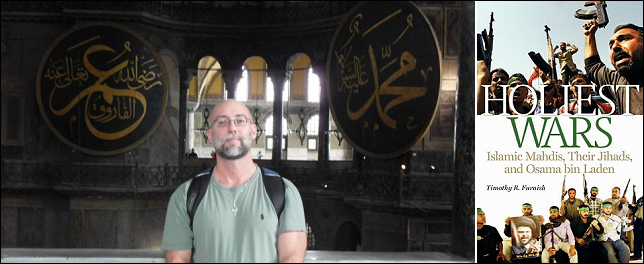
I’m delighted to welcome Dr Timothy Furnish as a guest-blogger here on Zenpundit. Dr Furnish has served as an Arabic linguist with the 101st Airborne and as an Army chaplain, holds a PhD in Islamic history from Ohio State, is the author of Holiest Wars: Islamic Mahdis, Their Jihads, and Osama bin Laden (2005), and blogs at MahdiWatch. His extended piece for the History News Network, The Ideology Behind the Boston Marathon Bombing, recently received “top billing” in Zen’s Recommended Reading of April 24th.

**

Does This Paint It Black, or Am I A Fool to Cry? Breaking Down the New Pew Study of Muslims
by Timothy R. Furnish, PhD
.

Pew has released another massive installment of data from its research, 2008-2012, into Muslim attitudes, entitled “The World’s Muslims: Religion, Politics and Society.” Over 38,000 Muslims in almost 40 countries were surveyed, thus constituting a survey both statistically sound and geographically expansive. Herewith is an analysis of that information and what seem to be its major ramifications.

The first section deals with shari`a, usually rendered simply as “Islamic law” but more accurately defined as “the rules of correct practice” which “cover every possible human contingency, social and individual, from birth to death” and based upon the Qur’an and hadiths (sayings and practices attributed to Muhammad) as interpreted by Islamic religious scholars (Marshal G.S. Hodgson, The Venture of Islam, Vol 1: The Classical Age of Islam, p. 74). Asked “should sharia [as Pew anglicizes it] be the law of the land,” 57% of Muslims across 38 countries answered “yes” — including, most problematically for the US: 99% of Afghans, 91% of Iraqis, 89% of Palestinians, 84% of Pakistanis and even 74% of Egyptians. Should sharia apply to non-Muslims as well as Muslims? Across 21 countries surveyed on this question, 40% answered affirmatively — with the highest positive response coming from Egypt (its 74% exceeding even Afghanistan’s 61%). And on the question whether sharia punishments — such as whippings and cutting off of thieves’ hands — should be enacted, the 20-country average was 52%, led by Pakistan (88%), Afghanistan (81%), the Palestinian Territories [PT] (76%) and Egypt (70-%). On the specific penalty of stoning for adultery, the 20-country average was 51% — with, again, Pakistan (89%), Afghanistan (85%), the PT (84%) and Egypt (71%) highest in approval. Finally, 38% of Muslims, across those same 20 nations, support the death penalty for those leaving Islam for another religion.

Huge majorities of Muslims across most of these surveyed nations say that “it’s good others can practice their faith” — but Pew’s imprecise terminology on this topic makes possible that this simply mean many Muslims are willing to grant non-Muslims the tolerated, but second-class, ancient status of the dhimmi. Majorities, too, in most countries say that “democracy is better than a powerful leader;” however, the latter was actually preferred by most surveyed in Russia, Bosnia-Hercegovina, Kyrgyzstan, Afghanistan and Pakistan, as well as by 42% of Iraqis, 40% of Palestinians and 36% of Egyptians. Most Afghans, Egyptians and Tunisians (and even 1/3 of Turks) believe that “Islamic political parties” are better than other ones, although 53% of Indonesians and 45% of Iraqis are also worried about “Muslim extremists.” (Curiously, 31% of Malaysians are, on the other hand, worried about “Christian extremists” — although evidence of such existing in that country is practically non-existent.) There is good news on the question of suicide bombing, however: across 20 countries, only 13.5% think it is ever justified — although the support is much higher in the PT (40%), Afghanistan (39%) and Egypt (29%).

In terms of morality, large majorities in most Muslim countries (especially outside Sub-Saharan Africa) think drinking alcohol is morally repugnant, notably in Malaysia (93%), Pakistan and Indonesia (both 91%). Most Muslims in most countries surveyed consider abortion wrong, as well as pre- and extra-marital sex and, almost needless to say, homosexuality. (Although one wishes Pew had asked about mu`tah, or “temporary marriage” — a practice originally Twelver Shi`i which has increasingly become used by Sunnis.) Yet, simultaneously — following Qur’anic rubrics — some 30% of Muslims in 21 countries support polygamy, including almost half of Palestinians, 46% of Iraqis and 41% of Egyptians. There is also significant support for honor killings in not just Afghanistan and Iraq but also Egypt and the PT. Over ¾ of Muslims across 23 countries says that “wives must always obey their husbands:” an average of 77%. And Pew notes that there is a statistically very significant correlation between sharia-support and believing women have few(er) rights.

Asked whether they believed they were “following Muhammad’s example,” 75% of Afghans and 55% of Iraqis answered affirmatively — although most Muslims were not nearly so confident. On the question “are Sunni-Shi`i tensions a problem,” 38% of Lebanese, 34% of Pakistanis, 23% of Iraqis and 20% of Afghans said “yes.”

It is no surprise that huge majorities of Muslims in most surveyed countries believe that Islam is the only path to salvation, nor that most also say “it’s a duty to convert others” to Islam. It is somewhat counterintuitive, however, that many Muslims say they “know little about Christianity” — even in places with large Christian minorities, such as Egypt. Muslims in Sub-Saharan Africa are the most likely to agree that “Islam and Christianity have a lot in common,” and so are 42% of Palestianians, as well as some 1/3 of Lebanese and Egyptians. But only 10% of Pakistanis agree. Asked whether they ever engaged in “interfaith meetings,” many Muslims in Sub-Saharan Africa said that they did (with Christians), and a majority of Thais said likewise (albeit with Buddhists). But only 8% of Palestinians, 5% of Iraqis, and 4% of Egyptians said they ever do so—despite substantial Christian populations in each of those areas.

Regarding the question “are religion and science in conflict,” most Muslims said “no” — with the exceptions of Lebanon, Bangladesh, Tunisia and Turkey where over 40% in each country (and, actually, a majority in Lebanon) said that they were at loggerheads. Most Muslims also say they have no problems with believing in Allah and evolution — the exceptions being the majority of Afghans and Indonesians. Regarding popular culture, clear majorities of Muslims in many countries say they like Western music, TV and movies—but, at the same time, similar majorities say that such things undermine morality (although Bollywood less so than Hollywood).

Observations:

1) The high degree of support for sharia is the red flag here. Contra media and adminstration (both Obama and Bush) assurances that most Muslims are “moderate,” empirical data now exists that clearly shows most Muslims, in point of fact, support not just sharia in general but its brutal punishments. Perhaps just as disturbing, almost four in ten Muslims are in favor of killing those who choose to follow another religion. And countries in which the US is heavily involved either diplomatically or militarily (or both) are the very ones where such sentiments run most high: Pakistan, Afghanistan, Egypt, the Palestinian Territories. So are the “extremists” these very Muslims who want to follow, literally, the Qur’an and hadiths? Messers Brennan, Holder and Obama have some explaining to do.

2) Afghanistan would appear to be a lost cause. Afghans are at the top of almost every list in support for not just sharia, suicide bombing, honor killing and — ironically (or perhaps not) — confidence that they are emulating Islam’s founder, as well as dislike for democracy. In light of this clear data, two points about Afghanistan become clear: tactically, ostensible American befuddlement as to the causes of “green on blue” attacks and the continuing popularity of the Taliban in Afghanistan appears as willful ignorance; strategically, the US decision to stay there after taking out the al-Qa`ida [AQ] staging, post-9/11, and attempt to modernize Afghanistan was a huge, neo-Wilsonian mistake. 2014 cannot come soon enough.

3) In some ways Islam in Southeastern Europe, and to a lesser extent in Central Asia, seems to be a more tolerant brand of the faith than the Middle Eastern variety. For example, the SE European and Central Asian Muslims are the least likely to support the death penalty for “apostasy,” and the most supportive of letting women decide for themselves whether to veil. And Muslims in Sub-Saharan Africa are the most likely to know about Christianity, and to interact with Christians. On the other hand, African Muslims are among the most enamored of sharia, and Central Asian ones fond of letting qadis (Islamic judges) decide family and property disputes. So there does not seem to be a direct link between Westernization and moderation; in fact, the influence of Sufism — Islamic mysticism — in the regard needs to be correlated and studied (beyond what Pew did on the topic in last year’s analysis).

4) One bit of prognostication based on this data: Malaysia may be the next breeding ground of Islamic terrorism. It’s home to some 17 million Muslims (61% of its 28 million people), who hold a congeries of unsettling views: 86% want sharia the law of the land; 67% favor the death penalty for apostasy; 66% like sharia-compliant corporal punishments; 60% support stoning for adultery; and 18% think suicide bombing is justified. PACOM, SOCOM and the intelligence agencies need to ramp up hiring of Malay linguists and analysts.

5) Finally, some words for those — like FNC’s Megyn Kelly and Julie Roginsky (on the former’s show “American Live,” 4/30/13) — who pose a sociopolitical and moral equivalence between Muslim support for sharia and Evangelical Protestant Christian support for wives’ obedience to husbands: that’s a bit too much sympathy for the devil. Yes, Evangelical Christian pastors hold some pretty conservative views of the family, as per a 2011 Pew study of them; for example, 55% of them do agree that “a wife must always obey her husband” (compared to 77% of Muslims). And, ironically, many such Evangelicals agree in large measure with Muslims on issues such as the immorality of alcohol, abortion and homosexuality. However, one searches in vain for any Evangelical (or other) Christian support for whippings, stonings, amputation of thieves’ limbs, polygamy or suicide bombing.

Islam is the world’s second-largest religion, numbering some 1.6 billion humans (behind only Christianity’s 2.2 billion). There is, thus, enormous diversity of opinion on many issues of doctrine and practice, and essentializing Islam as either “peaceful” or “violent” is fraught with peril. Nonetheless, this latest Pew study provides empirical evidence that many — far too many — Muslims cling to a literalist, supremacist and indeed brutal view of their religion. Insha’allah, this will change eventually — but time is not necessarily on our side.
Of plagues of locusts, then & now?

Tuesday, February 26th, 2013

[ by Charles Cameron — the juxtaposition of sacred and secular worldviews, and what happens where they overlap ]
.

**

I’m returning here to an old theme of mine, the juxtaposition of worldviews — in this case, accounting for plagues of locusts in Egypt.

Such juxtapositions are like Rorschach blots in some ways — they allow each reader to see the items juxtaposed from within their own worldviews, perhaps applauding one and dismissing another, perhaps seeing some virtue in each or none in either — and perhaps arriving at some meta-level understanding which neither one alone would afford.

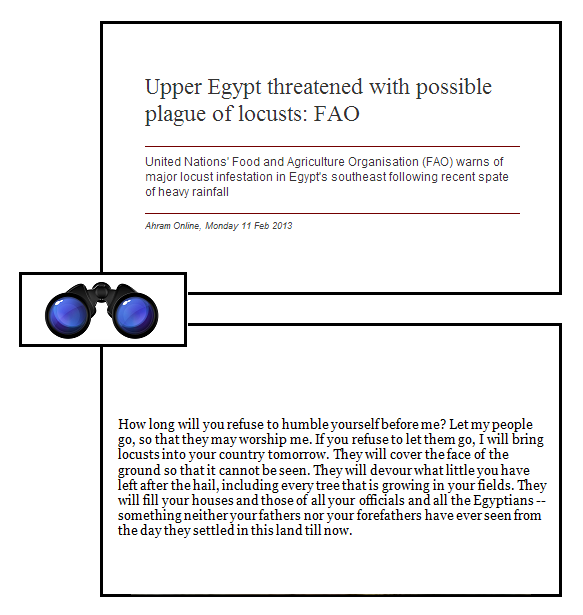
Is a plague of locusts in Upper Egypt of which the FAO warns in the upper panel above entirely explained in terms of rainfall? Is it pure mental happenstance that Egypt was the site of a Biblical locust plague at the time of the Israelite Exodus [Ex. 10. 3-6]? Is there, perhaps, a message for Egypt vis-a-vis Israel for our own day?

The answers people give to questions such as these, in which secular and sacred sources address what are putatively similar situations, can influence the way on which they voice themselves and vote — perhaps a good thing, perhaps not.

**

For what it’s worth, the plague of locusts is mentioned in the Qur’an in Sura 7.133:

So We let loose upon them [the Egyptians} the flood and the locusts, the lice and the frogs, the blood, distinct signs; but they waxed proud and were a sinful people.

**

In contemplating matters of this sort, it may be valuable to consider the remarks of the Pontifical Biblical Commission in The Interpretation Of The Bible In The Church, 1993/4:

The basic problem with fundamentalist interpretation of this kind is that, refusing to take into account the historical character of biblical revelation, it makes itself incapable of accepting the full truth of the incarnation itself. As regards relationships with God, fundamentalism seeks to escape any closeness of the divine and the human. It refuses to admit that the inspired word of God has been expressed in human language and that this word has been expressed, under divine inspiration, by human authors possessed of limited capacities and resources. For this reason, it tends to treat the biblical text as if it had been dictated word for word by the Spirit. It fails to recognize that the word of God has been formulated in language and expression conditioned by various periods. It pays no attention to the literary forms and to the human ways of thinking to be found in the biblical texts, many of which are the result of a process extending over long periods of time and bearing the mark of very diverse historical situations.

US Foreign Policy, Egypt and the Muslim Brotherhood

Wednesday, January 30th, 2013

The Obama administration, though they would not characterize it as such nor have much desire to acknowledge it at all, have attempted  a strategic detente with the “moderate” elements of political Islam.

This policy has not been entirely consistent; Syria, for example, is a quagmire the administration has wisely refrained from wading directly into despite the best efforts of R2P advocates to drag us there.  But more importantly, under President Obama the US supported the broad-based Arab Spring popular revolt against US ally, dictator Hosni Mubarak, and pushed the subsequent ascendancy of the Muslim Brotherhood in Egypt and the Libyan revolution against the entirely mad Colonel Gaddafi. These appear to be geopolitical “moves” upon which the Obama administration hopes to build.

I would like to emphasize that there is one legitimate and valid strategic pro to this sub rosa policy; namely, if everything went well, it would provide the United States with powerful triangulation against revolutionary, apocalyptic, radical Islamism as expressed by al Qaida and various Salafi extremist movements. There are reasons, rooted in takfirism, strategy and the politics of lunacy that our terrorist enemies frequently hate and revile the Brotherhood as traitors, apostates or whatever. Isolating the most actively dangerous and violent revolutionary enemies from a large mass of potential allies is, at least, a good strategic goal.

It is also my view, that this “outreach” is as politically sensitive  to the Obama administration as was the China Opening was to Nixon and about which they have been equally opaque and misleading for fear of a domestic backlash. The weird, foot-dragging, dissembling, embittered, kabuki drama inside the Beltway about public statements and intelligence on whether Benghazi was caused by obscure crackpot Islamophobic film makers or a well-orchestrated terrorist attack  is in my view due to a major foreign policy strategy never having been framed in public for what it is. I’m sure people will differ strongly with me on this (which is fine), but I would characterize detente with Islamists as a strategic shift on par with the “Pivot to Asia”.

The downside here is that first, things are not likely to come out well at all, as unfinished revolutions tend to give birth to monsters; and secondly, any detente with “moderate” political Islam is an uncertain gamble based on certain exceptionally optimistic conceptions of not only what the Brotherhood might do, but about it’s very nature.

While the removal of Arab dictators resonated with American values , it was questionable realpolitik while the administration’s de facto support of  Egypt’s Muslim Brotherhood faction over poorly organized secular liberal modernists was an act of realpolitik that required a compromise of the democratic values so recently invoked to justify abandoning Mubarak. This was cynical diplomatic flexibility worthy of Talleyrand.

Unfortunately, the most democratic thing – perhaps the only thing – about Mr. Morsi and his Brotherhood supporters was his election.

The Egyptian people who are subjected now to thuggery from both Morsi’s Islamist stormtroopers and from the security forces of the Egyptian military are less sanguine than are the Brotherhood’s cheerleaders inside the administration. The Egyptian people, in fact, seem to be in revolt against domination by the Muslim Brotherhood’s shadow government.

The first question to ask in assessing if the Obama administration policy here is wise would be “What is the nature of the Muslim Brotherhood?” Americans love to personalize foreign policy, but if  Morsi were to be toppled or die, the Brotherhood will remain what it currently is, the best organized political force in Egypt and one widely influential throughout the Arab world and the West itself.

I am not an expert on the Muslim Brotherhood, nor am I an Arabist by education. Most of us aren’t – a group that I fear includes most of the Obama administration officials involved in shaping this policy. Almost fifty years after King Faisal determined to export Wahhabism, more than thirty years since Khomeini’s Revolution and more than ten years since 9/11 the USG still has less in-house expertise related to Islam than it did about the Soviet Union and Communism a decade after the Berlin Blockade.

Perhaps we all should begin learning more?

Here is an analysis from FPRI; it is extremely critical but it touches on organizational aspects of the Muslim Brotherhood that I have not seen elsewhere (hat tip to David Ronfeldt). Feel free to suggest others, both for and against. The Brotherhood is a very large group with a long history that includes violence , terrorism and subversion on one hand and peacefully representing expressions of pious, middle-class, social conservatism in other places and times:

Lecture Transcript: What Every American Should Know about Egypt’s Muslim Brotherhood, Delivered by Eric Trager 

….Two years ago when I was doing my dissertation fieldwork in Cairo, I sought out interviews with leaders from the Muslim Brotherhood, and I was referred to a man named Muhammad Morsi, now the President of Egypt. At the time, President Mubarak was ill and had gone off to Europe for operations amid a lot of mystery surrounding his health. I asked Muhammad Morsi whether the Muslim Brotherhood would run a presidential candidate if Mubarak died tomorrow. Here is what he said:

[From an audio file played by Trager]

Eric Trager: You don’t see the Muslim Brotherhood nominating a presidential candidate [if Mubarak dies tomorrow]?

Muhammad Morsi: No… because society is not ready… Our society is not ready yet to really defend its worth. We want a society to carry on its responsibilities, and we are part of this society. Another thing, if we are rushing things, then I don’t think that leads to a real stable position.

When he made that statement, I don’t think he was lying, and I don’t think he was being coy. I think that he didn’t expect that he would be faced with this reality in a mere six months. He did not expect that Mubarak would step down six months later and, to be completely honest with you, neither did I. My dissertation was entitled “Egypt: Durable Authoritarianism”—until the revolution.

What did Morsi mean when he said that the Brotherhood was trying to build a society? Let me give you some background on the Muslim Brotherhood. It was founded in 1928 by Hassan al-Banna, who was a schoolteacher in Ismailia. The Muslim Brotherhood’s goal was then—and remains now—to establish an Islamic state in Egypt. The way it pursues this goal is by trying to Islamize Egyptian society. Through social services, education, and the mosque, it sought to make Egyptians more religious and more Islamic as a grassroots strategy for building an Islamic state. That’s very, very different from a strategy that says, “We’re going to run for president, run for the Parliament, and use that power to transform society.” Rather, the Brotherhood says, in effect, “We’re going to Islamize society to build towards power.” It was a long-term strategy; it took them 84 years before they ran for and won the presidency. So Morsi told me in 2010 that the Muslim Brotherhood was not going to run for the presidency because it was not done Islamizing Egyptian society….

Read the rest here.

Gaza negotiations: sincerity and symmetry

Thursday, November 22nd, 2012

[ by Charles Cameron — sincerity and symmetry as the basis for dialog and negotiation ]
.


.

If you read me regularly, you know I’m passionate about form as well as content.

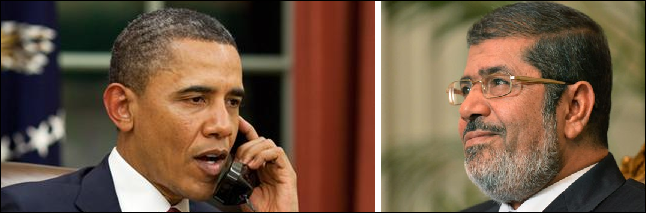
Here’s the New York Times report on the interactions between Presidents Obama and Morsi in the runup to the Gaza ceasefire negotiations:

Mr. Obama told aides he was impressed with the Egyptian leader’s pragmatic confidence. He sensed an engineer’s precision with surprisingly little ideology. Most important, Mr. Obama told aides that he considered Mr. Morsi a straight shooter who delivered on what he promised and did not promise what he could not deliver.

“The thing that appealed to the president was how practical the conversations were — here’s the state of play, here are the issues we’re concerned about,” said a senior administration official who spoke on the condition of anonymity to discuss private conversations. “This was somebody focused on solving problems.”

The Egyptian side was also positive about the collaboration. Essam el-Haddad, the foreign policy adviser to the Egyptian president, described a singular partnership developing between Mr. Morsi, who is the most important international ally for Hamas, and Mr. Obama, who plays essentially the same role for Israel.

“Yes, they were carrying the point of view of the Israeli side but they were understanding also the other side, the Palestinian side,” Mr. Haddad said in Cairo as the cease-fire was being finalized on Wednesday. “We felt there was a high level of sincerity in trying to find a solution. The sincerity and understanding was very helpful.”

**

And here, by way of context, is David Bohm on dialogue:

One way of helping to free these serious blocks in communication would be to carry out discussions in a spirit of free dialogue. Key features of such a dialogue is for each person to be able to hold several points of view, in a sort of active suspension, while treating the ideas of others with something of the care and attention that are given to his or her own. Each participant is not called on to accept or reject particular points of view; rather he or she should attempt to come to understanding of what they mean.

Bohm, Science, Order and Creativity, p 86

**

What interests me here in the Obama-Morsi interaction as described is the dual emphasis on sincerity and symmetry. Sincerity is needed so that each of the two sides — Israel’s POV, as presented by Obama, and that of Hamas, as presented by Morsi — is in fact presented, and not hinted at, watered down or reneged on. And when both sides are in fact sincerely represented, they are mutually present — heard — and there is symmetry.

That symmetry, it seems to me — symmetry of form in the presentations of contents — is the facilitator of successful negotiations.

The Pillar of Cloud and the Pillar of Fire

Thursday, November 15th, 2012

[ by Charles Cameron — IDF terminology and the Gaza conflict, explanations of Exodus, an IDF video, Megillah 10b and the koan “with God on our side” / “with God on all sides” ]
.

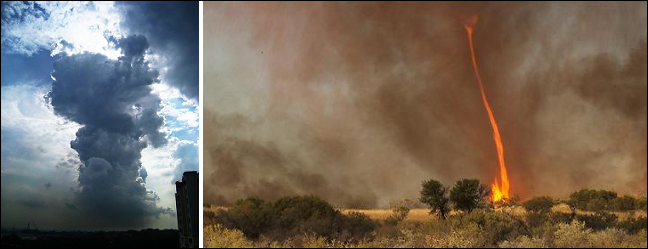
photo credits: Schristia, Cloud; Chris Tangey, Fire

.

I’m curious.

The IDF calls today’s Israeli operation in Gaza “Operation Pillar of Defense” in English, but as John Cook points out in Gawker, uses the term Hebrew term “Pillar of Cloud” in Hebrew.

There’s a great deal of interest here, apart from the difference between their use of non-Biblical terminology in English and Biblical terminology in Hebrew. One point that catches my ear, a poet being a poet, is that the phrase “Pillar of Cloud” is in fact only one half of a double reference…

Thus in Exodus 13.21-22 we read:

And the LORD went before them by day in a pillar of a cloud, to lead them the way; and by night in a pillar of fire, to give them light; to go by day and night: He took not away the pillar of the cloud by day, nor the pillar of fire by night, from before the people.

**

There are various ways of understanding the pillar of cloud and pillar of fire, but it’s pretty clear that there’s only one pillar —

And it came to pass, that in the morning watch the LORD looked unto the host of the Egyptians through the pillar of fire and of the cloud… [Exodus 14.24]

which is called a pillar of cloud by day and a pillar of fire by night, perhaps simply because we are speaking of theophany — the Divine Presence made visible — perhaps because smoke from a brazier is more visible in daylight and flames at night — perhaps because as Hans Goedicke, then chairman of the department of Near Eastern Studies at Johns Hopkins, suggested, the source of both fire and smoke was the eruption of Santorini around 1600 BCE.

The difference in worldviews behind those explanations alone is a matter of considerable interest.

**

Linguistically, however — and this is where the poet being a poet comes in — there are two pillars, and I have to wonder whether the name “Pillar of Fire” is being saved for a later and perhaps more impressive (“shock and awe”) operation, or — in line with the “by day and by night” distinction — refers to the covert side of the same op?

Not that anyone would be likely to give me that information, or that I’d have any use for it if they did.

But the Biblical phrasing is powerful, and “Pillar of Defense” doesn’t make a whole lot of sense — besides, cloud and fire go together in Hebrew in much the same way smoke and mirrors do in English.

Of the three choices, I’d have gone with “Pillar of Fire” myself.

**

An IDF spokesperson, in a response to Cook’s Gawker article, claimed:

I think that every example of Bible quotes you cited has defensive connotations, rather than “vengeful.”

One of those quotes is Exodus 14:24, which I quoted above but will now give in full, along with verse 25:

And it came to pass, that in the morning watch the LORD looked unto the host of the Egyptians through the pillar of fire and of the cloud, and troubled the host of the Egyptians, and took off their chariot wheels, that they drave them heavily: so that the Egyptians said, Let us flee from the face of Israel; for the LORD fighteth for them against the Egyptians.

I think calling that “defensive” is a bit one-sided, but on the other of the two hands in question, so is calling it “vengeful”.

The Israelites saw themselves in the larger context as escaping Egyptian oppression, the Egyptians obviously considered themselves under attack in the short term — just as surely as the people of Gaza must feel under attack by the oppressive Israelis today, while the Israelis clearly feel under attack by terroristic Hamas and its rockets. But hey, the IDF spokesman only offered his explanation that the Pillar of Cloud and Defense was “defensive” as “Just my two cents”…

FWIW, those two verses from Exodus sound just a little like Quran 33.26:

And He brought down those of the People of the Book who supported them from their fortresses and cast terror in their hearts; some you slew, some you made captive. And He bequeathed upon you their lands, their habitations, and their possessions, and a land you never trod. God is powerful over everything.

That’s an ayat that has always interested me, because of the use of the word “terror” found in a number of translations including this one, by AJ Arberry — others have “awe” or “panic”, but “terror” is interesting in the context of its contemporary usage.

**

Here’s the current strike counter strike in two tweets:

**

Okay, let’s get as close to visceral as modern technological warfare permits. After the recent truce was broken and numerous rockets fired into Israel, the IDF fired a missile that killed Hamas military leader Ahmed Jabari, and quickly put the video feed up on YouTube:

**

People are killing and getting killed. Should that be a matter for concern, or delight?

The narrative from which the IDF drew the name of their campaign in Gaza is taken from that of Israel’s escape from Egypt in Exodus, which also includes the parting of the waters and destruction of the Egyptian army:

And the angel of God, which went before the camp of Israel, removed and went behind them; and the pillar of the cloud went from before their face, and stood behind them: And it came between the camp of the Egyptians and the camp of Israel; and it was a cloud and darkness to them, but it gave light by night to these: so that the one came not near the other all the night. And Moses stretched out his hand over the sea; and the Lord caused the sea to go back by a strong east wind all that night, and made the sea dry land, and the waters were divided…. [Exodus 14.19-21]

And it came to pass, that in the morning watch the Lord looked unto the host of the Egyptians through the pillar of fire and of the cloud, and troubled the host of the Egyptians, And took off their chariot wheels, that they drave them heavily: so that the Egyptians said, Let us flee from the face of Israel; for the Lord fighteth for them against the Egyptians. And the Lord said unto Moses, Stretch out thine hand over the sea, that the waters may come again upon the Egyptians, upon their chariots, and upon their horsemen. And Moses stretched forth his hand over the sea, and the sea returned to his strength when the morning appeared; and the Egyptians fled against it; and the Lord overthrew the Egyptians in the midst of the sea. [Exodus 14.24-27]

Here again we see an instance of what I have called the two-fold logic of scriptures: In the Babylonian Talmud, Megillah 10b, R. Johanan tells us:

The ministering angels wanted to chant their hymns, but the Holy One, blessed be He, said, The work of my hands is being drowned in the sea, and shall you chant hymns?

to which R. Eleazar responds:

He himself does not rejoice, but he makes others rejoice.

**

To my mind, what we’re looking at here is a global koan: the immediate and eternal paradox of life and death.

But more on koans shortly.


Switch to our mobile site