zenpundit.com » poetry

Archive for the ‘poetry’ Category

On the topology of dreams

Saturday, August 6th, 2016

[ by Charles Cameron — a poem that’s far too philosophical to work as poetry, Laramée’s Apparatus, and Alyce Santoro’s philosoprops ]
.

The logic of poetry is, más o menos, dream logic, and so I’ve been pondering the logic of dreams and recently wrote this not terribly poetic poem:

The egg at the conjuror’s table

There is a topology of dreams.
Out beyond Riemann and names I have yet to learn,
there are configurations of space:
past Boole, dreams have their logics.

*

Take an egg.
With a tap of the wand, crack it open,
let it fall apart so precisely
the two half-shells could again fit together,
ovoid, seamlessly,
almost an egg.
Catch white and yolk in a glass.
Toss up and catch the half shell in your left hand
holding the right steady,
bring them together, there’s a fit,
a logic to it, a topology, one
to one, across many thousands of facets
of fragile, broken shell.
Break another egg so preciely
the left half of ts shell would match exactly
the right half of the first,
bring them together,
the fit is exact by definition,
brown shell with speckled,
but there is loss of logic, the thing is surreal,
an egg not an egg at all.
Holding the half-shell in your right hand
face upwards, pour into it
yolk and white of the same egg,
the heart of the egg filling its own shell,
the fit ovoid, but better:
the original yolk united with its familiar shell.
Cover shell and all with a handkerchief,
red, green, blue,
whisk it away, and the egg vanishes —
or appears, whole.

**

There are logics, topologies,
affinities beyond the exact match
of shell and shell,
and so between times, places,
people in dreams –
the half hovel, half cathedral
with its walkways among lily ponds, the koi,
dusk in one century dawn in another,
her youth your old age your youth again, time
cracked open so precisely,
its yolk, meaning,
its moments an exact match across centuries,
its half-shell a perch for Venus,
its wholeness Fabergé,
its yolk, tempera mixed by Giotto,
meaning, tempera, Assisi,
gesso, the chalk cliffs of Dover, the sea..
There is a harmony of the whole,
of the broken unbroken,
named yet unnameable, unspeakable,
there is a logic.
there is a topology of the sundries of dreams,
a mathematics to this matching
of thou with i,
of words, asleep, awake, of dusk to dawn, with all.

Recognising that it belongs in a category she might call philosopoetry, I sent it to my friend, the artist Alyce Santoro, author of the remarkable Philosoprops: A Unified Field Guide>

**

I’m a lucky fellow.

Today, via 3 Quarks Daily, I ran across this quote from Walter Bejamin:

I had suffered very much from the din in my room. Last night the dream retained this. I found myself in front of a map and, at the same time, in the landscape which was depicted on it. The landscape was incredibly gloomy and bleak, and it wasn’t possible to say whether its desolation was merely a craggy wasteland or empty grey ground populated only by capital letters. These letters drifted curvily on their base, just as if they were following the mountain range; the words formed from these letters were more or less remote from each other. I knew, or came to know, that I was in the labyrinth of the ear canal. The map was at the same time a map of hell.

There’s something darkly Borgesian about that quote, eh? But it certainly illuminates dream topology, and even moreso, the topology of the relationship of dream to waking, itself worth comparing with the relationship of map to territory, word to referent, and indeed moon to finger with which Count Korzybski, Lao Tzu, and the Zen poets are each so notably concerned.

**

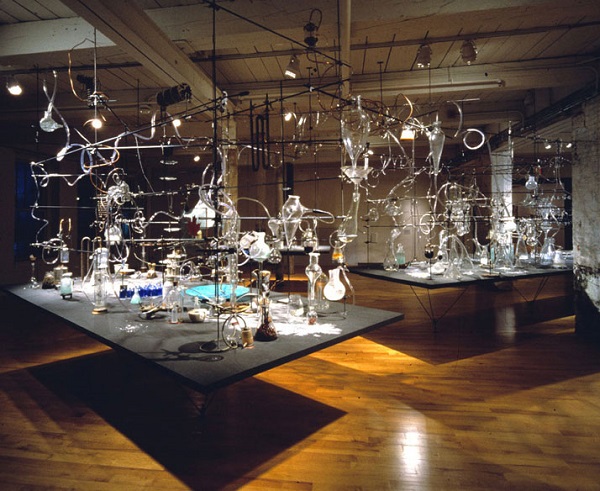
Tunneling on through, I find myself contemplating one of Alyce’s inspirations — Eve Andrée Laramée’s Apparatus for the Distillation of Vague Intuitions, shown in Mass MoCA‘s 2000-2001 exhibition Unnatural Science, from 2000 – 2001:
laramee

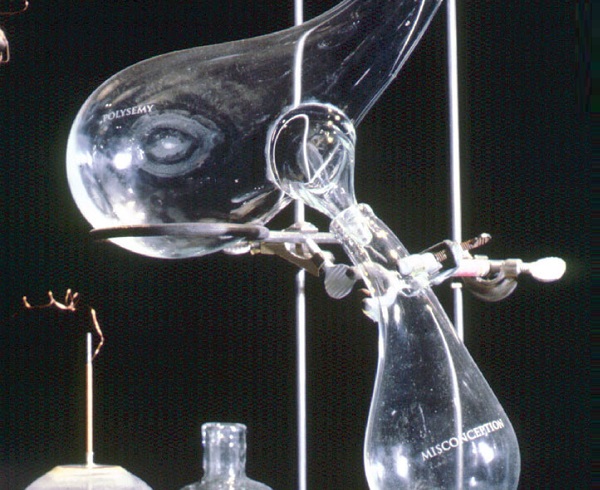
A detail from that work illustrates the etching of certain phrases into the glass — in this case, the words polysemy and misconception:
7. Eve Andree Laramee_polysemy-misconception

The display is characterized in this piece from Art & Science Jounral:

Apparatus for the Distillation of Vague Intuitions by American artist Eve Andrée Laramée consists of an array of tall metal stands, clamps, PVC tubings, glass beakers, flasks and vials. Although much of the equipment looks standard from afar, the installation is a dysfunctional and mythological sort of laboratory that highlights the inherent but often unnoticed subjectivity in scientific inquiry. [ .. ]

In this fantastical and visually dazzling Apparatus, many of the glassware are hand-blown with various cloudy or luminous turquoise solutions and copper wires attached to large exotic flowers contributing to the spectacle of a giant chemistry experiment gone amok.

Upon close inspection, a second level of complexity is revealed by the seemingly unscientific words and phrases such as “HANDFULS”, “LEAP IN THE DARK” and “UNNECESSARY EXPLANATORY PRINCIPLES” delicately etched into the glass, exposing a sense of insecurity and imprecision behind the process of science.

**

My Egg at the conjuror’s table is really more a philosoprop, to use Alyce’s coinage, than what many expect a poem to be, and likewise Laramée’s Apparatus more a philosoprop than what many expect an artwork to be.

Philosoprops:

The word philosoprop is a portmanteau of philosophy (love of wisdom) and either prop (theatrical property) or propaganda (influential communication), depending. A philosoprop is a device, implement, or illustration – crafted or discovered ready-made – that can be used for the purpose of demonstrating a concept or sparking a dialog.

Let’s talk..
Contemplative Fire

Thursday, August 4th, 2016

[ by Charles Cameron — two poems, one from Thomas Merton, one from today ]
.

About an hour ago I posted Economics as if spirit matters most, with a DoubleQuote drawing a parallel between Zen Buddhist monastic tradition and that of the Desert Fathers of the Church.

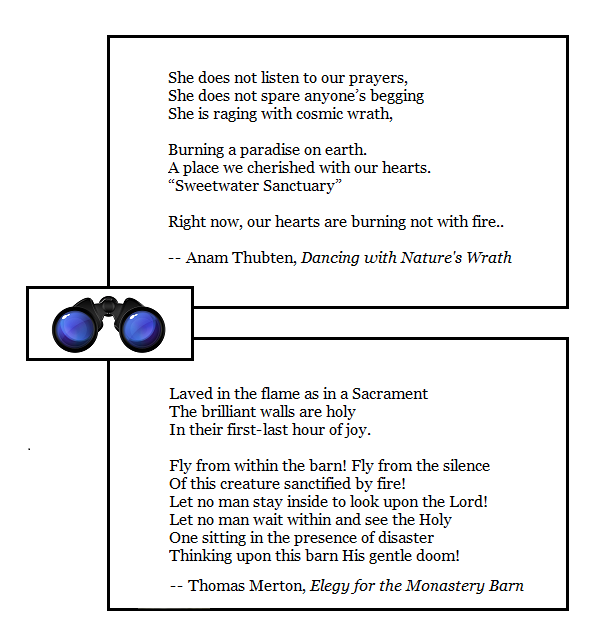
Here’s another Buddhist / Christian juxtaposition, this time in the form of excerpts from two longer poems about fires — one of which, the Soberanes wildfire between Carmel and Big Sur, is still raging as we speak:

SPEC DQ contemplative fire

**

Anam Thubten is a Tibetan Buddhist teacher, and it is his Sweetwater Sanctuary retreat that was destroyed in the Soberanes fire. Thomas Merton was a Catholic Trappist monk, and the barn that burned was at his home monastery, the Abbey of Our Lady of Gethsamani in Kentucky.

Both poems are worth readong in full.

Sources:

  • Anam Thubten, Dancing With Nature’s Wrath
  • Thomas Merton, Elegy for the Monastery Barn
  • Recep Tayyip Erdogan and the poetry of names

    Tuesday, July 26th, 2016

    [ by Charles Cameron — a bridge & burial ground in Turkey, an Oregon creek & road, all named for death ]
    .

    There’s a certain power to names. Ursula LeGuin described it best, perhaps, when she wrote:

    He saw that in this dusty and fathomless matter of learning the true name of every place, thing, and being, the power he wanted lay like a jewel at the bottom of a dry well. For magic consists in this, the true naming of a thing.

    **

    I included that quote in my post Indistinguishable from magic? six days ago, little realizing I would need it again so soon, but here we are: a dark magical DoubleTweet:

    That’s the more positive of the pair — less so, I think, is this:

    **

    A couple of other notes from the poster of that second tweet:

  • The term “traitor” is still very loosely used in Turkey; some day may come, all those accusing eachother of treason might lie side by side..
  • Istanbul Metropolitan Mayor had announced the will to construct the Traitors’ Cemetary some days ago “for all to spit on when passing by”
  • **

    When my Lakota mentor, Wallace Black Elk, came to teach a class in the building and ceremonial use of the stone people’s lodge (“sweat lodge”) at what was then Southern Oregon State College in Ashland, Oregon, the route to the site where we performed the rituals on Dead Indian Creek went along the clearly marked Dead Indian Road. Wallace always got a chuckle out of that.

    But then, Wallace was glad Columbus told Queen Isabella he was en route for India, not Turkey — “Full-Blooded Turkey I’d be,” he’d say, “Native Turkey Movement, Bureau of Turkey Affairs..”

    The road, though not perhaps the creek, has now been renamed:

    Dead Indian Road

    Sunday’s second surprise — the Van Gogh DoubleQuote

    Sunday, July 17th, 2016

    [ by Charles Cameron — Van Gogh, Rilke, El Greco, Von Kármán. Hokusai, Jakob — rich correspondences between singificant items in widely separate disciplines ]
    .

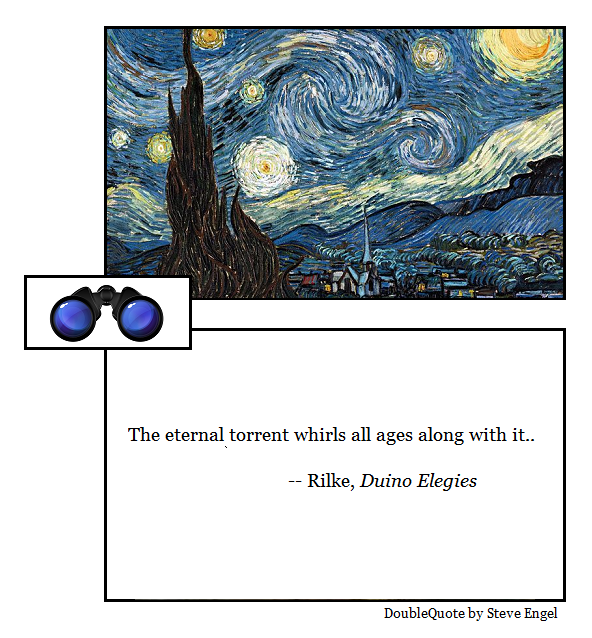
    My friend Steve Engel suggested this variant on my personal favorite DoubleQuote — the one pairing Van Gogh with Von Kármán — and as a lover of Rainer Maria Rilke I very much appreciate his suggestion, which bridges painting and poetry as my original DQ brdges arts and sciences:

    SPEC DQ Gogh Rilke Steve Engel

    **

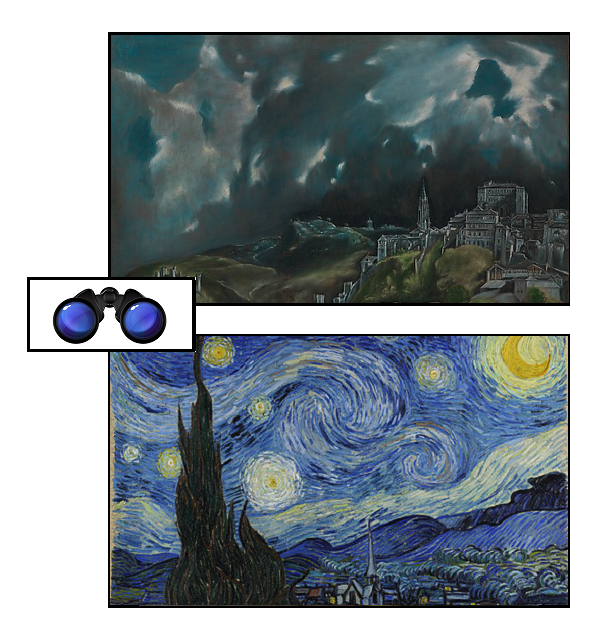
    I’ve also featured that particular van Gogh painting in another DQ, this one showing the sky as painted by El Greco and Van Gogh:

    SPEC DQ greco gogh

    El Greco was first among my loves in painting, and I’ve long thought that the differences between how El Greco sees the sky and how Van Gogh sees it could stand in for the differences between religions — you don’t see Van Gokkites attacking El Grekkites in museums on account of the different visions of their preferred painters, and if we could view religions as visionary rather than prescriptive, taking from them what a poetic, metaphoric, non-literal, non-fundamentalist, non-reductionist reading would approve, we might be a little farther on our way towards interfaith harmony, and away from religiously-sanctionable violence.

    I’m thinking here of St Francis‘ meeting with the Sultan Malik al-Kamil, and more recently Thomas Merton‘s meetings with Buddhist contemplatives, Sufis and the like..

    **

    Here’s the Von Kármán / Van Gogh DQ, which I value in light of Hermann Hesse‘s Glass Bead Game as a clear bridge between one of the crucial dualities of recent centuries — the needless and fruitless schism between the arts and sciences, which has given rise not only the rantings of Christopher Hitchens and his less elegant disciple Bill Maher, but to such other matters as the Papal condemnation and “forgiveness” 359 years later of Galileo Galilei, Charles Babbage‘s Ninth Bridgewater Treatise, Andrew White‘s A History of the Warfare of Science With Theology in ChristendomW, and CP Snow‘s The Two Cultures:

    karman gogh

    **

    And finally, here’s an ugraded version of the other DQ of mine that seeks to bridge the arts and sciences — featuring Hokusai‘s celebrated woodblock print, The Great Wave off Kanagawa (upper panel, below) and Jakob aka nikozy92‘s fractal wave, which I’ve flipped horizontally to make its parallel with the Hokusai clearer (lower panel) — Jakob‘s is a much improved version of a fractal wave compared with the one I’d been using until today:

    SPEC-DQ-Hokusai-fractal v 2.0 minikozy92

    Sunday surprise: Bach BWV 998

    Sunday, July 17th, 2016

    [ by Charles Cameron — with a ramble via his peerless peer, Shakespeare ]
    .

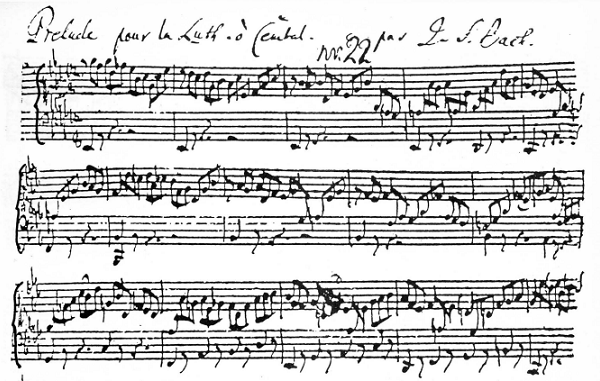
    What’s a piece of music worth, on paper?

    BWV 998 MS image

    **

    I had the good fortune some decades ago to be invited to attent Dr Homer Swander‘s seminar at the Oregon Shakespeare Festival in Ashland. Dr Swander is notable among Shakespearean scholars for his insistence that the texts we have of the plays are not themselves works of art, but serve the same function with respect to actual performances that an anrchitect’s blueprints serve with respect to a house, or a musical score to the performance of a work of music. Dr Swander dedicated much of his life to Shakespeare‘s plays, so we should not imagine that he thought little of the First Folio — or indeed of the First Quarto of Hamlet with its truncated soliloqy beginning:

    To be or not to be, ay there’s the point,
    To die, to sleep, is that all? Ay all:

    [for the original spelling, see this facsimile ©The British Library]

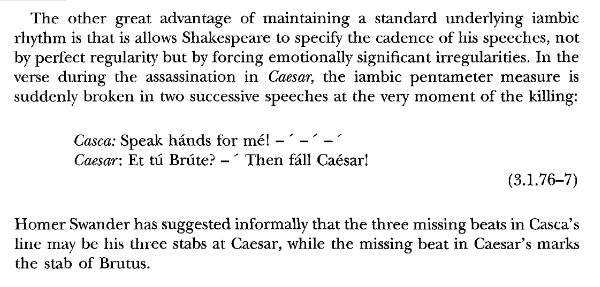
    — it’s simply that he saw them as prelimiaries, not the thing itself. This in turn allowed him to “see” aspects of the plays from a director’s standpoint, with intriguing results:

    Swander Caesar
    Hugh Macrae Richmond, Shakespeare’s Theatre: A Dictionary of His Stage Context

    You should have seen Dr Swander stab that point home!

    But to return to Johann Sebastian Bach.. Similarly, we may ask ourselves, what’s the manuscript score of a great work of music worth?

    **

    Christie’s auction house in London has one answer for us in ther case of Bach’s Prelude, Fugue, and Allegro in E-flat major, BWV 998 — $3.3 million:

    Valuable Bach manuscript goes under the hammer

    The manuscript’s value was originally estimated at between 1.5 and 2.5 million pounds (between 2 and 3.3 million dollars). At the auction on Wednesday (13.07.2016) in London, the final bid came in at the high end of expectations.

    Likely written between 1740 and 1745, the Prelude, Fugue and Allegro in E-flat Major (BWV 998) is a favorite among both harpsichords and lutenists. Like many works by Johann Sebastian Bach (1685-1750), it can be played on different instruments, which is expressly indicated on this score in the composer’s handwriting: “Prelude pour la Luth ò Cembal” (for lute or keyboard).

    That’s its current cash value as judged by the market.

    **

    But what’s it worth — to you, to me, to life?

    Nicholas Harnoncourt
    explains:

    **

    I am grateful as always to my friend Michael Robinson of Ornamental Peasant for pointing me to the sale at Christie’s — and to this remarkable piece.


    Switch to our mobile site