Pussy Riot, Holy Foolishness and Monk Punk
Sunday, August 19th, 2012[ by Charles Cameron — mystery beyond the senses, holy of holies behind the veil, altar beyond the iconostasis, and other considerations bearing on Orthodoxy, Pussy Riot, holy folly and monastic punk ]
.
Life is full of surprises.
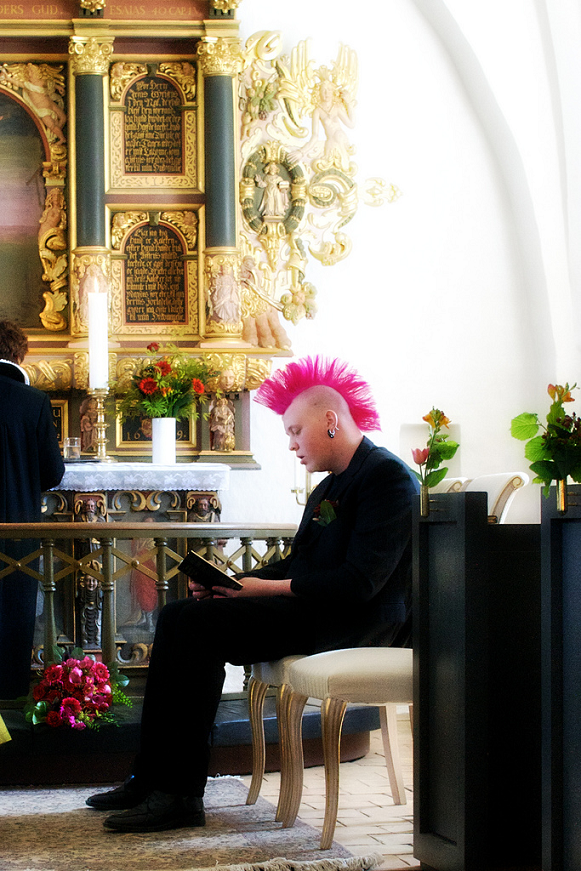
glorious photo credit: choir punk by teosartori under cc license
.
Okay, I started fishing around the web the way I do because when I first ran across the Pussy Riot story, I kept seeing press reports that said the grrls had been protesting on the altar of Christ the Savior Cathedral [Russian Orthodox] in Moscow.
**
What surprised me about this was that the altar in an Orthodox church would be behind the closed doors of the Iconostasis, because what takes place on the altar is too mysterious for us to grasp through the unaided senses.
Aside: there’s a lot of religious “clash of civs” going on in the Pussy Riot affait, so let me untangle some of the interesting threads, and then see where that leads us.
You may recall that when Christ died on the cross outside the City walls, there was a parallel incident inside Jerusalem: “the veil of the temple was rent in twain from the top to the bottom; and the earth did quake, and the rocks rent” [Matt 27.51]. This could, it seems to me, be an involuntary gesture of mourning on the part of the earth and temple — but it also opens the holy of holies..
In very broad strokes then, there are three spaces in Orthodoxy, separated by two doors, and they correspond to three ways of knowing.
- Outside the church, there’s the realm where the senses and rational mind can be pretty much relied on for the kinds of transactions that humans mostly engage in, food, drink, shelter, exchange of goods…
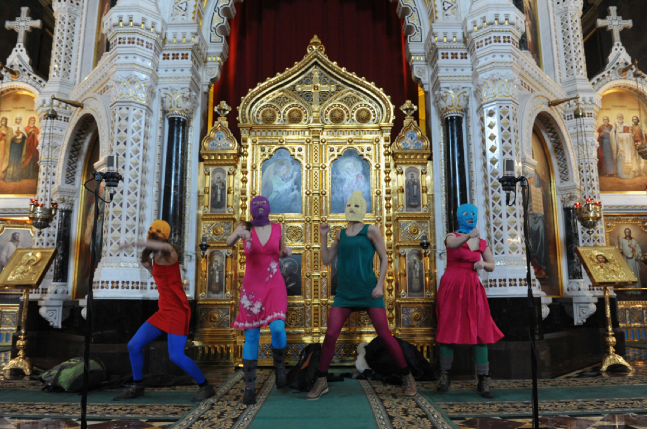
- Passing in through the church door we are in a space of devotion, the nave, in which attention is focused on the second doorway, that of the iconostasis, where the icons are presented. Here the mental activity is typically one of prayer, and the icons are available to lead the senses and mind towards that which the mind cannot comprehend.
.
.
- And passing, as only the ordained may, through the doors of the iconostasis into the Sanctuary, we enter the space of the altar and the sacramental transformation of the Eucharist — which neither rational mind nor senses can apprehend, and which is accordingly the realm of Mystery properly defined.
The Pussy Riot grrls are clearly dancing (and singing and prostrating and crossing themselves in the video) in front of the doors of the iconostasis — not “on the altar” — a big difference, which I would suggest is comparable in kind to the difference between human prayer and divine revelation.
No, they were not “staging an anti-Kremlin protest on the altar of Moscow’s main cathedral” [Telegraph], nor “performing what they called a ‘punk prayer’ on the altar of Moscow’s Christ the Savior Cathedral” [ABC News].
**
By way of giving you some context, Eurasia Review has the religious politics:
The actions of Pussy Riot inspired indignation on the part of Church leaders and regime officials. Patriarch Kirill called their action a “mockery of a sacred place.” Sergei Lavrov, the Russian foreign minister, said it was “blasphemy.” The women were described as “satanic devils” and “prostitutes” and there were calls for them to be ripped to pieces on the ancient execution site in Red Square.
What was lost in all this was the identification of the Russian Orthodox Church with the Putin regime. Putin’s inauguration was marked by the ringing of church bells in the Kremlin. Kirill held a special prayer service for his “health” and “success in government,” in the Cathedral of the Assumption in the Kremlin. In the Novodevichy Monastery, the nuns sang psalms round the clock for Putin’s health.
And then there was that 2009 London Times article:
The Russian Orthodox Church will choose tomorrow between three alleged former KGB agents as its next spiritual leader.
More than 700 priests, monks and lay representatives will decide who should become the new Patriarch in the first Church election since the collapse of the Soviet Union.
The contest at Christ the Saviour Cathedral in Moscow pits the favourite, Metropolitan Kirill of Smolensk and Kaliningrad, against two rivals who also rose through the heirarchy at a time when the Church was under strict Communist control.
**
Here are the lyrics to the “punk-prayer” Virgin Mary, Put Putin Away that they were singing:
(choir)
Virgin Mary, Mother of God, put Putin away
?ut Putin away, put Putin away(end chorus)
…
Black robe, golden epaulettes
All parishioners crawl to bow
The phantom of liberty is in heaven
Gay-pride sent to Siberia in chainsThe head of the KGB, their chief saint,
Leads protesters to prison under escort
In order not to offend His Holiness
Women must give birth and loveShit, shit, the Lord’s shit!
Shit, shit, the Lord’s shit!(Chorus)
Virgin Mary, Mother of God, become a feminist
Become a feminist, become a feminist(end chorus)
The Church’s praise of rotten dictators
The cross-bearer procession of black limousines
A teacher-preacher will meet you at school
Go to class – bring him money!Patriarch Gundyaev believes in Putin
Bitch, better believe in God instead
The belt of the Virgin can’t replace mass-meetings
Mary, Mother of God, is with us in protest!(Chorus)
Virgin Mary, Mother of God, put Putin away
?ut Putin away, put Putin away(end chorus)
Here’s a linguistic comment, which I can neither affirm nor refute, from The Economist:
“The Lord’s Shit!” is a literal translation, while the expression “Sran’ Gospodnya” found in the lyrics is an equivalent of English “holy shit”, which is a totally diferrent matter.
And then there’s this:
But prosecutors sought to downplay the political angle and highlight the blasphemy, overriding the defense’s objections with the help of Syrova’s many “question disallowed!”
“Do you believe it acceptable to say ‘Holy sh*t!’ in the church?” a prosecutor asked a father of one of the defendants in the courtroom.
The man denied it, pointing out Russia’s ancient tradition of skomorokhi – traveling actors afforded the degree of freedom of speech that apparently exceeded that allowed to Pussy Riot. Of course, the skomorokhi sometimes faced burning at the stake, but this was not mentioned at the hearing.
**
Which brings us to the entire issue of holy fools in Orthodoxy…
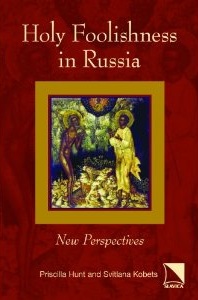
The holy fools are understood to “feign madness in order to provide the public with spiritual guidance” — but I wonder if that’s a rationalization of behaviors that were simply sane, direct and challenging at the time. Consider this description from the National Catholic Register:
In Russian history the greatest of the “holy fools” was Basil the Blessed, a man so revered that the famous Cathedral in Moscow’s Red Square next to the Kremlin was named in his honor. Basil walked through Moscow wearing nothing more than a long beard. He threw rocks at wealthy people’s houses and stole from dishonest traders in Red Square.
Few doubted Basil’s holiness. Tsar Ivan the Terrible feared no one but Basil. Basil was also given to eating meat on Good Friday. Once he went to Ivan’s palace in the Kremlin and forced the tsar to eat raw meat during the fast saying, “Why abstain from eating meat when you murder men?” Countless Russians died for much less but Ivan was afraid to let any harm come to the saintly Basil.
And the grrls explicitly claimed the Holy Fools inspired their mode of protest:
Nadia said. “We were searching for real sincerity and simplicity, and we found these qualities in the yurodstvo [the holy foolishness] of punk.”
Well, there are similarities, and there are differences. The canonical Holy Fools were presumably orthodox in their beliefs, which the Riot may not be — but on the other hand, they are clearly “speaking truth to power” to use the admirable Quaker phrase.
Folly is a tad under-appreciated these days.
**
On the other hand, maybe it’s demonic possession. From the examination of “altar warden Vasily Tsyganyuk, classified as a victim because he claimed to have suffered psychological trauma as a result of the performance” during the trial:
VICTIM: “Those who are possessed can exhibit different behaviors. They can scream, beat their heads against the floor, jump up and down…”
DEFENSE ATTORNEY NIKOLAI POLOZOV: “Do they dance?”
VICTIM: “Well, no.”
JUDGE: “Stop questioning him about those who are possessed. Tsyganyuk is not a medical professional and is not qualified to render a diagnosis.”
Nah, not possessed — possession would be a medical diagnosis.
**
Hey — the name Pussy Riot is a riot — and riots are not always comfortable.
Who would have imagined the name “Pussy Riot” would appear on the digital tongue of Archbishop Cranmer — who only the other day was chastised for saying that British Olympic athletes had “given the nation a veritable golden shower of success after success” when the kind of golden shower he was thinking of was presumably the kind Zeus showered on Danae.
But the good Archbishop — or at least the conservative Christian blogger who has taken that name — has in fact been vociferous in support of the Pussy Tribe, their name notwithstanding:
This is foolish. If history teaches us anything about the murky fusion of religion and politics – the spiritual with the temporal – it is that you cannot persecute the prophets of truth without multiplying the message and spreading the cult. These women had no bombs or bullets: they are not terrorists, but anarchic artists. The more inflated and preposterous the charges laid against them, the more they are elevated to martyrdom. The longer they rot in prison at the behest of a puffed-up Patriarch, the more that martyrdom becomes a cause.
Pussy Riot have nailed their 95 Theses firmly to the door of the Cathedral of Christ the Saviour. You can’t kill a movement by crucifying the radicals.
That’s theology!
But look, ecclesial nomenclature can be ambiguous in its own right. The original Archbishop Cranmer was a Puritan divine, and Richard Hooker the latitudinarian divine who wrote the classic Of the Lawes of Ecclesiastical Politie.
I think we can be safely if secretly amused that one of Cranmer’s respondents in the Pussy matter has chosen the online moniker “The Judicious Hooker”. In fact he’s the one who posted:
I realise that YG was rather plain in the chancel department (praise God for the Laudian revival!) but the ‘prisoners of conscience’ were not dancing on the altar. The Orthodox Holy Table lies behind the iconostasis screen and access is confined to sacred ministers.
The Orthodox – of all Christians – still maintain the sense of the sacred. The Cathedral’s iconostasis – where icons of our Lord and his Saints are displayed for veneration – looks rather impregnable and its doors firmly shut against profanation.
But I digress, I contain multitudes, I know.
**
One of the more interesting blogs I’ve run across discussing the Putin Pussy event has been Khanya — here’s a taste:
Is there an Orthodox culture, and does it have anything to say about this?
Yes, I believe there is an Orthodox culture, and it is well expressed in one of the hymns we sing repeatedly in the Paschal season.
Let God arise, let his enemies be scattered
Let those who hate him flee from before his face.Does that apply to Pussy Riot?
Yes, I believe it does.
But you have to come to the end of the hymn to see how it applies.
This is the day of resurrection.
Let us be illumined by the feast.
Let us embrace each other.
Let us call “Brothers” even those that hate us, and forgive all by the resurrection, and so let us cry:
Christ is risen from the dead
Trampling down death by death
And upon those in the tombs bestowing life.
So what do we call the members of Pussy Riot?
Sisters.
And what do we do with them?
Embrace them, forgive them by the resurrection and tell them that God loves them and we love them too.
That’s Orthodox culture.
**
Another insightful blog has been Registan, where Sarah Kendzior came at things from a different angle:
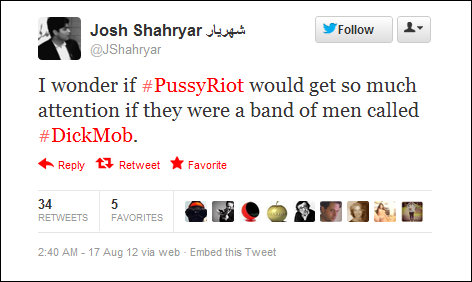
Media outlets that regularly cover Russian politics have noted how male Russian dissidents have been ignored as Pussy Riot draws world sympathy.
.
.
Removing Pussy Riot from the broader problem of political persecution in Russia is a mistake, but the case also raises specific questions about gender, media and politics.In the same week that Pussy Riot was profiled in the New York Times style section, the Boston Review republished a 2010 interview with Hillary Clinton, in which she was asked who her favorite designer was. “Would you ever ask a man that question?” she snapped. “Probably not, probably not,” the reporter replied. The American media embraced Clinton’s riposte, reprinting it widely. But when it comes to foreign female dissidents, they promote the values Clinton rejects.
**
Meanwhile — and I mean meanwhile, since this has nothing directly to do with Pussy Riot, and a great deal to do with them in indirect ways — in my own beloved California:
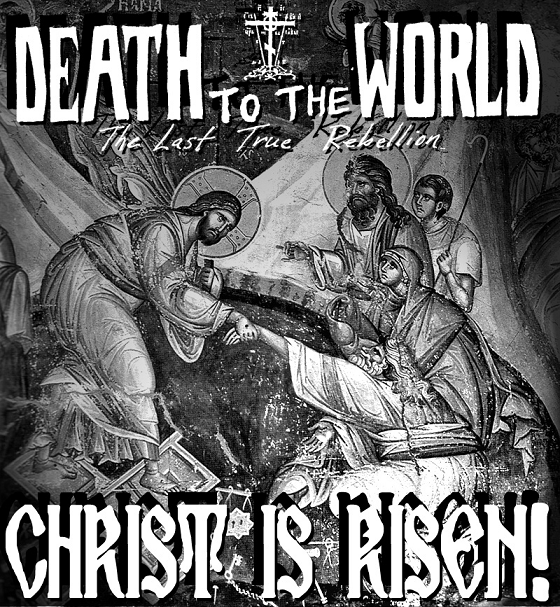
In the wilderness of Northern California, Monks John and Damascene searched in hopes of finding a way to reach out to the Punk scene, which John had escaped. Seeing that the scene was full of kids that were sick of themselves and crippled by nihilism and despair, the Monks set out to give them the same hope that they found in Ancient Christianity. To do this, they decided to submit an article about Father Seraphim Rose in the popular magazine, Maximum Rock and Roll.
When Father Damascene read over the magazine, he knew that they would never publish something like it. Struggling to show truth to the darkened subcultures, they tried again, but this time only placing an ad for Saint Hermans Brotherhood. They got a response from the editor, saying “What the @#*% is a Brotherhood?” and the Monks were told “We only run ads for music and ‘zines*.” A light bulb went on and thus, Death to the World was born.
The first issue was printed in the December of ’94 featuring a Monk holding a skull on cover. The hand-drawn bold letters across the top read “DEATH TO THE WORLD, The Last True Rebellion” and the back cover held the caption: “they hated me without a cause.” …
.
.The first issue, decorated with ancient icons and lives of martyrs inside, was advertised in Maximum Rock and Roll and brought letters from all around the world. People from Japan, Lithuania, and Ireland wanted to get their hands on this new radical magazine. The mailing list grew and grew and the ‘zine was distributed at punks shows and underground hangouts. It was photocopied and passed around by hundreds who wanted to read about the radical lives of the lovers of truth and the mystery of monasticism. It was estimated that at one time, there were 50,000 in circulation.
Father Paisius, who is a Monk at the monastery, said, “This subculture is raucous and deeply disturbed because of their own pain. They see life as worthless. We want to show them an ideal that is worth their life. These are marginalized youth who are wounded, and Death to the World is meant to touch with a healing hand that wound.”
Writing and putting together issues 1-12, the Monks lived in the forests of Northern California in the midst of deer, bears, mountain lions, and rattlesnakes, translating and publishing wisdom from the holy fathers and mothers of ages past. The Monks and friends of the monastery also went to rock concerts and festivals, distributing Death to the World ‘zines and t-shirts, together with icons and other books that the monastery published. The Monks did not put out any issues after issue 12, but they continued to share and hand out back orders of Death to the World.
**
That may be where the guy up there in the choir with the shocking pink mohawk comes in.