zenpundit.com » photography

Archive for the ‘photography’ Category

An Afghan Buddha koan

Friday, October 5th, 2012

[ by Charles Cameron — for Madhu ]
.

Our friend Madhu has requested that I post poems here on occasion, and this particular poem made me think of her and her request, so here it is:

A copper and gold koan
.

The world happened, the world is drifting away,
the farther away the world floats the deeper into the mists.

In Mes Aynak, Afghanistan, the remains
of a buddhist monastery already eroded by time are adrift,
a sitting buddha is floating into the mist,
headless, gold paint still on his knees and robe,
the devotion has drifted, lifted its focus
to the one without a second, the buddha left
whatever he left in memory, lingering, to gather aromas
of other ideas, realms, dust, archaeology, oblivion,
there is change, ceaseless change,

and adults must decide: is the wealth implied by the copper
beneath the buddha worth more than a trace of halo,
as the moon moves once again across a brilliant night sky.

.
Koans are those brilliant paradoxes zen buddhism uses to pry the mind open, I think they’re important aids to handling complexity, and I have a post about them coming up shortly. Here, it’s enough to say that the issue of copper mining vs archaeology in Mes Aynak seems to me to be a living, breathing koan.

**

It’s awkward, when you write an “ekphrastic” poem, a poem about a painting or photo, to have the image right there when the poem is read, because it trammels the reader’s mind in much the same way that a film can trammel the mind of a reader into “seeing” only the film-maker’s Gandalf, no longer her or his own.

And I’m going on at some length about this, because next up is the image from which that particular poem was built, but I’d like the image to be, as they’d say in the newsprint world, “below the fold” as you read the poem.

So here it is, #4 in a fine series of photos in a Foreign Policy photo essay which I recommend, although I’ve taken this particular (smaller) version from a CNN page, since the subtitle in the lower right corner explains the basic situation handily:

You can hear the archaeologist Brent Huffman, who took the photo, talk about the situation here — local reactions pro and con, who the Taliban are shooting at, the likelihood that the Chinese operation will in fact benefit the locals and more:

The koan of balancing material with immaterial values remains, but in this circumstance the likelihood of local Afghans receiving litter or nothing from the mining project likely tips the scales.

You can petition Afghan President Hamid Karzai for preservation…

But then he’s another wild-card in the continuing Great Game, isn’t it?

Iwo Jihad?

Thursday, September 6th, 2012

[ by Charles Cameron — our stuff turned against us once again, this time it’s our symbolism ]
.

.

**

Richard Clarke, at that time Chair of the President’s Critical Infrastructure Protection Board and Special Advisor to the President for CyberSpace Security, said in December 2001:

Just as Al-Qaeda used 767s, transforming them into effective missiles, our future enemies will turn our technology against us.

It’s a recurring theme: as Seth Baum noted in April of this year in an article titled When Our Technology Is Used Against Us:

The 2008 Mumbai terrorist attacks, which killed 164 people, were made possible by the sophisticated use of information technology.

Baum links to an AP piece by Kathy Gannon, in which she writes:

In an Internet age, al-Qaeda prizes geek jihadis as much as would-be suicide bombers and gunmen. The terror network is recruiting computer-savvy technicians to produce sophisticated Web documentaries and multimedia products aimed at Muslim audiences in the United States, Britain and other Western countries.

**

So far, this is all techno-heavy stuff.

But they’re using our symbolism too, and turning it against us, as Ibn Siqilli notes in his blog post today, IN PICTURES: “Jihad Is Not Terrorism”:

Sad but true: Iwo Jihad.

**

To be honest, I don’t think this works for them. Using clips from the Lord of the Rings works far better, IMO, because it’s a symbol-system that can appeal to youth, and because it draws on a fantasy realm whose “good” and “evil” characters can be mapped directly onto their own identifications.

Propaganda is a subtle business. Still, kudos once more to Chris at Ibn Siqilli for spotting this and posting it.

Tree series, I: This is how nature thinks

Saturday, June 23rd, 2012

[ by Charles Cameron — this one’s a companion piece for One bead for a rosary and the first of three more or less contemplative / creative posts on trees. ]

.


.

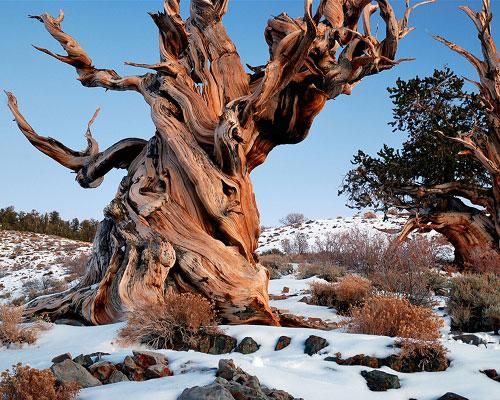
This is how nature thinks: this is one of nature’s thoughts, and it’s the kind of thought that comes late, after much else has been worn away and only essence remains, the kind we find in our elders and call by the name wisdom.

We don’t think of trees as thoughts, but perhaps we should: our idea of mind might broaden.

*

And rivers.

We spend a great deal of our time thinking and speaking in straight lines. One of the straight lines I tent to think along and speak about is the idea that we might want to think differently, to braid our linear ideas perhaps, to listen to the voices of others and join ours to theirs, making somehow a thought that is many-voiced, a thought stream that reflects on itself, echoes itself, has eddies of questioning, rapids, calm stretches, still ponds… “pondering”, my friend Derek suggests.

There are certain people who, I trust you’ll agree, are deliciously frank and frankly strange: we call them by affectionate negative names – he or she’s “an ornery old cuss” we say, perhaps – I suppose I may be one myself, and my language old-fangled, but I trust again that you get my drift.

Gnarly.

Now there’s another word for them. It comes from the gnarls in wood, and the poet Hopkins applies it to the nails that tear the hands of Christ: With the gnarl of the nails in thee, niche of the lance…

A gnarly character has come to conclusions you probably don’t share, but you feel a grudging admiration for the forthrightness with which this character has pursued some intricate and personal logic to its unordinary conclusion.

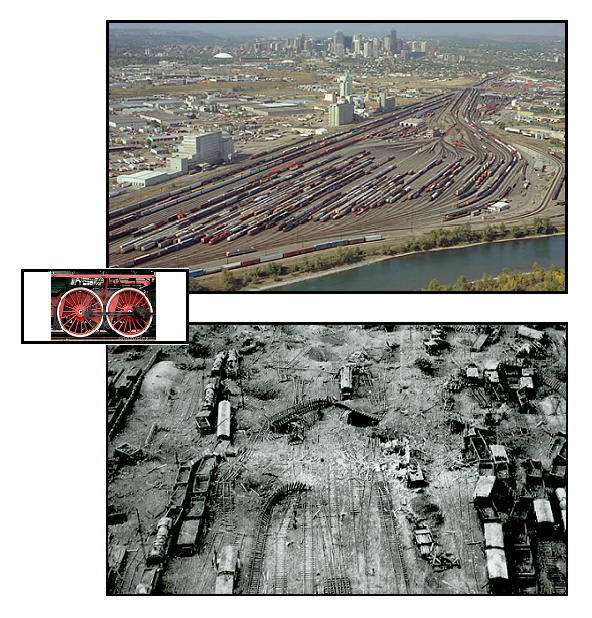
I have presented various images for a kind of thinking that is many-braided, communal yet irrepressibly individualistic, including a railway marshaling yards after a bombing raid and the multiple complex paths of the Mississippi.

*

Please consider the tree above – seen in a photo by Rick Goldwasser of a Bristlecone Pine from the White Mountains in California – as exemplifying the gnarly, intensely personal, complexly braided thought of a Beethoven in the late quartets and sonatas, the Hammerklavier and Grosse Fuge – or the unfinished late masterworks of a Michelangelo.

A tree, a way of thinking – and appreciation for that which is bone-weary yet resolute, difficult yet rewarding, which swirls like water yet is almost as still as stone.

* * *

The Grosse Fuge, performed by the Takács Quartet:

The Hammerklavier, performed by Mitsuko Uchida:

These, also, are among nature’s thoughts.

Another magnificent example of which is GM Hopkins’ poem, The Wreck of the Deutschland, from which that line about “the gnarl of the nails in thee” is drawn…

One bead for a rosary

Friday, June 22nd, 2012

[ by Charles Cameron — one bead from NASA for the glass bead game as rosary ]
.


photo credit: Norman Kuring, NASA’s Goddard Space Flight Center
.

Consider her sacred, treat her with care.


Switch to our mobile site