zenpundit.com » complexity

Archive for the ‘complexity’ Category

Ronfeldt’s In-Depth Review of America 3.0

Monday, September 23rd, 2013
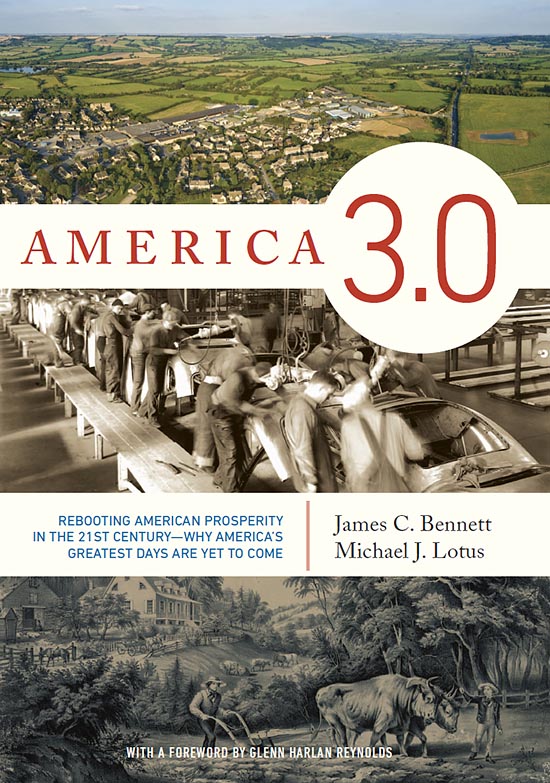
 

 David Ronfeldt, RAND strategist and theorist has done a deep two-part  review of America 3.0 over at his Visions from Two Theories blog. Ronfeldt has been spending the last few years developing his TIMN analytic framework (Tribes, Institutions [hierarchical], Markets and Networks) which you can get a taste from here  and here or a full reading with this RAND paper.

David regards the familial structure thesis put forward by James Bennett and Michael Lotus in America 3.0 as “captivating”  and “compelling” for  “illuminating the importance of the nuclear family for America’s evolution in ways that, in my view, help validate and reinforce TIMN”. Both reviews are detailed and should be read in their entirety, but I will have some excerpts below:

America 3.0 illuminates significance of nuclear families — in line with TIMN (Part 1 of 2) 

….Bennett and Lotus show at length (Chapter 2, pp. 29-45) that the nuclear family explains a lot about our distinctive culture and society:

“It has caused Americans to have a uniquely strong concept of each person as an individual self, with an identity that is not bound by family or tribal or social ties. … Our distinctive type [of] American nuclear family has made us what we are.” (p. 29)And “what we are” as a result is individualistic, liberty-loving, nonegalitarian (without being inegalitarian), competitive, enterprising, mobile, and voluntaristic. In addition, Americans tend to have middle-class values, an instrumental view of government, and a preference for suburban lifestyles. 

As the authors carefully note, these are generally positive traits, but they have both bright and dark sides, noticeable for example in the ways they make America a “high-risk, high-return culture” (p. 38) — much to the bane of some individuals. The traits also interact in interesting ways, such that Americans tend to be loners as individuals and families, but also joiners “who form an incomprehensibly dense network of voluntary associations” — much to the benefit of civil society (p. 39). 

In sum, the American-style nuclear family is the major cause of “American exceptionalism” — the basis of our freedom and prosperity, our “amazing powers of assimilation” (p. 53), and our unique institutions:

“It was the deepest basis for the development of freedom and prosperity in England, and then in America. Further, the underlying Anglo-American family type was the foundation for all of the institutions, laws, and cultural practices that gave rise to our freedom and prosperity over the centuries.” (p. 52)The authors go on to show this for America 1.0 and 2.0 in detail. They also reiterate that Americans have long taken the nuclear family for granted. Yet, very different marriage and family practices are the norm in most societies around the world. And the difference is profoundly significant for the kinds of cultural, social, economic, and political evolution that ensue. Indeed, the pull of the nuclear model in the American context is so strong that it has a liberating effect on immigrants who come from societies that are organized around extended families and clans (p. 55) — an important point, since America is a land of immigrants from all over, not just from Anglo-Saxon nuclear-family cultures.

….As for foreign policy, the authors commend “an emerging phenomenon we call “Network Commonwealth,” which is an alignment of nations … who share common ties that may include language, culture and common legal systems.” (p. 260) Above all, they’d like to see the “Anglosphere” take shape. And as the world coalesces into various “global networks of affinity” engaged in shifting coalitions (p. 265), America 3.0 would cease emphasizing democracy-promotion abroad, and “reorient its national strategy to a primary emphasis on maintaining the freedom of the global commons of air, sea, and space.” (p. 263) [UPDATE: For more about the Network Commonwealth and Anglosphere concepts, see Bennett’s 2007 paper here.]

Read the whole thing here.

America 3.0 illuminates significance of nuclear families — in line with TIMN (Part 2 of 2)  

….Overlaps with TIMN themes and propositions

Part 1 discussed America 3.0’s key overlap with TIMN: the prevalence and significance of the nuclear family in the American case. This leads to questions about family matters elsewhere. Furthermore, it should be pointed out that there is more to TIMN’s tribal form than the nature of the family. I also spotted several additional thematic overlaps between America 3.0 and TIMN, and I want to highlight those as well. Thus, in outline form, this post addresses:

  • Seeking a fuller understanding of family matters beyond the American case.
  • Gaining a fuller understanding of the tribal/T form.
  • Anticipating the rise of the network/+N form.
  • Recognizing that every form has bright and dark sides.
  • Recognizing the importance of separation among the forms/realms.
  • Recognizing that balance among them is important too.
  • Cautioning against the exportability of the American model.

After these points, the post ends by summarily noting that America 3.0 is more triformist than quadriformist in conception — but a worthy kind of triformist plus, well worth reading.

My discussion emphasizes the T and +N forms. Bennett and Lotus also have lots to say about +I and +M matters — government and business — and I’ll squeeze in a few remarks along the way. But this post mostly skips +I and +M matters. For I’m more interested in how America 3.0 focuses on T (quite sharply) and +N (too diffusely). 

By the way, America 3.0 contains lots of interesting observations that I do not discuss — e.g., that treating land as a commodity was a feature of nuclear-family society (p. 105), and so was creating trusts (p. 112). Readers are advised to harvest the book’s contents for themselves.

….Caution about the exportability of the American model: TIMN sharpens — at least it is supposed to sharpen — our understanding that how societies work depends on how they use four cardinal forms of organization. This simplification leaves room for great complexity, for it is open to great variation in how those forms may be applied in particular societies. Analysts, strategists, and policymakers should be careful about assuming that what works in one society can be made to work in another. 

….In retrospect it seems I pulled my punch there. I left out what might/should have come next: TIMN-based counsel to be wary about assuming that the American model, especially its liberal democracy, can be exported into dramatically different cultures. I recall thinking that at the time; but I was also trying to shape a study of just the tribal form, without getting into more sweeping matters. So I must have pulled that punch, and I can’t find anywhere else I used it. Even so, my view of TIMN is that it does indeed caution against presuming that the American model is exportable, or that foreign societies can be forced into becoming liberal democracies of their own design.

Meanwhile, America 3.0 clearly insists that Americans should be wary of trying to export the American model of democracy. Since so much about the American model depends on the nature of the nuclear family, policies that work well in the United States may not work well in other societies with different cultures — and vice-versa. Accordingly, the authors warn,

“American politicians are likely to be wrong when they tell us that we can successfully export democracy, or make other countries look and act more like the United States.” (p. 24)

“A foreign-policy based primarily on “democracy-promotion” and “nation-building” is one that will fail more times than not, … .” (p. 254)TIMN is not a framework about foreign policy. But as a framework about social evolution, it may have foreign-policy implications that overlap with those of America 3.0. In my nascent view (notably herehere, and here), the two winningest systems of the last half-century or so are liberal democracy and patrimonial corporatism. The former is prominent among the more-advanced societies, the latter among the less-developed (e.g., see here). As Bennett and Lotus point out, liberal democracy is most suitable where nuclear families hold sway. And as I’ve pointed out, patrimonial corporatism is more attractive in societies where clannish tribalism holds sway. 

Read the rest here.

This discussion about America 3.0 and TIMN seems particularly appropriate in light of the need to process, digest and distill the lessons of more than a decade of COIN and counter-terrorism warfare in Iraq, Afghanistan, Pakistan, Yemen and – increasingly- Africa. One of the more difficult aspects of COIN operations has been for American military and diplomatic to decipher the layered relationships and interplay of family honor, tribe, political institution, emerging market and networks in a nation shattered by dictatorship and war like Iraq or to import modern institutions and  a democratic political system in Afghanistan where they had never existed.

Many of these aspects were opaque and were understood only through hard-won experience (frequently lost with new unit rotation) or still remain elusive to Americans even after ten years of fighting among alien cultures which were also permeated by the sectarian nuances and conflicts of Islam. A religion to which relatively few Americans adhere or know sufficiently about, yet is a critical psychological driver for many of our adversaries as well as our allies.

Arguably, the eye-opening response of people to America 3.0 indicates we do not even understand ourselves, much less others
Serpent logic and related

Saturday, September 14th, 2013

[ by Charles Cameron — where paradox begets form in phrasing, redux ]
.

Here for your entertainment and entrainment are some further instances where the tweet doubles back on itself, bites its tail, or otherwise embodies some form of “form” that’s noteworthy in its own right, and possibly indicative of the heart of a problem — think of these tweets as eddies in the flow of things, knots in the wood…

Two arms crossed as in that MC Escher hand-draws-hand piece:

And a net version of the same, aka “tit for tat”:

Speaking of economics, here’s a bit of spiral logic — the economics of spiralling out of control?

And here’s an example of “endless” recursion, as featured in two tweets about “end” times from Barth’s Notes:

and its 2013 equivalent:

**

Okay, here are some simple sample opposites. First, the weather forecast for Syria:

— spelled our explicitly by Andrew Stroehlein, who tweeted “Sunny with a chance of cluster bombs…” in response.

That one seems fairly fair, but click on the links yourself to see the nuances in King‘s actual statements.

**

Now for some regular serpents’ tails, from the reasonably light-hearted to the heavier end of the scales:

Okay, here are two from Mikko Hypponen, the first of which is frankly outdated, but still fun:

Angela Watercutter caught the tide at just the right moment with her Wired piece, Skynet Becomes Self-Aware: How to Welcome Our AI Overlords:

The time has come. According to the Terminator clock, at 8:11 p.m. Tuesday, Skynet will become self-aware. And humanity will be screwed. Going by canon set out in the Terminator: The Sarah Connor Chronicles TV series, Judgment Day should hit Thursday.

Never mind Mikko, this one’s funny too — if and only if one’s also familiar with Wikipedia, which seems plausible in all cases for those who follow twitter — it wins double-honors in fact, hitting it out of the self-reference ball-park and into parallelism as satire:

**

Namarupa, or “name and form”, has to do with parallelisms between a name and its referent — or what zen might call the “finger pointing” and the moon — always fun:

The next one depends on your knowing that the Greek mythological creature known as a Naiad refers to “any of the nymphs in classical mythology living in and giving life to lakes, rivers, springs, and fountains”:

— aptly named indeed.

**

We’re almost done — here’s one with a built in time-factor:

It it still there? Aha!

**

Finally, this isn’t a serpent eating its tail by itself:

— but it becomes one, I’d suggest, when Husain Haqqani, Pakistan’s Ambassador to the US from 2008 to 2011, retweets it!

**

Until next time…

Big Pharaoh: Levels of complexity in presentation

Thursday, August 29th, 2013

[ by Charles Cameron — Syria, yes, but with a focus on networks, tensions, mapping, and understanding ]
.

Binary logic is a poor basis for foreign policy, as Tukhachevskii said on Small Wars Council’s Syria under Bashir Assad: crumbling now? thread, pointing us to the work of The Big Pharaoh. Here are two of the Big Pharaoh’s recent (before Obama‘s “undecided” speech) tweets:

Each of those tweets is non-linear in its own way, but via its implications — we “complete the loop” by knowing that the “mass murderer” is the Syrian President, Bashar al-Assad and the “cannibal” is the Syrian rebel, Abu Sakkar, and that Al-Qaeda typically cries “allahu Akbar” after killing Americans, while Americans typically rejoice after killing Al-Qaeda operatives. So these two tweets are already non-linear, but not as complex as what comes next>

**

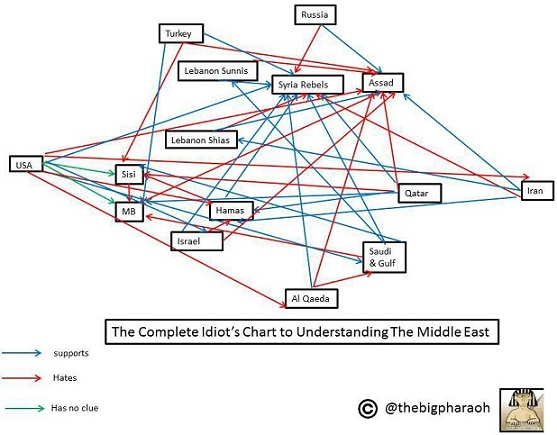
The Big Pharaoh also put this diagram on his blog, and Max Fisher picked it up and blogged it at the Washington Post as The Middle East, explained in one (sort of terrifying) chart:

I’d have some questions here, of course — one about the directionality of the arrows, which only seem to go in one direction — okay for the “supports” and “has nu clue” arrows, perhaps, but surely the “haters” would mostly be two-way, with AQ hating US as well as US hating AQ? There’s no mention of Jordan, I might ask about that… And there are no arrows at all between Lebanese Shias and Lebanese Sunnis — hunh?

**

What really intrigues me here, though, is that while this chart with fifteen “nodes” or players captures many more “edges” or connections between them than either or even both of the two tweets above, the tweets evoke a more richly human “feel” for the connections they reference, by drawing on human memories of the various parties and their actions.

Thus on the face of it, the diagram is the more complex representation, but when taken into human perception and understanding, the tweets offer a more immediuate and visceral sense of their respective situations.

And scaled down and in broad strokes, that’s the difference between “big data” analytic tools on the one hand, and HipBone-Sembl approach to mapping on the other. A HipBone-Sembl board may offer you two, or six, ten, maybe even a dozen nodes, but it fills them with rich anecdotal associations, both intellectual and emotional — a very different approach from — and one that I feel is complementary to — a big data search for a needle in a global needlestack…

**

But I’d be remiss if I didn’t also point you to Kerwin Datu‘s A network analysis approach to the Syrian dilemma on the Global Urbanist blog. He begins:

A chart by The Big Pharaoh doing the rounds of social media shows just how much of a tangled mess the Middle East is. But if we tease it apart, we see that the region is fairly neatly divided into two camps; it’s just that one of those camps is divided amongst itself. Deciding which of these internal divisions are fundamental to the peace and which are distractions in the short term may make the diplomatic options very clear.

and goes on from there, offering a series of network graphs of which is the fourth:

from which he draws the following observation:

What can we do from this position? If the US decides to pursue a purely military route to remove Assad from power, it will incur the ire of Russia, Iran and Lebanese Shias, but it can do so with a broad base of support including the Syrian rebels themselves, Israel, Qatar, Turkey, Lebanese Sunnis, and even Al Qaeda. However if it chooses a diplomatic route to curry support to remove Assad it must isolate him in the above graph by making an ally out of Russia and/or Iran (assuming that making an ally out of Lebanese Shias would have little impact). Russia doesn’t hate the US but it does hate the Syrian rebels, making it an unpromising ally against Assad. Iran hates the Syrian rebels and the US hates Iran, but the Al Qaeda is a thorn in both their sides, making it a potential though unlikely source of cooperation.

Really, you and I should read the whole piece, and draw our own conclusions.

**

Or lack thereof. I’ll give the last tweet to Teju Cole, who articulates my own thoughts, too:

Various body parts for various body parts

Friday, May 31st, 2013

[ by Charles Cameron — mostly about a fascinating quote from Martin Luther King ]
.


.

Let’s start with the Code of Hammurabi, 196-97:

If a man put out the eye of another man, his eye shall be put out. If he break another man’s bone, his bone shall be broken.

A few days ago, I found I was feeling mildly exercised by one Dan Hodges writing in the Telegraph:

Indeed, “An eye for an eye, a tooth for a tooth,” quoted by one of Lee Rigby’s suspected killers, comes from the Bible, not the Koran.

Hodges was quoting Michael Adebolajo, who had said on camera:

The only reason we have killed this man today is because Muslims are dying daily by British soldiers. And this British soldier is one. It is an eye for an eye and a tooth for a tooth. By Allah, we swear by the almighty Allah we will never stop fighting you until you leave us alone.

**

It is true that Deuteronomy 19.21 reads:

And thine eye shall not pity; but life shall go for life, eye for eye, tooth for tooth, hand for hand, foot for foot.

and Exodus 21.23-25:

And if any mischief follow, then thou shalt give life for life, Eye for eye, tooth for tooth, hand for hand, foot for foot, Burning for burning, wound for wound, stripe for stripe.

— but its is clear that Adebolajo — who was brought up devoutly Christian in Nigeria, converted (“reverted”) to Islam, and now references suras of the Qur’an using their Arabic names — would also be aware of Sura Al-Ma’ida (5) 45:

And therein We prescribed for them: ‘A life for a life, an eye for an eye, a nose for a nose, an ear for an ear, a tooth for a tooth, and for wounds retaliation’; but whosoever forgoes it as a freewill offering, that shall be for him an expiation.

**

The quote “An eye for an eye makes the whole world blind” is often attributed to Mohandas Gandhi, but I checked with Quote Investigator and found it was originally used by one Louis Fischer to paraphrase Gandhi’s teaching, although the Gandhi family apparently think it sounds authentic. But what interested me most was that a form of the same phrase can safely be attributed to Martin Luther King, who is quote in Stride Toward Freedom: The Montgomery Story, p 208, as saying:

Violence as a way of achieving racial justice is both impractical and immoral. It is impractical because it is a descending spiral ending in destruction of all. The law of an eye for an eye leaves everyone blind. It is immoral because it seeks to annihilate the opponent rather than win his understanding; it seeks to annihilate rather than to convert. Violence is immoral because it thrives on hatred rather than love. It destroys community and makes brotherhood impossible. It leaves society in monologue rather than dialogue. Violence ends by defeating itself. It creates bitterness in the survivors and brutality in the destroyers.

That’s quite a paragraph.

**

Of note, besides the parallel structure with which King addresses violence as both impractical and immoral, are two matters I have often pointed to here on Zenpundit:

Self-reference:

Violence ends by defeating itself.

and polyphony:

It leaves society in monologue rather than dialogue.

**

Gandhi’s position seems to come close to that presented in Matthew 5. 38-48 — in which Christ clearly countermands the lex talionis as promulgated in Exodus and Deuteronomy:

Ye have heard that it hath been said, An eye for an eye, and a tooth for a tooth: But I say unto you, That ye resist not evil: but whosoever shall smite thee on thy right cheek, turn to him the other also. And if any man will sue thee at the law, and take away thy coat, let him have thy cloke also. And whosoever shall compel thee to go a mile, go with him twain. Give to him that asketh thee, and from him that would borrow of thee turn not thou away.

Ye have heard that it hath been said, Thou shalt love thy neighbour, and hate thine enemy. But I say unto you, Love your enemies, bless them that curse you, do good to them that hate you, and pray for them which despitefully use you, and persecute you; That ye may be the children of your Father which is in heaven: for he maketh his sun to rise on the evil and on the good, and sendeth rain on the just and on the unjust. For if ye love them which love you, what reward have ye? do not even the publicans the same? And if ye salute your brethren only, what do ye more than others? do not even the publicans so? Be ye therefore perfect, even as your Father which is in heaven is perfect.

And. for that matter, to The Richmond Declaration of Faith of 1887, as quoted today by my friend, Friend Marshall Massey:

We feel bound explicitly to avow our unshaken persuasion that all war is utterly incompatible with the plain precepts of our divine Lord and Law-giver, and the whole spirit of His Gospel, and that no plea of necessity or policy, however urgent or peculiar, can avail to release either individuals or nations from the paramount allegiance which they owe to Him who hath said, ‘Love your enemies.’ (Matt 5:44, Luke 6:27)

**

How — without denigrating those who are of either the Deuteronomic or the Gandhian persuasion — does one nudge the world-system gently away from justice and towards mercy, away from revenge and towards reconciliation, away from war and towards peace? Towards a new and more viable homeostasis?

Glass Beads and Complexity

Monday, May 27th, 2013

[ by Charles Cameron — achieving something like closure on a post I started for Adam Elkus here, with a side dish along the way here ]
.

.

It’s astonishing to me how closely complexity science is related to Hermann Hesse‘s Glass Bead Game.

Adam Elkus recently pointed those who follow him to Cosma Rohilla Shalizi, Methods and Techniques of Complex Systems Science: an Overview, and just a quick dip there gave me the graphic I’ve put at the head of this post, together with this quote about “patterns” as Shalizi understands that term:

I mean more or less what people in software engineering do: a pattern is a recurring theme in the analysis of many different systems, a cross-systemic regularity. For instance: bacterial chemotaxis can be thought of as a way of resolving the tension between the exploitation of known resources, and costly exploration for new, potentially more valuable, resources (Figure 1.2). This same tension is present in a vast range of adaptive systems. Whether the exploration-exploitation trade-off arises among artifcial agents, human decision-makers or colonial organisms, many of the issues are the same as in chemotaxis, and solutions and methods of investigation that apply in one case can profitably be tried in another. The pattern “trade-off between exploitation and exploration” thus serves to orient us to broad features of novel situations. There are many other such patterns in complex systems science: “stability through hierarchically structured interactions”, “positive feedback leading to highly skewed outcomes”, “local inhibition and long-rate activation create spatial patterns”, and so forth.

**

Let’s start with patterns. The “people in software engineering” Shalizi mentions gleaned their use of the term “pattern” from the architect Christopher Alexander, author of the extraordinary, seminal book A Pattern Language, which in turn has hugely influenced computer science. Alexander distilled the essence of his thinking in his “Bead Game Conjecture”:

That it is possible to invent a unifying concept of structure within which all the various concepts of structure now current in different fields of art and science, can be seen from a single point of view. This conjecture is not new. In one form or another people have been wondering about it, as long as they have been wondering about structure itself; but in our world, confused and fragmented by specialisation, the conjecture takes on special significance. If our grasp of the world is to remain coherent, we need a bead game; and it is therefore vital for us to ask ourselves whether or not a bead game can be invented.

Manfred Eigen, Nobel laureate in Chemistry, called his book with Ruth Winkler-Oswatitsch Laws of the Game — and it deals with molecular biology, cellular automata, game theory, and games. But not just that — it is specifically written with Hesse’s concept in mind:

We hope to translate Hermann Hesse’s symbol of the glass bead game back into reality.

While we’re on about cellular automata, what about Stephen Wolfram? I don’t know that he talks about the Glass Bead Game himself, but at least three people talk about Wolfram’s book, A New Kind of Science, and/or his search engine, Wolfram Alpha as being strongly analogous to Hesse’s game — Jason Dyer, Graeme Philipson, and most recently, Mohammed AlQuraishi. Here’s a key para from Quraishi’s piece:

I think the Game is an intriguing concept, and I think it may one day be realized. In fact I think we are already on our way toward realizing it. In the simplest and most general sense, mathematics and programming languages allow us to formalize all knowledge. Contenders for the language of the Game already exist, at least in principle. But we are further along than that. Search engines like Wolfram Alpha have already begun the process of formalizing diverse pieces of knowledge, unifying them in a single medium, and providing the means to connect and reason about them. A repeated example in the book, the mapping of musical compositions to mathematical formulas or even historical events, is eminently doable within Wolfram Alpha. Much remains to be done of course, and there is no “game” yet that can be played across the vast sea of all human knowledge, but some enterprising individuals have already gotten started on creating it.

And then there’s John Holland, the “father of genetic algorithms”. Holland told an interviewer:

I’ve been working toward it all my life, this Das Glasperlenspiel. It was a very scholarly game, starting with an abacus, where people set up musical themes, then do variations on it, like a fugue. Then they’d expand it to where it could include other artistic forms, and eventually cultural symbols. It became a very sophisticated game for setting up themes, almost as a poet would, and building variations as a composer. It was a way of symbolizing music and of building broad insights into the world.

If I could get at all close to producing something like the glass bead game I can’t think of anything that would delight me more.

**

I’ve been working on a playable variant on the Glass Bead Game too, for twenty years quite consciously, and more if you count subterranean stirrings. And I don’t think glass beads, or stones, or chess or go pieces, or beads on an abacus, or strings of ones and zeros, or cells in an agent-based model for that matter, are the way to go. Which is not to say those approaches shouldn’t be tried, or don’t have remarkable things to teach us. I just don’t believe they give us quite what Hesse envisioned:

a direct route into the interior of the cosmic mystery, where in the alternation between inhaling and exhaling, between heaven and earth, between Yin and Yang, holiness is forever being created.

I think what’s important in Hesse’s game is that concepts that humans can grasp should reveal their stunning interrelations to heart and mind. And for that reason, the “moves” in my games [Hipbone, and more recently Sembl] consist of concepts — musical, verbal, visual, mathematical — and the links, the analogies, the “semblances” between them.

**

And thus the game is a search for analogies.

The human mind must inevitably perform what Shalizi calls the “trade-off between exploitation and exploration”. Some thoughts are proximate to others, they can be developed without any special insight by regular “linear” thinking. We do this every day, every minute — but it is not particularly revelatory. It doesn’t solve thorny problems, much less create beauty. There is another mode of thinking, however, that leaps between thoughts that are not so “close” but are nevertheless deeply related. To leap the apparent distance between such deeply related thoughts, we deploy analogy and creative thinking, and that is where the aha! of revelation occurs.

So I would suggest there is a close analogy here with the point Shalizi is making with the diagram atop this post. The human mind, to slightly paraphrase Shalizi’s caption, will “exploit the currently-available patch of food” for thought by linear, inside-the-patch thinking, but at full stretch it will also “explore, in hopes of ?nding richer patches elsewhere” — the “elsewhere” being attained precisely by “creative leaps” — by seeing semblances, patterns, analogies.

And to return to my earlier post, Thinking outside the cocoon, of which this post is a continuation, and perhaps the completion….

Shalizi’s “random walk” is thus also the archangel’s “zig-zag wantonness” in that great poem, Tom O’Roughley — when William Butler Yeats asks, “how but in zig-zag wantonness / could trumpeter Michael be so brave?” and writes, “wisdom is a butterfly / and not a gloomy bird of prey”…


Switch to our mobile site