zenpundit.com » CIA

Archive for the ‘CIA’ Category

Gene Sharp

Monday, February 21st, 2011

[ by Charles Cameron ]

I was impressed by him in London in the early sixties.

Okay, I was young and impressionable. But others have noticed him more recently, too: Hugo Chavez accused him of being a conspirator with the CIA, and the Iranians thought he, George Soros and John McCain were in cahoots.

gene-sharp.jpg

Gene Sharp has been in the news quite a bit recently [1, 2, 3, 4], because he pretty literally wrote the book on non-violent resistance.

The young leaders of the Egyptian revolt that toppled Mubarak studied tactics with members of the Serbian Otpor youth resistance who topped Milosevic, Otpor studied tactics in the writings of Gene Sharp, specifically his 90-page pamphlet From Dictatorship to Democracy [download as .pdf]. Sharp wrote that handbook for use in Burma, where it was apparently translated at the request of Aung San Suu Kyi — who once cautioned her readers that that phrase they kept hearing wasn’t “jeans shirt”, it was “Gene Sharp”.

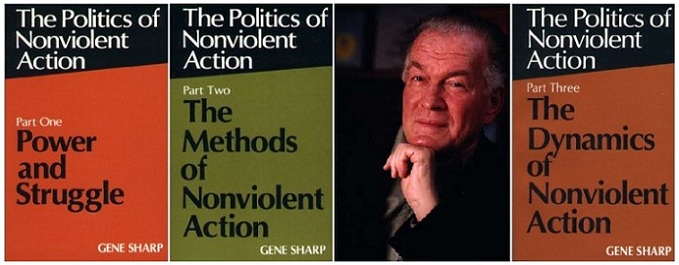
And before that, he’d penned his masterful 900-page, three-volume work, The Politics of Nonviolent Action

I told you he was impressive.

Recommended reading:

From Dictatorship to Democracy is now available in Amharic, Arabic, Azeri, Belarusian, Burmese, Chin (Burma), Jing-paw (Burma), Karen (Burma), Mon (Burma), Chinese (Simplified Mandarin), Chinese (Traditional Mandarin), English, Farsi, French, Indonesian, Khmer (Cambodia), Kyrgyz, Pashto, Russian, Serbian, Spanish, Ukrainian, Tibetan, Tigrigna, and Vietnamese.

DoubleQuotes and Questions

Friday, January 28th, 2011

[ by Charles Cameron ]

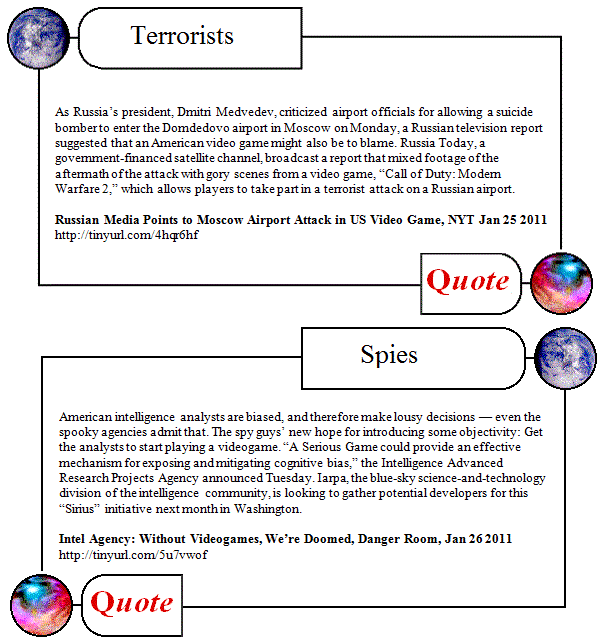
You know, I really enjoy building my DoubleQuotes. They can be entirely frivolous, as is this one, for instance:

with its touch of gothic — a taste I share with my friend Bryan Alexander.

Or they can work like a Necker cube, offering opposite framings with which to view a single topic — in this case, video games.

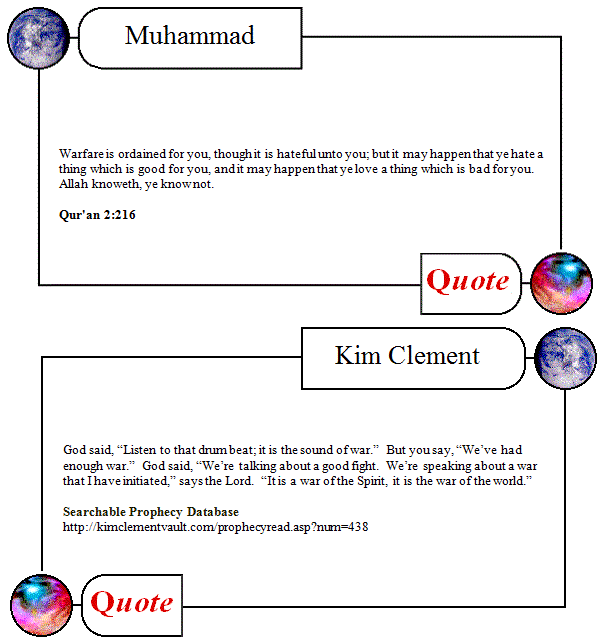
They can also work like Rorschach blots — this one compares two prophecies, one from the Quran and one from a contemporary Christian prophet (if I’m not mistaken, President Obama quoted him recently) —

— but it is left up to the reader to determine the value of each…

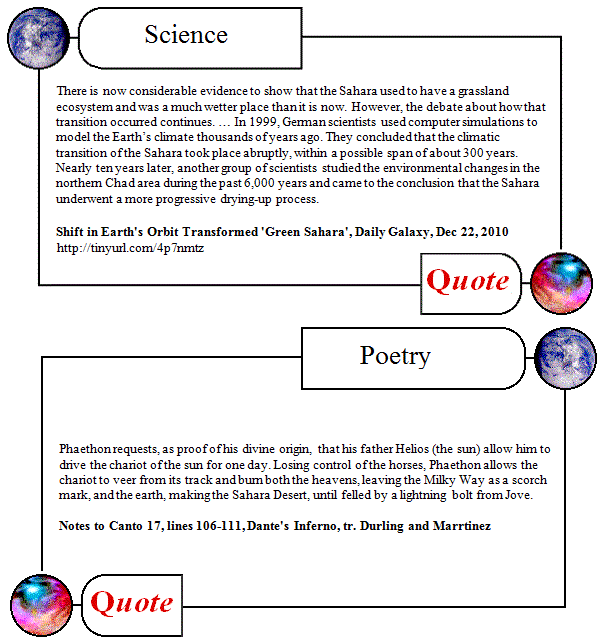
And they can also pose fundamental questions of preference:

Has science simply replaced myth, d’you think? or is science for the facts, perhaps, and the mind — while poetry and myth are for the heart, and truth?

“Whoever took religion seriously?”

Saturday, January 8th, 2011

[ by Charles Cameron — cross-posted from the DIME/PMESII boards at LinkedIn ]

I’ve been hammering away at the importance of a nuanced understanding of religious drivers in successful modeling of our world, and today I ran across some paragraphs from a book by Gary Sick that explain, forcefully and briefly, just why this seems like a big deal to me.

1

Sick, who was the National Security Council’s point man on Iran at the time of the Ayatollah Khomeini‘s Iranian Revolution, recounts how totally unprepared we were for the sudden emergence of a theocracy in his book, All Fall Down:

Vision is influenced by expectations, and perceptions — especially in politics — are colored by the models and analogies all of us carry in our heads. Unfortunately, there were no relevant models in Western political tradition to explain what we were seeing in Iran during the revolution. This contradiction between expectation and reality was so profound and so persistent that it interfered fundamentally with the normal processes of observation and analysis on which all of us instinctively rely.

On one level, it helps to explain why the early-warning functions of all existing intelligence systems — from SAVAK to Mossad to the CIA — failed so utterly in the Iranian case. Certainly, US intelligence capability to track the shah’s domestic opposition had been allowed to deteriorate almost to the vanishing point. But even if it had not, it would probably have looked in the wrong place. Only in retrospect is it obvious that a good intelligence organization should have focused its attention on the religious schools, the mosques and the recorded sermons of an aged religious leader who had been living in exile for fourteen years. As one State Department official remarked in some exasperation after the revolution, “Whoever took religion seriously?”

Even after it became clear that the revolution was gaining momentum and that the movement was being organized through the mosques in the name of Khomeini, observers of all stripes assumed that the purely religious forces were merely a means to the end of ousting the shah and that their political role would be severely limited in the political environment following the shah’s departure, The mosque, it was believed, would serve as the transmission belt of the revolution, but its political importance would quickly wane once its initial objectives had been achieved.

2

The blissful ignorance didn’t end back there in 1979. Right at the end of 2006, reporter Jeff Stein asked Rep. Silvestre Reyes (Dem, TX), the incoming head of the House Intelligence Committee (which has oversight of the entire US Intelligence Community) whether Al-Qaida was Sunni or Shiite – noting in two asides, “Members of the Intelligence Committee, mind you, are paid $165,200 a year to know more than basic facts about our foes in the Middle East” and “To me, it’s like asking about Catholics and Protestants in Northern Ireland: Who’s on what side?”

Reyes guessed wrong – not good – and so did a lot of other senior people in the FBI, Congress and so forth. Understandable perhaps, but still, not good.

The popular media keep many of the rest of us confused, too. Glenn Beck has been misinformed by the Christian thriller writer Joel Rosenberg, and refers to the “Twelvers” when he means the “Anjoman-e Hojjatieh” -which, to extend Stein’s point, is the equivalent of saying “Catholic Church” when you mean “Legionnaires of Christ”.

3

Okay, we know that religion has something to do with all this Iran – and Afghanistan and Pakistan and Iraq, and Yemen, and Somalia, and Nigeria — and maybe even homegrown — mess. And I agree, other people’s religions really aren’t our business normally, and it’s not surprising if we don’t know much about them.

Except, I’d say, when religions take up the sword, or have significant power to influence decisions about the use of nuclear weapons — at which point it’s appropriate to get up to speed…

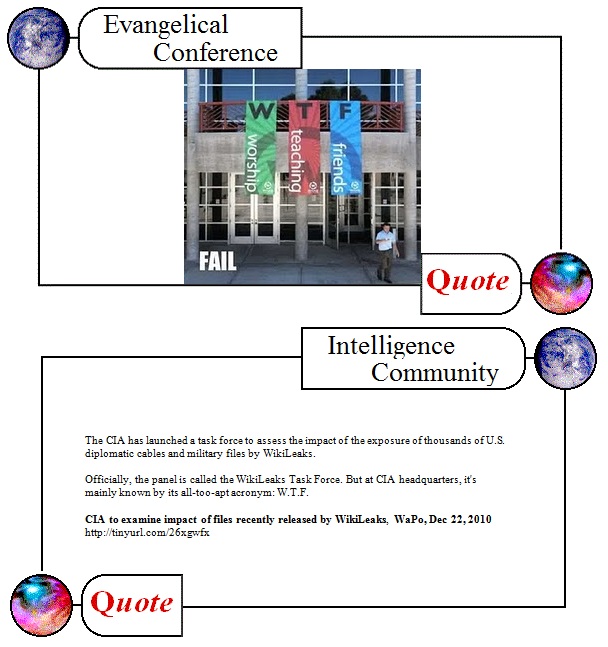
WTF, Zen?

Wednesday, December 22nd, 2010

[ by Charles Cameron ]

QUOwtf

WikiLeaks in conspiracy space

Sunday, December 12th, 2010

I thought my response to a comment Lex posted at ChicagoBoyz might be of equal interest here.

Lex wrote:

This is starting to remind me a little bit of Robert Anton Wilson. Even the squirrels in the trees are in on the conspiracy. What conspiracy? You know, the conspiracy

My comment follows…

Indeed, it seems there’s plenty of room in conspiracy space for WikiLeaks:

Wikileaks – A Big, Dangerous US Government Con Job
By F. William Engdahl
12-10-10

The story on the surface makes for a script for a new Oliver Stone Hollywood thriller. A 39-year old Australian hacker holds the President of the United States and his State Department hostage to a gigantic cyber “leak,” unless the President leaves Julian Assange and his Wikileaks free to release hundreds of thousands of pages of sensitive US Government memos. A closer look at the details, so far carefully leaked by the most ultra-establishment of international media such as the New York Times, reveals a clear agenda. That agenda coincidentally serves to buttress the agenda of US geopolitics around the world from Iran to Russia to North Korea. The Wikileaks is a big and dangerous US intelligence Con Job which will likely be used to police the Internet.

*

WikiLeaks – More Israeli Game Theory Warfare?
By Jeff Gates
12-1-10

“The United States is the real victim of WikiLeaks. It’s an action aimed at discrediting them.” Franco Frattini, Foreign Minister of Italy

The impact of the WikiLeaks release of diplomatic cables fits the behavior profile of those well versed in game theory warfare. When Israeli mathematician Robert J. Aumann received the 2005 Nobel Prize in economic science for his work on game theory, he conceded, “the entire school of thought that we have developed here in Israel” has turned “Israel into the leading authority in this field.” The candor of this Israeli-American offered a rare insight into an enclave long known for waging war from the shadows. Israel’s most notable success to date was “fixing” the intelligence that induced the U.S. to invade Iraq in pursuit of a geopolitical agenda long sought by Tel Aviv. When waging intelligence wars, timing is often the critical factor for game-theory war planners. The outcome of the WikiLeaks release suggests a psy-ops directed at the U.S.

BTW, both theories come via the same publisher, rense.com.


Switch to our mobile site