zenpundit.com » 2011 » February

Archive for February, 2011

Viewdle is a Two-Edged App

Sunday, February 20th, 2011

Saw this on Shlok’s site:

Viewdle – Photo and Video Face Tagging from Viewdle on Vimeo.

This kind of app is a required step for making augmented reality devices part of the social media ecology. Therefore, this tech will become a standard for all mobile devices – merchants and advertisers want us as an army of data collectors on each other.

OTOH, automatic face-recognition and social media aggregation raises serious concerns about the potential dangers of living under a panopticon state if an app is aggregating and bundling all your online data in real time, while giving out your GPS and home address. A godsend to stalkers, oppo researchers, con men, disgruntled spouses or employees, autocratic governments and other creepy malefactors. Expect businesses, which are already attempting to illegally pry and spy into all areas of employee’s lives, to make surreptitious use of apps of this nature

Puts the protests to revolution in Egypt and Tunisia in perspective, doesn’t it?

If the FCC wanted to do something useful and promoting of liberty, they might consider regs to let individuals exercise greater control the use third parties would have to their collective online IDs – then you could be “out there” or not or to the degree you liked. Some people, do want to be “out there” professional or social reasons. While you cannot control pictures of yourself in a public space, I’m not sure the Supreme Court thought that your presence in public meant that random strangers and government officials should be able to run your credit history as you sit at a table in a restaurant or bar or take in a movie or ball game by taking your photo. A similar logic underlies state laws prohibiting wiretapping or making auditory recording individuals without their knowledge and consent (Illinois being one such state where Chicago aldermen and state legislators have acquired a healthy fear of recording devices).

Speaking of government, I have been told by an authoritative source that the USG rsearch is far advanced in this area. Probably a lot further along than is Viewdle, but perhaps not.

Reagan Roundtable: The Art of the Deal

Thursday, February 17th, 2011

Ronald Reagan’s monicker as President was always “the Great Communicator“, for his command of message and the medium of television, though Reagan had a considerable ability to read a live audience as well. Everyone acknowledged Reagan’s rhetorical wizardry, even his Democratic critics, who took some comfort in imagining that Reagan was “only a B movie actor” reading his lines. A nickname that would have pointed to one of his greatest political skills would have been “the Great Negotiator” because Reagan’s talent for winning favorable outcomes, legislatively and diplomatically, is rivaled among presidents only by FDR and LBJ. Yet few pundits give Reagan that credit of being a master of the art of the deal.

Reagan’s strategic insight has been alluded to previously in this roundtable and the ability to look at a big picture and construct a strategy for acheiving favorable ends, using acceptable and effective ways that are within your means is the cornerstone of being a good negotiator. Reagan’s career as an actor is frequently cited but it is forgotten that if they gave out Oscars for running the Screen Actor’s Guild, Reagan would have cleaned up at the academy awards. He was a tough union boss and Reagan’s deft handling of contract negotiations with the studios, winning substantial concessions for actors in a politically charged, anti-Hollywood atmosphere, led to his being elected president of SAG seven times:

“At the request of the SAG National Board, Reagan returned to the SAG presidency in 1959 in order to head 1960
theatrical negotiations that ultimately resulted in the first pension and health plan for SAG members, not to mention residuals on filmsshot January 31, 1960, and after (once they were replayed on television).”

Not having anticipated the advent of television, having little bargaining leverage and facing punitive tax rates, many early film actors lived hand to mouth in their old age while the studios raked in a fortune selling their performances to TV networks. Most had been paid a pittance and the lucky few who had made real money had found Uncle Sam claimed up to 90 % of their paycheck. Reagan never forgot that bitter experience and made decreasing marginal income tax rates a key objective in his economic program, which he managed to get through a Democratic-controlled House of Representatives under the Speakership of Tip O’Neill. How? He negotiated for it and afterward, liberal Democrat Tip O’Neill paid conservative Republican Reagan the ultimate compliment that a political opponent can bestow:

How am I doing? I’m getting the whale shit kicked out of me!

As the former Speaker explained in his memoirs, belying his image as a genial and somewhat lazy figurehead, Reagan was a shrewd but relentless bargainer. “You fellas tell me who I need to call and I’ll make the calls” Reagan told his staff. Reagan called. He worked the phones like the winner of a national sales award. Congressmen, Senators, their supporters and newspaper editors back home, he charmed the wives of members of Congress, asked after their children and hand wrote them personal letters of thanks and gave them photo ops at the White House. He shared the spotlight and made compromises with Democrats like Bill Bradley and Dan Rostenkowski who were willing to advance Reagan’s strategic goals. Walking in to the conference room to talk with the Democratic leadership, Reagan would frequently begin discussions having dozens of their Democratic members in his pocket and an equal number wavering. Reagan would at the last minute, take half a loaf in legislation if it moved the ball down the field. Then in the next negotiation, he’d return for the other half and often as not, get some of that too.

The Soviet politburo fared no better with arms control with Reagan than did the leaders of the Democratic party on tax cuts and tax reform. That Reagan was disinclined to make the sort of breezy, one-sided, concessions that had been the hallmark of Kissinger’s approach to SALT was made dramatically clear by Reagan’s appointment of Paul Nitze, the father of NSC-68 and co-founder of Team B, as his adviser on arms control and chief negotiator foe the INF treaty talks. Reagan’s propensity to treat the Soviets in his public speeches as if their Communist ideology were illegitimate and dangerous gave the Soviet leaders fits.

Longtime Soviet ambassador to the United States, Anatoly Dobrynin remained a dedicated Communist apparatchik and a skillful advocate of the Soviet position even after the demise of the USSR, but his comments about Reagan in his memoir In Confidence, while laden with frustration and incomprehension, are not the picture often seen of Reagan in the MSM:

  •  
    • Brezhnev and his colleagus found themselves dealing with something truly new, a deeply disturbing figure who tenaciously advanced a course that profoundly offended and alarmed them.
    • To me, the directness and insouciance of his remarks confirms once again my belief that personal conviction underwrote Reagan’s approach to the Soviets and everything associated with us, and not just some political pose.
    • It was evident from Shultz’s Behavior during our White House conversation and long afterward that Reagan was the real boss, and that the secretary of state carried out his instructions. Shultz hardly intervened in the conversation and ostensibly agreed with Reagan throughout. I even had the impression, perhaps an erroneous one, that the secretary of state was somewhat afraid of the president.

As Dobrynin’s memois meander slowly, as diplomatic tomes are wont to do, the Soviets ultimately, by stubborn, painful inches born of endless meetings, bent to many of Reagan’s positions, orginally regarded by them as absolutely intolerable: the zero option, exit visas for Pentacostal dissidents, SDI research and most dramatic of all, consenting to the tearing down of the Berlin Wall, occurring the year Reagan left office.

Ronald Reagan, not Mikhail Gorbachev, understood the art of the deal.

COL Pat Lang on Twitter

Wednesday, February 16th, 2011

[ by Charles Cameron ]

Excellent news!  COL Patrick Lang has now signed up on Twitter, so a quick and easy way to know when he’s posted at Sic Semper Tyrranis is to follow him @pat_lang. I hope he’ll post the occasional quick comment on — or pointer to — breaking news there, too.

*

Okay, that’s the main message here — but there’s also an amusing aside to be made.

I tend to pride myself (I’m afraid that’s probably the right word) on my humility — so you can imagine how I felt when I discovered earlier today that Twitter was doing my humility for me:

humility-by-twitter.jpg

That’s right: as a follower of COL Lang, I rate precisely zero.

Humility by twitter — is our technology getting wise to us at last?

Egypt: Life imitates digital art

Wednesday, February 16th, 2011

[ by Charles Cameron ]

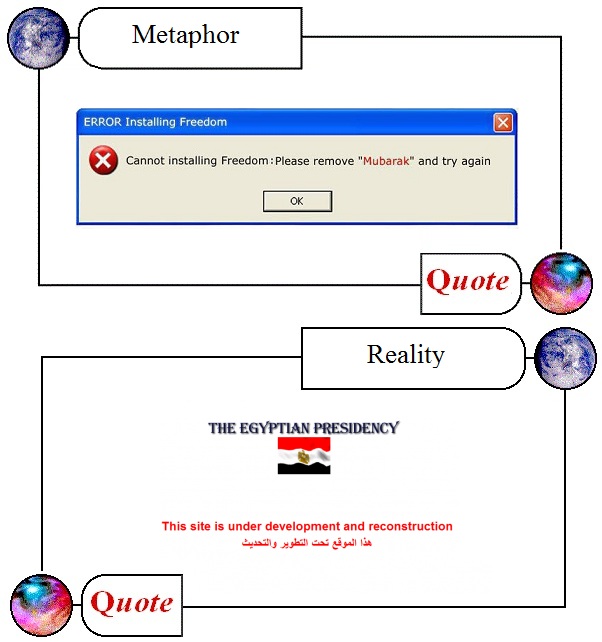
The first “quote” in this pair is a clever, geeky commentary on the situation in Egypt from shortly before the fall of Mubarak.

quowesbite.jpg

The second is a screen capture made today from the official Egyptian Presidency site — virtuality meets reality.

[ This post is a follow-up to my earlier DoubleQuote Egypt: uninstalling ]

Reagan Roundtable:The Cold War Ends by Joseph Fouche

Wednesday, February 16th, 2011

Joseph Fouche at the Ronald Reagan Roundtable at Chicago Boyz.

Reagan Roundtable: The Cold War Ends

….Some observers (kind according to their own lights) take a more moderate course. They’ll concede that Reagan had something to do with the end of the Cold War. Perhaps mesmerized by the sight of his own reflection looking back at him from Gorby’s shiny bald head, the senile old dinosaur was stunned into a quiescence sufficient to allow Gorby to let peace break out without the hurdle of Reagan’s habitual warmongering. Under other circumstances, Reagan would wake up, eat his Wheaties, break out a map, and plan which bastion of worker’s solidarity he would besiege that day. Gorby’s charm and skill in handling this wild rampaging elephant of imperialist plutocracy was only just enough to overcome even the power of the Breakfast of Champions and end the Cold War.

Others concede that Reagan was more than a patsy skillfully played by a smooth talking Commie. Instead, he was a patsy skillfully played by a smooth talking State Department. In this version, George Schultz and other enlightened diplomats slowly weaned Reagan away from the Precambrian depths of his native Birchery and convinced him that speaking softly was more constructive than his unthinking waving of a big stick. The mandarins of Foggy Bottom supplied the script and Reagan, secretly yearning the direction of Hollywood days of yore, performed his role with all the aplomb a B-movie actor could summon. Reagan was convinced that the diminutive Gorby was Bonzo. It was his job to put the little bald chimp to bed with all the tender care a leading man could devote to an expensive studio prop. If Gorbachev happened to outshine him, it was all in good fun. Reagan understood in the light of the timeless wisdom of W.C. Fields: “Never work with animals or children”.

The heroic story that Reagan arose like a bronzed colossus from the hills above Los Angeles and not only consigned but personally muscled Marxism and Leninism on to the ash heap of history takes various forms. The most popular variant holds that Reagan won in spite of the serial arch-appeasers in State. His dedication to confidently waving around the DoD-forged mace of martial virtue in the face of Useful Idiot naysayers pushed the Soviets over the edge. The evil Commies strove to forge their own mace of martial virtue only to stumble over the inefficiencies of GOSPLAN. Gorby was simply playing for time by appealing over Reagan’s head to the useful idiots and fellow travelers in the West as the coils of Reagan’s grand strategy gradually squeezed the last breaths from the dying Bear. Faced with the unstoppable force of Truth, Justice, and the American Way, it wouldn’t have mattered who was leader of the USSR. Their place in the ash heap was prepared and furnished with all the trimmings of dread inevitability.


Switch to our mobile site