zenpundit.com » 2012

Archive for 2012

Selil’s Cyber Paradigm

Thursday, May 24th, 2012

Now, in order to understand it, go here:

Information assurance and security and cyber warfare is muskets in a sharks with lasers world 

….I think that we’re diverging significantly from the old world of cyberspace into a newer set of taxonomical and ontological concepts. Perhaps we’re finally beginning to mature the thinking of the domain. The focus on offense is not yet nearly the focus we need. In my opinion we do focus to much on defense. The problem is we have continued to focus on information security as if that is a form of cyber war. The focus on computer security artificially limits what could be considered valid forms of attack and most obviously has nothing to do with nation state attackers. In reverse the language of war being applied to the management principles of information systems causes inappropriate risk calculations, increases costs outside the requirements, and inhibits innovation and efficiency at significant social costs. 

Basically, information security is a form of management and cyber war is a form of conflict. That they happen in the same domain and have different goals is no different than the gate guards that protect your gated community from bad guys. The Wackenhut security guys carry guns, but their entire mission set is quite different from the rather impressive troops of say Seal Team 6. As a community of interest we continue to conflate these two roles at extreme cost and significant increase in strategic level risk.

Excellent!  Read the rest here.

Hat tip to Adam Elkus

Between the warrior and the monk (i): my father

Tuesday, May 22nd, 2012

[ by Charles Cameron — a warrior, a monk, and where that leaves me ]
.

Like one of those toy acrobats who flips up, over and under when you squeeze or release the two sticks he’s strung on, I’m strung between these two fellows…

and flip up, over and under on the string that stretches from war to peace.

So here I am at Zenpundit, and I thought it might be time for me to give you a little more background about myself, where I’m coming from, and where I hope to be going…

*

To get to the figure on the left of the image above, Captain Orford Gordon Cameron DSC, RN, my father, we have to track back a couple of generations deeper into family history, to this gentleman whose first name I bear as my own second name.
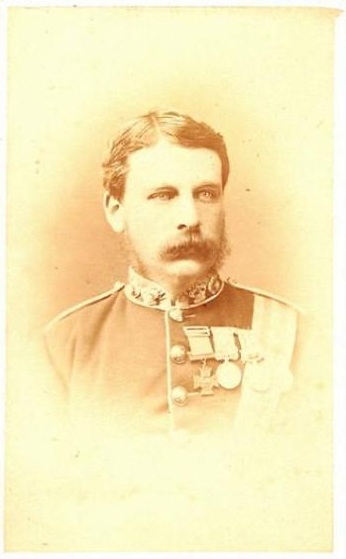
Col. Aylmer Spicer Cameron, VC, CB, my great-grandfather, earned his Victoria Cross during the Sepoy Rebellion:

For conspicuous bravery on the 30th of March, 1858, at Kotah, in having headed a small party of men, and attacked a body of armed fanatic rebels, strongly posted in a loop-holed house, with one narrow entrance. Lieutenant Cameron stormed the house, and killed three rebels in single combat. He was severely wounded, having lost half of one hand by a stroke from a tulwar.

There’s pride in that, passed down from his son to my father and so on down the line…

*

There’s pride, too, in the story of my own father’s DSC.

HMS Sheffield in Battle of the Barents Sea, stamp design, oil on canvas, Brian Sanders

As gunnery officer of HMS Sheffield in the Battle of the Barents Sea, Lt. Cdr. Cameron’s guns and those of Jamaica crippled the German heavy cruiser Hipper. When the news arrived in Germany, Hitler “with veins standing out on his neck” excoriated Admiral Raeder:

This operation only confirmed what he had instinctively felt all along — that the surface fleet was completely useless and that it was poorly staffed and ineptly commanded. The three battleships Tirpitz ,Schleswig-Holstein and Schlesien , the two pocket battleships Admiral Scheer and Lützow , the battle-cruisers Scharnhorst and Gneisenau , the heavy cruisers Hipper and Prinz Eugen , and the light cruisers Emden , Köln , Leipzig , and Nürnberg would all be decommissioned and summarily scrapped. To the extent possible their guns would be converted to land use. Henceforth, the largest navy ship would be a destroyer and all emphasis would be on the u-boat fleet.

Churchill wrote:

This brilliant action fought by the Royal Navy to protect an Allied convoy to Russia at the end of the year (1942) led directly to a crisis in the enemy’s naval policy and ended the dream of another German High Seas Fleet.

*

I have been thinking about my father quite a bit recently, since his medals arrived from England about ten days ago:
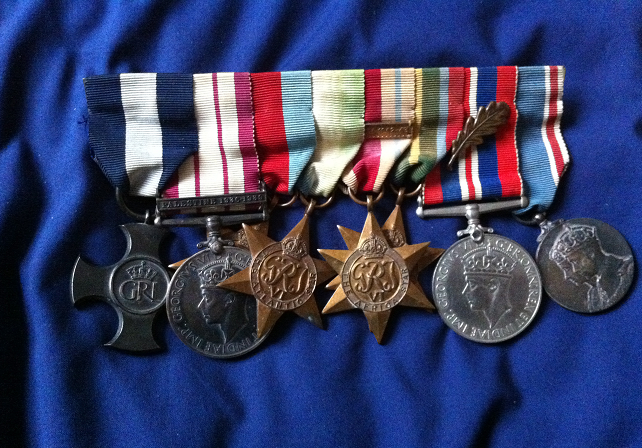
His DSC, left, was awarded for gallantry in the Barents Sea engagement, for which Cpt. Sherbrooke, on Onslow, was awarded the Victoria Cross, and Rear-Admiral Burnett, on Sheffield, the DSO.

There’s pride there, too.

Gallantry: what a word.

*

And the military strain in the family runs deep…

This photo of my parents’ wedding shows, from left to right in uniform, my grandfather Col. Sir Henry Clayton Darlington KCB, CMG, TD; John Wise; my great uncle Gen. Sir Clement Armitage KCB, CMG, DSO; Jan Newnham (best man); my father, Lt. Cdr. OG Cameron; my grandfather Brig. Orford Somerville Cameron, DSO, RA; my uncle Glenton Roslyn Williams; my uncle Colonel Henry John Darlington, OBE, DL; and Rev. Aylmer Peter Cameron, also my uncle.

Quite the gang — and not a civilian among them, although admittedly the photo was taken in 1942.

My varied aunts — brilliant, eccentric, elegant, delightful, take my word for it — are there too.

*

So that’s my father, and the pole that pulls me towards gallantry and the martial side of things. The other pole is represented by Fr. Trevor Huddleston CR, to the right of my father in the image at the top of this post.
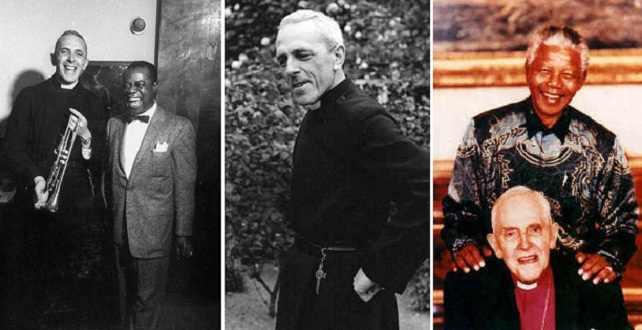
I’ll return to Fr. Trevor in my next installment.

When Does Conflict Become “War”?

Tuesday, May 22nd, 2012

When does mere conflict end and war begin?

Great philosophers of strategy and statecraft did not treat all conflict as war but regarded war as a discernably distinct phenomenon, different from both peace and other kinds of conflict. War had a special status and unique character, glorious and terrible:

“Hence to fight and conquer in all your battles is not supreme excellence; supreme excellence consists in breaking the enemy’s resistance without fighting. “

    -Sun Tzu

“When the Corcyraeans heard of their preparations they came to Corinth with envoys from Lacedaemon and Sicyon, whom they persuaded to accompany them, and bade her recall the garrison and settlers, as she had nothing to do with Epidamnus. If, however, she had any claims to make, they were willing to submit the matter to the arbitration of such of the cities in Peloponnese as should be chosen by mutual agreement, and that the colony should remain with the city to whom the arbitrators might assign it. They were also willing to refer the matter to the oracle at Delphi. If, in defiance of their protestations, war was appealed to, they should be themselves compelled by this violence to seek friends in quarters where they had no desire to seek them, and to make even old ties give way to the necessity of assistance. The answer they got from Corinth was that, if they would withdraw their fleet and the barbarians from Epidamnus, negotiation might be possible; but, while the town was still being besieged, going before arbitrators was out of the question. The Corcyraeans retorted that if Corinth would withdraw her troops from Epidamnus they would withdraw theirs, or they were ready to let both parties remain in statu quo, an armistice being concluded till judgment could be given. “

-Thucydides 

“Thus, therefore, the political object, as the original motive of the war, will be the standard for determining both the aim of the military force, and also the amount of effort to be made. This it cannot be in itself; but it is so in relation to both the belligerent states, because we are concerned with realities, not with mere abstractions. One and the same political object may produce totally different effects upon different people, or even upon the same people at different times; we can, therefore, only admit the political object as the measure, by considering it in its effects upon those masses which it is to move, and consequently the nature of those masses also comes into consideration. It is easy to see that thus the result may be very different according as these masses are animated with a spirit which will infuse vigour into the action or otherwise.”

– Carl von Clausewitz 

We see from the above that war was not regarded as the same as either the political conflict which precipitated it or even, in the case of the Corcyraeans, the violence done against their interests in Epidamnus by the Corinthians, which did not yet rise to be considered war in the eyes of either Corcyra or Corinth. Instead the occupation of Epidamnus was something we would recognize today as coercion.  Like war itself, coercion operates by a calculus that is only partially rational; not only is the psychological pressure of coercion subject to passions of the moment, our reactions to the threat of violence -and willingness to engage in it – may be rooted in evolutionary adaptations going back to the dawn of mankind. Coercion, or resistance to it, usually is the midwife of war.

Prehistoric man lived a life that archaeology increasingly indicates, contrary to philosophical myth-making, was endemic in it’s violent brutality. Whether the violence between or within tiny paleolithic hunter-gatherer bands constituted private murder or warfare is a matter of debate, but the existence of the violence itself is not. Earliest firm evidence of a possible large skirmish or massacre dates back to 14,000 BC and definitive evidence for large-scale, organized battle dates to the end of the Neolithic period and dawn of the Bronze Age in 3500 BC.  Lawrence Keeley, in War Before Civilization, describes primitive man as being hyperviolent in comparison with those noted pacifists, the ancient Romans:

….For example, during a five and a half month period, the Dugum Dani tribesmen of New Guinea were observed to participate in seven full battles and nine raids. One Yanomamo village in South America was raided twenty-five times over a fifteen month period…. 

The high frequencies of prestate warfare contrast with those of even the most aggressive ancient and modern civilized states. The early Roman Republic (510-121 BC) initiated war or was attacked only about once every twenty years. During the late Republic and early Empire (118 BC -211 AD), wars started about once every six or seven years, most being civil wars and provincial revolts. Only a few of these later Roman wars involved any general mobilization of resources, and all were fought by the state’s small (relative to the size of the population) long-service, professional forces supported by normal taxation, localized food levies and plunder. In other words, most inhabitants of the Roman Empire were rarely directly involved in warfare and most experienced the Pax Romana unmolested over many generations. [Keeley,33] 

Simple, prestate societies probably waged “war” – a violent and deliberate conflict with rival groups and in alliance with rival groups against more distant interlopers – but the degree to which archaic and prehistoric humans culturally differentiated between this and their everyday, casual, homicidal violence remains unknown. Moreover, many academics would not accept the thesis of neolithic societies being “warlike”, much less, waging “war” as we understand the term until they rose to levels of social and political complexity generally denoted as chiefdoms, kingdoms and empires (“political” societies).

There’s something to that argument; a certain element of cultural identity is required to see the world in distinctly  “us vs. them” terms instead of an atomized Hobbesian “all vs. all” but I suspect it is far more basic a level of communal identification than the level of cultural identity typical of sophisticated chiefdoms like Cahokia or ancient Hawaii. Cultural and communal identity would tend to focus violence toward outsiders while increasingly complex political and social organization could “shape” how violence took place, molding it into recognizable patterns by regulation, ritual, taboo and command of authority. Once there is enough societal complexity for a leadership to organize and direct mass violence with some crude degree of rational choice and control, not only is war possible but strategy is as well.

Once a society is sophisticated enough to employ violence or the threat of violence purposefully for diplomacy or warfare, it is making a political decision to separate mundane and nearly chronic “conflict” and “war” into different categories. This would appear to be a primitive form of economic calculation distinguishing between conflict that generates acceptable costs and manageable risks and those conflicts that pose unacceptable costs or existential risks. This would give the relationship between primitive tribes the character of bargaining, an ongoing negotiation where the common currencies were violence and propitiation, until one party vacated the area or ceased to exist, most wars then having an innate tendency to escalate toward genocide (our current limitations on warfare, such as they are, derive from greater social complexity and political control over the use of violence).

If an economic calculus is indeed the root of the political decision to recognize some conflicts as “war”, that raises some interesting questions about modernity and advanced  states. What happens  when a conflict occurs with a state sufficiently complex that the ruling elite see their class interests as distinct and superceding those of the state? The calculus and what is considered “acceptable” costs or risks in a conflict vice those mandating “war” shift dramatically away from what might be considered “rational” state interest.

In a society at such an end-state, seemingly intolerable conflict might be tolerated indefinitely while full-fledged wars could be waged over what would appear to be mere trivialities to the national interest.

ADDENDUM:

In addition to some already excellent and extensive comments in the thread, I would like to turn your attention to an interview post at The Last Word on Nothing recommended byZack Beauchamp:

Horgan, Hayden, and the Last Word on Warfare 

Ann:  I understand both of you have written authoritative and charming books on war — John’s, just out, is called The End of War; and Tom’s is Sex and War — and that you’vediscussed these matters before.  I also understand you disagree about war.  How could you not agree?   I mean, war is just nasty stuff and we shouldn’t do it, right?

Tom: Ann, you’re poking the hornet’s nest right off the bat! I don’t think John and I disagree about war, but rather about peace. Don’t get me wrong: we both prefer the latter to the former, by a wide margin. And there are many things we do agree on, I think, such as the substantial observed decrease in the frequency and lethality of war over the past several centuries, and the idea that culture is an important part of the balance between war and peace. But I think we do have a difference of opinion about the attainability of peace (John) versus the inevitability of war (me). I think this makes John a better person than me, and certainly a more optimistic one. And I really, really hope he’s right. In my mind it comes down to an argument about human nature, and whether the impulses and behaviors of war are inborn or acquired. Or at least, that’s my take. John, what’s yours? [….]

High Ground

Monday, May 21st, 2012

Hat tip to Kanani Fong of Kitchen Dispatch

The award -winning film HIGH GROUND  is due for release in August 2012:

Since 2002, almost 50,000 U.S. soldiers have returned home from Iraq and Afghanistan with their lives radically altered by war. With the improvement of battlefield medical treatments, these soldiers return alive yet not whole, and face long painful paths to recovery.

Full integration back into their community and the civilian world is a treacherous road, fraught with obstacles and pitfalls. After initial rehabilitation, these veterans are often left to fend for themselves, and struggle with physical and mental roadblocks, depression, and alienation.

This issue affects every aspect of society, not just families and hometown communities, but our national character and our legacy. How these wounded soldiers transition is one of the most important repercussions of these wars and an adversity with which we will contend for generations.

igh Ground was a showcase expedition bringing together disabled war veterans with world recognized mountain climbers to demonstrate what could be achieved by climbing a Himalayan giant. A key outcome of the expedition was to produce a documentary film that would tell the inspiring stories of these heroes and spread a healing message to a national audience.

This film, featuring stunning cinematography and capturing powerful emotions, will touch the hearts of concerned citizens, military families, outdoor enthusiasts and most of all, soldiers who find themselves wondering how to face the days and months and years ahead. It is an honest and gripping portrayal of our American warriors, telling an action packed story that unfolds in unexpected ways as the team makes their way high into the mountains, through the villages of Nepal, over raging rivers and up terrifying steep terrain risking injury and death for a chance at the summit.

A second and equally important goal is to continue to impact those thousands of injured soldiers in the midst of their own daunting recoveries through the use of the film at veteran’s hospitals and military bases around the United States. In the fall of 2011, a multi-city nationwide tour will be launched to welcome our soldiers home, celebrate their spirit and sacrifice, and to encourage them to pursue their dreams.

Efforts are currently underway to assess the potential of additional expeditions and to create a long-term strategy as a non-profit organization. By getting involved and supporting this project you can participate directly in this vital process and connect your company to the message that our soldiers can indeed… return home to live again.


Boyd & Beyond 2012

Saturday, May 19th, 2012

Colonel John Boyd

This is a head’s up early warning so people can get their schedules and plans together.

From J. Scott Shipman at the Disciples of Boyd’s Strategy Group:

Greetings! A gentle reminder that Boyd & Beyond 2012 is scheduled for 12 & 13 October 2012 at Quantico, VA. 

I would encourage those interested in presenting to contact me or Colonel Stan Coerr. As far as I know, Stan doesn’t have a presenters list. As in the last couple of years, we discourage the use of PowerPoint. The last two years have been two compelling days, and I’ve no doubt this year will be no exception.

There is no charge to attend, as the Command & Staff College makes space available. So check you schedules and make plans to attend, and consider submitting an idea for a presentation.


Switch to our mobile site