zenpundit.com » 2015

Archive for 2015

Must Beethoven really roll over?

Wednesday, October 21st, 2015

[ by Charles Cameron — time, like an ever rolling stream, bears all its sons away ]
.

I’m more than a little proud of these two tweets from my nephew, the conductor Daniel Harding, who was in Japan at the time of the March 2011 quake:
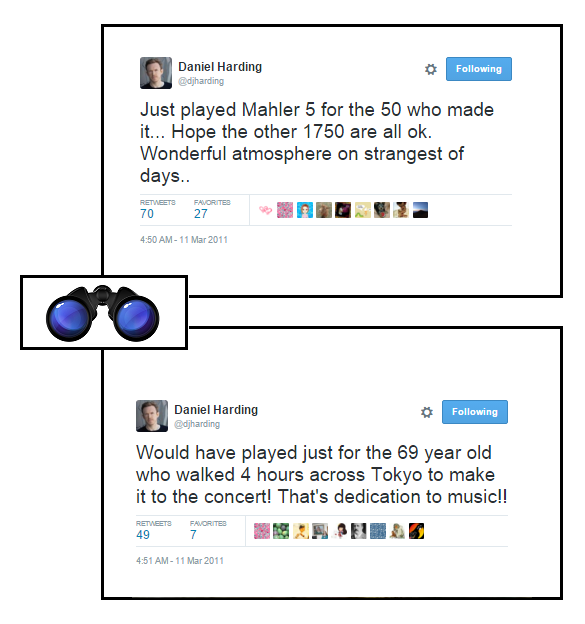
SPEC Daniel Harding Tokyo quake

I remembered them today while reading Anna Goldsworthy‘s The Lost Art of Listening — subtitled Has classical music become irrelevant?

**

Goldsworthy’s central theme is this:

Reports of the death of classical music are not new. There are those who have made a career out of eulogising it, such as the English journalist Norman Lebrecht, who has written the same book on the subject several times; the late pianist and musicologist Charles Rosen quipped that “the death of classical music is perhaps its oldest continuing tradition”. Classical music has absorbed a number of deaths already – the death of patronage, of the composer-virtuoso, of tonality. Clearly it is made of stern stuff, but can it survive the death of its audience?

It was this sentence, however, that reminded me so vividly of Daniel’s tweets:

Might there be a concert a few decades hence in which – God willing – my trio is still performing, but only to an audience of one? And if that listener were to perish mid performance, would we keep playing?

**

I’m wondering whether Goldsworthy’s question — Has classical music become irrelevant? — may not parallel a similar concern about poetry.

Language shifts. Eliot caught it nicely:

                                  Words strain,
Crack and sometimes break, under the burden,
Under the tension, slip, slide, perish,
Decay with imprecision, will not stay in place,
Will not stay still.

The Oregon Shakespeare Festival has announced its plan to “provide translated texts in contemporary modern English as performable companion pieces for Shakespeare’s original texts..” The OSF comments:

We have asked the writers to limit their efforts to updating the more antiquated language in the plays. Shakespeare’s works are all written in modern English; it’s just that in the last 400 years, many of the words, phrases and references have fallen out of use. So our focus is squarely on translating this antiquated language to increase understanding, while maintaining the vibrancy of the original.

So there you have it: Shakespeare’s works are all written in modern English; it’s just that..

And so the wheel turns.

**

When I was researching 4chan clues to the recent Umpqa shooting, I had to avail myself of the Urban Dictionary to learn the meanings of such terms as sperg out, pepe, normie, edgelord

Edgelord:

A poster on an Internet forum, (particularly 4chan) who expresses opinions which are either strongly nihilistic, (“life has no meaning,” or Tyler Durden’s special snowflake speech from the film Fight Club being probably the two main examples) or contain references to Hitler, Nazism, fascism, or other taboo topics which are deliberately intended to shock or offend readers

— and there isn’t even a definition for libcucks as yet. Hey, I’m an Ancient. It’s what happens to the young.

So I get the feeling Shakespeare may have now reached the point of obscurity that Chaucer had reached in 1951, when I was yet a child and Penguin published Neville Coghill‘s verse translation of The Canterbury Tales.

**

One of many notable comments in Goldsworthy’s piece was this:

In 1942 starving musicians performed Shostakovich’s Symphony No. 7 in Leningrad while the city was under siege. The musicians were given an hour-long ovation, and the concert was broadcast to German forces as a form of psychological warfare.

Pablo Neruda, Andrei Voznesensky: I’ve seen it suggested that poetry has urgency — and the large audiences to prove it — in those times and places where poets also risk imprisonment, perhaps torture, and even death.

Irina Ratushinskaya described her writing habits while in the Soviet Gulag:

In defiant prose, she tells of her refusal to cower in the camp “like a frightened mouse.” Determined to continue writing poetry, she would scratch verses onto bars of soap with the burnt end of a matchstick. One poem described “the first beauty which I saw in this captivity: a window in the frost!” Another confided: “We live stubbornly/like a small beast who’s gnawed off his paw/ to get out of a trap on three.” After memorizing her words she would wash the evidence away. Later she copied the poems, in minute handwriting, onto four-centimeter—wide strips of cigarette paper and smuggled them out to Igor, who passed them on to Western journalists. “All poets should have such a school,” she says now, with a laugh. “It taught me to be very spare and concise.”

**

Daniel’s tweets:

  • Daniel Harding, Wonderful atmosphere on strangest of days
  • Daniel Harding, Would have played just for the 69 year old
  • Oregon Shakespeare Festival announcements:

  • News Release, OSF Launches Three-Year Shakespeare Translation Commissioning Project
  • Play On FAQ, 36 playwrights translate Shakespeare
  • Next year, Daniel takes up the post of music director of the Orchestre de Paris.

    Serpent bites tail, or Genesis revisited

    Wednesday, October 21st, 2015

    [ by Charles Cameron — serpent, dragon — take your pick ]
    .

    I’ve been interested in the form of the serpent that bites its own tail at least since I was in Oxford and wrote the poem:

    dragon eats self reference bd

    Putting it in a circle-with-tail like that, however, was a much later business, dating to a time when I was figuring out how to annotate recursion in a HipBone game move, and suddenly realized I’d tumbled on the smallest HipBone game board in the process..

    Recursion is a key indicator, as Douglas Hofstadter explained in Godel Escher Bach, and as the Cretan philosopher Epimenides knew, with St Paul echoing him at Titus 1.12:

    One of themselves, even a prophet of their own, said, The Cretians are alway liars, evil beasts, slow bellies.

    **

    SPEC Westboro Baptist

    The God Hates Fags church protesting Kim Davis, the Rowan (Kentucky) County Clerk who fasted, prayed, and then refused to issue licenses to gay couples who wished to marry, is surely a serpent bites tail moment..

    Madness.

    Unless, perhaps, publicity is your god, your sole aim and glory.

    **

    Sources:

  • HuffPo, Kentucky Clerk Says She ‘Prayed And Fasted’ Before Deciding To Stop Issuing Marriage Licenses
  • HuffPo, Westboro Baptist Church Picketed Kim Davis For ‘Enabling Fag Marriage’
  • A simian (ethological) glance at the Republican presidential race

    Wednesday, October 21st, 2015

    [ by Charles Cameron — just one photo among many, or a defining display of power? ]
    .

    My friend Tom Parsons made what I thought was an insightful comment on the photo above:

    the serious hit was seeing the accompanying picture of Trump again showing simian dominance as the alpha male, and getting a submissive smile and pose from Jeb. That’s scary because I’m not finding online discussion of the simian dominance game that seems so clearly to me to be the foundation stone of Trump’s campaign.

    **

    Tom’s not exactly right about there being no discussion of the Trump / Bush body language, as these two headlines [1, 2] show:

    SPEC wimp

    — but “wimp” is pretty mild pop-psych for “simian submission”, and Tom’s language emphasizes the biological roots of Trump’s apparent dominance.

    **

    See what I mean?

    SPEC trump

    **

    When you come down to it, ain’t biology everything?

    There’s the height factor to consider, too. Hey, in Fahrenheit 451, Ray Bradbury has one of his characters claim:

    You just don’t go running a little short man like that against a tall man.

    — and Abraham Lincoln stood tall at six foot four.

    On the felicities of graph-based game-board design: five

    Tuesday, October 20th, 2015

    [ by Charles Cameron — Hofstadter Langdon Kim — for Gabi Nasemann, & in recognition of Gödel Escher Bach ]
    .

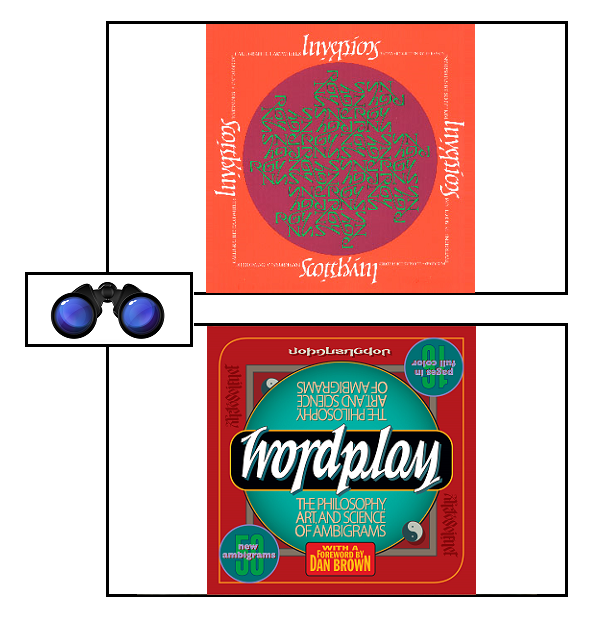
    My friend the photographer Gabi Nasemann recently inquired whether I knew John Langdon‘s book, Wordplay, and I responded, DoubleQuote-style, with Scott Kim‘s Inversions:

    SPEC kim langdon

    I had the pleasure of meeting Scott Kim lo these many years past at the Computer Game Developers Conference, and he was kind enough to say of my HipBone Games:

    Your game does seem to really call to mind the Bead Game. Almost a divination system, much more metaphorical than most games.

    **

    Scott Kim and his friend Doug Hofstadter both have a keen interest in Bach, so I thought it might be neat to see Scott’s treatment of the name — an ambigram, lower panel below — and how John Langdon might treat it — upper panel:

    SPEC bach

    Langdon’s Bach I assembled from his own typeface, Biform, which apparently seeped from his grasp into the wider world under the entirely irrelevant name Lampoon.

    **

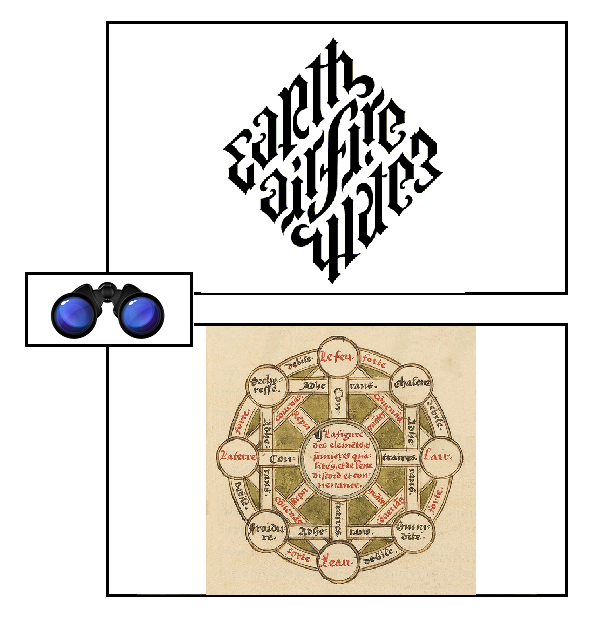
    Of all Langdon’s ambigrams, the one that’s no doubt best known — since Dan Brown used it in one of his execrable books — is his square of the four elements, upper panel, below:

    SPEC langdon oronce

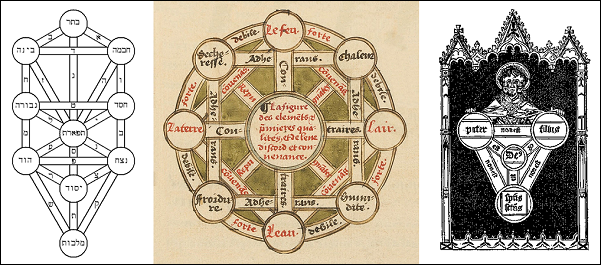
    It was a nice touch, though, that Brown offered Langdon an hommage by naming his professor of symbiology after him. No doubt the fictional Robert Langdon would be familiar with the glorious diagram of the elements created by Oronce Fine, which he’d have run across in a 1549 Harvard Houghton Library volume, Le Sphere du Monde, and which I have elsewhere compared with Jewish and Christian diagrams:

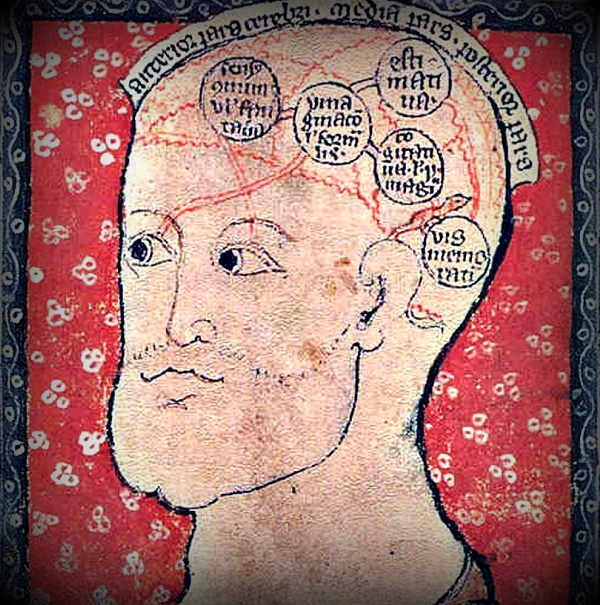
    Sembl and HipBone gameboards are in the same genre.. being games of linkage that you play with your mind:

    games you play in your mind

    **

    Sources and further readings:

  • John Langdon, Ambigrams
  • Scott Kim, Ambigrams on Google Search
  • Scientific American, Remembering Martin Gardner, with Douglas Hofstadter
  • Slate, Can You Really Be a Professor of Symbology?
  • The New Yorker, Harvard_ No Symbology Here
  • Wikipedia, Robert Langdon
  • Random House, The Official Website of Harvard Symbologist Robert Langdon
  • John Langdon, Biform
  • John Langdon, Lampoon
  • Triple Canopy, This is your brain on paper
  • Military Reform through Education

    Tuesday, October 20th, 2015

    [by Mark Safranski, a.k.a. “zen“]
    Photo of Don Vandergriff instructing with a map

    Don Vandergriff facilitating Adaptive Soldier/Leader exercises at Fort Benning

    Fred Leland at LESC Blog recently had a guest post up by Dan Grazier from the Project on Government Oversight regarding the important work Don Vandergriff is doing to reform professional military education and training:

    Military Reform Through Education: From The Straus Military Reform Project, Something We In Policing Can Learn From

    ….I had the privilege of experiencing this process with a group of 30 soldiers and Department of Defense (DoD) civilians learning about adaptive leadership and mission command. All were teachers from various courses at Fort Benning sent by their senior leaders seeking to infuse new ideas into their organizations. They spent a week learning how to incorporate adaptability into their courses during a seminar taught by CDI military advisor Don Vandergriff and his colleagues with Yorktown Systems Group.

    The Adaptive Soldier/Leader Training & Education (ASLTE) seminar aims to move the Army away from outdated assembly-line training methods that teach soldiers to mindlessly execute checklists. Instead, the seminar shows soldiers how to incorporate creative and interactive methods that challenge both students and teachers. This results in empowered soldiers at all levels able to adapt to any situation. [….]

    ….Don Vandergriff, a retired Army major, has been on the front lines of personnel reform for many years. While he is most noted for his work at the service level, these seminars seek to transform the Army from the bottom up.

    Approximately 20 soldiers and 10 civilian educators spent the week learning various teaching methods through experiential learning, which flips the traditional method military students are used to. Most training today follows the “crawl, walk, run” theory all service members are familiar with. Students are generally expected to complete reading assignments, sit through a PowerPoint lecture, and then finally conduct field training to reinforce what they have learned.

    The seminar exposed students to new methods by putting the practical exercises first. For example, the seminar uses several Tactical Decision Games (TDGs) to encourage students to rapidly develop a plan for a military problem presented by the facilitators. TDGs can be created for nearly any kind of a situation, but this course mostly used actual battlefield problems like how to capture a bridge or defeat an enemy force entrenched on a hilltop. While working through these problems, the students are exposed to such concepts as Mission Command and the Observe, Orient, Decide, and Act decision cycle, commonly called the OODA Loop or Boyd Cycle.
    It is only after the practical exercises that they receive reading assignments about those concepts. Because they’ve encountered them during the exercises, the concepts become more tangible. The OODA Loop, for instance, explains an individual’s or an organization’s decision-making process. It is a difficult concept to truly understand, but it becomes easier when one first sees how it works and then reads about it. The idea is to give them a moment of discovery, that “Ah ha!” moment. Success using such methods is to have a student say, “So, that’s what you call that,” while reading.

    Don is making use of several powerful learning methodologies in his Adaptive Leadership philosophy – and I saying “learning” and not “teaching” because Don has properly put the emphasis on the student actively thinking and doing rather than on passively listening to a lecture or discussion. Lecture has a place in education, to explain or to set the student up for new learning experiences, but it should be used sparingly and in short bursts of time when the instructor has carefully set up a “teachable moment”. By having the students doing active problem solving first, they come to Vandergriff armed with their own questions, eager to have feedback.

    The use of games are also a very powerful learning tool, perhaps one of the most effective because the situational learning. tends to be transferrable rather than be compartmentalized and isolated information. The right kind of decision games are serious practice for life. This was noted by RAND social scientists way back during the early days of the Cold War:

    “The gamers argued that insights arose from immersion in play. In 1956 Joseph Goldstein noted that the war game demonstrated ‘ the organic nature of complex relationships’ that daily transactions obscured.War-gaming gripped its participants, whipping up the convulsions of diplomacy ‘ more forcefully…than could be experienced through lectures or books’.”

    ” A team from the Social Science Division [ at RAND ] posed a number of questions which they hoped the unfoldig month of gaming would resolve. Chief among them was whether gaming could be used as a forecasting technique ‘ for sharpening our estimates of the probable consequences of policies pursued by various governments’. Would gaming spark “political inventiveness“, and more importantly, how did it compare to conventional policy analysis? Did gaming uncover problems that might otherwise be neglected? And invoking the emerging touchstone of intuition, did the experience impart to policy analysts and researchers “ a heightened sensitivity to problems of political strategy and policy consequences?”

      Sharon Ghamari- Tabrizi, The Worlds of Herman Kahn

    Back to the article:

    ….Vandergriff’s teaching method incorporates recent research into adult learning, designed “to engage students in direct experiences which are tied to real world problems and situations in which the instructor facilitates rather than directs student progress.” This creates a situation where the students learn from one another. Unlike most other military classes, the ASLTE teachers use very few PowerPoint presentations. They also end up speaking far less than the students themselves.

    Vandergriff ran the class through the first TDG and led the discussion afterward. From that point forward, students took turns leading the class through After Action Reviews. Students gained confidence in leading such an exercise while the rest of the class bounced ideas off each other. The interactive nature of this kept the entire class engaged and gave all of them ownership of their own learning.

    The concept of ownership was a consistent theme throughout the seminar. According to Vandergriff, a good teacher “works to make his students better than himself and encourages them to take ownership of their development, to make them life-long learners.”

    Here Don is making use of the social pressure and reinforcement of a Peer to Peer (P2P) dynamic to maintain maximum student engagement while having them practice critical intellectual reflection, something that is a vital constituent of a professional culture of learning. A true professional embraces an honest discussion of ideas and both accepts and gives critical feedback on performance in hopes of learning and improving.

    Read more regarding Don Vandergriff’s adaptive leadership methods here and here.


    Switch to our mobile site