zenpundit.com » 2020

Archive for 2020

Doing without, a new wave?

Sunday, February 23rd, 2020

[ by Charles Cameron — intuitive and counter-intuitive redefined, no politicians, no borders, no traffic lights ]]
.

Consider these two titles, both of which I ran across today:

Sources:

  • The Nation, What Would an Open-Borders World Actually Look Like?
  • New Yorker, Politics Without Politicians
  • **

    Consider: doing without traffic lights:

    The original example is Drachten, a town in Holland of 50,000 people. It is home to exactly zero traffic lights. Even in areas of the town with a traffic volume of 22,000 cars per day, traffic lights have been replaced by roundabouts, extended cycle paths and improved pedestrian areas. The town saw accidents at one intersection fall from 36 over a four-year period to just two in the last two years since the lights were removed in 2006.

    The counter-intuitive finding is that streets without traffic signals mean that cars drive more slowly and carefully because the rules of the road are ambiguous—there’s no red, green or yellow to tell drivers precisely what to do.

    Counter-intuitive. eh? Highly intuitive, and counter to popular assumption, I’d say. Out of the box from one-two-three to zero.

    The Fractal Partition of Bangladesh / India

    Saturday, February 22nd, 2020

    [ by Charles Cameron — in and out, up and down, black and white, fractals, enclaves, exclaves and chhitmahals, the prophet Isaiah and the Virgin Mary — a wild spin through geographies, religions, people, peoples, and their maps ]
    .

    It’s remarkable, from a geotheological point of view, the prayers within prayers within orayers. But look at this excerpt from a Nation piece on a world without borders:

    The so-called “Radcliffe line” separated a Hindu-majority India in the center from Muslim-majority East and West Pakistan on its wings, with a smattering of independent princely states throughout. But neat division wasn’t remotely possible, and what resulted was a labyrinthine confusion of over 100 enclaves (a portion of a nation entirely inside another nation), counter-enclaves (an enclave within an enclave), and even a counter-counter-enclave, in which a little pocket of India sat in a little pocket of East Pakistan which sat in a bigger pocket of India which was entirely enisled in East Pakistan.

    The mind jumps to the Tai-chih symbol in Taois [left] and its implicit fractal presentation [right]m:
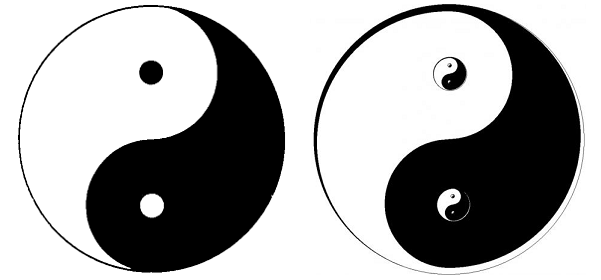
    The thing is, one can map a single mini-me of the Tai Chih within the Tai Chih, but that’s about all the eye can manage, except when the symbol is blown up to all-size. But The Subcontinent is large enough for Indian within Pakistan within India within Pakistan — something we could abstractly represent using a target:

    * in Cooch Behar
    Well, here’s a map of what the French term LA VIE ENCHAÎNÉ — enclave within enclave within enclave:

    Sensing that this sort of arrangement was unnecessarily complicated, India and Bangladesh have since done some land swaps to simplify matters, and moved villagers pof certain religious persuasions accordingly — and a certain complexity and perplexity is gone from the world map.

    There’s a certain samenness, anyway:

    A sari-clad woman tended to a small field of sticks of rolled cow dung, used as cooking fuel, bundling the ones that had baked in the sun and stacking them by a bamboo bench. A chicken, followed by four chicks, pecked nearby. If not for the corrugated metal barracks, we might have been witnessing village life almost anywhere in India, Bangladesh, or Pakistan, much as it had carried on for centuries.

    That we could map with a simple white space:

    **

    A friend where I write has a tattoo:

    It’s okay to not be okay

    That’s an enclave, Tai-Chih style insight — brava!

    **

    And let’s wind up with two celebrated quotes from the Old and New Testaments, from Isaiah 40 (Deutero-Isaiah, for textual critics) and the Magnificat of the Virgin Mary:

    :

    Isaiah‘s verse is a fom of land-swap — but it wasn’t until a few days ago that I realized Mary’s Magnificat echoes Isaiah, transposing positions within social hierarchy for heights and depths in social standing.

    **

    Hm: I do seem to have noticed this echoing of Isaiah in the Magnificat before — see my post The trouble with moral high ground, which opoens with another interesting variant of high and low ground:

    With the rise and fall of sea levels, sky levels, land emerges or submerges, mountain ranges with scattered lakes in their valleys transform into archipelagos, island clusters surge up to become continents — rise and fall, ebb and flow, wave upon wave..

    I mean, really, what of the moral high ground?

    and closes with yet another:

    O ye’ll tak’ the high road, and I’ll tak’ the low road,
    And I’ll be in Scotland afore ye

    A very interesting title from 2014, & a title match, 1972

    Saturday, February 15th, 2020

    [ by Charles Cameron — a biker gang as alt-army, a chess board as Cold War battlefield — Night Wolves, and Fischer Spassky ]
    .

    I mentioned the Night Wolves bikers in my post It’s how we / they roll in May 2015, and there have been many reports of their activities elsewhere — but yesterday I was pointed to some videos I hadn’t seen before, and came across this intriguing title on an RT video from Sevastopol, 2014:

    Russia: Epic Night Wolves biker rally takes war in Ukraine to the stage

    Similar, is this Guardian headline from 2916:

    Putin’s Angels: the bikers battling for Russia in Ukraine

    **

    Think about it. Taking a war to the stage — with a couple of rock bands, a light show, plenty of fires, and the Night Wolves themselves making high bike jumps across the stage — may sound like little or nothing, but for the citizens of Sevastopol is’s either w pretty profound warning or a pretty powerful affirmation that the Crimea belongs to Mother Russia.

    That’s quite an audience! And read the caption:

    This city will come back
    Sevastopol will stay Russian

    **

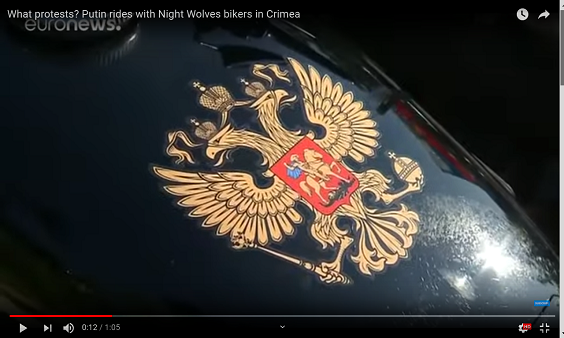
    Note — this is a very short video clip — that Putin rides with the Night Wolves — in Crimea:

    Note that Putin‘s bike has the Russian Imperial insignia of a double-headed eagle — on his gas tank!

    Note the crown at the very top, and St George slaying the dragon in the center panel.

    **

    If you have 35 minutes, watch this — it’s pretty damn impressive for a show put on by a biker gang:

    If you don’t have 35 minutes, just flick through it, catching a sense of the thing. But uit’s well worth watching in full, so perhaps you can find time to come back and watch it later.

    **

    The title of this post claims that “Epic Night Wolves biker rally takes war in Ukraine to the stage<" is A very interesting title". Any text which suggests that war can be considered a drama, a game, or a dream -- a subset of reality -- is of inherent interest: think of the impact of the black American athlete Jesse Owens crushing his German opponent to win four gold medals in Hitler's 1936 Summer Olympics!

    In this case we have the claim that war can be enacted in a rock and roll and light show. A comparison with warfare as chess may prove illuminating: consider the Telegraph article titled How Bobby Fischer and Boris Spassky became pawns — the title itself is extraordinary, making pawns of two great chess grand masters!

    Even before Fischer-Spassky, we are told:

    For the USSR, chess had always been a key weapon in the Cold War.

    And the match itself? For this, let’s turm to an Irish Times article:

    Cold War in Reykjavik as Fischer breaks Soviet defender Spassky

    Never before or after has a chess tournament, or perhaps any sporting event, taken on such non-sporting significance. This was not Spassky v Fischer. It was the USSR v US. [ .. ]

    The fate of a nation has rarely depended on the result of a sporting endeavour. But that was how the match-up between Fischer and Spassky was portrayed in the lead-up to Reykjavik in 1972.

    When he defeated Spassky, we are told, Fischer “was treated as a war hero.” Spassky resigned by telephone– and Fischer? Ever the eccentric —

    The audience (about 2,500) burst into rhythmic applause and rose. Fischer, still busying himself at the chessboard, again nodded, looked uncomfortable, glanced at the audience from the corner of his eyes and rushed off.

    Predictable, enormously surprising

    Friday, February 7th, 2020

    [ by Charles Cameron — read these in sequence and tremble — with a brief note on impeachment ]
    .

    Here:

  • New Yorker, Citing climate change, BlackRock will start moving away from fossil fuels
  • New Yorker, Will Big Business Finally reckon with the Climate Crisis?
  • World Economic Forum, The Global Risks Report 2020
  • BlackRock, A Fundamental Reshaping of Finance
  • Guardian, European Investment Bank to phase out fossil fuel financing
  • IEEFA, The terrible, horrible, no good, very bad year for oil and gas
  • **

    Climate scientists caught on first, then the military, and now financial risk analysts. Meanwile, Mitt Romney spoke his conscience to the Senate on impeachment. Things are shifting: if BlackRock and IEEFA were the jurors, with a dime of every dollar in the world at stake, President trump might not like their verdict.

    One or other, both or neither?

    Friday, January 31st, 2020

    [ by Charles Cameron — Modi or Trump, special or chosen? — with thanks to The Emissary on BrownPundits — and closing in on the shining suchness of the Tathagata ]
    .

    Modi of India, Trump of USA?

    **

    Trump of USA proclaims himself the Chosen One, while Modi of India’s supporters claim Modi is the Special One.

    Who knew?

    **

    Sources:

  • The Emissary, The Special One
  • Giphy, I am the Chosen One
  • **

    Buddhist logic from the beginning differs from its Aristotelian cousin, featuring the chatushkoti or tetralemma:

    India in the fifth century BCE, the age of the historical Buddha, and a rather peculiar principle of reasoning appears to be in general use. This principle is called the catuskoti, meaning ‘four corners’. It insists that there are four possibilities regarding any statement: it might be true (and true only), false (and false only), both true and false, or neither true nor false.

    Hence my title, One or other, both or neither?

    Oh ah:

    speaking of the Buddha, Nagarjuna states that the Buddha’s teaching is “emptiness is suchness, not suchness, both suchness and not suchness, and neither suchness nor not suchness.”

    Furthermore:

    The suchness of the Tathagata is the suchness of all phenomena.

    Rumor therefore has it that there’s a fifth possibility, a refuge from all dualities: the shining suchness of the Tathagata.

    **

    No, really — please comment!


    Switch to our mobile site