zenpundit.com » Uncategorized

Archive for the ‘Uncategorized’ Category

Two koi fish, the one waterfall

Wednesday, March 28th, 2018

[ by Charles Cameron — a yakuza movie shimmering between American and Japanese ]
.

Is strategy found here?

In the film, The Outsider, from which I have borrowed the koi quote above — which gives a riverine equivalent of the steady progress open to a pawn in the strict logic of chess — the outsider of the title played by Jared Leto is tatooed with a single koi fish moving up a waterfall, which the woman, enough said, tells him indicates that he is arrogant.

**

She, Miyu, played by Shioli Kutsuna, has two koi fish —

The film invites your understanding, needlessly, by explaining.

**

Ah well: how a brush pen readied on an ink-stone resembles a knife blade sharpened on a whet-stone.

Jordan Peterson, ouroboroi, paradise, and so forth

Wednesday, March 28th, 2018

[ by Charles Cameron — oh damn, cameron’s on about the ouroboros again, when do we get to strategy? ]
.

A slide from a youtubed lecture:

**

I have found someone who gives emphasis to many of the things I give emphasis to, and which few other peple emphasize. And FWIW, the Jungians do this better than most, but then I’ve been reading and appreciating them for ages. This is new.

Okay, Jordan Peterson. He’s been thinking across a wide range of fundamental concepts for many years now, and considerable fame has accrued to him. How I managed not to notice him until now, I’ll never know. Here he is, anyhow —

— with that ouroboros slide faintly visible behind him. The limits of vision, faintness included, are among his many interests, FWIW.

**

I’ve read Tanner Greer‘s recent critique of Peterson, which was enough to catch my inner eye, and then today there was an invite from Zen —

Hell yes.

And I’m maybe ten minutes into that lecture, have skipped around a bit, and went back to lecture #7 for a clear shot of the ouroboros behind him, which I’ve now inserted at the top of this post.

**

Peterson’s ouroboros is a conflation of a bird, a cat and a snake — wings, claws and venom — birds, cats and snakes being the three classes of being that can kill you from a tree. A “winged, legged serpent” — the “dragon of chaos”. That’s not how I get to the ouroboros, and my equivalent interest is in its recursive nature.

I wrote the poem below, as far as memory serves, in the Anscombe-Geach living room, heart of Oxford’s superb logic team at the time, back in the mid nineteen-sixties, and published it, I think, in Micharel Horovitz‘ 1969 anthology of Britain’s equivalent of the USian beat poets, Childrenn of Albion — wow, of which you could have purchased Amazon’s sole remaining copy for $729.32 as I was writing this — now it’s only $32.57 — is that a difference that makes a difference?

Here’s the poem:

I formatted it more recently in a HipBone Games manner, as a single move with a recursive tail.

**

Another significance of the ouroboros for Peterson is that the serpent (antagonistic to us) guards a treasure (to be desired)..

So along with recursion, we have predatory chaos, aka the unknown and indeed unknowable unknown, and the treasure trove or hoard. And as you might intuit, it’s a short leap from there to the word-hoard — poetry in the palm of your mind, with an early mention in Beowulf.

Here are a few gems from Peterson’s seemingly inexhaustible hoard:

  • there’s no place that’s so safe that there isn’t a snake in it..
  • even God himself can’t define the space so tightly and absolutely that the predator of the unknown can’t make its way in..
  • that’s the story of the garden
  • — and those are from maybe a three minute stretch of a two hour lecture — the word means “reading” — one of forty, is it, in the series?

    **

    Phew. I just received the book, Maps of Meaning: The Architecture of Belief, from Amazon —

    — the print is small — too small for me — stronger glasses coming soon..

    **

    Look, Stormy Daniels was just on 60 Minutes, offering prurient interest under cover of adversarial politics, how could I resist? I could have watched ten more minutes of Peterson video, and grabbed twice the number of notes I’ve made here — but that can wait.

    Stormy Daniels and her lawyer, Michael Avenatti, can show you strategy..

    Ah, but Jordon Peterson can show you abstraction.

    **

    Consider the recent school shootings. I go back to Columbine.. Peterson goes back to abstraction, mapping, and time-space:

    For example, we’re all sitting in this room, and someone leaps in with a weapon.

    It’s like this was known territory a second ago, and now it’s not known territory at all. Even though you’d say, well many things have remained the same, it’s like, yeah, but all the relevant things have suddenly changed, right? And so part of the way of conceptualizing that is that you can manifest a geographic transformation by moving from genuine geographic explored territory into genuine unexplored geographic territory. But you can do that in time as well. Because we exist in time as well as space. And so a space that’s stable and unchanging can be transformed into something completely other than what it is, by the movement forward of time. So why am I telling you that? It’s because we’ve mapped the idea of the difference in space, between the known and the unknown, to the difference in time between a place that works now and a place that no longer works, even though it’s the same place, it’s just extended across time.

    Consider the recent election:

    That’s what an election does, right?

    It’s like, we have our leader, who’s the person at the top of the dominance hierarchy, and defined the nature of this particulatr structure. There’s an election, regulated chaos, noone knows what’s going to happen, it’s the death of the old king, bang! We go into a chaotic state, everyone argues for a while, and then out of that argument they produce a consensus, and poof, we’re in a new state, like that’s the meta-story, right, order > chaos > order, but it’s partial order, chaos, reconstituted and revivified order — that’s the thing, that this order is better than that order, so that there’s progress, and that’s partially why I think the idea of moral relativism is wrong – there’s progress in moral order.

    Note:

  • plenty of intelligence
  • no actionable intelligence
  • a high level of abstraction
  • following the logic of evolution
  • not the logic of logic
  • too paradoxical for that
  • **

    That’s more than enough.

    Au revoir, quite literally!

    Biden Trump fisticuffs

    Friday, March 23rd, 2018

    [ by Charles Cameron — a war, a schoolyard war, a war of schoolyard words .. at least we know now how childlike American politics have become ]
    .

    In the aftermath of the Mexican-American War, General Zachary Taylor of the Whig Party defeated Senator Lewis Cass of the Democratic Party.
    **

    I searched for “biden trump fisticuffs” on Google, and Lord bless us, Elle magazine popped up with an almost exact title, Trump and Biden Challenged Each Other to Fisticuffs, which was a delight.. Well to be frank, the first time I’d spelled my inquiry “dien trump fisticuffs” and received the response Will: Trump is threatening war with North Korea. But what kind? The kind of war I was looking for was fisticuffs, as specified, and the hoped for opponent was Biden, not Dien. But I got satisfaction on my second attempt. Dien, pfft — what was Google thinking about, Dien Bien Phu?

    Anyway, even fisticuffs is a metaphor, I think / hope.

    **

    Elle’s words:

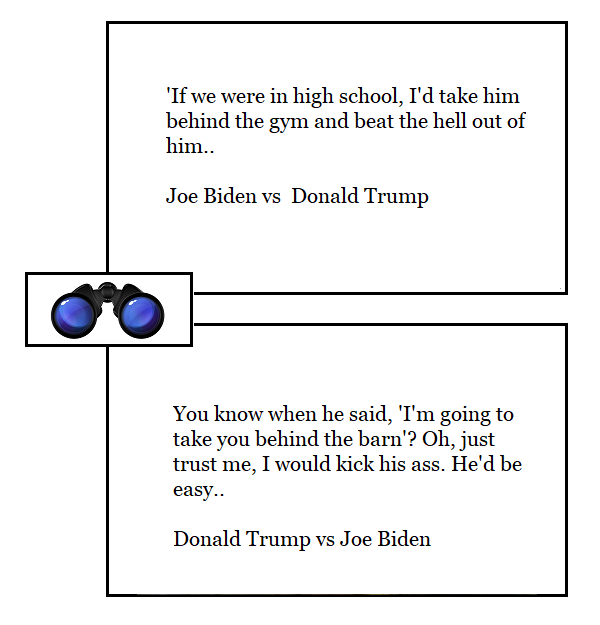
    Today, exciting news coming to us from the prison of masculinity — the sitting president and the former vice-president have gotten into a chest-puffing war of words over which elder statesmen would thrump the other in a schoolyard braw ..

    D dot Trump and J dot Biden fired warning shots at each other not at dawn on a field in Jersey but in the court of public opinion, a civilized and erudite arena if ever there was one.

    Everyone reading this post will almost certainly have seen a refernce to this “chest-puffing war of words” because it has been splashed all over the news — but I’m not featuring it here as anything original or particularly obscure, but because of its sheet delight, as conflict reduced to a children’s brawl reduced to words — a cousin twice removed from real war, which is itself drawing appreciably closer at a diplomatic removed by the appointment of John Bolton as National Security Advisor — gatekeeper to the President, and supposedly an even-headed fellow who can balance out the differing views of the Secretary of Stat,, Secretary of Defense, the Intel community, and other advisors.

    Bolton is distinctly not level headed, distinctly an ideologue, a hawk’s extreme hawk, in favor of war and opposed to Islam — Islam’s claim to be a religion of peace appears firmly confirmed by the contrast!

    **

    The 7 Traits of a Great Nat Sec Adviser (Bolton Has 0):

    Just a few days ago, Brent Scowcroft celebrated his 93d birthday. He is not in the best of health. His days on the public stage are behind him.

    But for those who study American power and leadership in the modern era, the slender, quiet former Air Force lieutenant general remains a giant. He established the standard by which all will be measured who hold the office of national security adviser to which John Bolton was just named. And understanding the reasons for Scowcroft’s success is the key to understanding why Bolton is such a disturbing, devastatingly bad choice for the job.

    Read the whole thing!

    On the felicities of graph-based game-board design: twelve

    Friday, March 23rd, 2018

    [ by Charles Cameron — Cambridge Analytica and Guardian logos, HipBone Game boards ]
    .

    A while back, I posted a series of pieces about the felicities of graph-based game-board design. This piece picks up from that series, with a bit of a refresher, and a pointer to the Cambridge Analytica logo.

    First, the question arises of what graphs are. A graph, from a mathematical point of view, consists of nodes and edges: nodes are, in this diagram, the red circles, and edges are the lines connecting them:

    We know a great deal about the mathematics of graphs, but they underlya vasst repertoire of modern systems, including — for an extreme. complex instance — the design of washing machines:

    **

    Back at least to medieval times, graphs can be found with concepts assigned to their nodes and the reasons connecting those conceptts assigned to their edges. These thre show one Jewish (Kabbalistic) conceptual graph, one graph of the four elements and their relaations, and a Christian ttrinitarian graph:

    I have usedsc similar conceptual graphs as the boards of my HipBone Games. SHown herear ethree of my boards, together with a spiffy board by my friend and colleagues Cath Styles for her Sembl games:

    **

    All the above, to show you why all usees of graphs are potentially of interest to me, and why I am particularly interested in the Cambridge Analytica logo (left, below), which offers a graph in the shape of the human brain, and the logo the Guardian devised (right, below), to give visual continuity to their articles about Cambridge Analytica;

    I think you can see how the Guardian logo would make a fine HipBone game board for teen Agatha Christie -type games.

    **

    Hey, on complexity — which graphs and diagrams are better at than “linear” verbal explanations — there’s this — not a graph! — from another post of mine — wow!:


    Shaping strategy — Constant turbulence and disruption

    **

    Earlier in this series:

  • On the felicities of graph-based game-board design: preliminaries
  • On the felicities of graph-based game-board design: two dazzlers
  • On the felicities of graph-based game-board design: three
  • On the felicities of graph-based game-board design: four
  • On the felicities of graph-based game-board design: five
  • On the felicities of graph-based game-board design: six
  • On the felicities of graph-based game-board design: seven
  • On the felicities of graph-based game-board design: eight
  • On the felicities of graph-based game-board design: nine
  • On the felicities of graph-based game-board design: ten
  • On the felicities of graph-based game-board design: eleven
  • Whether, weather or not you believe in climate change

    Wednesday, March 21st, 2018

    [ by Charles Cameron — in thunder, lightning; in darkness, light; in the eye of the hurricane.. ]
    .

    Weather or weather:

    **

    Sources:

  • CNBC, Powerful nor’easter ‘bomb cyclone’
  • WaPo, D.C. lawmaker says recent snowfall caused
  • **

    We don’t need the details of the two articles, or of other coverage such as the New Yorker’s Bomb Cyclones, Nor’easters, and the Messy Relationship Between Weather and Climate — the top panel headline deals with the weather-weather, the regular day to day no need to look further weather, but the lower panel headline lets in alternate, nay Biblical, spiritual explanations — and with that freedom I’ll fly to a consideration of atmosphere and atmosphere — the one measured by the barometer, the other an intangible presence in a room —

    For where two or three are gathered together in my name, there am I in the midst of them.

    **

    That’s Bibical, too — but it may apply, probably does indeed, to those of other and various flocks.. the joyful givers of any denomination, belief or disbelief.

    YMMV, of course. But read this:

    In his correspondence with Suzuki (the two finally met in New York in 1964), Merton refers to the doctrine of analogy in Aquinas by which it was just as legitimate , in one sense, to say of God that he is non-being as to affirm God is being, since God so transcends being as we know it that any attribution of being as we know it would mislead. Merton was quite taken by the mystical tradition of a kind of un-knowing in our contemplation of God. He said to Suzuki: “I have my own way to walk and for some reason Zen is right in the middle of wherever I go. If I could not breathe Zen, I would probably die of asphyxiation.” He also told Suzuki: “Speaking as a monk and not a writer, I am much happier with ’emptiness’ when I do not have to talk about it.” Merton and Suzuki exchanged manuscripts and books and eventually engaged in a written dialogue which appears in Merton’s posthumously published book, Zen and the Birds of Appetite.

    I cannot believe that between Merton the Trappist monk and Suzuki the man most responsible for introducing zen to the west, the I am was not resonant in the air between them.


    Switch to our mobile site

