zenpundit.com » theory

Archive for the ‘theory’ Category

A draft of what’s on my mind lately

Sunday, December 5th, 2010

by Charles Cameron
[ cross-posted from ChicagoBoyz ]

I’ve been thinking…

*

Reports, overstatements and underestimates

There are factual reports of violence and threats of violence, which are within the proper province of journalism and intelligence gathering.

There are also overstatements of such reports, generally resulting from paranoia, hatred, recruitment, or the desire to increase sales of advertising or munitions.

And there are understatements of such reports, generally resulting from sheer ignorance or a desire to be diplomatic.

*

Religious sanctions for violence

Similarly, there are factual reports of sanctions for violence in the scriptures, hagiographies and histories of various religions.

There are also overstatements of such reports, attributing to entire religions the beliefs and or activities of a significant subsection or outlier group of that religion

And there are understatements of such reports, avoiding the attribution of violence to religious beliefs regardless of whether the religious correlation is a “cover” for other motives or a sanction powerfully affecting the actions of those who respond to it.

*

Proportional and disproportionate responses

There are actions which represent a balanced and proportional response to threats or acts of violence, whether they be made at home or abroad, by the military or law enforcement, for reasons of just war or of security.

There are actions which present an unbalanced and disproportionate heightened response to acts of violence, into which category I would place both over-reactive military responses and over-reactive domestic security measures.

And there are inactions which are no less unbalanced as responses to acts or threats of violence, as with political wool-gathering or appeasement, bureaucratic failures to implement realistic information sharing and dot-connection within the IC, or public aversion to factual news or intelligent, nuanced analysis.

*

Ideals, kumbaya and skepticism

There are honest statements of aspiration for peaceable outcomes to current and future conflicts.

There are versions of such aspirations which naively overlook the very real correlations between religious sanctions and violence.

And there are skeptical aversions to such aspirations, which no less naively overlook the very real differences which are present between the most angry, the most terrified, the most politically driven, the most financially interested and the most generous members of any and every religious and irreligious viewpoint.

*

Let’s talk…

It is useful to bear these distinctions of category in mind, and to make accurate appraisals of one’s information inputs in terms of which categories they fall under, and how much trust one should therefore place in them.

There: it was on my mind and I have said it.

This is, as my title indicates, a first draft. I hope it will spark some interesting conversations, and lead to further insight and refinement…
More Books!

Friday, November 26th, 2010

Just picked up a few new reads…..


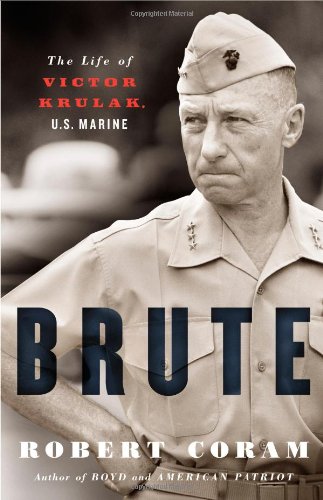
Brute: The Life of Victor Krulak, U.S. Marine by Robert Coram

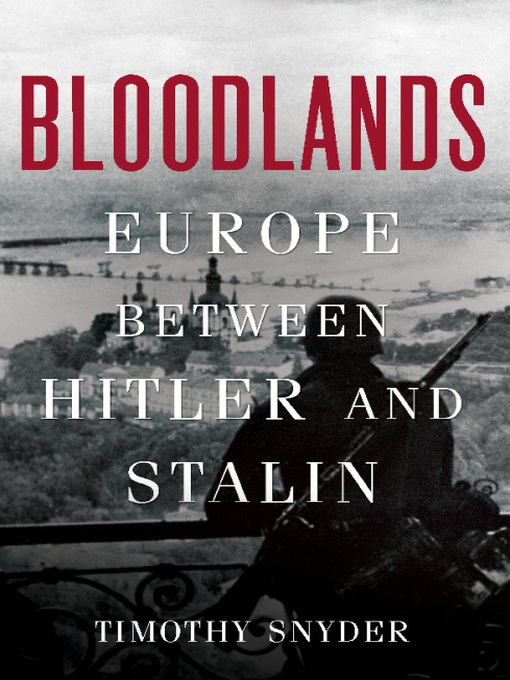
Bloodlands: Europe Between Hitler and Stalin by Timothy Snyder

Robert Coram, whom I had the pleasure of meeting at Boyd ’07, has a new biography of the legendary military visionary and Marine Lt. General Victor “Brute” Krulak, reviewed here by Max Boot and here by Tony Perry (Hat tip to Dr. Chet Richards). Having thumbed a few pages, Krulak appears a complicated man – gifted, dauntless and extremely driven but also possessed of a mean streak, edging at times toward petty cruelty.

Bloodlands I intend to read in a “Hitler-Stalin/Nazi-Soviet Comparison” series along with Richard Overy’s The Dictators: Hitler’s Germany, Stalin’s Russia, Robert Gellately’s Lenin, Stalin, and Hitler: The Age of Social Catastrophe , Richard J. Evans’ The Third Reich at War and Alan Bullock’s classic dual biography Hitler and Stalin: Parallel Lives.  I’d also recommend, for those with the stomach for historiographic commentary, Robert Conquest’s Reflections on a Ravaged Century and John Lukac’s The Hitler of History

CURRENTLY READING:

Human Face of War by Jim Storr

After reading approxmately a third of The Human Face of War by  Dr. Jim Storr, a retired Lt. Colonel, King’s Regiment and an instructor at the UK Defence Academy, I will say that if you are going to read only one book on modern military thought this year, it should be The Human Face of War. It’s that good.

Aside from a reflexive hostility toward John Boyd’s OODA Loop ( though not, strangely enough, toward the substantive epistemology advocated by Boyd that the diagram represented), Storr’s tome is an epistle of intellectual clarity on military theory that deserves to be widely read.

ADDENDUM:

NDU Press recommends, and I concur, this review of The Human Face of War by Col. Colonel Clinton J. Ancker III. Ancker, like Storr, is an expert on military doctrine, so it is a well-informed review by a professional peer.

More on Galula

Wednesday, November 24th, 2010

At SWJ Blog:

Octavian ManeaPros and cons on Galula model

In response to the interest raised on the relevance of the Galula model for understanding and dealing with today’s insurgencies, I conducted a brief inquiry with key experts on the topic – Peter Mansoor, Steven Metz, David Betz, and Alex Marshall.

Dr. Peter Mansoor

The Galula model applies in those cases where the population of a country is more concerned about the effectiveness and legitimacy of its government than in its sectarian or ethnic make-up. “Classic” counterinsurgency efforts to improve the legitimacy of a government are then operative. In those cases where sectarian or ethnic identity trumps other factors (e.g., Sri Lanka or Chechnya), then protecting the people will avail the counterinsurgent little in the way of gaining their trust and confidence. In these cases, other strategic or operational approaches need to be considered….

Dr. Steven Metz

To me, the Cold War/Maoist model of insurgency applied in situations where new segments of a society were becoming politically aware or mobilized and thus made demands on the state which it could not fulfill. These demands were both tangible–infrastructure, security, education–and intangible (a sense of identity). That’s why I think it has very little applicability to current insurgencies. Granted current insurgencies attempt to emulate the Maoist strategy because it worked in the past, but I think this will lead to failure.

Dr. David Betz

The work of the French officer David Galula was clearly very influential on the thinking of the authors of FM 3-24 Counterinsurgency. There is certainly a lot to like. For one thing, his book Counterinsurgency Warfare is less than 150 pages long which makes it an easy read-four cups of tea and a Sunday afternoon will get you through it. For another, it’s written in a very aphoristic style which is highly memorable. So if you’re trying to get across to a large number of people a number of ‘best practices’ or paradoxes of COIN then Galula is a very good assigned reading. The truth is though that most COIN best practice would fit on a bumper sticker. In fact the new UK Field Manual on COIN comes with a laminated credit card sized aide memoire on one side of which are printed the principles of COIN and on the other ISAF’s game plan for stabilizing Afghanistan. I’m not criticizing-I think it’s a handy thing; my point is rather that Galula and his interpreters sometimes sound a bit like Kipling’s ‘Just So’ stories. In practice, it’s complicated, as one sees in Galula too if you read his longer, messier, more ambiguous and more rewarding book Pacification in Algeria. Anyway, to get to the point I have three main reservations about Galula…..

Dr. Alex Marshall

My issue with the Maoist Paradigm is really two-fold.

My first reservation, as a historian, is that we lack a definitive English-language study of Maoist insurgency itself beyond some fairly stereotyped notions of a three-stage or five-stage revolutionary process (from political agitation to guerrilla conflict to regular warfare). Galula and Thompson were great generalizers, but one can scarcely call their work proper historical studies-their general view was that Maoist-style insurgencies involved a degree of mass brainwashing for example. We possess some interesting case studies of how Maoist mobilization worked in practice on the ground, in individual villages or Shanghai for example, but there is so much more that could be done. Thus Western writing during the Cold War in general generated a shorthand stereotype, when in reality insurgency practice was often more diverse. The reason was simple I suggest-most successful insurgents aren’t particularly pithy writers (Guevara and Mao were exceptions), most unsuccessful ones are very quickly dead.

My second concern is more overarching however. The majority of discourse on COIN doesn’t take into account the strategic context, remaining locked into the operational level instead…..

Read the whole thing here.

A very productive piece by Manea and the gents above. Galula’s historiographic importance in COIN should be undisputed and his contribution to theory acknowledged and respected. Application of Galula’s framework (or, really, anybody’s) for understanding COIN, in analyzing insurgencies should be used cautiously or lightly until there is enough of an emprical understanding of the structure and motivations of the insurgents and the political deficiencies of the state, to see to what extent the model fits, before the operational assumptions of a military bureaucracy and theater command harden into place.

Lacking the reliable contingency of a superpower patron on an ideological crusade in the 21st century to impose a stamp of identity and tactics on it’s proxies, insurgencies are likely to be as diverse as La Familia is from FARC, the Taliban or the Real IRA.

Book Review: Magic and Mayhem by Derek Leebaert

Monday, November 22nd, 2010

Magic and Mayhem: The Delusions of American Foreign Policy From Korea to Afghanistan by Derek Leebaert

As I mentioned previously, I enjoyed Derek Leebaert’s earlier Cold War history, The Fifty Year Wound, so I was pleased to be sent a courtesy review copy of his latest work, Magic and Mayhem:The Delusions of American Foreign Policy from Korea to Afghanistan. Leebaert, a professor of government who teaches foreign policy at Georgetown university, does not disapoint; Magic and Mayhem is a lively and highly provocative excoriation of of the dysfunctional political culture of making foreign and national security policy in America.  While I found many fine points of disagreement with Leebaert in Magic and Mayhem, his broad themes constitute a healthy challenge to a dolorous status quo in Washington.

In Leebaert’s view, American foreign policy suffers from being crafted under two related evils: a culture of “magical thinking” and a cadre of professional alarmists, the “Emergency Men” who constitute a kind of self-appointed, adrenalin-addicted, national security ecclesia who exploit the magical thinking of the public and labor under its delusions themselves. It is this dual embrace of ends without a priori examination of means or ways and a lust for action that leads our foreign policy elite to embrace all manner of costumed charlatans with polished English language skills who are allegedly willing and able to be America’s “partner” in dangerous neignorhoods. From South Korean autocrats to African kleptocrats to figures of a more recent vintage. Leebaert writes:

Afghan president Hamid Karzai, with his Western-style technocrats and talk of democracy, was immensely appealing to Washington after the Taliban was ousted.  For more than seven years, reports the Times Dexter Filkins, Karzai was a “White House favorite – a celebrity in a flowing cape and dark grey fez” a dramatic outfit that he had designed himself but that had no origin in Afghani dress…..

….”We thought we had found a miracle man” moaned one diplomat. On closer inspection, the sorcerer proved unconvincing as the opium trade and corruption flourished.

I have always wondered where the hell that cape came from.

Leebaert takes aim at a wide variety of targets. I definitely do not agree with his assessments of everything and everyone who has caught his ire, but it is a list that is breathtaking in expanse; a parade of names and terms that includes, but is not limited to:

George Kennan
Douglas MacArthur
Paul Nitze
Detente
Robert McNamara
McGeorge Bundy
Peter Rodman
Brinkmanship
Donald Rumsfeld
COIN
Richard Holbrooke
Henry Kissinger
The CIA
NSC-68
John McCain
Arms Control
John F. Kennedy

Richard Nixon
Curtis LeMay
Defense intellectuals
Lyndon Johnson
Maxwell Taylor
Dick Cheney
Cyrus Vance
George W. Bush
Neocons
Oliver North
Revolution in military affairs
Richard Perle
Crisis management
MAD theory
Strategic/Security Studies
Walt Rostow
Wiliam Westmoreland
Robert Kennedy
Bernard Lewis
Thomas P.M. Barnett
Lawrence Summers
George Tenet
Robert Kaplan
Samuel Huntington
John Abizaid
Stan McChrystal
Barack Obama
David Ignatius
Thomas Friedman
David Brooks
US Public Diplomacy
Jimmy Carter
Michael O’Hanlon

That, by the way, was not comprehensive.

It would be a much shorter list to cite those statesmen of whom Leebaert approved – men like Henry Stimson, Dean Acheson, Matthew Ridgway, Omar Bradley, George Marshall, Dwight Eisenhower, George Schultz and Ronald Reagan. The book is not flawless. There are minor factual errors. Not every person or doctrine in Magic and Mayhem is considered in depth.  At times, Leebaert comes across as glib or superficial in his criticism, but predominantly, as with the cases of Kissinger or Rumsfeld, his bitter jeremiads are skewering their targets.

Leebaert argues for a considered retreat from policy alarmism and the cult of emergency, and for a reduction of ambitious American policy grandiosity that would flow from recognizing and respecting the agency of other nation’s leaders and peoples. Implicitly, a call not so much for isolationism, as for restraint and a sense of proportion, coupled with a dimunition of status and power for national security “celebrities” and the cottage industry of think tank consultancy for which they stand.

Magic and Mayhem is a book that was written to demystify shibboleths and smash idols.

Infinity Journal

Monday, November 15th, 2010

Military consultant and ardent Clausewitzian, Wilf Owen contacted me today to alert me to the launch of Infinity Journal, “a peer-review electronic journalzine dedicated to the study and discussion of strategy “:

Infinity Journal views strategy as the use of any or all instruments of power to secure political objectives. IJ is concerned mainly – though not exclusively – with the use of force. Strategy must both pursue policy objectives and be viable via tactics. Beyond that there are no sacred cows within the pages of the Infinity Journal.

Critically, and beyond doubt, is the fact that the practice and application of strategy has life and death outcomes for people living in the world today. The fate of nations and peoples still rests in the realm of strategy and as such, it is a vitally important area of study.

Infinity Journal aims to make the discussion of strategy accessible to the widest possible audience, because today strategy is widely misunderstood not only by the layman but also by students, senior soldiers and politicians. Therefore, we aim to keep rigid language and complexity to minimum and comprehensible language and simplicity to a maximum. 

Wilf has an impressive line-up of current and future issue contributors including TX Hammes, Martin van Creveld, John Mackinlay, Colin Gray and many other strategists, soldiers, academics and “students of war” who share a deep interest in strategy. 

An excerpt, from Col. TX Hammes in the current issue of Infinity Journal, available online (registration is free!):

Assumptions – A Fatal Oversight

….In short, in every plan there will be key factors that are unknown to the planners. For instance, we can’t know for certain how a population will react to a U.S. invasion or how much of the international development assistance promised at a conference will actually be delivered. However, to continue planning, the planners must make an educated guess – an assumption – about such key unknowns. While some may see this as a bureaucratic process of little value, recent events show assumptions are central to all planning. For instance, General Tommy Franks assumed the Iraqi government would remain in place after we removed Saddam. Thus Iraqis would deal with the problems of getting their nation back on its feet after the war. And because they would, the United States could invade with a much smaller force than that recommended by the previous CentCom Commander, General Anthony Zinni. In contrast, Zinni assumed the government would collapse and he would need large number of U.S. forces (380,000) to provide security and services.[v] This single, unexamined assumption dramatically altered the war plan.

Check it out.


Switch to our mobile site

