zenpundit.com » cognition

Archive for the ‘cognition’ Category

On form and beauty

Saturday, November 28th, 2015

[ by Charles Cameron — capable photographers capture “form” in their viewfinders, not just “content” ]
.

A toothy sea
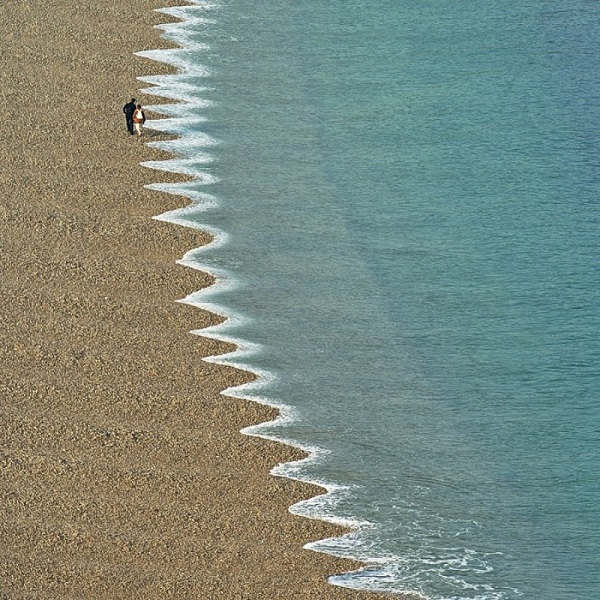
A toothy sea

**

I have just been browsing someone’s choice of the “100 best photographs ever taken without photoshop”, and was struck by the ways in which form in general, and contrasts in juxtaposition more specifically — two of my recurring interests, form and the DoubleQuotes respectively — kept cropping up. I’ll get to them, and offer some stepped-down images from the series —

but first, take a look at the whole series as posted at The 100 best photographs ever taken without photoshop. Even the reduction to 60% of published size necessitated by the ZP column width loses much of the beauty — and imagine how they’d be as actual framed prints, in their original full sizes!

Someone’s choices? Yes, and by no means necessarily the best choices — this selection no doubt answers to a selection bias in the individual who put the series together — so the patterns I’m seeing here may belong either to that individual, or to the general human delight in contrasts, parallelisms and oppositions.

**

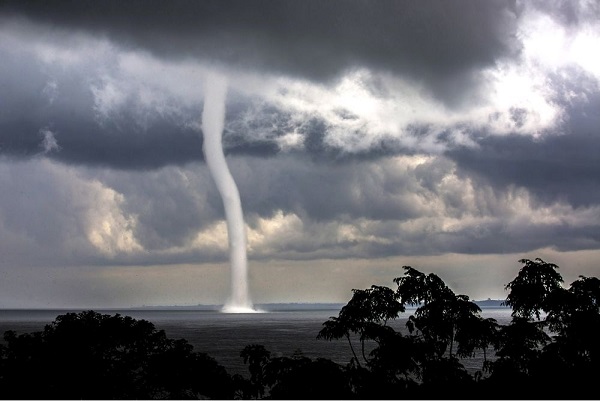
Earth and Sky, Heaven and Earth:

Waterspout on Lake Victoria, Uganda

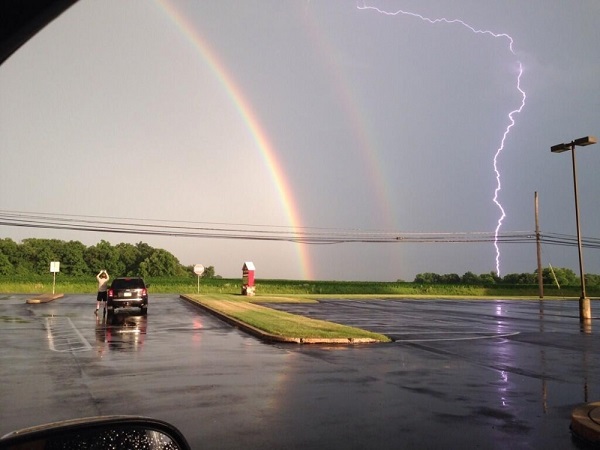
Fickle moods
Fickle moods

Volcanic eruption in IcelandVolcanic eruption in Iceland

**

The seasons: time as change

An autumn forest. 50 percent Downloaded

Autumn and winter meet in Colorado, USA

Autumn and winter meet in Miklukhin, Rostov region, Russia


**

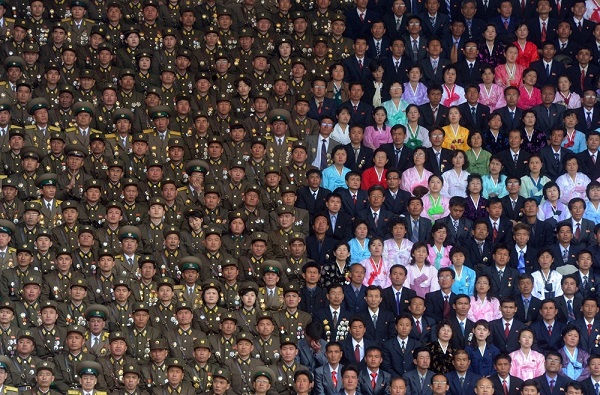
Human impact observed:

Two worlds divided, New York, USA

Celebrating the 100th anniversary of the birth of Kim Il-sung, North Korea’s founder

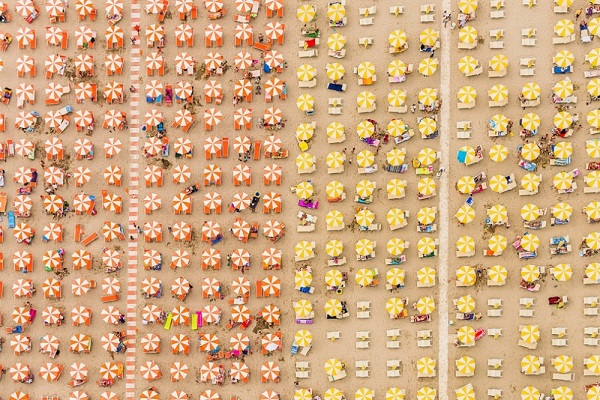
An Italian beach

An Italian beach

**

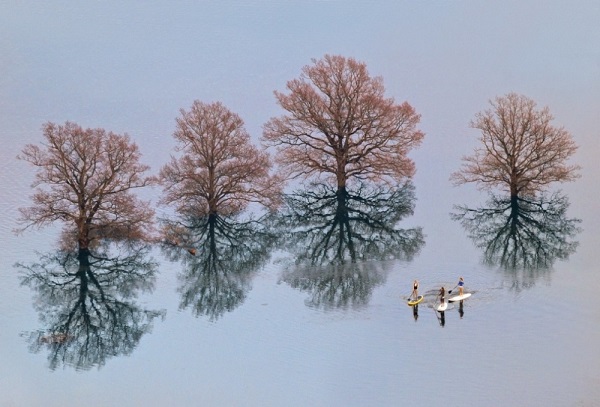
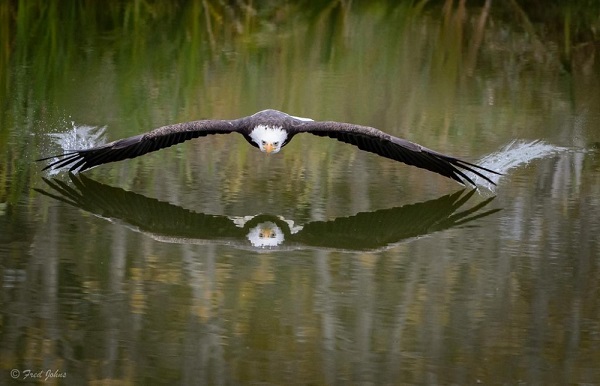
On reflection, sheer, simple symmetries:

The aftermath of a flood in Ljubljana, Slovenia

An eagle soaring over a lake in Canada
**

And that’s only a fraction of what the whole series of a hundred photos offers us. Each of these, I’d submit, is what I’d term a DoubleQuote in the Wild.

One final shot, color against grey — perhaps the loveliest of all:

A temple covered in ash from the Ontake volcanic eruption, Japan
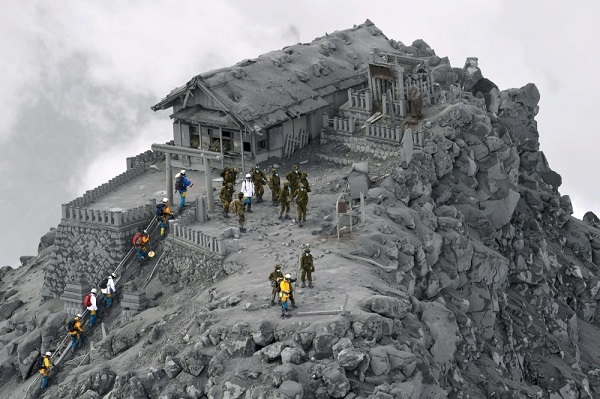

So much humanity, so much pathos there.

**

Brilliant minds in both the arts and sciences focus as much on form as on content — on patterns, repetitions, symmetries for their own sakes, as much as on the particulars of the fields they study and in which they find them. At heart, this is a matter of aesthetic cognition.

We would do well to cultivate this kind of double vision — the awareness of form as well as content — across the board, from education and the arts to the sciences and strategy.

The moment we become polarized, however, in terms of a political or other form of partisanship, content becomes all we see (and agree or disagree with), and form effectively evaporates. In terms of the images above, we see earth or sky, summer or autumn, town or country — left or right — but not — but no longer — the whole.
Ideal as cause, real as effect

Saturday, November 28th, 2015

[ by Charles Cameron — a pretty intense little cognitive romp, b’day surprise #2 ]
.

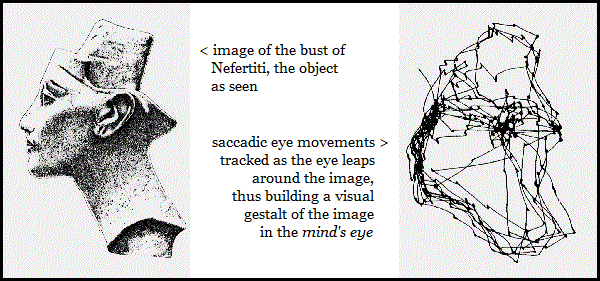
nefertiti saccade cc version
mapping object seen to eye movement, Yarbus via MIT

**

Today I was reading James Harkin, How the Islamic State Was Won, in Harper’s from November last year, and this sentence struck me:

The aim was to wipe out the regime’s armed opponents, but the result was to destroy the country’s social fabric and displace whole communities — leaving millions of Syrians with little to lose. Groups like the Nusra Front took control of towns across the north, and foreign jihadis flooded into Syria to join the fight.

Here’s the thought it prompted:

The aim, purpose, or target of an action will often represent some sort of ideal, and that ideal becomes the cause of the action in question. Like all ideals, it represents a trajectory in a model space, that of the imagination, which like all models, lacks some of the details of the reality it purports to represent. Not only is the map not the territory, it will in all cases not envisioned by Jorge Luis Borges be smaller and less informed than the reality.

The result of that action, its effect, takes place in reality, even thought we then cognize it in a mental comparison with its aim or cause.

Unintended consequences, then, are quasi-mappable as arising in precisely those areas of the real which the ideal fails to map.

Mapping the distinctions between reality and unconscious perception, conscious perception, neural activity, and verbal, visual and matghematical models in mind, brain, and on a napkin or computer is, accordingly, one of the great tasks of the age.

**

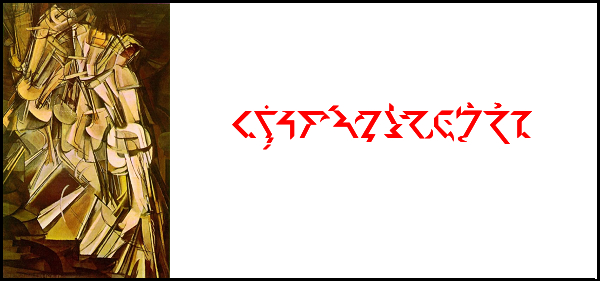
duchamp cc versionDuchamp (image) and Ithkuil (verbal description) via John Quijada, see Birthday surprise

Two ways a resemblance can be unwelcome

Monday, November 23rd, 2015

[ by Charles Cameron — NSFW, I repeat, NSFW , maybe ]
.

You can be photoshopped from Canada to France, Sikh to Muslim, &c —

The fake (on the left), photoshopped from the authentic selfie (on the right), was apparently created and posted because of the guy’s support of women in the games industry, cf Gamergate.

**

Alternatively, your name might sound suspiciously NSFW to non-Vietnamese=speaking ears:

Details at the link Cath at Sembl provides.

The process of associative memory

Wednesday, November 18th, 2015

[ by Charles Cameron — it seems — to me at least — that associative memory is at the root of creativity, and that the process, preconscious pattern-recognition, is basically aesthetic in nature ]
.

**

There’s the present moment — in this case, today’s tweet from the RNLI above.

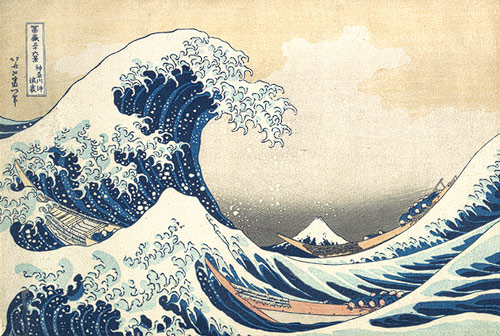
And there’s the memory it elicits — in this case, Hokusai‘s Great Wave at Kanagawa, with its three little boats, tiny Mt Fuji, and towering, breaking wave, from A Series of Thirty-Six Views of Mount Fuji:

**

That’s the same process, from perception to memory, that I was thinking of when I wrote DoubleQuoting the French Revolution, and quoted Robert Frost:

The artist must value himself as he snatches a thing from some previous order in time and space into a new order with not so much as a ligature clinging to it of the old place where it was organic.

**

Come to which, and moving by the same process from what’s in front of me to what I remember, here’s a DQ of Hokusai (~1760-1849) — before me now as I write this — and an image deriving from the work of Benoit Mandelbrot (1924-2010) on fractals” — which looking at the Hokusai quickly reminds me of:

SPEC DQ Hokusai fractal

**

And as I look at that DoubleQuote, here at the time of writing this post, it reminds me strongly of my earlier DoubleQuote of Van Gogh and Von Kármán:

In each of these two cases, art precedes science.

**

In each case, too, the associative process is the same, with some item perceived in the present calling up a past memory that is related to it — in a manner that can generally be articulated and annotated.

Such is the mechanism of a typical “move” in a DoubleQuote or HipBone game.

DoubleQuoting the French Revolution

Saturday, November 14th, 2015

[ by Charles Cameron — I was thinking of France yesterday, writing this in a happier mood before the evening’s news broke — up next, and tricky to write, a first response to the Paris outrage ]
.

frenchrevolutionarchive15

**

One of the great pleasures of my work on DoubleQuotes and the HipBone and Sembl Games is the discovery of earlier analogues to what I’m doing. My purpose, after all, is to take a common human cognitive practice and formalize it, thus sharpening it from a somewhat haphazard activity into a tool, a practice.

We have all had the thought, “and that reminds me” — it crops up without any special prompting whenever something happening in current time calls up the memory of something similar experienced in the past, and our store of memories is pretty significant. On that last point, the great American poet Robert Frost once said:

Scholars and artists thrown together are often annoyed at the puzzle of where they differ. Both work from knowledge? but I suspect they differ most importantly in the way their knowledge is come by. Scholars get theirs with conscientious thoroughness along projected lines of logic? poets theirs cavalierly and as it happens in and out of books. They stick to nothing deliberately, but let what will stick to them like burrs where they walk in the fields.

Thyat’s from Frost’s essay, The Figure A Poem Makes, and it’s fascinating to me how much of that essay seems to apply not just to poems but equally to DoubleQuotes, HipBone and Sembl. Frost continues:

Knowledge of the second kind is much more available in the wild free ways of wit and art. A schoolboy may be defined as one who can tell you what he knows in the order in which he learned it. The artist must value himself as he snatches a thing from some previous order in time and space into a new order with not so much as a ligature clinging to it of the old place where it was organic.

I’d remembered Frost’s remark about knowledge sticking to people “like burrs where they walk in the fields” because it’s the most concise statement I know that explains the extraordinary amount of knowledge, in the sense of available-if-required-memory, that each and every human, not just the university-credentialed kind, acquires across a lifetime — some people know gang colors, tats, and graffiti, or sexual hanky code as others know Herodotus and Ibn Khaldun, or the different colored scarves of the Oxford colleges.

I don’t believe that I’d read Frost’s whole essay before today, although I may have — but you can see how closely his artist who “snatches a thing from some previous order in time and space into a new order” corresponds with my basic cognitive motion of DoubleQuotes as described it above, when “something happening in current time calls up the memory of something similar experienced in the past” and its qualifying remark, “without any special prompting”!

GMTA, or just GTA — thought, or theft? Who knows.

**

One other quote from Frost’s essay amplifies the unexpected nature of a single HipBone or DoubleQuotes play:
move

For me the initial delight is in the surprise of remembering something I didn’t know I knew.

The passage continues, extending Frost’s description of the poem from a single initial linkage to the sort of web of linkages that characterize HipBone and Sembl games:

There is a glad recognition of the long lost and the rest follows. Step by step the wonder of unexpected supply keeps growing. The impressions most useful to my purpose seem always those I was unaware of and so made no note of at the time when taken, and the conclusion is come to that like giants we are always hurling experience ahead of us to pave the future with against the day when we may Want to strike a line of purpose across it for somewhere.

**

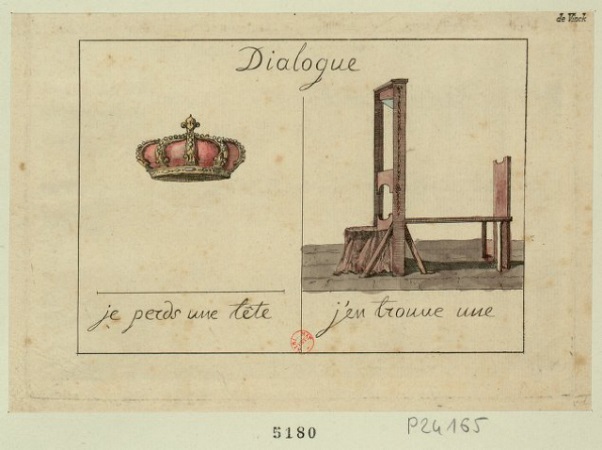
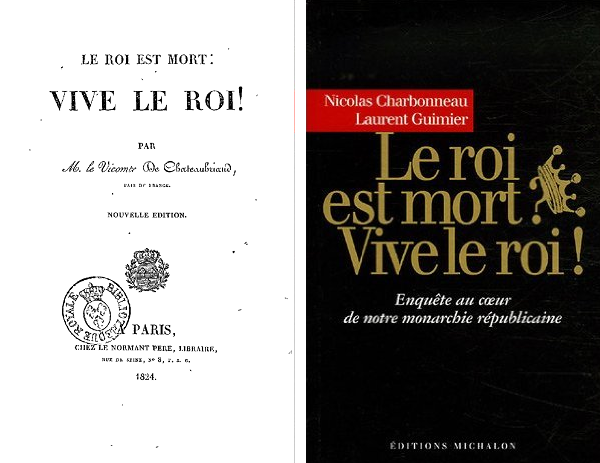
The natural response to the sequence from crown to guillotine at the head of this post is found in the motto “the king is dead; long live the king”. The sentiment is best known in French, as these two books attest:

chateaubriand monardhie republicaine

The Vicomte Chateaubriand was a monarchist. Charbonneau and Guimier speak of a “republican monarchy” — “plus ça change, plus c’est la même chose”, perhaps?


Switch to our mobile site