zenpundit.com » gangs

Archive for the ‘gangs’ Category

Descent into Barbarism

Wednesday, August 10th, 2011
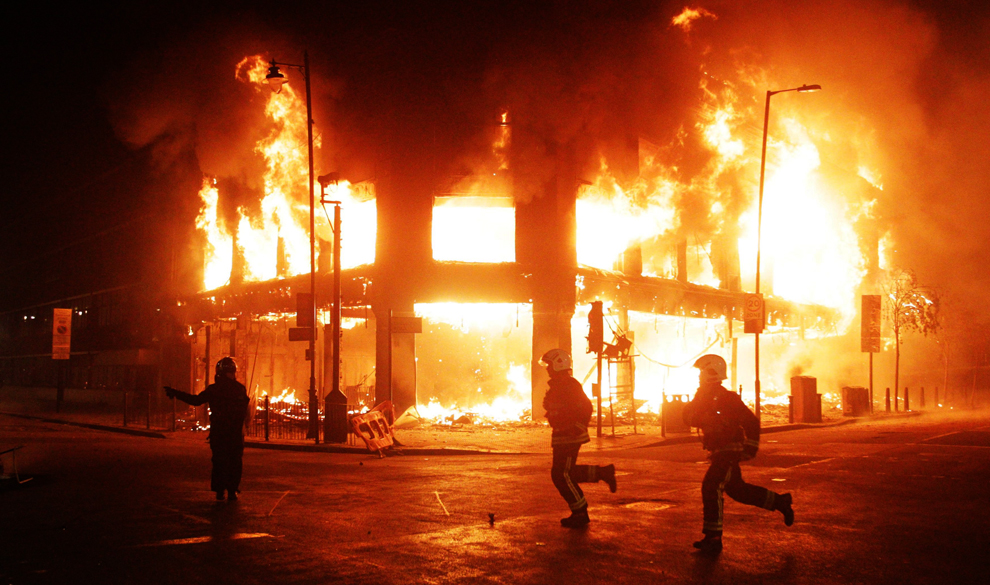
London burns for four days as UK authorities dealt timidly and uncertainly with semi-organized swarms of brazen thugs, causing rioting to spread to other cities. What have we seen so far?

* The British government and police acted with moral uncertainty in the face of violent challenge from swarming tactics by “underclass youth” rioters.  The BBC was filled with interviews of victimized citizens complaining about how police were unwilling to intervene to stop acts of looting, assault and arson. Police behavior fed the cycle of rioting and encouraged fence-sitters to join in and swell the ranks of the mob, as did early talking head comments in the British media that argued that the rioters were “justified”

* The British government was politically paralyzed by the crisis and needed three days and a Cabinet meeting to begin to organize an effective anti-riot strategy, distribute proper equipment, summon additional manpower, change police ROE and marshal a rhetorical narrative against the rioters.  All the halmarks of excessive top-down control by out of touch technocrats and politicians.

 John Robb summed up this kind of anti-leadership beautifully in his review of Rebecca Solnit’s A Paradise Built in Hell  :

…In contrast to the people on the ground, she shows that the only people that actually do panic during disasters are the elites — from those with wealth to those running the government’s response (I’m not talking about the first responders actually on the ground doing good work).  They panic over the loss of control a disaster brings.  This often results in extreme actions that only serve to make things worse: from martial law authorized to use deadly force against looters (often just people trying to survive the situation) to arbitrarily hearding people into locations that aren’t able to support large groups of people.  

What This Means

The lesson here is that during an extreme disaster, the people you may most need to fear are those in charge, particularly if their motives are focused on protecting elite interests put at risk by the disaster

* The Cameron government’s legitimacy is at risk, being currently blamed for everything connected to the riot from the underlying “root causes”, to their initial total lack of interest in defending ordinary Britons to the bad impression made of having senior ministers being on vacation while the capitol of the UK was ablaze. Earnest and repeated assertions by government officials that no political or racial motives were behind the rioting conflicted with the reality being broadcast live by the government’s own news service in the first hours and days of the riot.

Handling a riot properly is state power 101. The Prime Minister has about two days to turn this situation and the political perceptions created around or he will begin an irreversible downward spiral to an early retirement.

Why [still] bother with Breivik?

Friday, August 5th, 2011

[ by Charles Cameron — popular opinion, informed decision-making, journalism and analysis in reference to Oslo / Utoya ]

.

At least two regulars here on ZP, Cheryl Rofer and Joey, have wondered whether it’s even worth bothering to track Anders Breivik’s thought — fifteen hundred pages of cut and paste from all across the web, interspersed with page after page of his own musings.

Joey wrote, “I’m not sure this guy deserves the kind of close analysis he is getting” — and Cheryl:

I’m not at all sure that examining his “writings” tells us much beyond that these themes have been pulled into a particular orbit of hating. What might be interesting is why those themes have been found so suitable for that purpose.

I believe that tracking Breivik’s thought processes are important for two main reasons, and for two main audiences: the general public (and by extension the journalists who inform them), and policy makers, military and civilian (and thus also the intel analysts who brief them).

1: media and public

It’s important for the general public not to be left with the wrong impression, specifically as regards who or what is to blame — so that the events in Oslo do not contribute to a further deterioration in public debate.

There are a number of ongoing public conversations around Islam, Islamophobia, Christianity, the clash of cultures, the “socialist” left or “fascist” right, the media, the internet, the pernicious effect of gaming, etc., where it’s not just useful but necessary to establish some clarity on what can and cannot fairly be said about Brevik — who he was, who influenced him, who ignored him, who publicized him, who he really hated, whether he was simply mad, and above all, whose fault “it” was.

And as always the truth is more nuanced than black and white – so that in all this morass of claims and counterclaims, there are slippery slopes to be avoided, and significant distinctions to be drawn..

2: analysts and policy makers

There are also a number of areas of intel analysis where his writings may provide significant leads, and where intelligent intelligence (forgive the play on worlds) is at a premium.

As an example, I have suggested that just as it’s important to know the history of the far enemy and global jihad concepts in studying contemporary jihadism, it would be helpful to know if Breivik’s manifesto is the first place where Hindutva and Odinist and militant Christian and Masonic strands have been brought together in what I can only call an “ecumenical” manner.

I’ve no doubt some of this is of importance to those whose job it is to prosecute or defend Breivik himself: but it’s the significance Breivik has as a marker of otherwise barely detected currents of thought — “undertows” in my personal shorthand — and of the fact that such currents can now easily connect across the net to create an increased complexity of the unexpected, that most concerns me.

*

By now, most of the specific groups and individuals mentioned by Breivik have been identified, and those with specific interest in them have taken note: thus the Indian press has reported on his interest in Hindutva and quotations from Sita Ram Goel, both the UN-recognized “International Templar Order” and his own Masonic order have disowned him, and so on – so there’s no point in my posting separate comments on the role of the Hindutva movement in his thinking, nor of his fascination with the Templars and their symbolic presence in other places of interest such as Joseph Di Mambro and Luc Jouret‘s Order of the Solar Temple (locus of mass suicides/murders in France, Switzlerland and Quebec, 1994), or more recently the Michoacan La Familia cartel offshoot Los Templarios – a link which John Robb was one of the first to make…

ap-templar-09-small.jpg

Mexico, not Norway…

I will, however, post two more roundups of articles: one of pieces that strike me as outliers from the usual media coverage, touching on some of these specifics, the other noting the most thoughtful and informed coverage I have seen from scholars of religion.

I offer these as resources for those who have good reason for continuing interest in Breivik, in the hope that they may turn up some data points that are illuminating when connected — but also to help correct some of the erroneous linkages that have already been made.

*

I am also hoping to make a post here shortly on Romanticism and the significance of myths, rituals and dreams — focusing mainly on the recent Requiem and obsequies for Otto von Habsburg, but with, I suspect, relevance to a strong romantic streak in Breivik, too…

Now Reading….

Friday, July 15th, 2011

booksx.jpg

The Profession by Steven Pressfield 

Tequila Junction: 4th Generation Counterinsurgency by H. John Poole

Steve’s novel The Profession I have mentioned previously, but I confess that I am puzzled by the choice of book jacket on Tequila Junction, which looks somewhat like a children’s illustrated guide to COIN in 1980’s El Salvador. H. John Poole is a respected veteran and tactical expert and Tequila Junction carries the warm endorsements of General Anthony Zinni and William Lind. Maybe his grandson drew it? Odd.

In any event, small unit tactics are not a subject I pretend to know much about, so it will remedy a gap in my knowledge base.

Google Ideas SAVE conference

Friday, July 8th, 2011

[ by Charles Cameron — cross-posted with brief intro from Alix Levine‘s blog — topic: Google’s Summit Against Violent Extremism ]

.

Google Ideas — the Google “think/do tank” — recently co-hosted (with the CFR and Tribeca Film festival) a conference on countering radical extremism in Dublin, with a mix of “former extremists, activists, academics, survivors, executives and public sector officials” in attendance.  Blog-friend Matt Armstrong was there, live-tweeting with enthusiasm. Dr William McCants of Jihadica and CNA wasn’t terribly impressed with the outcome, and posted at Foreign Policy:

I am not ready to give up on the enterprise of countering violent extremism just yet, but I am less sanguine about its chances of success than I was before I started working on the problem. Google Ideas’ summit has not increased my optimism, but its resources and potential do.

Alix Levine of Cronus Global attended the event, and reported back on her blog. I’ve commented briefly on McCants’ piece on FP, but wrote a longer piece as a comment on Alix’ blog, and am cross-posting it here in the hope that it will stir further discussion…

*
I’m comparing Will McCants‘ response to the Google Ideas conference on FP with yours, and I’m glad you wrote as you did.

McCants – whose work I generally admire — opens his comments by quoting Jared Cohen to the effect that the purpose of the conference was to “initiate a global conversation”. McCants then more or less dismisses the conference itself a couple paragraphs later with the words “If these are indeed the conclusions of the conference, Google Ideas needs more thinking and less doing in its approach”.

Conclusions? How does he get so quickly from “initiate” to “conclusions”?

Okay, we all know that a conference can lead to a volume of proceedings read mostly by the authors themselves and a few aspiring students eager to follow-my-leader and dead end there – but this conference was very clearly intended to be the start of something, not the wrap-up.

So your comment, Alix, “Instead of critiquing Google’s effort, it will be more productive and valuable to work in unison with Google on their mission to ‘initiate a global conversation'” seemed to me to bring us back to the actual intent Google had announced for the conference, and you reinforce that when you write, “I hope that more people will join in on the conversation in a meaningful and (gasp) positive way.”

My questions are: how and where do we do this?

There will have been contacts made at the conference that will lead to an exchange of emails, no doubt – but that’s not a global conversation.

Here are some of the problems I foresee:

(a) siloing: the conversation limiting itself to a few constituencies, each of which talks mainly among its own members, leading to

(b) group think: in which the widely assumed gets even more firmly entrenched as “wisdom”, with

(c) secrecy: meaning that potentially relevant information is unavailable to some or all participants, all of which add up to

(d) blind spots: topics and approaches that still don’t get the attention and exploration they deserve.

The solutions would need to include:

(a) networked diversity: by which I mean a structured means of getting the unpopular or minority opinion front and center (compare business brainstorming in which a facilitator ensures even the “quiet ones” get heard, and that even poor ideas are expressed without critique until a later, evaluative stage),

(b) contrariety: meaning that whatever ideas are “easily dismissed” get special attention, with

(c) transparency: meaning that whatever could be redacted and made partially available is made available, not (as in US Govt “open source” material, closely held), so that

(d) oddballs and outriders get to participate…

Jami Miscik who was Deputy Director for Intelligence at the time, caught my attention when she said in 2004, “Embrace the maverick”. Oddballs aka mavericks make the best contrarians, because they start from different premises / different assumption bases. Miscik accordingly invited science fiction and film writers to interact with her analysts at CIA, and found that when they did, they produced 80% already known ideas, 10% chaff, and 10% new and “valid” scenarios. But even then, “science fiction and screen writers” is a box…

Cross-fertilization, questioning of assumptions, passion, reverie, visualization, scenario planning, play – the number of strategies that could be employed to improve the chances of a successful new insight emerging are many and various – unkempt artists probably know some of them better than suits with high IQs and clearances, and Google clearly knows this, too…

But where?

I mean, what Google+ circles do any of us join, to join this global conversation? What twitter hashtag brings us together under one roof? When’s the follow up in my neck of the woods, or yours?

What’s the method for getting the conversation widespread, well-informed – and scaleable, so the best of the grass roots and local ideas can find their way to the influential and informed, and the best insights of the influential and informed can percolate through to the grass roots and local?

Lastly, I’d like to thank Google for getting a dialog going between those with a range of subjective experiences of radicalization, and those whose job it is to understand and thus be able to interdict it. Demonization never got the situation in Northern Ireland anywhere near peace – listening did.

And thank you too, Alix, for your own contribution. Let’s move the conversation onwards.

Pundita on Mexican Insurgency and Hollowing Out America

Wednesday, June 15th, 2011

Blogfriend Pundita turns an eye to Mexico, which is currently entering free fall despite official US policy that the cartels are not an insurgency, and has extensive comments on how the transnationally oriented, strategically inept, elite mismanaging US foreign policy no longer think in terms of a “US foreign policy”. Or perhaps, a “US”:

“Hollowed out” Mexico and hollowed-out USA

….I hate to be the one to break this news to Mark but there can no longer be an American policy on Mexico because there is no longer a United States of America. He doesn’t know this because he doesn’t watch much television news, but a few weeks of watching CNN will clue him that the USA is no more. In its place is a country called The Whole World (aka RIC – Republic of International Community), which for reasons known only to the rascals who run CNN excludes every world region where CNN is not in hot competition with al Jazeera.I myself speak of the “country” of the USA, which I think is what seems to be a box of cookies or a milk carton in the foreground of the above satellite photo of the RIC, only as a matter of convention.

As for FNC (Fox News Channel): currently too busy taking pot-shots at other TV news outlets for initially covering up the Weiner story and otherwise too busy trying to find a Republican who can win the White House to notice that a U.S. government is a memory.

(Memo to FNC: The other TV media were initially quiet about Weiner’s texting problem not because he’s a Leftist but because his wife is Hillary Clinton’s closest aide and they didn’t want to have to tell the American public that the person closest to the U.S. Secretary of State is an American Muslim of Indian-Pakistani heritage who was raised in Saudi Arabia, you nitwits.)So before we try to upgrade U.S. policy on the hollowed-out state of Mexico, as the Narcos book terms it, I say let’s examine how the U.S. got hollowed out.

One more point before I cede the floor to Mark: His summary doesn’t indicate whether the book addresses racism and apartheid in Mexico. I know that Mark is aware of the subject so I think he would have mentioned it, if any of the monographs dealt specifically with racism; frankly I’d be surprised if any did because the topics of Mexican racism and apartheid are taboo in both the USA and Mexico.

Later this week or the next I’ll try to rip myself away from the Afghan War long enough to return to those issues, which I touched on in an earlier post. For now, I’ll just say that I think Mexico’s type of racism is the true “virus” that Dr Bunker talks about….

Good question regarding the effects of racism in Mexico on the evolution of the cartel wars. An important point. I know why employees of USG entities do not raise it; for the same reason they will not use the “i” word – Mexican officials would go ape.

Dr. Bunker reads ZP from time to time and he’s best placed to explain why none of the authors delved into that aspect of narcocultas folk religion or Mexican elite behavior. My recollection is that most of the contributors to Narcos Over the Border were security specialists rather than social historians or sociologists.  Maybe David Ronfeldt, who also has a specialty in Mexican affairs, can also weigh in on this important point.

Hollowing out of the US requires a post of it’s own to consider.


Switch to our mobile site

