zenpundit.com » africa

Archive for the ‘africa’ Category

Hysteria about Afghan schoolgirl hysteria

Sunday, April 28th, 2013

[ by Charles Cameron — Reuters publishes scary stuff, should have checked their facts with WHO epidemiologists first ]
.

Last time, it was the Jerusalem syndrome — this time it’s mass hysteria, not poison.

The Reuters article, Afghan girls’ school feared hit by poison gas by Folad Hamdard (upper frame, above) was posted on April 21, 2013, just one week ago.

Its key paragraphs in terms of etiology and blame are these:

As many as 74 schoolgirls in Afghanistan’s far north fell sick after smelling gas and were being examined for possible poisoning, local officials said on Sunday.

While instances of poisoning are sometimes later found to be false alarms, there have been numerous substantiated cases of mass poisonings of schoolgirls by elements of Afghanistan’s ultra-conservative society that are opposed to female education.

and:

Between May and June last year there were four poisoning attacks on a girls’ school in Takhar, prompting local officials to order principals to stay in school until late and staff to search the grounds for suspicious objects and to test the water for contaminants.

Takhar has been a hotbed of militancy and criminal activity since 2009, with groups such as the Taliban and the Islamic Movement of Uzbekistan active.

One wonders: Does Reuters employ fact checkers?

**

One wonders because…

An Editorial Note on the 2012 article Mass Psychogenic illness in Afghanistan (lower frame, above) in the WHO’s Weekly Epidemiological Monitor (Vol 5 # 22, 27 May) reads in part:

This is the fourth year where episodes of suspected mass poisoning of school girls is reported from Afghanistan. Like in the previous years the events are triggered off with one girl developing symptoms of headache, weakness, dizziness, nausea and fainting. Often these outbreaks were believed to be the work of political elements in the country who oppose girls education. Reports of stench smells preceding the appearance of symptoms have given credit to the theory of mass poisoning (chemical/bioterrorism). However, investigations into the causes of these outbreaks have yielded no such evidence so far. In the last four years over 1634 cases from 22 schools have been treated for Mass Psychogenic Illness (MPI) in Afghanistan. There are no related deaths reported.

Reuters is read by a whole lot more people than some WHO epidemiological weekly, eh?

**

Luckily, the NY Times at least posted a blog post by Matthieu Aikins writing from Kabul, The ‘Poisoned’ Girls of Afghanistan, by way of alerting us to the WHO report:

I’m willing to bet that there was no poison.

Over the past few years, thousands of girls have fallen victim to waves of alleged poisonings in Afghan schools. The government, media and education activists have blamed the Taliban, and the police in a number of provinces have produced the “guilty” parties, with some of them confessing on national television.

But last July when I investigated the subject for Newsweek, I discovered never-released reports showing that the United Nations, the World Health Organization and NATO’s International Security Assistance Force had investigated the incidents for years and had never found, despite extensive laboratory tests, any evidence of toxins or poisoning — a fact that may explain ISAF’s conspicuous silence on the issue.

I’m glad that’s been cleared up.

**

Here’s another DoubleQuote for you:
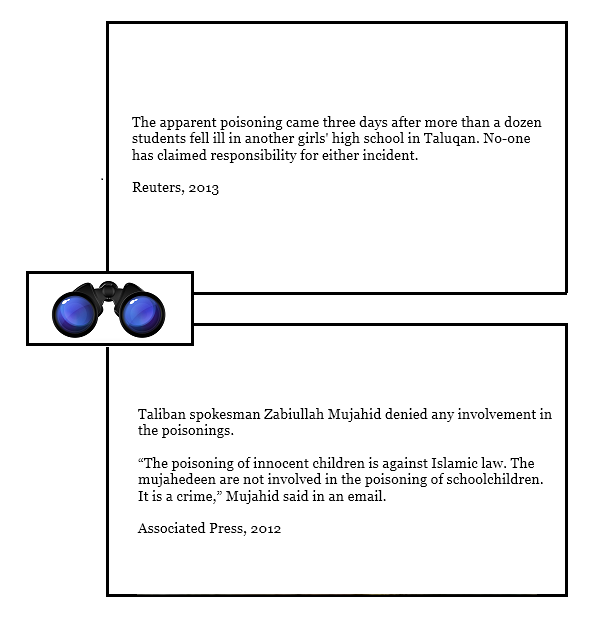
Of course, the Taliban spokesman was addressing a 2012 outbreak of the same hysteria story, and the “no claim of responsibility” report is from one of this year’s versions.

But why would anyone claim responsibility in any case, if the actual cause is mass hysteria rather than poisoning? There’s history to these things — they didn’t begin in Afghanistan:

The cases the Afghanistan incidents most resemble are the Tanganyika laughter epidemic of 1962, in which hundreds of people, mostly schoolgirls, were overcome by fits of mirthless, extended laughter, in what is now known as Tanzania, and the West Bank fainting epidemic of 1983.

The similarities between the heavily studied epidemic in the occupied West Bank and Afghanistan are particularly striking. Both places are in a state of conflict, where political violence is a fact of life, and both have powerful local rumor mills. The incidents follow a similar pattern: First a single report of a bad smell, then a small number of girls come down with symptoms, then it spreads. Local media fueled the rumors and the incidents spread in Afghanistan, just as they did in Israel and Palestine.

Albert Hefez, Israel’s lead psychiatric investigator of the incident, wrote in his 1985 study “The Role of the Press and the Medical Community in the epidemic of ‘Mysterious Gas Poisoning’ in the Jordan West Bank” that Israeli newspaper reports of “poisoning” at the start of the epidemic added fuel to the flames. A front page article in Haaretz on March 28, 1983 even claimed that Israeli military investigators had found traces of nerve gas and quoted “army sources” as saying they suspected Palestinian militants were poisoning their own people in order to blame Israel and provoke an uprising. Palestinian leaders followed up with accusations that Israel had poisoned them in an attempt to drive them from the West Bank.

And such things don’t only happen “abroad” — as detailed in that same NYT blog post I quoted above:

The phenomenon of groups of people falling ill for psychological, rather than physical, reasons is not unknown, nor is it limited to Afghanistan. Moreover, the typical victims are school-age girls. In late 2011, when a group of girls in Le Roy, New York, fell victim to a mysterious twitching illness, medical authorities eventually concluded it was psychogenic.
Of Omar Hammami — and dying more than once?

Friday, April 26th, 2013

[ by Charles Cameron — dying more than once in hadith, in press reports, in Rumi and John of the Cross ]
.

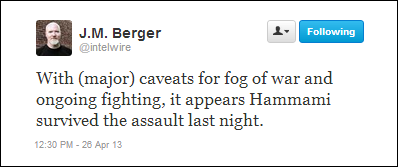
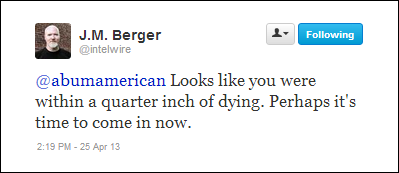
The American mujahid in Somalia, Omar Hammami [see his Wikipedia bio], who has been tweeting back and forth with various “U.S. national security professionals” [see this Wired piece], reported yesterday that he had been shot in the neck “by Shabab assassin” [see this piece by Clint Watts at Selected Wisdom]. JM Berger, who has been in close correspondence with him, tweeted:

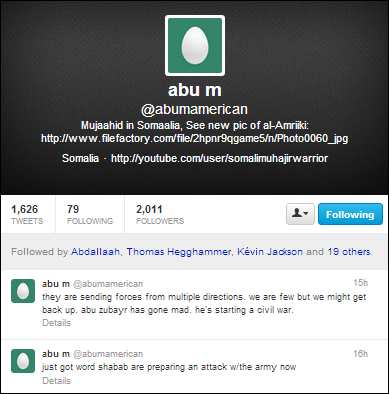
Omar has indeed been in dispute with Shabab, the group he originally joined [see this LWJ post], and his own most recent tweets, sent eighteen hours ago as I write this, were these:

Omar Hammami may or may not still be among us, although recent reports suggest with caveats that he survived the attack…

That’s the background.

**

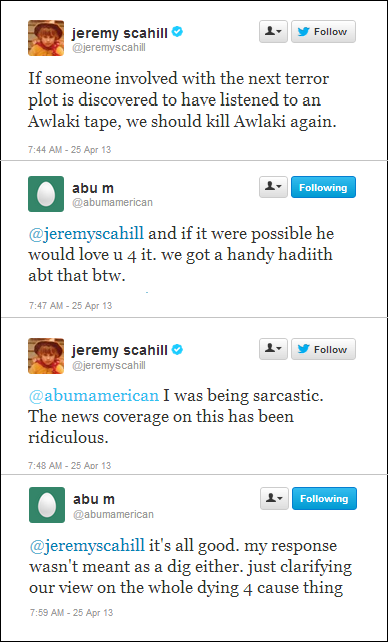
From my point of view, the most interesting discussion anyone had with Hammami in the last day or two was this exchange between Hammami and Jeremy Scahill, whose book Dirty Wars has just hit the stands:

Characteristically, Omar has a light tone — yet speaks to the issue in the context of his theology…

**

There are, it seems to me, basically three ways that one might imagine dying more than once. The first — and it’s the one Hammami himself was referring to — is found in the hadith in Bukhari [Volume 4, Book 52, Number 54]:

Narrated Abu Huraira:

The Prophet said, “… By Him in Whose Hands my life is! I would love to be martyred in Allah’s Cause and then get resurrected and then get martyred, and then get resurrected again and then get martyred and then get resurrected again and then get martyred.

Let the intensity of that hadith — and Hammami’s reference to it, a little earlier [?] on the same day he was shot — sink in.

**

The second, “secular” way to have “died” more than once is through faulty intelligence and / or journalism — and that’s what JM Berger is on about when he tweets:

Indeed, such reports led to the 2011 release of a nasheed in his name, though he may not have sung it himself:

Now Hammami has apparently resurfaced, with two new a cappella songs that appeared on the web earlier this week. In “Send Me A Cruise,” Hammami begs to be plastered by a tank shell, a drone attack or a cruise missile, so that he can martyred like some of the heroes he names, including Al Qaeda leaders Abu Musab al-Zarqawi and Abu Laith al-Libi. In his trademark tuneless drone, he claims “an amazing martyrdom” is what he “strive(s) for and adore(s).” “Send me a cruise like Maa’lam Adam al Ansari/ And send me a couple of tons like Zarqawi,” chants Hammami. “Send me four and send me more, that’s what I implore.”

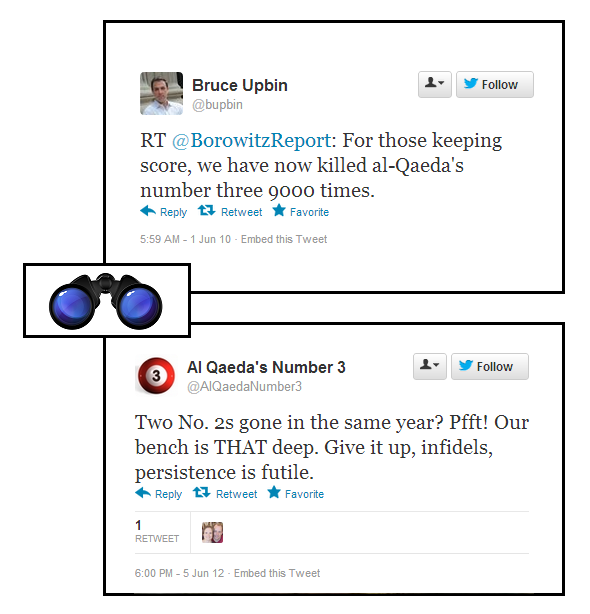
More generally, false reports of AQ leaders dying hither and yon have become so common that I posted a DoubleQuote about it last year:

**

Here’s where it get’s most interesting…

For a third view of dying more than once, we can turn to the mystical tradition. Thus the Prophet Muhammad is credited with the hadith “Die before death” by Jalaluddin Rumi, who in his Mathnawi, VI, 3837-38 writes:

The mystery of “Die before death” is this, that the prizes come after dying (and not before).
Except dying, no other skill avails with God, O artful schemer.

The death before death here is the death of the nafs, the “self” — the true martyrdom of the greater jihad. As Peter Lamborn Wilson puts it in his Introduction to the Sufi Path:

Man’s authentic existence is in the Divine; he has a higher Self, which is true; he can attain felicity, even before death (“Die before you die,” said the Prophet). The call comes: to flight, migration, a journey beyond the limitations of world and self.

Of course, St John of the Cross wrote in much the same vein:

This life I live in vital strength
Is loss of life unless I win You:
And thus to die I shall continue
Until in You I live at length.
Listen (my God!) my life is in You.
This life I do not want, for I
Am dying that I do not die.

US Foreign Policy, Egypt and the Muslim Brotherhood

Wednesday, January 30th, 2013

The Obama administration, though they would not characterize it as such nor have much desire to acknowledge it at all, have attempted  a strategic detente with the “moderate” elements of political Islam.

This policy has not been entirely consistent; Syria, for example, is a quagmire the administration has wisely refrained from wading directly into despite the best efforts of R2P advocates to drag us there.  But more importantly, under President Obama the US supported the broad-based Arab Spring popular revolt against US ally, dictator Hosni Mubarak, and pushed the subsequent ascendancy of the Muslim Brotherhood in Egypt and the Libyan revolution against the entirely mad Colonel Gaddafi. These appear to be geopolitical “moves” upon which the Obama administration hopes to build.

I would like to emphasize that there is one legitimate and valid strategic pro to this sub rosa policy; namely, if everything went well, it would provide the United States with powerful triangulation against revolutionary, apocalyptic, radical Islamism as expressed by al Qaida and various Salafi extremist movements. There are reasons, rooted in takfirism, strategy and the politics of lunacy that our terrorist enemies frequently hate and revile the Brotherhood as traitors, apostates or whatever. Isolating the most actively dangerous and violent revolutionary enemies from a large mass of potential allies is, at least, a good strategic goal.

It is also my view, that this “outreach” is as politically sensitive  to the Obama administration as was the China Opening was to Nixon and about which they have been equally opaque and misleading for fear of a domestic backlash. The weird, foot-dragging, dissembling, embittered, kabuki drama inside the Beltway about public statements and intelligence on whether Benghazi was caused by obscure crackpot Islamophobic film makers or a well-orchestrated terrorist attack  is in my view due to a major foreign policy strategy never having been framed in public for what it is. I’m sure people will differ strongly with me on this (which is fine), but I would characterize detente with Islamists as a strategic shift on par with the “Pivot to Asia”.

The downside here is that first, things are not likely to come out well at all, as unfinished revolutions tend to give birth to monsters; and secondly, any detente with “moderate” political Islam is an uncertain gamble based on certain exceptionally optimistic conceptions of not only what the Brotherhood might do, but about it’s very nature.

While the removal of Arab dictators resonated with American values , it was questionable realpolitik while the administration’s de facto support of  Egypt’s Muslim Brotherhood faction over poorly organized secular liberal modernists was an act of realpolitik that required a compromise of the democratic values so recently invoked to justify abandoning Mubarak. This was cynical diplomatic flexibility worthy of Talleyrand.

Unfortunately, the most democratic thing – perhaps the only thing – about Mr. Morsi and his Brotherhood supporters was his election.

The Egyptian people who are subjected now to thuggery from both Morsi’s Islamist stormtroopers and from the security forces of the Egyptian military are less sanguine than are the Brotherhood’s cheerleaders inside the administration. The Egyptian people, in fact, seem to be in revolt against domination by the Muslim Brotherhood’s shadow government.

The first question to ask in assessing if the Obama administration policy here is wise would be “What is the nature of the Muslim Brotherhood?” Americans love to personalize foreign policy, but if  Morsi were to be toppled or die, the Brotherhood will remain what it currently is, the best organized political force in Egypt and one widely influential throughout the Arab world and the West itself.

I am not an expert on the Muslim Brotherhood, nor am I an Arabist by education. Most of us aren’t – a group that I fear includes most of the Obama administration officials involved in shaping this policy. Almost fifty years after King Faisal determined to export Wahhabism, more than thirty years since Khomeini’s Revolution and more than ten years since 9/11 the USG still has less in-house expertise related to Islam than it did about the Soviet Union and Communism a decade after the Berlin Blockade.

Perhaps we all should begin learning more?

Here is an analysis from FPRI; it is extremely critical but it touches on organizational aspects of the Muslim Brotherhood that I have not seen elsewhere (hat tip to David Ronfeldt). Feel free to suggest others, both for and against. The Brotherhood is a very large group with a long history that includes violence , terrorism and subversion on one hand and peacefully representing expressions of pious, middle-class, social conservatism in other places and times:

Lecture Transcript: What Every American Should Know about Egypt’s Muslim Brotherhood, Delivered by Eric Trager 

….Two years ago when I was doing my dissertation fieldwork in Cairo, I sought out interviews with leaders from the Muslim Brotherhood, and I was referred to a man named Muhammad Morsi, now the President of Egypt. At the time, President Mubarak was ill and had gone off to Europe for operations amid a lot of mystery surrounding his health. I asked Muhammad Morsi whether the Muslim Brotherhood would run a presidential candidate if Mubarak died tomorrow. Here is what he said:

[From an audio file played by Trager]

Eric Trager: You don’t see the Muslim Brotherhood nominating a presidential candidate [if Mubarak dies tomorrow]?

Muhammad Morsi: No… because society is not ready… Our society is not ready yet to really defend its worth. We want a society to carry on its responsibilities, and we are part of this society. Another thing, if we are rushing things, then I don’t think that leads to a real stable position.

When he made that statement, I don’t think he was lying, and I don’t think he was being coy. I think that he didn’t expect that he would be faced with this reality in a mere six months. He did not expect that Mubarak would step down six months later and, to be completely honest with you, neither did I. My dissertation was entitled “Egypt: Durable Authoritarianism”—until the revolution.

What did Morsi mean when he said that the Brotherhood was trying to build a society? Let me give you some background on the Muslim Brotherhood. It was founded in 1928 by Hassan al-Banna, who was a schoolteacher in Ismailia. The Muslim Brotherhood’s goal was then—and remains now—to establish an Islamic state in Egypt. The way it pursues this goal is by trying to Islamize Egyptian society. Through social services, education, and the mosque, it sought to make Egyptians more religious and more Islamic as a grassroots strategy for building an Islamic state. That’s very, very different from a strategy that says, “We’re going to run for president, run for the Parliament, and use that power to transform society.” Rather, the Brotherhood says, in effect, “We’re going to Islamize society to build towards power.” It was a long-term strategy; it took them 84 years before they ran for and won the presidency. So Morsi told me in 2010 that the Muslim Brotherhood was not going to run for the presidency because it was not done Islamizing Egyptian society….

Read the rest here.

The possible unexpected consequences of intervention

Thursday, January 24th, 2013

[ by Charles Cameron — wondering whether it can ever be possible to expect the unexpected, and if so, what exactly that might mean? Libya & Mali ]
.


.

Alex Thurston at Sahel Blog: Covering Politics and Religion in the Sahel and the Horn of Africa posted Libya and Mali, Part I today. The topic is one I am not qualified to comment on, although I’m trying to learn from those (such as AT) who are — but this sentence caught my eye and got me writing:

A failure to soberly consider the possible unexpected consequences of intervention and transition has helped chaos to develop in post-Qadhafi Libya.

I wonder if that’s a koan?

**

Is it ever possible to “soberly consider the possible unexpected consequences” of anything? Consider Donald Rumsfeld‘s remark:

There are known knowns. These are things we know that we know. There are known unknowns. That is to say, there are things that we know we don’t know. But there are also unknown unknowns. There are things we don’t know we don’t know.

Throw in the missing fourth category, supplied by somebody for Wikipedia:

Moreover, one may criticize Rumsfeld statement for omitting the most dangerous type of unknown: the “unknown known”. That is, as Mark Twain famously expressed it, “It ain’t what you don’t know that gets you into trouble. It’s what you think you know that just ain’t so”. Indeed, Rumsfeld was really discussing an “unknown known” which provided faulty justification for the war — members of the Bush administration claimed that the Iraqi government possessed weapons of mass destruction (see Rationale_for_the_Iraq_War), but it just wasn’t so.

**

Now allow for what you might call informed guess-work, what CS Peirce called abduction — I’m just now introducing my elder son to Eco & Sebeok‘s magnificent book, The Sign of Three: Dupin, Holmes, Peirce — and “non-predictive” attempts to lay out a spread of possible outcomes by means of scenario-planning, as Tom Barnett wrote in his Year 2000 International Security Dimension Project Final Report:

By “decision scenario approach,” we mean using credible scenarios to create awareness among relevant decision-makers regarding the sort of strategic issues and choices they are likely to face if the more stressing pathways envisioned come to pass.

and:

Again, none of our material here is meant to be predictive in the sense of providing a step-by-step “cookbook” approach to Y2K and Millennial Date Change crisis management. Our fundamental goal in collecting and synthesizing this analysis is to avoid any situation where US military decision makers and/or operational commanders would find themselves in seemingly uncharted territory and declare, “I had no idea . . ..”

We (myself at times included) seem to be busily employed making non-predictive predictions.

**

Black swansNassim Nicholas Taleb may have been the one who most recently crept up behind us and clapped loudly to alert us to the unexpected, but Stéphane Mallarmé was there first in 1897 with the great graphical poem Un coup de dés jamais n’abolira le hasard, featured in the lower image of the pair at the top of this post.

My own “zen telegram” version, for those who neither know the poem nor read French:

A ROLL OF THE DICE

NEVER

not even when tossed sub specie aeternitatis from the depth of a shipwreck

WILL NEVER EVER ABOLISH

CHANCE

— now there’s a koan for our times — and always.

**

Listen to the poets…

Hear the voice of the Bard!
Who Present, Past, & Future, sees;
Whose ears have heard
The Holy Word
That walk’d among the ancient trees…

**

Sources and links:

  • Un Coup de Dés Jamais N’Abolira Le Hasard from Wikipedia
  • le début de la typographie moderne by Étienne Mineur with page images
  • Un coup de dés, French original and English translation, by AS Kline
  • See that voice of the Bard, William Blake
  • Mali: the wider context, the right now and the longue durée

    Tuesday, January 22nd, 2013

    [ By Charles Cameron — cross-tagging some useful resources from natsec bloggers with another from a bright historian friend ]
    .


    .

    Daveed Gartenstein-Ross‘s Globe and Mail piece The War’s in Mali, But the Danger is International from almost a week ago gave a global context to the conflict, while his more recent Al Qaeda in the Islamic Maghreb and Al Qaeda’s Senior Leadership on Gunpowder & Lead addresses the issue of relations between AQIM and AQ senior leadership.

    Zeroing in, we have a 4-part series on the jihadist actors in Mali from Andrew Lebovich, posting on Jihadica:

  • Primer on Jihadi Players in Algeria and Mali, Pt. 1: AQIM
  • Primer on Jihadi Players in Algeria and Mali, Pt. 2: Belmokhtar & Those Who Sign with Blood
  • Primer on Jihadi Players in Algeria and Mali, Pt. 3: Movement for Tawhid and Jihad in West Africa
  • — and there’s one more in the series still to come which has now been posted:

  • Primer on Jihadi Players in Algeria and Mali, Pt. 4 (Final): Ansar al-Din
  • **

    And by way of cross-fertilization of immediacy with history, here’s the key Mali para from The Slightly-More-Longue Duree by my friend, Swarthmore historian Tim Burke, on Easily Distracted:

    I would never for a moment want to fall back on a pure restatement of ibn Khaldun’s famous interpretation of the history of northern Africa (and the world) and say, “See, this is just pastoralist nomads versus settled agriculturalists and city-dwellers”. But there is a much more specific history that has considerable depth and antiquity to it that involves relationships between Berber-speaking Tuareg pastoralists, Fulani pastoralists, and the settled agricultural societies of the Niger River; between North African states and Sahelian states; between cities and their rural hinterlands; between Islamic cultures and non-Islamic ones. That all matters not just as contemporary sociology but as deep and structurally recurrent history, as a series of patterns and concepts that can be consciously recited by contemporary combatants but that also can be the structural priors of how they mobilize for and imagine conflicts.

    Tim’s conclusion:

    To talk about deeper histories is not to explain current conflicts as destiny, or to put aside a whole host of material, economic, geopolitical and cultural issues with much more immediate explanatory weight. But somehow I feel as if we have to give people struggling to understand what’s happening (and what to do about it) the permission to consider all of the history, as well as the guidance to help them to weigh its importance in context.


    Switch to our mobile site