zenpundit.com » john boyd

Archive for the ‘john boyd’ Category

Perception and Strategy Part I.

Tuesday, March 20th, 2012

Jason Fritz at Inkspots had a thoughtful post about Afghanistan in light of recent events and made some points regarding strategy well worth further consideration. I suggest that you read his post in full, but I will comment on excerpts of his remarks below in a short series of posts. Here’s the first:

Delicate strategic balancing: perception’s role in formulating strategy

…..That all said, incidents in Afghanistan these past few months have caused me to question the validity of strategies that hinge upon the perspectives of foreign audiences*. This is not to negate the fact that foreign perspectives affect nearly every intervention in some way – there has been plenty of writing on this and believe it to be true. I firmly believe that reminding soldiers of this fact was possibly the only redeeming value of the counterinsurgency manual. To say nothing of this excellent work. But strategies that hinge upon the perspectives of foreign populations are another matter altogether. 

I think Jason is correct to be cautious about either making perception the pivot of strategy or throwing it overboard altogether. The value of perception in strategy is likely to be relative to the “Ends” pursued and the geographic scale, situational variables and longitudinal frame with which the strategist must work. The more extreme, narrow and immediate the circumstances the more marginal the concern about perception. Being perceived favorably does not help if you are dead. Being hated for being the victor (survivor) of an existential war is an acceptable price to pay.

Most geopolitical scenarios involving force or coercion though, fall far short of Ludendorf’s total war or cases of apocalyptic genocide. Normally, (a Clausewitzian would say “always”) wars and other violent conflict consist of an actor using force to pursue an aim of policy that is more focused politically and limited than national or group survival; which means that the war or conflict occurs within and is balanced against a greater framework of diverse political and diplomatic concerns of varying importance.  What is a good rule of thumb for incorporating perception into strategy?

According to Dr. Chet Richards, the advice offered by John Boyd:

….Boyd suggested a three part approach:

  • With respect to ourselves, live up to our ideals: eliminate those flaws in our system that create mistrust and discord while emphasizing those cultural traditions, experiences, and unfolding events that build-up harmony and trust.  [That is, war is a time to fix these problems, not to delay or ignore them. As an open, democratic society, the United States should have enormous advantages in this area.]
  • With respect to adversaries, we should publicize their harsh statements and threats to highlight that our survival is always at risk; reveal mismatches between the adversary’s professed ideals and how their government actually acts; and acquaint the adversary’s population with our philosophy and way of life to show that the mismatches of their government do not accord with any social value based on either the value and dignity of the individual or on the security and well being of society as a whole.  [This is not just propaganda, but must be based on evidence that our population as well as those of the uncommitted and real/potential adversaries will find credible.]
  • With respect to the uncommitted and potential adversaries, show that we respect their culture, bear them no harm, and will reward harmony with our cause, yet, demonstrate that we will not tolerate nor support those ideas and interactions that work against our culture and fitness to cope. [A “carrot and stick” approach.  The “uncommitted” have the option to remain that way—so long as they do not aid our adversaries or break their isolation—and we hope that we can entice them to join our side. Note that we “demonstrate” the penalties for aiding the enemy, not just threaten them.]

I would observe that in public diplomacy, IO  and demonstrations of force, the United States more often than not in the past decade, pursued actions in Afghanistan and Iraq that are exactly the opposite of what Boyd recommended. We alienated potential allies, regularly ignored enemy depredations of the most hideous character, debased our core values, crippled our analysis and decision-making with political correctness and lavishly rewarded treachery against us while abandoning those who sacrificed at great risk on our behalf . We are still doing these things.

Most of our efforts and expenditures at shaping perception seem to be designed by our officials to fool only themselves.

To Be or To Do, the blog

Wednesday, February 1st, 2012

[by J. Scott Shipman]

To Be or To Do, the blog

For the last couple of years I’ve wanted to start a blog, and feel very fortunate to have had the opportunity to get my feet wet here at Zenpundit, and then a little later at Fear, Honor, and Interest. Last year, I engaged a graphic designer to come up with a logo for “to be or to do” (TBTD) which I use in presentations, and essentially decided to build a site around the logo. The result is about 95% complete. 95% because my wife plans to also begin sharing with clients the TBTD material that I’ve developed—with tweaks where she deems appropriate.

While the purpose of the blog portion of the site is primarily as an outlet to share my interpretations of John Boyd’s work, I’ve already wandered into a compelling navy issue less than a week in. With luck, order will emerge, but I’m making no promises.

In my business, I’ve been using what I call Boyd’s scaffold to help organizations create cultures of excellence. Most Boydian thinkers use his strategies for competition and maneuver; I have focused on his notions of teamwork and cultural harmony. I’ve also taken a synthesis of Boyd as a man and derived five principles that, for me, define the man: honesty, courage, curiosity, conviction, and persistence. Two distinctly non-Boydian attributes, humility and optimism have been added because it seems like the right thing to do based on my life experience. As a matter of fact, optimism almost didn’t make the list, but my late mother-in-law impressed upon me the importance of optimism as a force in life—she did this as one suffering from, and eventually succumbing to breast cancer in 2010. She lived what she said; she was a Doer. Her life example was enough to make me a believer.

The TBTD site is primarily geared towards clients and potential clients, with a blog thrown in. The blog is not intended to be limited to business pursuits, but rather topics of interest that may also be interesting to readers.

As for the future, I’ve linked to many blogs Zenpundit readers either read or own. My introduction to and participation with this unique group has been a pleasure and a privilege beyond words. The book recommendations alone have made a substantial dent in my bottom line, but my library is exponentially better! So keep those title recommendations coming!

With any luck, my postings here will pick up in 2012; I have a series on patterns still under construction and two book reviews still in draft form (the books are old:))

Many thanks to Zen and Charles, and to the readership! I hope to see you here and at the new place just around the corner.

Cordially, JSS


John Robb on the OODA Loop

Thursday, December 1st, 2011

John Robb at Global Guerrillas had a nice primer on John Boyd’s OODA Loop recently and he put on a twist that I thought was very useful:

HOW TO WIN ANY CONFLICT

….I’m Inside Your OODA Loop

How does all of this apply to conflict?  The simple answer is that conflict, in its most basic form, is a contest between decision making loops.  The side with the FASTER and BETTER decision making loop wins any conflict.  Why?  They adapt quicker.   Here’s some more detail:

A FASTER decision making loop means that you accomplish a successful OODA loop quicker than an opponent.  If you can do this, you are inside your opponent’s OODA loop.  This means that by the time your opponent responds to your last actions, you are already onto your next ones.  Get far enough ahead and the opponent’s decision making process will collapse and victory is assured.
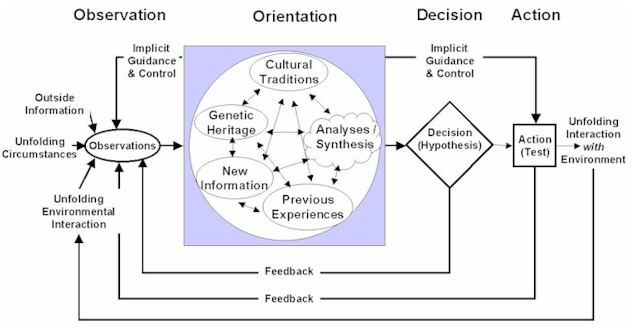
A BETTER decision making loop?  That’s question that can lead to endless debates and theory crafting.  My approach to improving a decision making loop?  Connectivity.  The more connected a loop is, the better the decision loop is.  Connectivity falls into three categories:

  1. Mental — improves decisions by connections to a superior mental model of the current situation.  A superior model/strategy is predictive of events. It can tell you what data is important and what isn’t.  Weak strategies/tactics fall apart upon first contact w/enemy.
  2. Physical   — improves observation through connections to better sources of data, cleaner w/less distortion  — improves action by making it possible to actually accomplish the desired decision in the real world
  3. Moral — better orientation due to connections to strong traditions, extensive experience, and collected wisdom.  Training can help here.

The opposite is true also.  Damage an opponents connectivity, and their decision making loops are less effective.

One of the difficulties with discussing OODA is that many people who either oppose the concept or do not know much about it, will explain the OODA Loop only as “getting inside your opponents OODA Loop” in terms of the capacity to “go faster” -i.e cycle through your own OODA Loop faster than your opponent, making more decisions, taking more actions, leaving them in the dust, disoreinted and going into a downward spiral to defeat. Usually, misrepresented like this:

Ok, well going “faster” is a small part of it, but not sequentially and there’s neurological limits on this that arrive pretty quickly in terms of thinking speed in any case. Robb’s use of “BETTER” helps capture more of the critical and subtle qualitative nature of the “Orientation” box:

What are some of the possible effects of a “virtuous cycle” of better decisions?

Position yourself with more options
Gain new perspectives (“Observation”, “Orientation”)
Position yourself with the greatest comparative advantage (best option)
Lock in a comparative advantage
Position yourself with the longest potential decision tree (no quick “dead ends” or “cul de sacs”)
Change the tempo of interaction in your favor
Change the rules of interaction in your favor
Prevent a conflict with additional potential oponents
Lower your costs or increase theirs
Assure minimum gains
Arrive first
Increase or decrease the distance between yourself and your opponent
Broaden or narrow the field of conflict
Gain time
Seize or maintain the initiative
Define or redefine “victory”
Foreclose a critical option or set of options to your opponent
Force your opponent to act on your terms (“Check”)
Lower the morale of your opponent

Confuse, mystify or mislead your opponent
Attract allies or supporters
Increase your resources or potential maximum gains
Repair, remediate or replace previous losses

John is correct that “connectivity” helps you gain many of these benefits. 

Remember:

 “Being on the winning side is a lot more fun!”

ADDENDUM (Some interesting commentary on OODA):

Adam Elkus

I’ve Got the OODA Blues

Joseph Fouche:

Libeling Boyd

How Not to be Like Boyd

Who’s Afraid of Genghis John?

TDAXP, PhD

Variations of the OODA Loop 1: Introduction
Variations of the OODA Loop 2: The Naive Boydian Loop
Variations of the OODA Loop 3: The Sophisticated Boydian Loop
Variations of the OODA Loop 4: Pseudo-Boydian Loops
Variations of the OODA Loop 5: Post-Boydian Loops
Variations of the OODA Loop 6: Bibliography

The Human Face of War, a second review

Wednesday, November 16th, 2011

[by J. Scott Shipman]

images-1.jpeg

The Human Face of War by Jim Storr 

[Zen reviewed this book earlier here. I had forgotten that I wrote a rather long review at Amazon after finishing in January 2010. Perhaps Storr will gain a wider audience as a result.]

Mr. Storr’s The Human Face of War will be I predict, a book studied by military professionals (and smart policy makers) for years to come. Using straightforward prose, Mr. Storr seeks to provide a philosophical approach to war—as he says, “In practice we are concerned so much with war as with waging it.” Storr goes on to differentiate between war and warfare; where war is an “issue” with history and warfare dedicated to methods/methodology. Storr rejects notion that war is art or science, and prefers instead to embrace pragmatism and limited empiricism. He points out correctly: “Pragmatism has obvious application to warfare. A significant aspect of warfare is `a process of trial and error; seeing what wins and exploiting it.” Storr continues that “empiricism is not just trial and error: it is a logical process based on structuring observed facts.” What “works” will suggest a way ahead. 

Storr uses broad themes of what has worked and what has not worked in military history by explaining the nature of combat and tools and models available to the practitioner. He uses Clausewitz’s “dialectic of aims and means” in conjunction with Systems Theory to describe the holistic nature of military units; where effective/efficient output is dependent on input—where a good outcome is “winning” (as Storr repeatedly observes throughout the book, armies aren’t paid to come in second). Hence, organization of military units is fundamental; efficient/effective organizations are more likely to succeed. He observes: “Cohesion and collective performance indicate the whole is greater than the sum of the parts. There is a systemic effect, and we should see armed forces as systems.” 

Storr is a proponent of forcing decision making to the folks on the ground using brief and succinct communications. His chapter on Commanding the Battle is excellent. Storr advocates lean command staff’s and dispersed decision making. “We should employ the best brains in small groups, rather than try to assemble a collective brain.” He points out that “when staff numbers are reduced, the effectiveness of HQ improves.” “Reducing staff numbers would increase speed with which they could get things done.” [Amazingly, Storr quotes a work from 1998 that reports a typical Western division commander has 600 people supporting!—and that number has, I’m sure increased in 10 years.] He concludes this excellent chapter making a distinction between technology and the human factor: “…the future is not digital: it’s human. What is needed is things that bind talents together as a team, not more bandwidth…given time, resources, open minds and not much money we could revolutionize land tactical command. The key problems are human, cultural and institutional.” 

Storr asserts that successful modern commanders are most likely intuitive thinkers and possess the ability to learn from experience. He suggests further the “tendency to learn is more critical. It implies a tendency to reflect on experience and to learn from it, to maximize the benefit of the experience.” This tendency is key to the development of “skills”. He encourages a “permissive man-management regime that allows those who can learn rapidly from their experience to do so.” At the opposite end, Storr makes clear the unsuitability of many leaders who use bullying tactics and fear to motivate. 

Storr concludes by observing that “institutional conservatism” inhibits armed forces from improving significantly during times of peace; that “the current size and shape of Western armies reflect issues that are not primarily related to warfighting effectiveness.” He insists that doctrine should be explicit, relevant,(descriptive and where appropriate, prescriptive), coherent, and practical. The short tours common in western armies harm team integrity—which is “huge”. Innovation is vital, and in many cases military members aren’t with a unit long enough to have the experience necessary to truly innovate. Storr advocates “experience is the best way to achieve practical coordination and overcome the fog of war, as long as the experience gained is positive.” He discourages the common use of lieutenant-colonels in jobs where a captain or major could function/thrive/learn; as these junior officers will have less experience when they are promoted and will have probably developed the habit of “referring decisions upwards, and hence develop little initiative.” 

According the Storr, the “human” aspect of war should take prevalence over technology. He acknowledges the utility of technology, but asks the reader to “…pause and look for a moment at the Vietnam War, which suggests that superior technology is not always the deciding factor.” [9-11 is illustrative of this point on the “terror” side; determination and box cutters wreaked havoc.] 

My review does not do justice to the wealth of information, insight, and counsel in Storr’s book and I quote him frequently because his style is better than a summary. This book was aimed at a narrow audience, hence the high price. When I began, I was concerned about Storr’ opinions concerning John Boyd’s OODA loop; but in late 2009 I rejected Boyd’s deterministic underpinnings of OODA—Storr’s pragmatic and partial empiricism makes more sense. OODA remains, in my humble opinion, a valuable and versatile methodology in both the military/law enforcement and business arenas. 

This book is highly recommended; particularly for junior officers and NCO’s—the price is high, but what you will gain will be worth the cost.

UPDATE 11.17.2011: Jim Storr contacted me and confirmed the issue of a paperback for about $40.

More on Boyd & Beyond II and Boydian Theory

Wednesday, October 19th, 2011

Two posts of note:

USNI Blog (Lucien Gauthier) – Training Sailors to be Autodidactic

….The conference spent a lot of time on the first half of the OODA-Loop, Observing and Orienting.  At some point I became convinced that the type of Sailor we need is one that is a “situational autodidact”.  Major Marcus Mainz, USMC, during his presentation made the brilliant comment that “training is for the known, education is for the unknown” in this sense, the spirit in which we must educate our Sailors must be towards making them capable of educating their self as needed when the unknown presents itself to them.

….For Sailors to take greater advantage of their experiences, they need to actively question their actions.  By this, I mean that a person analyses a question more than they do a statement.  But, it has been my experience that when someone recants an experience they had, it is a rare thing to hear someone say anything in terms of ‘why’ they did something.  Much more often someone only tells the ‘what’ of their actions.  Think of the Socratic Method, where Socrates would answer his students questions with another question.  A Sailor who has internalized such a ‘Socratic process’ would be in a position to provide more cogent feedback as well as learn from their mistakes more often than we do today.

What I am saying is not that the training we offer Sailors falls short of its objectives as they stand today.  But, that the spirit of the training is not where it needs to be-we focus our objectives too much on acting rather than orienting.  The training our Sailors receive are based on concrete and testable objectives that can be measured, quantified and turned into metrics, that fit well into powerpoint.  We do no help Sailors to become autodidactic-we are not training them to become students of their environment, but rather students of their school house.

We start to approach training Sailors to be autodidacts of their environment in the Operational Risk Management training we receive (One thing about ORM:  It is Boyd’s OODA-Loop operationalized.  The Navy has totally ripped off Boyd, and yet we never mention his name outside of the Warfare Universities-shame on us).  We need more and deeper training on ORM and how this method applies to everything we do, whether we consciously realize it or not.  In giving this deeper level or ORM, we should also find Sailors able to be more articulate of the process they’ve gone through.  Thereby becoming able to better train others of their experiences….

Naval affairs is not my bailwick, but my understanding of following online discussions by experts in the field like General Robert Scales, is that Professional Military Education across all the services is a) in need of significant reform and b) is facing a future of restricted budgets and possible deep cuts. My only firsthand knowledge of PME comes from a brief stint in June at The Army War College, courtesy of Dr. Steve Metz. The AWC curriculum was explained to me in detail by Col. Bill Lord, and while they were hitting the right notes in terms of trying to inculcate a strategic epistemology, the time frame allowed for doing so is extremely compressed.

Fast TransientsBoyd’s Conceptual Spiral – New Edition

This is from Dr. Chet Richards as well as Chuck Spinney….

Download Conceptual Spiral (152 KB PDF), Boyd’s take on the origin and importance of novelty:

Novelty is not only produced by the practice of science/engineering and the pursuit of technology, it is also produced by the forces of nature, by our own thinking and doing as well as by others. Furthermore, novelty is produced continuously, if somewhat erratically or haphazardly. Now, in order to thrive and grow in such a world, we must match our thinking and doing, hence our orientation, with that emerging novelty. (28)

Adds the original page numbers, which may seem a little odd because for readability this edition spreads several of Boyd’s originals over two or even three pages.  All of these will have the same number.

We are wired to crave and be attracted to novelty, it sets us thinking and generates insights and stimulates our creativity.


Switch to our mobile site

