The Sociobiological Origins of Beauty
Sunday, March 6th, 2011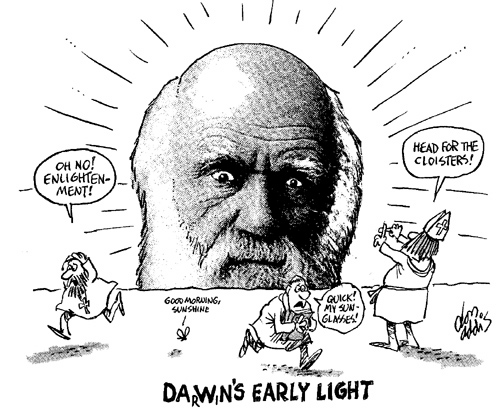
Great multidisciplinary talk by Dr. Denis Dutton on the possible evolutionary origins on culturally universal concepts of aesthetic beauty.
Great multidisciplinary talk by Dr. Denis Dutton on the possible evolutionary origins on culturally universal concepts of aesthetic beauty.


The New York Times, which I read on my iPad, particularly the non-political news sections of the paper where the obnoxious spin is reduced and the content quotient is higher, had an article that I think will ring a bell with ZP readers:
Sam Anderson –What I Really Want Is Someone Rolling Around in the Text’
One day in college I was trawling the library for a good book to read when I found a book called “How to Read a Book.” I tried to read it, but must have been doing something wrong, because it struck me as old-fashioned and dull, and I could get through only a tiny chunk of it. That chunk, however, contained a statement that changed my reading life forever. The author argued that you didn’t truly own a book (spiritually, intellectually) until you had marked it up.
….All of which means I’ve been feeling antsy over the last five years, as I’ve watched the inexorable rise of e-readers. I sympathize with the recent wave of public teeth-gnashing about the future of marginal notes. The digital book – scentless, pulp-free, antiseptic – seems like a poor home for the humid lushness of old-fashioned marginalia. You can’t even write by hand in an e-book – at least not comfortably, not yet. As John Dickerson recently put it on Slate, describing his attempt to annotate books on an iPad: “It’s like eating candy through a wrapper.” Although I’ve played with Kindles and iPads and Nooks, and I like them all in theory, I haven’t been able to commit to any of them. As readers, they disable the thing that, to me, defines reading itself. And yet I’ve continued to hope that, in some not-too-distant future, e-reading will learn to take marginalia seriously. And it looks as if that might be happening right now.
According to the marginalia scholar H. J. Jackson, the golden age of marginalia lasted from roughly 1700 to 1820. The practice, back then, was surprisingly social – people would mark up books for one another as gifts, or give pointedly annotated novels to potential lovers. Old-school marginalia was – to put it into contemporary cultural terms – a kind of slow-motion, long-form Twitter, or a statusless, meaning-soaked Facebook, or an analog, object-based G-chat. (Nevermind: it was social, is my point.) Samuel Taylor Coleridge, the undisputed all-time champion of marginalia, flourished at the tail end of this period, and his friends were always begging him to mark up their books. He eventually published some of his own marginalia, and in the process even popularized the word “marginalia” – a self-consciously pompous Latinism intended to mock the triviality of the form.
Incidentally, How to Read A Book is by Mortimer J. Adler. A classic
Marginalia is of critical importance to biographers and historians studying controversial figures. We know far more about such disparate figures as John Adams and Joseph Stalin because they enthusiastically marked up their books and documents with sharp and brutally frank opinions, revealing the true feelings often masked to contemporaries. Stalin, who sometimes used a crayon, would mark certain passages with “ha ha!” which, far from being a sign of the dictator’s amusement indicated rage toward the author – sometimes with lethal consequences. Stalin’s rival and equally deadly disciple, Mao ZeDong scrawled erudite literary, scholarly, sometimes poetical, comments about philosophy and Chinese history that belied his taste for the maniacal ruin of a classical Confucian culture in which he was deeply versed.
Richard Nixon, who clinked toasts of maotais with Mao and Zhou ( mostly Zhou as Mao was seriously ill) during Nixon’s historic visit ran his semi-isolated presidency via marginalia he methodcally wrote on news clippings, memos and yellow legal pads all day long, which he sent to his “Lord High Executioner” H.R. Haldeman, who like Henry Kissinger, discreetly ignored Nixon’s angrier, stranger and more ill-considered notations while carrying out Nixon’s incisive or at least harmless instructions. Harry Truman, known for employing blistering profainity in private, was also capable of the searing marginal commentary favored by John Adams.
It isn’t just e-readers, iPads and PCs that have reduced marginalia. The culture of literacy is in a general decline in America and the “gotcha” nature of modern politics and the criminalization of policy differences have caused political figures to adopt a strategy of eschewing diaries, journals, letters and email on the advice of attorneys. Statesmen are following the old rule of Chicago alderman, “Don’t write it down when you can say it, don’t say it when you can nod, don’t nod when you can wink”. It’s a loss to history. We will know far more about Teddy Roosevelt’s true interior life or Richard Nixon’s than we will of Barack Obama’s. Very little that is recorded will not be, in part, artifice and marginalia is a poor strategy for artifice designed to craft an image or advance an argument.
As part of the diminishing cadre of marginalians, I like to mark up books with colored, ultra fine point, sharpies. Generally lighter hues so it won’t bleed heavily through the page. Occasionally, for especially important passages, maybe one or two a book, a highlighter is used so that in the future, I can lazily pull the book from the shelf and quickly flip to the paragraph in question. I tend to do a lot of underlining and bracketing; when I was younger, I “argued” more with the authors in the margins. Older now, I expand on their points whether I agree with them or not. The Kindle has the capacity to type in notes, but I have not used the function much because most of the books I have read on it are fiction.
What do you do with the margins of your books?
Saw this on Shlok’s site:
Viewdle – Photo and Video Face Tagging from Viewdle on Vimeo.
This kind of app is a required step for making augmented reality devices part of the social media ecology. Therefore, this tech will become a standard for all mobile devices – merchants and advertisers want us as an army of data collectors on each other.
OTOH, automatic face-recognition and social media aggregation raises serious concerns about the potential dangers of living under a panopticon state if an app is aggregating and bundling all your online data in real time, while giving out your GPS and home address. A godsend to stalkers, oppo researchers, con men, disgruntled spouses or employees, autocratic governments and other creepy malefactors. Expect businesses, which are already attempting to illegally pry and spy into all areas of employee’s lives, to make surreptitious use of apps of this nature
Puts the protests to revolution in Egypt and Tunisia in perspective, doesn’t it?
If the FCC wanted to do something useful and promoting of liberty, they might consider regs to let individuals exercise greater control the use third parties would have to their collective online IDs – then you could be “out there” or not or to the degree you liked. Some people, do want to be “out there” professional or social reasons. While you cannot control pictures of yourself in a public space, I’m not sure the Supreme Court thought that your presence in public meant that random strangers and government officials should be able to run your credit history as you sit at a table in a restaurant or bar or take in a movie or ball game by taking your photo. A similar logic underlies state laws prohibiting wiretapping or making auditory recording individuals without their knowledge and consent (Illinois being one such state where Chicago aldermen and state legislators have acquired a healthy fear of recording devices).
Speaking of government, I have been told by an authoritative source that the USG rsearch is far advanced in this area. Probably a lot further along than is Viewdle, but perhaps not.
[ by Charles Cameron — cross-posted from SmartMobs ]

I was going to post on this subject but Dave beat me to it:
….Among the greatest barriers to innovation are the industrial giants like GE which have shed jobs at an alarming rate over the last 30 years while wielding intellectual property laws and political clout to crush upstart competitors which are hiring. One way of spurring innovation would be to get dinosaurs like GE, grown huge through rent-seeking, the hell out of the way. I doubt we’ll see suggestions in that vein from Jeffrey Immelt.
The only jobs Immelt will create in America are for K Street lobbyists to secure yet more government contracts for GE. Expect a blizzard of proposed agency regs and executive orders this year as the Oligarchy tries to lock in as much of a permanent rentier economy as they can before the next election cycle.

Zenpundit is a blog dedicated to exploring the intersections of foreign policy, history, military theory, national security,strategic thinking, futurism, cognition and a number of other esoteric pursuits.
Customized Web Site & Blog Design

