Booksbooksbooksbooks….
Monday, August 1st, 2011Two more for the pile….

Another Bloody Century by Colin Gray
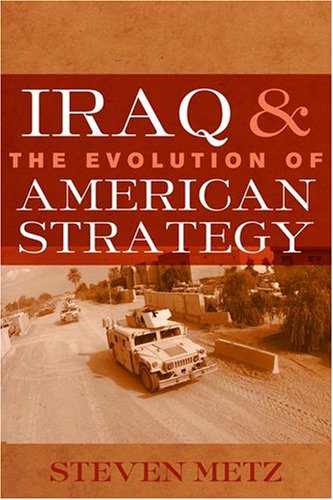
Iraq & the Evolution of American Strategy by Steven Metz
Comments or opinions?
Two more for the pile….
Another Bloody Century by Colin Gray
Iraq & the Evolution of American Strategy by Steven Metz
Comments or opinions?

At Fabius Maximus, Dr. Chet Richards reviews TEMPO by Dr. Venkat Rao, enjoying the book as much as I did, if not more. Chet has some particularly incisive comments, positive and critical, in his review, which I suggest you read in full:
…Rao draws on Boyd in several places, as well on sources ranging from the topical, such as Gladwell and Taleb, to the foundational (e.g., Camus and Clausewitz), to the downright obscure – know anything about The Archeology of Garbage? Do the words wabi and sabi ring a bell?
The result is a synthesis, what Boyd called a “snowmobile,” that combines concepts from across a variety of disciplines to produce a cornucopia of new ideas, insights and speculations. You may be confused, challenged, outraged, and puzzled (some of the language can be academic), but you’ll rarely be bored because every chapter, often every page, has something you can add to the parts bin for building your own snowmobiles.
Let me highlight just a couple, of special interest to folks familiar with Boyd’s concepts. Near the end of the book, Rao introduces an expanded version of “legibility”:
A piece of physical reality is legible if it is obviously the product of coherent human agency, a deliberate externalization of a mental model. When human and natural sources of order are harder to tease apart, you get greater illegibility (p. 133 – and I warned you about the academic language).
Then a couple of paragraphs later, he claims that:
Used with adversarial intentions, Boyd’s OODA can be understood as a deliberate use of illegibility to cause failure.
At first, this seems silly. Boyd only considers conflict between groups of human beings (Patterns of Conflict, 10), so all uses of his strategic concepts would seem to be prima facia examples of legible phenomena. On the other hand, and this is an example of what makes Rao’s little book so valuable, some commentators, such as Stalk and Hout in 1990’s Competing Against Time, point out that victims of a Boyd-style attack can rarely identify the cause of their problems – often blaming bad luck or incompetent, self-serving and treacherous idiots in their own organizations. Boyd made this clear in his own work, such as in Patterns of Conflict, 132, when he suggested that his victims would exhibit a variety of traumatic symptoms including confusion, disorder, panic, chaos, paralysis and collapse – indicating unrelenting attack by forces outside the scope of their own mental models…
Chet concludes with a suggestion for Venkat (with which I concur):
…As for where to go from here, Rao might write more about tempo. This will seem strange to him, I’m sure, but pages go by with hardly a mention of the concept. This means that we need another book from him. I’d suggest expanding on some of the concepts that he raises but doesn’t find space to develop. Here are three ideas: […]
But you will have to go over to Fabius Maximus to read the rest. Venkat, in turn responded to Chet over at his blog, Ribbonfarm:
Chet Richards’ Review of Tempo on Fabius Maximus
….Overall, Chet comes to the conclusion that Tempo resonates with the Boydian spirit of decision-making. I don’t entirely get out of jail free though:
Perhaps his unfamiliarity with the original briefings, however, led him to make one characterization that is incorrect, although widely believed:
The central idea in OODA is a generalization of Butterfly-Bee: to simply operate at a higher tempo than your opponent. (118)
Guilty as charged. I didn’t spend enough time exploring how OODA gets beyond merely “faster tempo” to “inside the adversary’s tempo.” That’s something I hope to explore in a more nuanced way in a future edition. Over the last 6-8 months, I think I’ve come to understand the subtleties a lot better, and the challenge is to now spend more time thinking through clear definitions and examples….
I think everyone who has explored the OODA Loop concept, including John Boyd himself, initially gravitated to the aspect of cycling “faster” than one’s oponent because it is a natural assumption that resonates with our own experiences. We have all seen competitions where one player or athlete was “quicker” in reading situations and arriving at the right intuitive decision – usually most of us have been both the faster as well as the slower and more hesitant person. It’s the first scenario that springs to mind and being “faster” gives an obvious comparative advantages. Obvious does not mean “only” though.
What made the “faster” interpretation of OODA Loop really stick in the culture though, IMHO, was this unfortunate but easily understood graphic:
NOT THE REAL OODA LOOP

As a result, we get critical arguments that the OODA Loop is really something germane only to binary situations similar to the high pressure aerial combat that Boyd experienced in the Korean War or as a tactical fighter pilot instructor (or Musashi’s sword fighting) and not something generally useful in military strategy. An odd argument, given that Clausewitz liked to use binary metaphors to describe the nature of war.
The next graphic, which better illustrates the simultanaeity and dynamic nature of the OODA Loop, with other potential avenues of exploitation than just going “faster” (which will swiftly hit diminishing returns in any event) does not lend itself as easily to nearly instant comprehension:
THE ‘OFFICIAL” OODA LOOP:
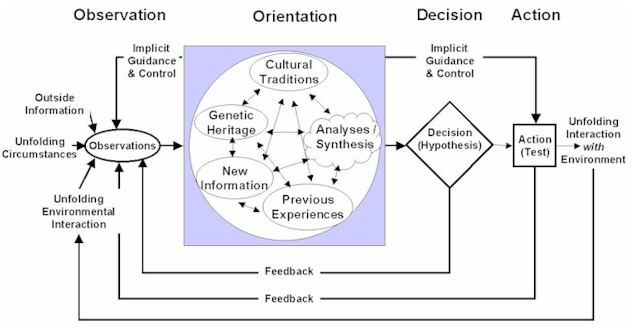
With these cognitive relationships operating continuously, mostly subconsciously with automaticity and in an iterative fashion, a different set of meanings to the phrase “inside your oponent’s OODA Loop” than just going “faster”, like a formula one race car zooming around a track.

The Profession by Steven Pressfield
We should begin this review with “Full Disclosure“:
I just finished reading The Profession by Steven Pressfield, which I enjoyed a great deal. Steve sent me an earlier draft doc of the book and I consider Steve a friend. Furthermore, in an extremely gracious gesture, Steve granted me (or at least zenpundit.com) the novelist’s equivalent to a walk-on cameo appearance in his book. Therefore, if you the reader believe that I cannot review this book objectively…well….you are right. It’s not possible 🙂 . Here are some other reviews by Shlok Vaidya, Greyhawk of Mudville Gazette and Kirkus if you want greater impartiality.
Nor am I going to delve into the mechanics of the plot structure and action sequence in The Profession. For one, I think too much of the story in a review of a work of fiction spoils the enjoyment for the group of readers who would be most interested. And you can get the blow by blow elsewhere.
Instead, I would like to draw your attention to how Pressfield has written this novel differently. And why that matters.
There is plenty of action in The Profession and the book really moves. It is violent, but not at a Blood Meridian level of cruelty and the murky political intrigue that surrounds the hero, the mercenary’s mercenary and “pure warrior” Gilbert “Gent” Gentilhomme, is a nice counterpoint to physical combat and technical military details. Many people will enjoy the novel on this level and The Profession would make for an exciting action film. Or perhaps a series of films along the lines of The Bourne Identity or those Tom Clancy movies with Harrison Ford. All well and good. But that is not why The Profession is worth reading – that’s merely why it is fun to read.
What surprised me initially about The Profession was how unlike Killing Rommel it was. Killing Rommel also had war and adventure, but it was a deep study in the character development of Chap, the protagonist, who had enough of a textural, cultural, authenticity as a young gentry class British officer of the WWII period as to make Killing Rommel seem semi-biographical. As a reader, I didn’t much care if Chap and his men succeeded in killing Rommel, only that I would be able to continue to see the story unfold from Chap’s perspective. Many artists believe characters and character interaction are the most important element in a story, from Saul Bellow to Quentin Tarantino. Their stories are captivating even though their narratives are not always particularly logical or centered on a grand conflict.
The Profession is not like that at all. In my view, Pressfield turned his creative energies, his knowledge for military affairs and his formidible ear for history away from character development and toward theme. This difference may or may not explain his own reports of difficulty in wrestling with this novel.
Reaching back to the lessons learned from late Republican Rome, Thucydides, Xenophon and seasoning it liberally with Machiavelli, Pressfield’s 2032 near-future is also jarringly allegorical with America of 2012. Like Rome of the 1st century BC or Athens after it’s defeat in the Peloponnesian War, America in The Profession is strategically paralyzed, politically polarized and teetering on the precipice of decay and decline. These historical inspirations have been mashed up with a dystopian 4GW world, filled with mercenary PMCs like Force Insertion and The Legion, terrorists, drones, tribes, criminal corporations and and a devious and cowardly global financial elite. A future more evenly distributed from the present.
The antagonist against whom the plot is structured is not the story’s nominal villain terrorist, but Gent’s Homeric father-figure, former Lieutenant General James Salter, USMC, “the crawling man” who was martyred, disgraced, exiled and redeemed as the new master of Force Insertion’s Mideast deployed “armatures” (combined arms divisions) and the book’s geopolitical apex predator, who boasted:
” I was obeying a more ancient law”
This marks a drastic shift in Pressfield’s use of characters from people existing in themselves with humanistic nuances to their use as philosophical archetypes to better express the theme, more like the technique of Fyodor Dostoyevskii, Victor Hugo or Ayn Rand.
The interplay between the kinetic Gent and the increasingly totemic Salter elucidates a theme that is creating tectonic political shifts in America and the world; a theme which is expressed explicitly to Gent at one point by the ex-Secretary of State, Juan-Estebaun Echevarria. The ex-Secretary plays Cicero to Salter’s Caesar, but Gent is ultimately cast in the role of a very different Roman by the manipulative Salter. Pressfield, in honing the various characters, including AD, Maggie Cole, El-Masri and others, is also drawing on Alcibiades, Critias, Livy, Homer, Robert Graves, Joseph Conrad and the pattern of mythic epics. Salter is at once a pagan chieftain and a philosopher-king, a civilized Kurtz or a barbaric John Galt, who after continuous dissembling, in a brutally honest speech, gives his followers, his enemies, Gent and even himself, no opportunity to morally evade what he has become or his reasons for what he proposes to do. A speech that resonates with the negative trends we see today.
The Profession is a cautionary tale outfitted in kevlar.
Doing some heavy duty research…..Amazon will be doing well this year on my dime:


Architect of Global Jihad by Brynjar Lia
A Terrorist’s Call to Global Jihad by Jim Lacey
Modern Strategy by Colin Gray

The Profession by Steven Pressfield
Tequila Junction: 4th Generation Counterinsurgency by H. John Poole
Steve’s novel The Profession I have mentioned previously, but I confess that I am puzzled by the choice of book jacket on Tequila Junction, which looks somewhat like a children’s illustrated guide to COIN in 1980’s El Salvador. H. John Poole is a respected veteran and tactical expert and Tequila Junction carries the warm endorsements of General Anthony Zinni and William Lind. Maybe his grandson drew it? Odd.
In any event, small unit tactics are not a subject I pretend to know much about, so it will remedy a gap in my knowledge base.

Zenpundit is a blog dedicated to exploring the intersections of foreign policy, history, military theory, national security,strategic thinking, futurism, cognition and a number of other esoteric pursuits.
Customized Web Site & Blog Design

