zenpundit.com » globalization

Archive for the ‘globalization’ Category

Elkus on Wikileaks and Sovereignty

Sunday, September 4th, 2011

Adam Elkus has a smart piece up at Rethinking Security that deserves wider readership:

WikiLeaks and Sovereignty

….WikiLeaks represents the idea that states have no inherent authority to hold onto vital national secrets. Because information is fundamentally boundless and unlimited by the “oldthink” of national borders and politics, state control over proprietary information is irrelevant. WikiLeaks and other radical transparency advocates believe that they-an unelected, transnational elite-can pick and choose which states are good and bad and whose secrets deserve exposure. And if information deserves to be free-and the only people who would keep it from being so are those with something to hide-then it is fine for non-state networks to arrogate themselves the right to receive and expose state secrets.

….While WikiLeaks is often positioned as a champion of digital democracy, it is actually wholly anti-democratic. It transfers power and security from national governments and their publics to unelected international activist organizations and bureaucrats. While this may seem like a harsh interpretation, there is no check on the likes of Julian Assange. Governments-even autocratic ones-still must contend on a day-to-day basis with the people. Even China had to face a reckoning after the Wenzhou train crash. WikiLeaks and other radical transparency organizations mean to replace one group of elites-which at least nominally can be called to court-with another who are accountable only to their own consciences.

Read the whole thing here.

Let me add a few comments to Adam’s excellent analysis.

Wikileaks and Julian Assange were not and have never been, lone wolves or information-must-be-free martyrs. They are allied with important institutions and individuals within the Western progressive elite, not least major media heavyweights like The New York Times, The Guardian and Der Spiegel, but also sympathizers within Western governments. Unless you think that Pvt. Bradley Manning was a hacker wunderkind with an intuitive grasp of which files that could be swept up to further a sophisticated political agenda, the man had some inside help from further up the food chain.

Adam is correct to describe these political factions as anti-democratic because they are and while leaking has been going on as long as there have been governments, we now have the emergence of a transnational generational clique that see themselves as entitled to rule and impose policies that comport with their social prejudices, economic self-aggrandizement and ideological fetishes, whether the people support them or not. A vanguard attitude, if not an organizational vanguard.

Wikileaks and other devices operating in shadowy undercurrents are their form of liberum veto against the rest of us in the instances where they are not completely in control, thus migrating political power from responsible state institutions to the social class that currently fills most of the offices and appointments. So far, their actions have been largely cost-free because their peers in government, however irritated they may be at the effects of Wikileaks, are loath to cross the Rubicon and hammer these influential conspirators with whom they went to school, intermarry, do business, live amongst and look out for the careers of each other’s children the way they have hammered Bradley Manning.

The same oligarchical class indulgence is seen in the financial crisis where almost none of the people responsible for massive criminal fraud in the banking and investment  sectors that melted the global economy have faced prosecution, unlike previous financial scandals like the S&L crisis or BCCI where even iconic figures faced grand juries. Instead of indictments, the new class received subsidies, bonuses and sweetheart, secret deals from their alumni chums running central banks and national governments. 

Carl Prinecommenting on a much narrower and wholly American slice of this corrupt camarilla, described this new class very well:

Let me be blunt.  A late Baby Boomer generation of politicians, bankers, reporters and generals has formed into a cancer inside this democracy, and their tumorous leadership won’t be kind to your future.

Unfortunately, this cancer is not limited to our democracy, it is the root of the decline of the West.
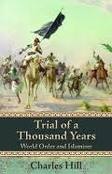
Trial of a Thousand Years, by Charles Hill—a review

Thursday, August 11th, 2011

 trial of thousand years

by J. Scott Shipman 

Trial of a Thousand Years, World Order and Islamism, by Charles Hill

Ambassador Charles Hill’s Grand Strategies, Literature, Statecraft, and World Order was the best book I read in 2010, so I had high expectations for this volume and was not disappointed. Ambassador Hill provides a 35,000-foot view of the relationships between the West and Islam in history focusing on the subtitle of his earlier work in the form of “world order.”

Unsurprisingly, as in Grand Strategies Hill goes back to the roots of modern order in the Treaty of Westphalia (1648). He provides a brief review of the world ushered in by the men who negotiated, and quotes another historian who said, “men who were laboring, each in his own way, for the termination of a terrible war. They had no idea of progress. The word “innovation” was anathema to them. The last thing on their minds was the creation of a new system of sovereign states…” Here we are 363 years later and “from the seeds sown at Westphalia” the system they set in place is has grown, but has been under siege many times from many fronts.

Westphalia was distinctive because it was “procedural, not substantive” and required a minimum number of procedures/practices to which to adhere and allowed disparate parties with different, “even mutually antagonistic, substantive doctrines and objectives” to work together. Hill points out four distinctions:

  • Religious arguments were not allowed in diplomacy.
  • The State was the fundamental entity.
  • Interstate/international norms and laws were encouraged, absent “divine sources” but based on mutually beneficial/positive agreements.
  • Use of professional military and diplomats with “its own set of protcols.” [Personal note: In another life, I was an arms control inspector enforcing the START I and INF Treaties—protocol was very serious and the true measure of the actual treaty language. There was also a strong and consistent application of reciprocity that made each party think before stretching protocol—this happened to my teams more than once.]

For Hill a central mission of the United States is the defense of the Westphalian world order. In less than 165 pages and six chapters, he outlines the origins of modern Western order and correspondingly covers Islamic order. From the beginning to the end Hill provides ample evidence of challenges to Westphalia, often from indigenous Western sources, but focusing mostly on our trials with Islam.

Hill sets the sources from whence the Western and Islamic world orders arose, where the West was grounded in Christianity, and the Islamic in the Caliphate. For two religions claiming Abrahamic roots, their worldviews were, and in many instances remain diametrically opposed. Central was the question of duality or unity. For the West, the State and religion were two complementary systems/powers—following the teaching of Christ ““Render unto Caesar the things which are Caesar’s, and unto God the things that are God’s” (St Matthew’s Gospel 22:21) For Islam there was no distinction, and the very thought was hateful to Islamists. Islam’s “unswerving devotion to monotheism” continues to this day among those groups and states using terror to upend existing world order.

I am sympathetic to Hill’s ideas; however recognize with globalization and the internet tweaks may be required. And I’ll take this segue to introduce an idea for consideration.

Westphalia’s removal of religion made trade possible among former religious enemies. Unambiguous rules for contracts and dispute resolution evolved. What if we could bridge the gap between Western jurisprudence and tribal, or non-Western legal systems? What if, instead of insisting our way or the highway we design a solution that would allow both sides to keep their respective legal processes and procedures, thereby opening untapped markets?

At least one person has already considered these alternatives. Michael Van Notten (1933-2002) was a practicing lawyer in the Netherlands and married into a Somali tribe. Van Notten used his legal training and insights gained as a member of his new family to design a method of contracting where tribal law and Western jurisprudence could peacefully and prosperously coexist. Van Notten recorded his ideas in a book called The Law of Somalis, A Stable Foundation for Economic Development in the Horn of Africa. I’ll not review this book, but wanted offer this as a teaser alternative.

After reviewing the history of the West and Islam, Hill identifies seven Clausewitzian centers of gravity for both: legal, military, the State, women, democracy, nuclear weapons, and values. Hill makes the distinction between the use of diplomacy by Islam and the Islamist (the fundamental variety). No surprises, to the Islamist a secular State is an “apostasy,” as is international law (Sharia being the single source), democracy and the rights of women.

Hill concludes, “Islamic civilization entered the international system under duress,” which he believes has contributed to the current situation of failing states and lagging economies that establish conditions where radicalized Islam can flourish. The radicalized elements reject the secular Westphalian world order, however Hill points out that some in Islam insist that sharia imposed by the state “cannot be the true law of Islam. It is not possible to apply sharia through the state; it can only be applied through acceptance by human beings (An-Na’im).” Another alternative is the Medina polity established by the Prophet (“later called the Pact—kitab—of Medina) “guaranteeing each tribe the right to follow its own religion and customs, imposing on all citizens rules designed to keep the overall peace, establishing a legal process by which the tribes settled purely internal matters themselves and ceded to Muhammad the authority to settle intertribal disputes…Although this document has been called the first written constitution, it was really more of a multiparty treaty” (Ansary).

Hill convincingly demonstrates that more often than not, rulers have co-opted Islam as a way to dominate the people (Iran comes to mind.). He quotes Professor L. Carl Brown of Princeton, “nothing exclusively “Islamic” about this Muslim attitude towards politics, any more than the politics of feudalism or of imperial Russia was distinctly “Christian.” It is the political legacy of Muslims, not the theology of Islam…”

For the Islamist, secularism is the booger man, but secularism in the Westphalian order has its own set of problems. Hill writes, “A new phenomena arose: wars motivated by religious convictions were replaced by wars driven by ideologies—surrogates for religion—each aimed to oppose, undermine, destroy and replace the Westphalian system. The greatest of these was international communism, the latest is international Islamism.”

In many respects, Trials is as good as Grand Strategies. Ambassador Hill is to be commended for his insight, courage, and conviction—this little book packs a big, enlightening punch. Strongest recommendation.

References you may find of interest (links to quoted authors above are links to the respective reference):

The Incoherence of the Philosophers, Abu Hamid Muhammed Al-Ghazali

The Crisis of Islamic Civilization, Ali A. Allawi

The Caliphate, Thomas W. Arnold

Sayyid Qutb and the Origins of Radical Islamism, John Calvert

Crimea: The Last Crusade, Orlando Figes —Figes’ The Whisperers was very good.

The Morality of Law, Lon L. Fuller

The Muqaddimah, Ibn Khaldun (Translated Franz Rosenthal)

The Clash of Empires: The Invention of China in Modern World Making, Lydia H. Liu

The Government of the Ottoman Empire in the time of Suleiman the Magnificent, Albert Lyber

Byzantine Civilization and The Fall of Constantinople, both by Steven Runciman

The First World War, Hew Strachan

Mozart and the Enlightenment; Truth, Virtue and Beauty in Mozart’s Operas Nicholas Till

Muslim Intellectual: A Study of Al-Ghazadi, W. Montgomery Watt

Dialectic of Enlightenment, Max Horkheimer and Theodor W. Adorno 


2083 Graphics — a first look

Sunday, July 24th, 2011

[ by Charles Cameron — index of graphics, first 800 or so pages of the “2083 European Declaration of Independence”, with some analysis ]

.

A great deal of work needs to be done on the 2083 European Declaration of Independence, and I thought a useful place to start would be a catalog of images.

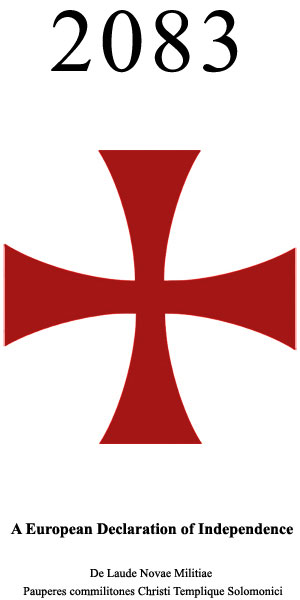
The document opens with a graphical title:

000-2083-cross-tp.jpg — title page —

That’s probably the largest single graphic in the entire work, and it puts the work squarely in the context of the Knights Templar — with e Templar cross and the full name of the order, “Pauperes commilitones Christi Templique Solomonic” or Poor Fellow-Soldiers of Christ and of the Temple of Solomon.  The Templars were a Western Christian chivalric order strongly associated with the Crusades — and the topic more recently of much historical, occult and fictional speculation.

The date 2083 is a date SFE (in the Science Fictional Era) as was 1984 before it — but it was almost certainly chosen for its echo of the 1683 Battle of Vienna, which is commonly taken to represent the turning back of the Ottomans by the Habsburgs, and thus the victory of Christendom over Islam.  Two maps show the Umayyad Conquests:

umayyad-conquests-p-228.jpg — p 228 —

and the Second Islamic Wave, turned back in Spain and at the gates of Vienna:

243-1683-second-islamic-wave-p-243.jpg — p 243 —

These can fruitfully be contrasted with a map of “tomorrow”:

demain-p-487.jpg — p 487 —

it being the author’s contention that France will be the first European country to fall to Islamic dhimmitude.  I suspect much the same is implied in this version of the French tricolore:

flag-face-p-781.jpg — p 781 —

There are some pointed attacks on leftist intellectuals:

033-academic-reform-p-33.jpg — p 33 —

and on media perceived as left-leaning, notably the BBC:

bbc-flag-w-crescent-p-384.jpg  — p 384

— that’s the Saudi flag mashed up with the BBC logo and star and crescent — and:

804-bbc-02-p-804.jpg  — p 804 —

giving both “ancient” and “modern” variants on the theme…

There are some strange items which I’ll drop in here for a breath of fresh air…

free-pluto-equal-gravity-for-all-planets-p-381.jpg  — p 381 —

which appears to be a commentary on the respective attractions of Venus and Mars, since it’s situated in a commentary on Feminism…

this really is a strangely mythic document… and…

global-warming-voidka-p-657.jpg

with its reference to “mind control agents” — and those whose minds have been controlled are clearly sheep:

wake-up-p-803.jpg — p 803 —

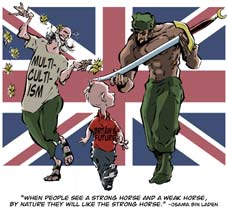
which may be the right moment to mention that the British, too, come in for a measure of contempt, via a quotation from none other than Osama bin Laden:

when-people-see-a-strong-horse-p-707.jpg  — p 707 —

“When people see a strong horse and a weak horse, by nature they will like the strong horse”.  Perhaps its unsurprising that the author is something of an admirer of bin Laden’s means, if not his ends.

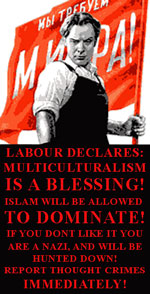
Of course, that’s largely the fault of the Labour party:

labour-declares-multiculturalism-is-a-blessing-p-373.jpg

But that’s probably enough for one post — in my next, I’ll consider how weak we are, what the jihadist strategy against us is, and how the new Templars hope to turn the tide

against:

worst-threats-to-mankind-p-674.jpg — p 674 —

the worst threats to mankind.

The East Rising

Sunday, July 3rd, 2011

Gifts from a generous Meatball:


Hardcovers too. Nice.

The Party: The Secret World of China’s Communist Rulers by Richard McGregor

Monsoon: The Indian Ocean and the Future of American Power by Robert D. Kaplan

I have already dived a few chapters into the McGregor book and it is very good. What makes it good is that is running counter to the message of the herd in terms of popular Sinology, which is to emphasize that China is a) uniquely Chinese with deeply introspective Confucian civilizational traditions (that’s modern PC-speak for “inscrutable”) and b) the brave new world of liberal, globalized, capitalism with a benign technocratic face.

Now there’s important truths in both of the popular mass messages on China, incompatible as they can be with one another. The economic rise of China in a globalized economy is the most important story of the last quarter of the 20th century and the first quarter of the 21st ( collapse of the USSR is second; the Soviets were beaten before they imploded and imploded largely because they knew they were beaten). China is also not like America, not even when they imported stock options, blue jeans, McDonald’s and the American jobs that used to create all those things. China’s civilization is truly of a dizzying depth, complexity and scale that is best compared to Europe rather than a specific country. That in itself, is important because it points to how ignorant the average American policy maker is, never mind the average American, about what makes their Chinese counterpart tick.

[ Sidebar: Perhaps the Obama administration assembling a new senior “China/East Asia” diplomatic and national security team that does not include a single official with any professional knowledge of China was unwise? How is that better than the Bush II administration shunning Arabists during the run up to and occupation of Iraq? It is not that these diplomats and officers are poor, they are smart and experienced, but none of them are China specialists. Or Japan specialists, for that matter and only one has expertise in Korean affairs. These are the region’s great powers! This is like turning EU/NATO policy over to diplomats who speak Hindi and Swahili ]

What McGregor is doing in The Party that is important is reminding Westerners that the Soviet experience, particularly the Leninist Party model, is still deeply embedded in China’s political DNA. Not in an ideologically Marxist, Khrushchevian, shoe-pounding sense but in a functional sense. In a structural sense. In an instrumental governance sense. In a networking theory sense. And all these characteristics, which are largely innately hostile or indifferent to the values of liberal democracy, continue to shape Chinese policy, leadership succession, national security, defense strategy and geopolitical outlook to this day.

That doesn’t mean China is itching for a war with the United States, but it means they are playing a longitudinal strategic game where the first goal is to stay in power forever and the next is to advance one’s position relative to others.

We are the other.

China is not an enemy but she is no friend or ally of the United States either, yet it is the most important relationship the US has to manage for the next thirty years – and that relationship in a strategic context with rising India, Japan, South Korea and Australia.

It might help if America brought a team to the table that included people who could tell Han Fei Tzu from Mencius or spoke Chinese.

Announcements!

Tuesday, March 29th, 2011

A busy day for blogfriends and associates….want to draw your attention to a few highlights:

First, congratulations to Matt Armstrong of MountainRunner on his new appointment as Executive Director of the US Advisory Commission on Public Diplomacy. It’s hard to think of anyone better qualified than Matt!

There is a new Executive Director of the US Advisory Commission on Public Diplomacy

The U.S. Advisory Commission on Public Diplomacy is charged with appraising U.S. Government activities intended to understand, inform, and influence foreign publics. The Commission formulates and recommends to the President, the Secretary of State, and Members of Congress policies and programs to carry out the public diplomacy functions vested in the State Department, Broadcasting Board of Governors, and other government agencies, as well as appraising the effectiveness of the public diplomacy policies and programs carried out by government agencies.

There are seven members on the Commission, with “not more than four members may be from one political party.” In February, the White House sent to the Senate four nominations for the Commission.

Today, Matt Armstrong, author and publisher of MountainRunner.us, was sworn in as the Executive Director of the Advisory Commission. The immediate impact is the suspension of blogging, including the publishing of guest posts, at MountainRunner.us.

Secondly, Steven Pressfield has a new book out, titled Do The Work, in Kindle format and, for a limited time, it is free! One of the great things about Steve is that as an author, he gives back to his readership in myriad ways and isn’t afraid to break new ground:

A Publishing First: General Electric sponsorship for a Best Selling Author’s latest book

Never before done in the history of the publishing industry has this been done before (as far as we know, and we’ve checked) and we are so proud to be offering this phenomenal opportunity to our readership and the world.

General Electric has become our “Launch a Book” sponsor for  Do the Work, our latest release from The Domino Project.

What this means for you, the reader, is that you have access to the digital edition of this book for FREE. It won’t be free forever, so you should act now to grab your free copy. Order it here and it will be automatically delivered on pub date. You can read it on a Kindle, an iPad, an iPhone a PC and more. (If you already ordered your copy, your payment will be credited back to you…

Dr. Thomas P.M. Barnett threw some props my way for the Wikistrat futurist simulation on Turkey and managed to find a few sentences from my section that were non-abstruse and jargon-free 🙂 . The nice thing about the analytical process at Wikistrat is that people can grasp the part of the scenario where their strengths are emphasized ( I looked at possible external strategic options and impacts and left Turkish internals to those who could better drill-down):

Turkey – Re-Rise of the Ottoman Empire?

One of the most interesting things we do in Wikistrat is Scenario Planning. Through the use of live collaborative simulations, our analysts and subscribers alike engage in the mapping of scenarios, country interests and policy options on a given issue. We ran such drills on Egypt (The Egypt War Room) and on the “Sudden death of Kim Jong Il“.

Our current Simulation is on Turkey, and deals with its political and economic rise in the Middle East, its implications and potential pathways. So far several interesting scenarios were mapped, as well as interests and policy objectives for major regional and global powers affected by Turkey’s Rise.

Essentially we ask – Will Turkey’s rise continue? Will its relations with the West deteriorate given its “Shift eastward”? And- How should the US, the EU, Israel, Iran and the KSA react? [….]

Join Wikistrat


Switch to our mobile site