zenpundit.com » globalization

Archive for the ‘globalization’ Category

Stocking Stuffers……

Saturday, December 12th, 2009

In a burst of raw self-interest – and also a little love for my blogfriends – these books make nifty gifts for any war nerd or deep thinker on your Christmas list:

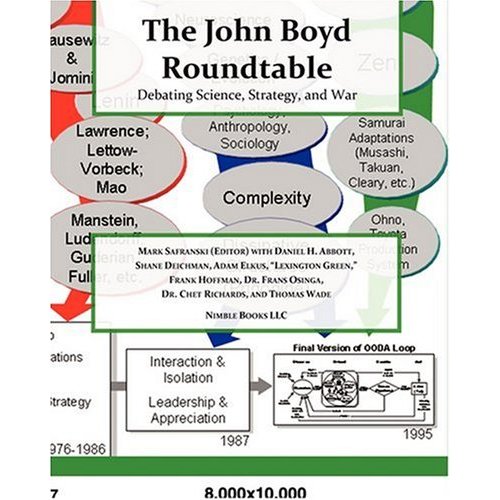
The John Boyd Roundtable: Debating Science, Strategy, and War – Mark Safranski (Ed.)


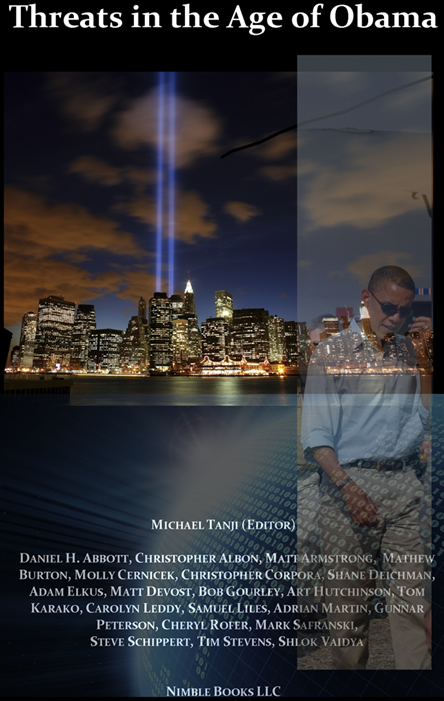
Threats in the Age of Obama – Michael Tanji (Ed.)

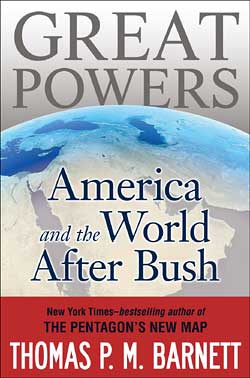
Great Powers: America and the World After Bush – Thomas P.M. Barnett

Brave New War: The Next Stage of Terrorism and the End of Globalization – John Robb

Science, Strategy and War: The Strategic Theory of John Boyd – Frans Osinga


The Genius of the Beast: A Radical Re-Vision of Capitalism  by Howard Bloom

Intelligence and How to Get It: Why Schools and Cultures Count  by Richard Nisbett

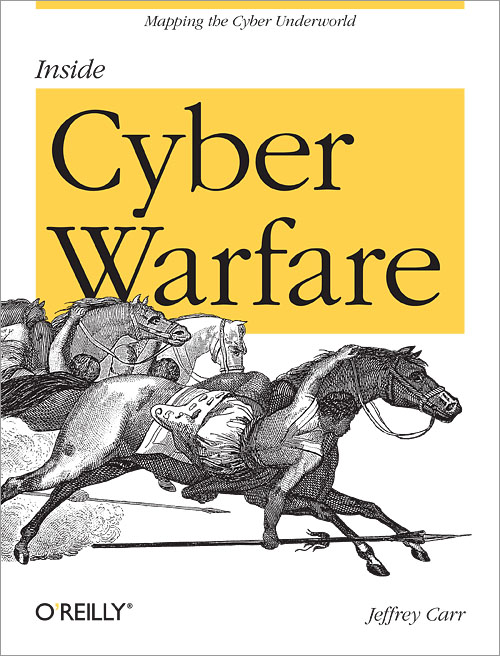
Inside Cyber Warfare: Mapping the Cyber Underworld  by Jeffrey Carr

This Is for the Mara Salvatrucha: Inside the MS-13, America’s Most Violent Gang  by Samuel Logan

Full Disclosure:

In copmpliance with new Federal regulations of dubious Constitutional merit, I hearby declare ZP does not accept money for publishing reviews or any paid advertising. Courtesy review copies were extended to me by authors or publishers acting on behalf of Sam Logan, Tom Barnett and Jeff Carr. I edited the first book in this post and was a contributing author to the second one. All of the books, with the exception of Cyber Warfare have been the subject of prior reviews or posts at ZP.

Still too Busy to Blog Properly….But Hey, Look What I’m Reading!

Tuesday, November 24th, 2009

Were it not for guest posts, November would have seemed like I went on hiatus 🙂  Normal blogging will resume in a few weeks.

I did find time to pick up a few new books to read in the late hours of the night, one of which will be the subject of a book review by a new guest poster.


The Genius of the Beast: A Radical Re-Vision of Capitalism by Howard Bloom

The Shia Revival: How Conflicts within Islam Will Shape the Future by Vali Nasr

Nixonland: The Rise of a President and the Fracturing of America  by Rick Perlstein

The only thing these three tomes have in common is that the authors have a penchant for contradicting conventional wisdom, at least to a degree. 

Howard Bloom is an offbeat, pop science to pop culture master of horizontal thinking whose earlier work, Global Brain, I very much enjoyed and highly recommend. Bloom’s intellectual reach is first rate and he is one of the few writers who can take very difficult concepts from wildly disparate fields and tie them together for a lay audience with comprehensible analogies and anecdotes .

I put Vali Nasr’s The Shia Revival on my list back after the high praise Thomas P.M. Barnett gave Nasr in his book, Great Powers – in my experience, Tom does not hand out comments of “brilliant” all that often ( Great Powers, BTW, is also a “must read” book for those interested in strategy and geoeconomics). I am approximately 80 pages in to The Shia Revival and I will say that as a writer, Nasr does not waste time getting to key points in explaining his subject – concise but not simplified.

Rick Perlstein, while far to the Left, has the uncommon quality among leftwingers of working very, very hard at the scholarship of attempting to understand conservatism and leading conservatives ( must be a legacy of attending the University of Chicago). Much like Orangemen in Ulster, eavesdropping on a Catholic mass, I suspect the essence of conservatism eludes Perlstein, but at least he takes the ideas seriously.  That Richard Nixon is Perlstein’s subject is an added draw, since Nixon’s foreign policy was an area of historical research for me. Very interested to see how Perlstein’s take on Richard Nixon compares to that of Robert Dallek and Richard Reeves.

“Let me make one thing perfectly clear….”

Excess Complexity is the Route to Extinction

Friday, April 10th, 2009


Nassim Nicholas Taleb, author of The Black Swan: The Impact of the Highly Improbable and Fooled by Randomness: The Hidden Role of Chance in Life and in the Markets, had an op-ed in FT.com entitled “Ten principles for a Black Swan-proof world” (Hat tip to John Robb and Pundita). Taleb was addressing the global economic crisis, but I was particularly drawn to Taleb’s fifth principle, which has a more general implication:

5. Counter-balance complexity with simplicity. Complexity from globalisation and highly networked economic life needs to be countered by simplicity in financial products. The complex economy is already a form of leverage: the leverage of efficiency. Such systems survive thanks to slack and redundancy; adding debt produces wild and dangerous gyrations and leaves no room for error. Capitalism cannot avoid fads and bubbles: equity bubbles (as in 2000) have proved to be mild; debt bubbles are vicious.

Taleb has encapsulated many important concepts very well here. Up to a certain point, increasing complexity represents a advantage for an evolving system (biological, financial, physical etc.) by increasing efficiency through adding specialization, interconnection, diversification, redundancy and checks for mitigation of risks. Complexity, in the earlier part of a development curve can add to a system’s overall resiliency – to a point.

Superfluous complexity, that which goes beyond the minimum required for additional gains in systemic efficiency or productivity, is a net drag on the system, an economic waste, a source of friction, a cancer,  a useless eater of resources and the earliest sign of the system’s inevitable decay. Worse, excess complexity represents an increasing probability of systemic failure by multiplying the number of variables involved in the normal process of the system. There are more things that can go wrong and more choke points where a catastrophic failure can occur. Increasing the degree of complexity moves the system away from simplicity and reliability and toward chaos and the creativity of emergent properties, but like an ice skater seeking ever greater range, go too far and the ice will crack under one’s feet.

This is an effect familiar to engineers and scientists but one that appears to escape the majority of politicians, corporate executives and economists. My co-blogger at Chicago Boyz, Shannon Love,  took GE to task for trying to get on the Federal dole by advocating needlessly complicating the nation’s power grid:

If Your Grid Had a Brain

GE is advertising to build political support for Obama’s plan to purchase billions of dollars of GE tech in order to make the power grid “smart”.  After all, who would want a “dumb” anything when they could have a “smart” something? 

The reason we should keep things dumb is that in engineering the word “dumb” has a different connotation. In engineering, “dumb” means simple and reliable. 

Increasing complexity in any networked system increases possible points of failure. Worse, the more interconnected the system, i.e., the more any single component affects any other randomly selected component in the system, the faster point-failures spread to the entire system. Power grids are massively interconnected. Every blackout starts with a seemingly trivial problem that, like a pebble failing on a mountain side, triggers an avalanche of failure. 

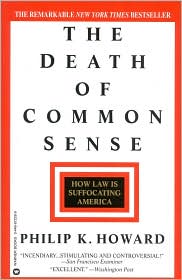
In the social and political domain, back in the 1990’s Philip K. Howard wrote a book called The Death of Common Sense: How Law is Suffocating America in which he detailed example after example of how the overlawyering of regulatory systems in America by an emerging and hyper-aggressive legal class was producing neither restraint on government abuses nor fine-tuned social outcomes but instead created a state of paralyzed rigidity, risk aversion, perverse incentives and general dysfunction; in other words, chaos instead of order.
The Obama-ites in the White House are not “socialists” ( at least not most of them) but there is a great love of liberal-minded technocracy there, and a seemingly boundless self-confidence in the ability of high-minded, upper-middle class, progressive, wonks and lawyers from the “good schools” (or investment houses – in some cases, both) to micromanage not just our lives for us, or even the United States of America but the global economy itself. Sort of a Superempowered Oligarchy of Good Feelings.

The ancient Greeks had a word for that: hubris. More importantly, the Obama-ites are wrong here – adding endless amounts of regulatory complexity is not going to give them the kind of granular control or positive returns that they seek to obtain from the system. Counterintuitively, they should be radically simplifying where and to the degree they safely can instead.
The U.S. is Not Going to Disengage from the Mideast

Tuesday, December 16th, 2008

Dave Schuler of the Glittering Eye is involved in a formal debate at Outside the Beltway with Dr. Bernard Finel over the role of the United States in the Mideast. Dr. Finel is arguing for a grand bug-out, or at least a serious reduction in “footprint” and “fingerprint”, and Dave is going to argue the negative.

Here is the introduction by Dave:

Pulling Out: Debating Middle East Disengagement (Intro)

One of my common patterns of thought is to frame any given proposition as a debate proposal, I did so in this specific context, and said as much in the comments to the post. Dr Finel was kind of enough to respond to my comment with enthusiasm, welcoming a debate with me on the subject.

Over the next week or so we’ll be debating the following proposition:

Resolved: that the United States should disengage from the Middle East

Dr. Finel will make the affirmative case; I will provide the negative.

Dr. Finel’s affirmative case will be posted in the next day or so; it will be followed by my cross-examination; I’ll state my negative case; Dr. Finel will cross-examine me; and so on.

Debating is a form seen only occasionally in the blogosphere and I think this is an exciting project. The longer format, extending over multiple posts, will enable us to explore the subject in more detail than is usually found in the hit-and-run blog post. It’s an important topic and, regardless of the immediate situations in Iraq and Afghanistan, is worthy of substantial reflection, rarely seen as a consequence of the poverty of our public discourse which is mainly limited to headlines, op-eds, and sound bites and is often enmeshed in partisan squabbling.

Dr. Finel, who is a senior fellow at the American Security Project, has opened with the following post:

Pulling Out: Debating Middle East Disengagement (Affirmative)

….The second issue is oil. The U.S. presence in the Middle East does serve to reduce some of the risks associated with the Western world’s reliances on Middle Eastern oil. It does not lower the cost necessarily, but it may reduce some potential for volatility in supply. But the cost of this risk mitigation is tremendous. We pay for lowering the supply risk with increased risk of terrorist attacks, greater hostility from the Arab population, and the costs of men and materiel associated with military commitments. Are there other ways to reduce those risks? Of course there are. They include investments in alternative energy, oil exporation at home, better fuel efficiency from cars. Certainly those are costly measures in the short-run, but so is deep involvement in a volatile region. In the long-run, the calculus is easy. Energy independence is a strategic imperative.

This excerpt shortchanges the breadth of Finel’s argument, which you should read in full here.

First, I’d like to commend both gentlemen for making use of the formal debate method. Construction of a reasoned argument in a civil debate is the blogosphere at it’s best. I intend to follow this debate as it evolves.

I know Dave to be a deeply thoughtful, well informed and even tempered commentator. I do not know Dr. Finel, though his c.v. seems impressive to me and he probably has a number of interesting things to say on terrorism policy. As a strategist however, he is not winning me over, though in terms of tactics, he accurately identifies many points of irritation that traditional U.S. policy has for the Arab World. The answer for that irritant is not amputation.

The thesis that regions of the world will move to a better state of polity with an absence of American presence or influence is not “counterintuitive” as Finel suggests – it’s a position lacking in real world evidence. The world’s absolute worst regimes have the least interaction with the United States or with globalization and movements like Islamism have intrinsic drivers, not simple Act-React mechanisms.

Alternate energy sources are a long term – a very long term – solution. In terms of technological application with immediate policy effect, it is the equivalent of Edward Teller’s vision of SDI in 1987. By all means, invest in alternative energy but even throwing $ 100 billion at the problem in fiscal year 2009 is not going to disconnect the United States, much less the West, from oil in 2010 or even 2020. Any reduction in our own oil consumption by the use of alternate energy sources in coming decades will more than be made up by rising Asian demand and the Gulf will increase, rather than decrease, in importance as a geopolitical “choke point”.

Mandelbrot and Taleb on the Economic Crisis

Thursday, October 23rd, 2008

Go here.  Hat tip to Chadmalik.

They are talking not “Great Depression” but a system perturbation  on an epochal scale that causes an economic Black Hole.

Makes John Robb look like Pollyana on antidepressants.


Switch to our mobile site