[ by Charles Cameron — Universities hither and yon, illustrating Matthew 25:29 and it clearly still is news ]
.
Celebrated cellist Yo-Yo Ma, and acclaimed astronomer Professor Andrea Ghez were among the recipients of honorary degrees at Encaenia..
News below from my alma mater, the University of Oxford
**
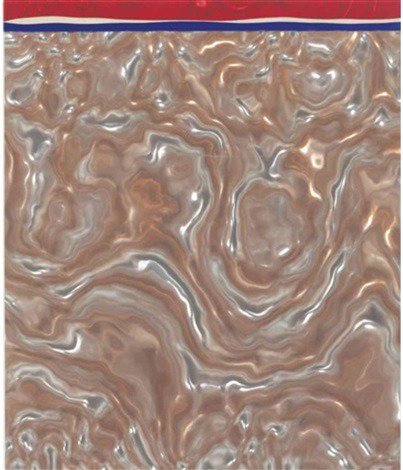
It’s worth noting that the gift to the humanities (top panel, above), though smaller than that to the sciences (lower panel), is to the University of Oxford itself, whereas the gift to the sciences, though larger, is to the city of Oxford.
But Oxford — city with university, town and gown — benefits in both cases.
**
Contrast that with the University of Alaska:
My hope here would be for the university to prioritize the full continuation of its unique services – the indigenous language and arctic climate change programs — all else is covered elsewhere..
**
A Biblical explanation:
For unto every one that hath shall be given, and he shall have abundance: but from him that hath not shall be taken away even that which he hath.
[ by Charles Cameron — bright and dancing Bach — a cantata to give you the fresh spirit of Il Gardellino, then the great Mass in B Minor in their brilliant version ]
.
J.S. Bach: Cantata “Wir müssen durch viel Trübsal” BWV 146:
This recording fairly leaps out at you, it’s so crisp and dance-like! Brilliant!
**
And then, enthused by that magnificent cantata, here’s the B Minor Mass in all its glory, with voices that have been hidden, unheard, in all the other renderings I’ve heard — and I love the Corboz, for instance — and those inner voices, clear as bells..
And if your Sunday evening is almost gone, bookmark this post and return to it when you have time — such a fine performance of one of the three or four greatest sacred choral works in the Western tradition!
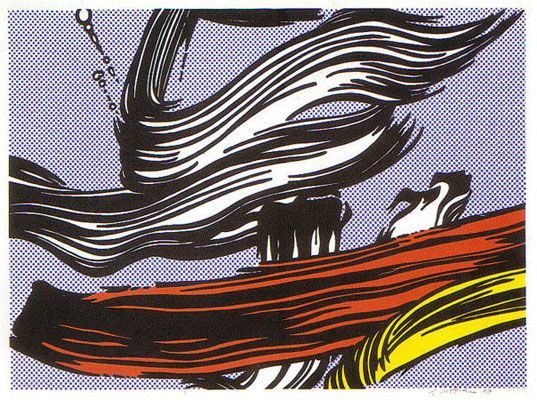
But that’s too easily “cool” to impress me much. Far more interesting is his painting of painting:
He’s still doing a blow-up, in this case even more extreme than in his comic-book blow up Whaam, above — but this time it’s self-conscious, a painter taking paint for his subject, a serpent biting its own tail you might say, an exemplary ouroboros.
**
And in the course of my quick search for Lichtenstein images, I also found this, which interests me as, potentially, an image of multiple musical voices intersecting and separating — a strange, wave-like form of polyphony:
This in turn reminds me of the “wavy music” in Reynolds Stone‘s bookplate for my aunt Esther:
**
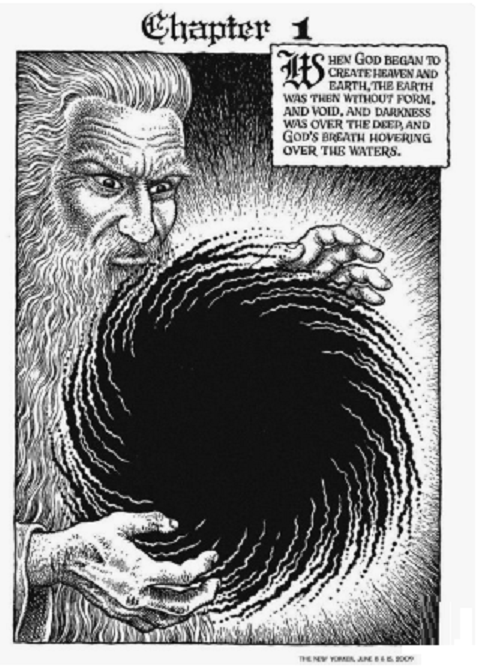
But to return to that first image:
That’s an astonishing image of tohu-bohu, the “formless and void” just before creation as envisaged in Genesis. And here’s my point:
This image is both patterned (with formal properties) and abstract (formless), as befits that great mirror in which all forms arise and fade away, and thus a superb image for complexity, which is both patterned like overlapping waves, and swirling beyond our comprehension..
[ by Charles Cameron — the ability to recognize similarities across wide conceptual or memory distances is what Cindy Storer calls “magic” in analytic practice — here we examine it in terms of advertising ]
.
You could almost learn how to write poetry by watching the commercials on TV — or learn a bit more about how the ads themselves work.. come have some fun.
Consider rhyme for a moment. There’s a rhyme between the car that’s too small for comfort and the shoe that’s too tight to fit in this ad, and there’s an analogy between the larger, more comfortable — luxurious, even — car and the wide and comfortable — “like a luxury ride for my feet” — Skechers wide fit shoes that the ad is all about:
The rhyme here between today’s American fisherman and his Irish fisherman ancestor is stunning — and plausible. This, after all, is genetics, which is often said to rhyme from one generation to another:
And even when the analogy between an image and the product it’s supposed to resemble (“rhyme with”) is weak, making a successful rhyme between two such images is a delight in itself, and makes the weak rhyme seem plausible. Here, a two-thirds shaved dog rhymes with a two-thirds mowed lawn:
Allstate piles the rhymes on — drawing on powerful similarities between widely different parts of the country — in its brilliant Park Road / Street / Avenue commercial:
Here’s a beautiful rhyme between cement and sand — it’s not so great to find you’ve stepped unexpectedly in wet cement — but what a delight to feel sand on the beach between your toes!
Look, Exxon wants to make it’s industrial plants more closely resemble living, breathing, green plants: it’s not a bad idea, laudable really — but the rhyme is a bit of a stretch, eh?
**
One form of rhyme that’s worth noting falls under the heading of Opposites:
In this case, the equation would be something like blue plus red equals unbiased. I haven’t checked the product, but the math is clean, and the divide the ad bridges is very real and quite perilous for democracy:
So opposites can be powerful. But it’s worth considering, too, the mind-numbing effect of seeing opposing commercials:
That’s not the kind of opposition you want if you’re Roundup, but exactly the kind of opposition you seek if you’re the legal opposition!
**
Rhyming — twinning — as it’s dreamed up in the creative agencies of Madison Avenue, and no doubt Madison Wisconsin too, requires horizontal, associative thinking — thinking based on pattern recognition, thinking that makes creative leaps where similarities can be found in the midst of difference. Metaphors and analogies are woven of the same kind of thinking, rhyme in poetry, graphic match or match cut in enema, canon and fugue in music — and it’s the type of thinking my HipBone Games are designed to teach and practice, until they’re strong reflexes in your intellectual arsenal.
When readers or movie-goers, or just people watching commercials on TV, recognize patterns or rhymes — shaving a dog, then mowing a lawn, okay — it may elicit a chuckle the first time you see the ad, but you’re not sitting there to learn about dogs or lawns, or even Flonase unless you happen to need that kind of medicine. No, you’re there to see the next installment of the movie you’re watching, the next entertainment — which was almost certainly put together with less cash and care per minute or per frame than the commercials that slip into your mind almost subcutaneously.
And analogy — this type of analogical thinking — works. Analogy is the very heart of magic:
**
Do you have time for another example?
Here we have analogy across time, as we did in the case of the Donegal fisherman, but this time woven into the telling of a very simple short story: he wants a Heineken, looks in the fridge, no luck, goes out onto the street, flags down a cab, takes a short ride, steps down from his Hackney Carriage about a century earlier, and gets the Heineken he was looking for. Plus ça change!
The Heineken’s the same — the six-pack at the end is the essence of difference!
[ by Charles Cameron — Krishna’s flute, evoked by a commercials videographer’s eye — brilliant! ]
.
Let me remind you again: real magic is simplicity itself:
Especially if you are a Hindu with strong devotion to Lord Krishna, but even so if you are secular, or the holder of some other faith or practice — there’s magic in this simple hand-gesture, conjuring the flute with which Krishna lures the lovely Radha to his side:
Photo: Jeremy Hunter
Simplicity is the essence of elegance!
**
And since this is a series on advertising and magic — what, you might wish to know, is the advertising connection here?
Well, “to borrow a leaf from his bio, photographer JEREMY HUNTER began his career in advertising — as a television creative, working for Young and Rubicam, Leo Burnett, Ogilvy and Bates, and winning a number of international awards in Cannes, Venice, New York and Los Angeles along the way.
Zenpundit is a blog dedicated to exploring the intersections of foreign policy, history, military theory, national security,strategic thinking, futurism, cognition and a number of other esoteric pursuits.