zenpundit.com » extremists

Archive for the ‘extremists’ Category

Egypt: the jihad’s receding tide?

Saturday, February 5th, 2011

[ by Charles Cameron — cross-posted from Chicago Boyz ]

Here’s the evidence I’m seeing for one hopeful outcome…

From an Egyptian FaceBook page:

I will NOT accept that religious groups hijack what we have been doing for their own agenda. A large group of the ones organizing them yesterday were people in galabeyas and long beards shouting “Al Jihad fe Sabeel Allah (Jihad in the name of Allah), you have to continue fighting, we will win this war, if you die here today, you will be a martyr and go straight to heaven, don’t stop, fight, fight, fight”. NO! This is NOT why we were in the streets on Friday being tear gassed and dodging rubber bullets and it is not why we have been going to Tahrir everyday to be heard. The reason why this revolt went through and became successful was because it was not religiously or politically charged.

quoted on the The International Centre For The Study Of Radicalisation blog – ICSR is a joint venture between King’s College London, the University of Pennsylvania, Israel’s Interdisciplinary Center, Herzliya, and the Jordan Institute of Diplomacy.

*

This DoubleQuote first presents a jihadist spin on things, from a legal team member at Minbar al-Tawhid wa’l-Jihad, in Quote #1:
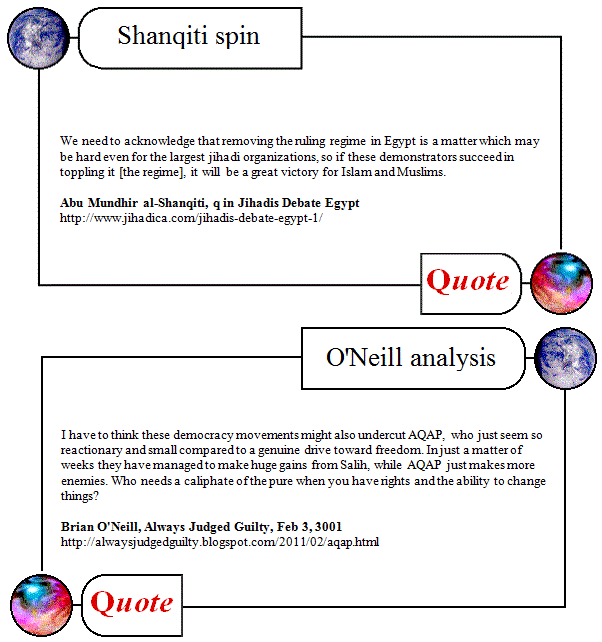
Below that, and lending it both context and irony, is a comment from one of our best analysts of the situation in the Yemen, a former editor for the Yemen Observer.

*

John Robb gives the same general message a little strategic push…

What’s the best way to defuse Islamic radicalism across the ME and beyond? Help make the protest in Egypt work.

.
Sources: ICSRShanqitiO’NeillRobb Feb. 3, 2011.

DoubleQuotes and Questions

Friday, January 28th, 2011

[ by Charles Cameron ]

You know, I really enjoy building my DoubleQuotes. They can be entirely frivolous, as is this one, for instance:

with its touch of gothic — a taste I share with my friend Bryan Alexander.

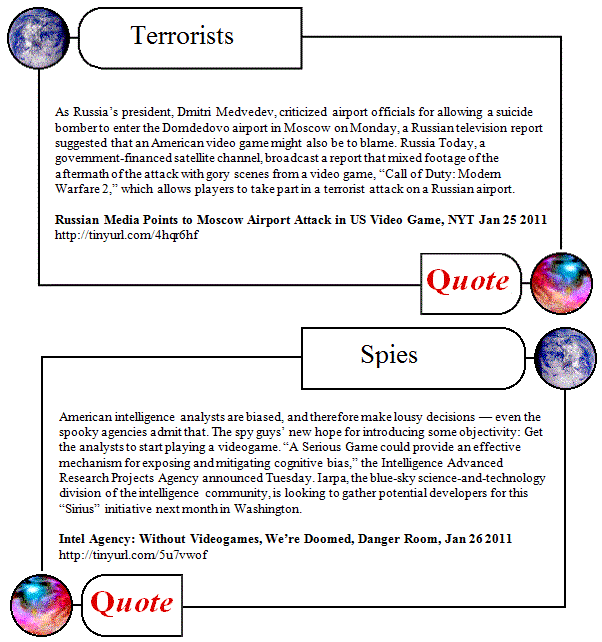
Or they can work like a Necker cube, offering opposite framings with which to view a single topic — in this case, video games.

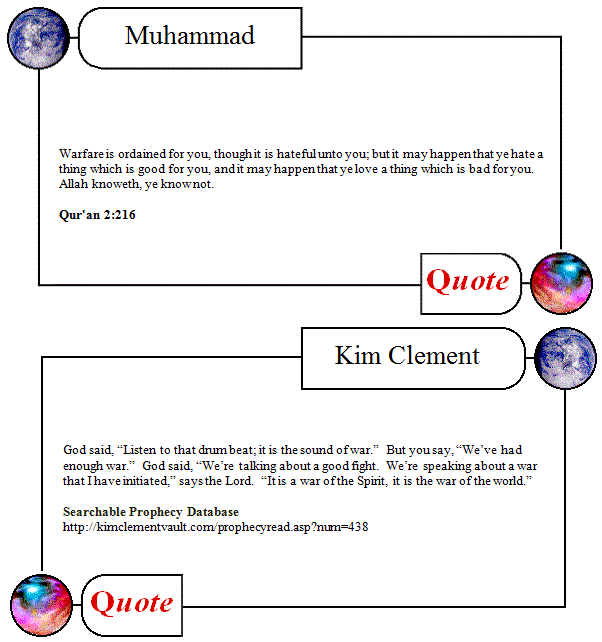
They can also work like Rorschach blots — this one compares two prophecies, one from the Quran and one from a contemporary Christian prophet (if I’m not mistaken, President Obama quoted him recently) —

— but it is left up to the reader to determine the value of each…

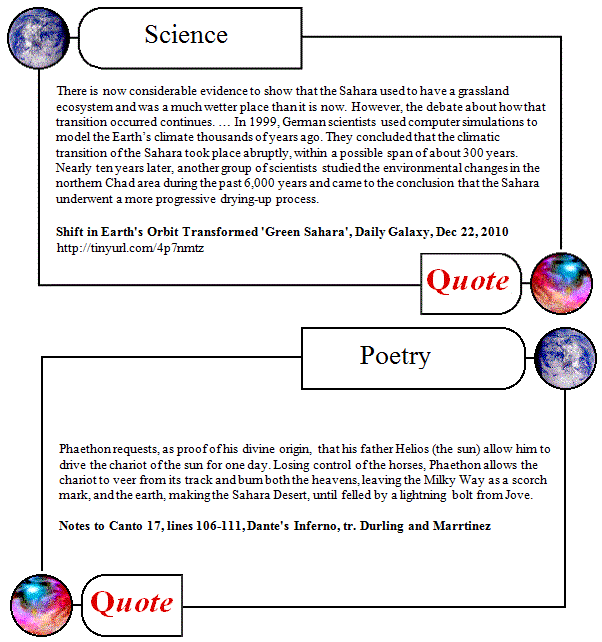
And they can also pose fundamental questions of preference:

Has science simply replaced myth, d’you think? or is science for the facts, perhaps, and the mind — while poetry and myth are for the heart, and truth?

Off-Base

Thursday, January 27th, 2011

Dr.David Ucko at the excellent Kings of War blog has his story and he is sticking to it:

The Weather Underground: a different approach to political violence

I recently watched The Weather Underground, a 2002 documentary on the eponymous radical organisation active within the United States during the 1970s. The film may be of interest to those studying radicalisation, insurgency and political violence, as it effectively explores the rise, evolution and demise of a revolutionary organisation. It also raises some semantic/ethical questions about ‘who is a terrorist’.

….The use of violence for political messaging may be viewed as ‘terrorism’, and this is typically how the Weather Underground is understood. But is this accurate? Terrorist groups deliberately target civilians to scare or terrorise wider populations into a certain political behaviour. The WUO refrained from such action: they used violence against buildings rather than people, to symbolise their discontent with specific policies and actions, but without killing those held responsible. It was ‘propaganda of the deed’, but without the bloodshed. Accordingly, none of WUO’s attacks resulted in casualties (the one exception has not been definitively linked to the group), and for this reason alone, it is difficult to call WUO a ‘terrorist’ organisation.

Uh, no it isn’t. As the commenters at KoW are busy trying to inform Ucko, this narrative does not fit the facts of the history of the Weathermen.

David, I suspect, is not trying to romanticize the Weathermen here so much as force-fit them into his theoretical model of terrorism, possibly influenced by a tactical turn that was undertaken by the IRA to drive up financial costs for the British government while minimizing the bad press that and damage to their public image that had been growing from earlier, bloody, IRA bombings.

Of Anwar al-Awlaki and Bold Christian Clothing

Monday, January 24th, 2011

[ by Charles Cameron ]

I am, admittedly, very interested in religion, and Christianity has been the mother-lode for me of the imagery, gestures and profound words that can move heart, soul, mind and imagination into a greater depth.

Advertising, on the other hand… well, let’s just say that the best of it plays on imagination, too, but it is generally more of an intrusion upon – via billboards on landscapes, via commercials in movies, or via irritating jingles and catch phrases that subvert my best attempts at quieting the mind – than an experience of the kind of depth that religion at its best can offer.

But if you are interested in religion, and click online in enough of the right places, advertising that has “religious” content will be targeted to you.

*

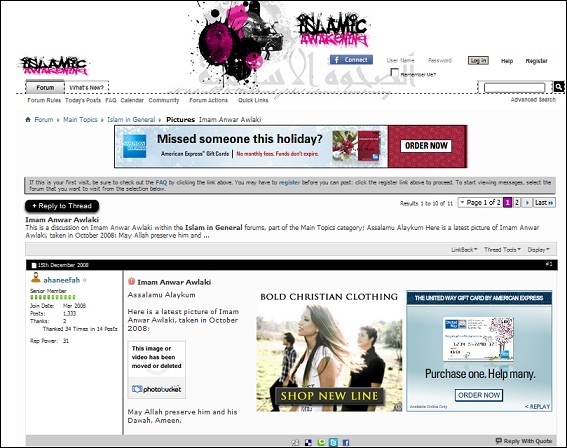
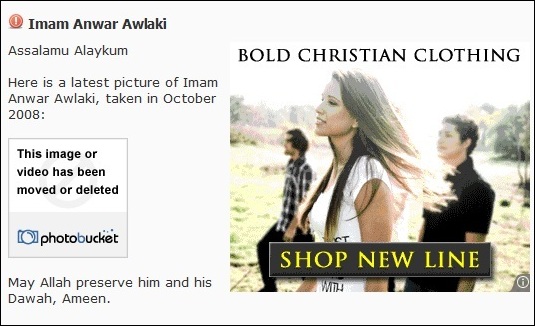
And so it is that I went online this morning to check out something about al-Awlaki on Islamic Awakening, an American jihadist forum, and found myself invited to consider, instead, wearing some “bold Christian clothing”.

This was while I was researching al-Awlaki, right? the Muslim jihadist preacher?

at:

a site with its own curious graphics…

And looking closer at that logo, isn’t that some sort of triumphalist armored vehicle I see?

*

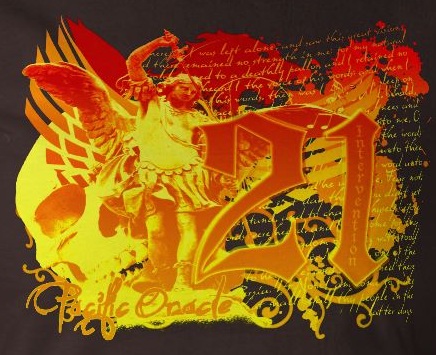
Well, never averse to a pretty girl, and noticing the one in the Bold Christian ad, I thought I’d taker a look at Bold Christian Clothing to find out what sort of fashion sense was popular among the younger Christian set just now, and found I could obtain t-shirts with such comforting images as these…

— this one’s symbolic of our relatively new century, I guess…

or this:

which I am praeternaturally fond of since my online moniker is hipbone, with its veiled reference to the Valley of the Dry Bones in that very same chapter 37 of Ezekiel…

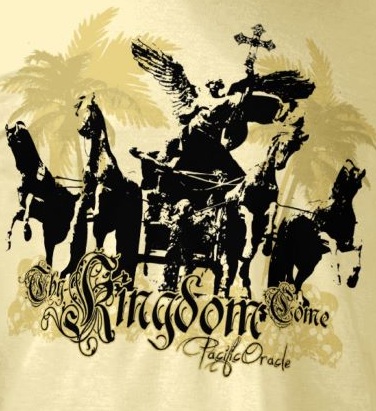
and then there’s this masterfully supremacist rendering of a part of the Lord’s Prayer:

which I must admit isn’t the image of Thy Kingdom Come that springs to mind when I personally hope and pray for heaven on earth.

What exactly is it, you may ask? According to the manufacturer, it’s

The Lord’s Prayer — “Thy Kingdom Come” with an Angel holding the cross, Horses, skulls under the horses, and palm trees (with Shield and Pacific Oracle cross logo added)

It’s also “the softest, smoothest shirt we sell” … “made from combed cotton for your added comfort” and gives “a flattering and stylish fit to virtually any body type”.

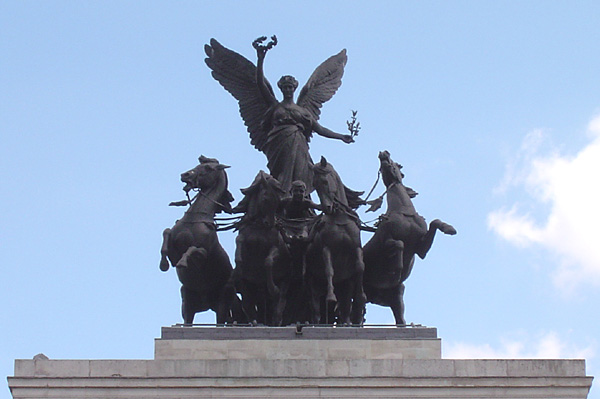
I on the other hand think it looks more like a photoshopped variant of the Quadringa statue in London that celebrates Wellington’s victory over Napoleon at Waterloo:

*

In light of all this, I do believe I’ll just wear white – although even that could be misinterpreted, I guess.

“Whoever took religion seriously?”

Saturday, January 8th, 2011

[ by Charles Cameron — cross-posted from the DIME/PMESII boards at LinkedIn ]

I’ve been hammering away at the importance of a nuanced understanding of religious drivers in successful modeling of our world, and today I ran across some paragraphs from a book by Gary Sick that explain, forcefully and briefly, just why this seems like a big deal to me.

1

Sick, who was the National Security Council’s point man on Iran at the time of the Ayatollah Khomeini‘s Iranian Revolution, recounts how totally unprepared we were for the sudden emergence of a theocracy in his book, All Fall Down:

Vision is influenced by expectations, and perceptions — especially in politics — are colored by the models and analogies all of us carry in our heads. Unfortunately, there were no relevant models in Western political tradition to explain what we were seeing in Iran during the revolution. This contradiction between expectation and reality was so profound and so persistent that it interfered fundamentally with the normal processes of observation and analysis on which all of us instinctively rely.

On one level, it helps to explain why the early-warning functions of all existing intelligence systems — from SAVAK to Mossad to the CIA — failed so utterly in the Iranian case. Certainly, US intelligence capability to track the shah’s domestic opposition had been allowed to deteriorate almost to the vanishing point. But even if it had not, it would probably have looked in the wrong place. Only in retrospect is it obvious that a good intelligence organization should have focused its attention on the religious schools, the mosques and the recorded sermons of an aged religious leader who had been living in exile for fourteen years. As one State Department official remarked in some exasperation after the revolution, “Whoever took religion seriously?”

Even after it became clear that the revolution was gaining momentum and that the movement was being organized through the mosques in the name of Khomeini, observers of all stripes assumed that the purely religious forces were merely a means to the end of ousting the shah and that their political role would be severely limited in the political environment following the shah’s departure, The mosque, it was believed, would serve as the transmission belt of the revolution, but its political importance would quickly wane once its initial objectives had been achieved.

2

The blissful ignorance didn’t end back there in 1979. Right at the end of 2006, reporter Jeff Stein asked Rep. Silvestre Reyes (Dem, TX), the incoming head of the House Intelligence Committee (which has oversight of the entire US Intelligence Community) whether Al-Qaida was Sunni or Shiite – noting in two asides, “Members of the Intelligence Committee, mind you, are paid $165,200 a year to know more than basic facts about our foes in the Middle East” and “To me, it’s like asking about Catholics and Protestants in Northern Ireland: Who’s on what side?”

Reyes guessed wrong – not good – and so did a lot of other senior people in the FBI, Congress and so forth. Understandable perhaps, but still, not good.

The popular media keep many of the rest of us confused, too. Glenn Beck has been misinformed by the Christian thriller writer Joel Rosenberg, and refers to the “Twelvers” when he means the “Anjoman-e Hojjatieh” -which, to extend Stein’s point, is the equivalent of saying “Catholic Church” when you mean “Legionnaires of Christ”.

3

Okay, we know that religion has something to do with all this Iran – and Afghanistan and Pakistan and Iraq, and Yemen, and Somalia, and Nigeria — and maybe even homegrown — mess. And I agree, other people’s religions really aren’t our business normally, and it’s not surprising if we don’t know much about them.

Except, I’d say, when religions take up the sword, or have significant power to influence decisions about the use of nuclear weapons — at which point it’s appropriate to get up to speed…


Switch to our mobile site