[ by Charles Cameron — conceptual echoes in a PK Dick bio-flick ]
.
**
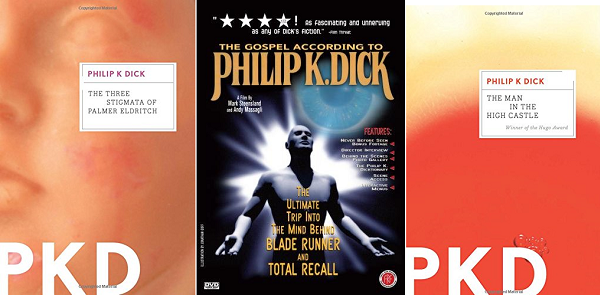
I have just been watching Mark Steensland’s movie, The Gospel According to PK Dick, and a couple of fine parallelisms – echoes, really – struck me.
I’m going to start with one quote from the Chuang Tzu which is so often quoted it has been dulled for me, like a few other very great very over-celebrated works, Beethoven’s Fifth, and Bach’s Toccata and Fugue in D minor BWV 565, among them. Finding its echo in the words of Robert Anton Wilson in this film breathes new life into it, at least for me, for this moment.
Once Chuang Chou dreamt he was a butterfly, a butterfly flitting and fluttering around, happy with himself and doing as he pleased. He didn’t know he was Chuang Chou. Suddenly he woke up and there he was, solid and unmistakable Chuang Chou. But he didn’t know if he was Chuang Chou who had dreamt he was a butterfly, or a butterfly dreaming he was Chuang Chou. Between Chuang Chou and a butterfly there must be some distinction! This is called the Transformation of Things.
DoubleQuote that with Robert Anton Wilson in the movie:
In 1994, I think it was, somebody put up on internet a report of my death, and no matter how much I’ve denied it, it seems most people accept that I’m still alive, but there’s a die hard minority who insists I’m dead and the CIA has replaced me with an android. And I’d be much happier if I’d never read Philip Dick, because I would just think, “Well, I know I’m not an android,” but having read Philip Dick I realized if I was an android who’s properly constructed, I’d think I am Robert Anton Wilson. So that leaves me perpetually in a predicament of not being sure that I’m Robert Anton Wilson or an android programmed to think it’s Rob– to think, talk, and write like Robert Anton Wilson. I guess I’m really grateful to Phil for that, it gives me a certain agnostic detachment, which I think is necessary for mental health.
**
The echo of Chuang Tzu in the words of Robert Anton Wilson occurs towards the beginning of the movie. Towards the end of the movie, we have Paul Williams, the “father of rock criticism” also talking about his friend PK Dick, who was also the subject of his celebrated 1974 Rolling Stone article:
That particular, unique personality this is Philip K Dick arises, when you and I or the three of us, or any two or three readers of {Philip K Dick, or friends of his, or whatever, get together, then we have the opportunity, as in the ends of those stories, to actually experience his presence, and it’s uniquely him. And, uh, I appreciate that, and I appreciate that in that way, I still have him in my life. And that’s definitely quite a gift.
DoubleQuote those words of Williams with these, from Matthew 18.20:
For where two or three are gathered together in my name, there am I in the midst of them.
It is now 2015, so for practical purposes, we’re thinking here about prophecies and predictions that offer what their authors hope will come close to 35-year foresight.
Short form: I don’t get it.
Obama, like him or not, Christor Antichrist, Peace-Nobelist or Pol, is now US President and has — whatever his strengths, failings, or both — some influence on how the earth turns, which way the moral arc of the universe bends, and or what history will be seen and written once the future is present.
Short form: How does history happen?
I’ll raise that question by posting three videos along one such arc of history — and I’ll avoid the usual genre of “news” and work with song, dream and sermon.
**
Describing the impact of Billie Holliday’s song, Strange Fruit, David Margolick wrote in his “biography of a song“:
An “historic document,” the famed songwriter E.Y. “Yip” Harburg called “Strange Fruit.” The late jazz writer Leonard Feather once called “Strange Fruit” “the first significant protest in words and music, the first unmuted cry against racism.” To Bobby Short, the song was “very, very pivotal,” a way of moving the tragedy of lynching out of the black press and into the white consciousness. “When you think of the South and Jim Crow, you naturally think of the song, not of `We Shall Overcome,’” said Studs Terkel. Ahmet Ertegun, the legendary record producer, called “Strange Fruit,” which Holiday first sang sixteen years before Rosa Parks refused to yield her seat on a Montgomery, Alabama bus, “a declaration of war … the beginning of the civil rights movement.”
As Shelley reported, “Poets are the unacknowledged legislators of the world.”
**
Preaching borders on prophecy when it addresses dreams, as in Martin Luther King’s great 1963 oration, spoken decades after Abel Meeropol published Strange Fruit as a poem in 1937 and Billie Holliday recorded it in 1939:
The focus on “I have a dream” comes through the speech’s delivery. Toward the end of its delivery, noted African American gospel singer Mahalia Jackson shouted to King from the crowd, “Tell them about the dream, Martin.” King stopped delivering his prepared speech, and started “preaching”, punctuating his points with “I have a dream.”
**
The President of the United States is an acknowledged legislator, constrained by checks and balances that preachers and poets do not face, yet his voice too has been raised from rhetoric to song:
Here are the Here are the “three rhetorical aspects” of Obama’s speech that James Fallows singled out for special praise:
The choice of grace as the unifying theme, which by the standards of political speeches qualifies as a stroke of genius.
The shifting registers in which Obama spoke—by which I mean “black” versus “white” modes of speech — and the accompanying deliberate shifts in shadings of the word we.
The start-to-end framing of his remarks as religious, and explicitly Christian, and often African American Christian, which allowed him to present political points in an unexpected way.
Amazing Grace now takes the place of Strange Fruit, and a President that of a poet and a singer — much has changed, yet much remains.
**
My own Prior Art on prognostication:
Recently, in Simply so much.. 02 here on Zenpundit, I pondered the nature of foresight in terms of a Marine Corps forecast:
I’m thinking of Lise Meitner as I view the Marine Corps’ ambitiously titled Security Environment Forecast 2030-2045. Who would have thought in 1919 that Hahn, Meitner and Strassmann in 1935 would begin a program that resulted in 1939 in her 1939 paper Disintegration of Uranium by Neutrons: A New Type of Nuclear Reaction — which in turn led to Moe Berg‘s attending a lecture by Heisenberg, the Trinity test at Alamagordo, and Hiroshima and Nagasaki?
And yet the period from 1919 (Treaty of Versailles) to 1939 (fission theorized) is only 20 years, and from 1919 to 1945 (nuclear warfare) is 26 years — equivalents, respectively, to the periods from 2015 (today) to 2035 (a third of the way into the USMC’s period of prediction) and 2041 (still within the UMSC timeline).
That’s my attempt at a sober assessment of how difficult it is to “see ahead”.
**
My Art of Future Warfare story, War in Heaven, is set — as the contest rules required — in 2090.
By twenty-ninety, in my fanciful hypothesis, we may well have learned how to choose which timeline we want to live along in a “manyworld” of constantly branching possibilities – “words are many, worlds are many more, if possible” I wrote, and supplied portals to worlds secular, magical, religious and fictitious:
Forty some years from now, in the wake of John Hardy Elk’s vision and its definitive corroboration “in the external” by physicists at the CERN Diffraction Lab, Shamanism is overturning “the Enlightenment” as the preferred intellectual basis for inquiry. With its gestalt understanding of the interconnectedness not only of space and time but of chance and will, context and perspective, self and other, the Shamanic method of burrowing into deep external space “in the internal” has proven more powerful, faster, and – yes — way more creative than what are now known as the old “heavy lifting” methods of transport.
With schools of Tibetan, Navaho, Benedictine and other forms of contemplative instruction now rapidly surpassing CalTech as the educational venues of choice, and Oxford morphing back towards its earlier life in which theology was Queen of the Sciences, a great many talented explorers have now visited realms considered impossibly “far away” even a decade earlier, the “digital” has fallen away at a time when communication between the like-minded is achieved telepathically, and “radiance bombs” vie with “dark bombs” in the end-of-century duels scattered across many galaxies in which “white” and “black” magics compete — under the law, some would say theory, of the Conservation of Moral Balance.
Who knows? Who can really say?
**
And then there was the ChicagoBoyzAfghanistan 2050 RoundTable. Introducing the RoundTable, Lexington Green noted:
40 years is the period from Fort Sumter to the Death of Victoria, from the Death of Victoria to Pearl Harbor, from Pearl Harbor to the inauguration of Ronald Reagan. It is a big chunk of history. It is enough time to gain perspective.
The event, then, was pitched five years past the Marines’ forecast, though still forty years short of my War in Heaven. And once again, though more explicitly this time, I relied on the branching worlds idea.. Here, though, I attempted –- not unlike a circus performer astride two horses -– to bring together the physical and moral universes:
Historians — on the world-line this is written from, and consequently in those cognate worldlines in which you are reading me — tend to date the by now (2050) clear shift in priorities (if not in actualization) currently emerging along these world-lines to the 2020 joint publication in Nature and Physical Review G of Dogen’s confirmation of the Everett-Klee Transformation Hypothesis, which stated (in its minimal formulation) that free choice is the mechanism by which a human individual switches tracks in a given “present moment” from a “past” world-line to a particular “future” world-line, branching “in that moment” from the first.
We don’t, I posited, move across parallel “shadow” worlds by diving into portrait size Tarot cards, walking a kundalini-enhancing maze, or substituting the sky, landscape and other furniture of one world-line into that of another, though the great Roger Zelazny in his Amber series posits these as methods for planet-hopping.
My suggestion: we chose which routes we take when faced with the constant bifurcations of the manyworlds by the moral choices we make.
**
And in all this I attempt, however playfully, to glimpse how the past and present might prefigure our possible and impossible futures — and how one or more of those futures may pass through the sieve of the onward-pressing present to become history
[ by Charles Cameron — an enclave within an enclave within an enclave within a state no more! ]
.
You know my obsession with form — and that one form of particular interest to me is the world within a world, the play within a play, or that potentially infinite regression of dolls we know as Matroshka?
Dahala Khagrabari, the Washington Post informs us, was “a part of India, surrounded by a Bangladeshi enclave, which was surrounded by an Indian enclave, which was surrounded by Bangladesh”.
No more, it’s not.
India and Bangladesh have swapped out various enclaves, 160 of ’em in all, and Dahala Khagrabari is no longer “the only third-order enclave in the world – an enclave surrounded by an enclave surrounded by an enclave surrounded by another state.”
**
But all is not lost, nor won. At least for fictioneers, there still remain the Groaning Hinges of the World of which RA Lafferty informed us:
Eginhard wrote that the Hinges of the World are, the one of them in the Carnic Alps north of the Isarko and quite near High Glockner, and the other one in the Wangeroog in the Frisian islands off the Weser mouth and under the water of this shelf; and that these hinges are made of iron. It is the Germanies, the whole great country between these hinges that turns over, he wrote, after either a long generation or a short generation. The only indication of the turning over is a groaning of the World Hinges too brief to terrify. That which rises out of the Earth has the same appearance in mountains and rivers and towns and people as the land that it replaces.
We all know how dire the result can be when that happens.
**
Back to the enclaves — there’s a games angle there too. Again via the Washington Post:
Old stories say that the enclaves were the end result of a chess game between the Maharaja of Cooch Behar and the Faujdar of Rangpur many centuries ago, or the result of a drunk British colonial spilling ink on a map, both apocryphal stories but a good indication of how arbitrary the borders seemed.
Chess, a game of skill. Spilled ink, a game of chance. Is that what this post is? A game of virtual spilled ink?
[ by Charles Cameron — 3 Quarks Daily, Boston Apocalyptic conference, LapidoMedia, World Religions and Spirituality Project, Bellingcat, Loopcast, Pragati, Sembl ]
.
First, please vote!
. [ Note added: voting is now closed: my story received the fifth highest tally of votes out of 45 entries, and is now up for consideration by the 3QD editors in the next round — many, many thanks! ]
My story, War in Heaven, is in the running for the 3 Quarks Daily Arts & Literature Prize. 3 Quarks Daily is a great aggregator site, I’m honored to have made the cut so far, and would love to make it to the next level. My entry is #33 in the alphabetical list here, and votes can be cast at the bottom of the page. Networking for votes is all part of the game, so I’m hoping you’ll vote — & encourage your friends to go to that page & vote my entry up.
There’s even a Google Hangout video in which Atlantic Council Non-Resident Senior Fellow August Cole, who directs the Art of Future Warfare project, interviews the contest’s winner and finalists, myself included. August’s book, Ghost Fleet: A Novel of the Next World War, is in the running for next great Tom Clancy like techno-thriller.
You’ll find plenty of other good entries at the 3QD contest page, and daily at 3QD as well — as I say, it’s excellent in its own right, and one of the richest contributors of varied and interesting posts on my RSS feed.
**
Then, in no particular order — check ’em all out —
To my way of thinking, the critical thing to know about the Islamic State is its “apocalyptic, end-of-days strategic vision” as Martin Dempsey put it — and the implications of that statement, both in terms of strategy and of recruitment & morale. That’s what the Boston conference focused on, and that’s why I think it was no less significant for being sparsely attended. In a series of future blogs I hope to go over the videos of the various presentations and spell some of their implications out — Will McCants‘ book, The ISIS Apocalypse, is due out in September, and I’d like to have filled in some background by then.
Here, though, as I’m giving an update on my own doings, is my presentation — an attempt both to tie together some of the strands of the panel I was commenting on (but could barely hear, but that’s a tale or another day), and to express my sense of the importance of apoclyptic thinking, not merely as an intellectual exercise but as an emotional and indeed visceral relaity for those swept up in it:
The other speakers were Richard Landes, WIlliam McCants, Graeme Wood, Timothy Furnish, Cole Bunzel, Jeffrey Bale, David Cook, J.M. Berger, Itamar Marcus, Charles Jacobs, David Redles, Mia Bloom, Charles Strozier, Brenda Brasher and Paul Berman — quite a stellar crew.
**
My two latest pieces for LapidoMedia, where I’m currently editor:
YOU might not think that ‘what jihadis do in their spare time’ would be a topic of much interest, but it’s one that has been under-reported and is just now breaking into public awareness.
Much of the credit for this goes to Robyn Creswell and Bernard Haykel for their current New Yorker piece, Battle lines: Want to understand the jihadis? Read their poetry.
But behind Creswell and Haykel’s piece lurks a striking presentation given by the Norwegian terrorism analyst Thomas Hegghammer at St Andrews in April.
Hegghammer’s Wilkinson Memorial lecture was titled Why Terrorists Weep: The Socio-Cultural Practices of Jihadi Militants…
A CHINESE couple, dismayed by the Taliban’s destruction of Bamiyan’s two Buddha statues, has brought the larger of the statues back to life.
Locals and visitors can once again see the Bamiyan Buddha through the use of laser technology – this time not in stone but in light.
Carved into the great cliff face towering over the fertile valley of Bamiyan in Afghanistan, two Buddha statues stood for centuries.
In 2001 the Taliban dynamited the statues, built in the Sixth century in the Gandhara style, the larger of them standing 55 metres tall.
It was not the first attack against them.Lapido aims to provide (mostly secular) journalists with insight into the religious & spiritual values behind current events.
I stood there, atop the Bamiyan Buddha: it’s personal.
**
At the World Religions and Spirituality Project at Virginia Commonwealth University, I’m one of two Project Directors for the JIHADISM Project. We’re very much a work in progress, aiming to provide a resource for scholarship of religion as it relates to jihadism.
**
Justin Seitz made a post titled Analyzing Bin Ladin’s Bookshelf on Bellingcat, to which I responded, and we had a back-and-forth of emails &c.
Justin then gave our discussion a shoutout at The Loopcast —
— the immediate context starts around the 30 min mark, and runs to around 35 — and followed up with a second Bellingcat post, Analyzing Bin Ladin’s Bookshelf Part 2 — in which he quoted me again. Key here is his remark:
a human with domain expertise is always going to be in a better position to make judgement calls than any algorithm
Agreed — & many thanks, Justin!
Bellingcat — definitely an honor to get a shoutout there,
It’s a terrific feeling to see the next runner in a relay race take off from the handover… Cath is getting some high praise for her work on Sembl for the museum world, including the following:
Sembl incredibly succesfully mixes competitive and collaborative play, creativity and expression, and exploration and inspiration. It’s the sort of game you think about when you’re not playing it, and it’s the sort of game that helps you see the world in new ways.
Paul Callaghan
Writer, Game Developer, Lecturer at Unversity of East London
Meanwhile, I’m still quietly plugging away at some other aspects of the HipBone / Sembl project.
Zenpundit is a blog dedicated to exploring the intersections of foreign policy, history, military theory, national security,strategic thinking, futurism, cognition and a number of other esoteric pursuits.