Saturday, June 25th, 2011


The German Generals Talk by BH Liddell-Hart
War Before Civilization by Lawrence Keeley
The German Generals Talk
A must-read book for those interested in strategy, the history of the Third Reich or the military history of WWII. That said, The German Generals Talk as a text must be treated very cautiously due to the author’s lack of objectivity, the disadvantage of his interview subjects at the time of their captivity and Liddell-Hart’s well documented efforts to use his interview subjects for self-promotional purposes. Nevertheless, the commentaries by major Wehrmacht generals and field marshals, especially Gerd von Rundstedt, Wilhelm Ritter von Thoma, Hasso von Maneuffel, Günther Blumentritt and Heinz Guderian, are informative and at times, provocative. Liddell-Hart’s critiques of German military campaigns are often insightful, usually colorful, frequently sycophantic, but usually to the point – though they often used as a foil for advancing Liddell-Hart’s strategic ideas.
War Before Civilization
Two of the smarter, myth-debunking books I have read in the past year or so have been older, still in print, works by academic archaeologists. Much like Joseph Tainter’s The Collapse of Complex Societies, Lawrence Keeley overturns dogmatic archetypes about “primitive” warfare in prehistoric and pre-contact societies held by social scientists and military historians in War Before Civilization. Not only was prehistoric warfare more violent, more “total” and less restrained than modern warfare but Keeley argues that primitive “warriors” tended to best disciplined “soldiers” in wars when all other things were equal, except when the “soldiers” enlisted their own savage proxies (or adopted morally unconstrained primitive tactics). It was a sliding scale; the barbaric Vikings terrorized “civilized” European and English men-at-arms, but were in turn themselves routed and expelled by the more savage Native Americans and Inuit warriors of North America.
Posted in academia, authors, book, social science, society, strategy, Strategy and War, Tactics, theory, tribes, war, warriors, wwii | 9 Comments »
Wednesday, June 22nd, 2011
Major Michael Few had a short theoretical post that sparked an important discussion at SWJ Blog and other social networking sites. He’s wrestling with the military-tactical effects of diminishing returns. Well worth your time to read through:
Less is Often More?
This is a post that I never would have written while practicing the art in Iraq. On the ground level, every commander wants more forces. In fact, one of the unstated prerequisites for command is that you must conduct at least one daily bitching session where you emphatically describe how much more effective you could be if you were given another platoon, company, battalion, etc…
– More forces equal more villages and more neighborhoods you can clear and occupy.
– More forces equal more visible power and control.
– More resources equal more money to bribe your enemies.
But, sometimes more is actually less:
– More forces mean that you can act unilaterally and just ignore the impotent host nation security forces.
– More forces mean that you can coerce and bully the corrupt political leaders.
– More resources mean that you may waste money building elaborate schools and medical clinics and digging canals rather than repairing the existing suitable structures.
Sometimes with more, we merely attack the symptoms creating short-term visible gains rather than attacking the root problems. Doctrinally, we would call this creating maneuver space on the human and physical terrain.
Read the rest here.
Posted in COIN, complexity, counterinsurgency, counterintuitive, DIME, ideas, intellectuals, leadership, military, organizations, Patterns, Questions, risk, security, small wars journal, social science, society, state building, swj blog, Tactics, theory, war, warriors | 2 Comments »
Wednesday, June 22nd, 2011
The real value was in the comment thread. Original post here.
That caused Joseph Fouche to post Overgrown Comment, Short Post from which I will excerpt relevant comments from JF, Dave Schuler and Seydlitz89:
Dave Schuler comments:
I think that the Obama Administration’s actions are less an instance of only an indirect relationship between means and ends than a disagreement with you on ends, Mark. Just as one example, the primary objective of the Obama Administration (as in all administrations) is a second term. Consider the actions through that lens.
Also, isn’t it possible that the Administration is really sincere about the “international support” trope that marked the Libyan intervention? International support will never be forthcoming for intervention against the Syrian regime. I don’t think that either the Russians or Chinese would stand for it. The Russian relationship with Syria at least is much cozier than that between Russia and Libya.
Noted Clausewitzian seydlitz89 comments:
Zen-
Good thought-provoking post, you actually got me out of my hiatus from blogs/blogging, just don’t tell anyone over at milpub ;-)>
While I agree with Joseph’s comment, I would add a few other points to consider:
First, “strategy”, is a specific concept in terms of strategic theory which can be linked to “strategic effect”, but not necessarily so. Force and personality alone (which are not “strategy” the way I define it -see http://milpubblog.blogspot.com/2010/11/when-strategy-is-not-strategy.html) can achieve strategic effect. So we need to be clear how we are using this particular adjective, which need not be linked to a specific strategy at all. Also the strategy in question might be bad, even self-defeating, as Joseph points out and still be a strategy.
Second, when has our Middle Eastern policy ever been consistent, in terms of treating all countries the same? Perhaps under Bush I during 1990-91, but we have always treated the different Arab countries differently in line with our different interests involved. Bahrain gets a pass, whereas Libya gets NATO intervention, and Syria gets referred to the ICC . . . In each case the US interest is seen as different so the response is different.
Third, the real root cause of the problem is imo our dysfunctional political system which is unable to implement policies which are in the best interests of the country as a political community. The Iraq war was essentially a collapse of US strategic thought and rather was based on narrow and corrupt interests, deceptive politics and notions of unlimited US power (force) and exceptionalism (personality) which triggered a still ongoing strategic disaster for US interests in the region, but not limited to it.
We have a long way to go and I don’t see us getting there any time soon, unfortunately.
The Committee comments posts:
Scottish historian Niall Ferguson, just before transmogrifying into Scottish celebrity historian Niall Ferguson, proposed an approach that serious credentialed historians could use if venturing to write the generally silly and uncredentialed genre of counter-factual history:
To produce serious counter-factual history that is not utter bollocks, your point of departure from our factual timeline has to be a documented and real credible alternative raised by a documented and real credible person at a documented and real point in time prior to the moment when factual and the proposed counterfactual timelines diverge.
As Dave Schuler alludes, how Zen, I, or seydlitz interpret what is strategic, what is astrategic, and what is antistrategic is often determined by what we individually interpret as political, apolitical, or antipolitical. We put events in boxes and eventually there is a box beyond which we do not stray because we don’t know this outer box is there. We can perhaps use Ferguson’s approach to separate which of the Administration’s factual alignment of ends to means are impossible and which are merely improbable and which of our various counterfactual alternative alignments of ends to means are impossible or merely improbable.
….I’ll close my observations on this post and its comment thread with two points:
- Whatever framework you use to analyze human actions, especially those actions your framework categorizes as war or conflict, it should be equally capable of shedding light (and defining) “good” or “successful” actions and “bad” or “failed” actions. Categorizing one lump of actions as Actions while excluding another lump of actions as less than actions does not a good framework make. For those frameworks that aspire to pass as “strategic theory”, this means that they should be just as capable of analyzing Hitler’s strategy of dividing Germany into bloodied, burned out, and thoroughly wrecked fragments occupied by foreigners as they are of analyzing Bismarck’s strategy of creating a unified and independent Germany. A proposed strategic analytic framework that accepts some strategic phenomena into the garden of strategy while consigning others to the outer darkness of non-strategy does serve a useful purpose. Strategic effect rains on both righteous and wicked alike. Neither can be barred from opening an umbrella to shield themselves from strategic fallout because an observer runs up and commands them to stop because theory forbids it. One of the fundamental principles of strategic theory is that theory cannot absolutely forbid umbrella opening: the umbrella opener will inevitably seek to subvert any theory that seeks to unnaturally restrict their freedom to open umbrellas.
That was very interesting and thought provoking. I have, in fact, thought about these comments for several days and I do not have a neat, plausible rejoinder so much as some thoughts in regard to epistemology, which is the level where this discussion really is taking place.
Dave, I think, is correct that are a jumble of motivations in play within the Obama administration, not least of which is the overriding focus of domestic politics in an administration where the national security and foreign policy apparat is heavy with politicos. There is an internationalist faction in the administration too, though they are hardly dominant. They win some and lose some. Incidentally, most administrations, from transcripts and memoirs I have read operate in a state of crisis management much of the time – tightly focused sessions like ExComm during the Cuban Missile Crisis are exceptions. Oval Office convos and meetings as a rule, ramble like meetings do everywhere except when the POTUS (like Eisenhower) demands otherwise.
So, is it proper to categorize this behavior as something other than strategy? Yes – at least when you want to discern conscious strategic thinking about geopolitics and military operations, or absence thereof, you’d refer to what the administration is doing currently as “politics” insofar as their eye seemed to be primarily concerned with domestic political effects rather than strategic effects in the international arena. Strategy requires conscious effort because it is pro-active and often, what passes for strategy is brilliantly intuitive tactical reactions coupled with a fair piece of luck that generated fortunate outcomes that were strategic in their effect, if not intent.
I am pretty much in agreement with Seydlitz89 that the root of our inability to think and act in a strategic fashion is our dysfunction as a political community and his caution regarding strategic effects. There’s a number of reasons for this dysfunction but even if that was instantly remedied by the Good Civics Fairy, we would have to make a conscious effort to build a rational strategic culture.
Regarding Joseph Fouche’s comment on frameworks, he has a logical point regarding strategic theory that works….in theory. By that I mean that I don’t disagree, he’s right in the abstract sense that such a comprehensive and consistent structure would be preferable. My impression though – and I think this is in line with what he is arguing above – is that strategic theory as a field itself may not be quite up to the high standard to which Fouche aspires. Strategic theory in practice, rarely demonstrates the concise elegance of Newtonian physics. In terms of explanatory power, strategic theory used by practitioners or created by modern day theorists rarely rises beyond being situationally “good enough” for the problem at hand. An intellectual tool, like a sharp rock or a pointy stick in the fist of a paleolithic hunter-gatherer. For that matter, if strategic theory proves to be situationally accurate and useful, that is often a cause for celebration!
Going beyond “good enough” to “universally” or “generally” applicable strategic theory is an intellectual feat of the first order. That kind of system -building is usually the result of a life’s work and cannot be called into being on a moment’s notice. Aside from the fact that most people are not capable of rising to becoming a Clausewitz or Sun Tzu, the time constraints make it impossible for state decision makers to think and act within such a framework unless they have arrived into office with one already inculcated as part of their worldview (and even then, it is of great help if they spent years out of office thinking through real and hypothetical problems using that framework, internalizing the principles without losing the ability to observe and think critically). This is why in matters of strategy, our decision makers are usually wielding the intellectual equivalent of stone tools – the statesman with the cognitive flintlock musket or strategic steam engine is few and far between.
So, we are often left with a fractured mess, analytically speaking. Entrails to root through, looking for signs from the gods.
Posted in Clausewitzian, cognition, counterintuitive, democracy, Epistemology, geopolitics, ideas, intellectuals, metacognition, national security, politics, psychology, scenario, social science, society, strategist, strategy, Strategy and War, synthesis, Tactics, theory, Uncategorized, war | 5 Comments »
Tuesday, June 14th, 2011
“Criminal Insurgency” is becoming a preferred term of art to describe entities like the Narco-cartels of Mexico that have evolved from transnational criminal organizations into groups with paramilitary and intelligence capabilities or Colombia’s FARC which formerly was a model Marxist insurgency but devolved downward into a drug trafficking army. The term is used partly to placate doctrinaire purists among defense intellectuals who see insurgency definitively as armed political movements following Mao’s three stages or bust. After all, they have only had since the late 80’s and early 90’s, when Bill Lind and Martin van Creveld warned them this was coming, to get used to the idea.
Colonel Robert Killebrew, a smart fellow at CNAS, has an article in NDU‘s PRISM that puts the problem of criminal insurgency into a hemispheric context:
Criminal Insurgency in the Americas and Beyond
….Essentially, the United States faces external and internal challenges in reorienting to more effectively fight the cartels and their allies. Refocusing U.S. policy from a “war on drugs” to a more comprehensive fight against the cartels and gangs is essential if the United States and its allies are to prevail. Since the basis of the cartels’ survival lies in the control of regions where governmental control is nonexistent and populations may be impoverished and alienated, successful counter-cartel strategies are fundamentally counterinsurgency strategies developed by the concerned states themselves and supported by the United States. Counter-cartel strategies must first be political strategies, integrating military and police activity into a broader political approach that emphasizes the rule of law as an alternative to the rule of force. Four aspects of a Western Hemisphere counter-cartel strategy follow.
First, step up the direct attacks on the cartels. Over the past decades, U.S. law enforcement professionals have developed successful operational techniques that cartel leaders fear: partnerships with effective local police (often with U.S. training), expertise with judicially approved wiretaps and electronic surveillance, rewards programs that make criminal bosses vulnerable to betrayal, and, above all, when local laws permit, extradition to U.S. courts and prisons. The United States and its allies should increase the capability for multiagency field operations in all these dimensions, as well as the professionalization of host country military forces for operations requiring holding ground while the rule of law is reinstituted by other national agencies. DEA already operates throughout the region and has solid relationships with counterpart agencies; additionally, the agency has worked closely with U.S. combatant commands, notably U.S. Southern Command, where its powerful extraterritorial jurisdiction authority supplemented the military’s own programs to help U.S. allies in the region. DEA should continue to advise and assist host country police and counternarcotics forces, but the size of the agency must be greatly increased. With 5,500 agents spread over the hemisphere-including the United States-the agency that plays such a key role in the ongoing war with the cartels is spread too thin.
Second, the U.S. and its allies must continue to attack the cartels’ financial networks and money-laundering capabilities-a key strategy that requires more resourcing at Treasury. Cartel leaders fear U.S. indictments and extradition to American courts; extradition, exposure, and seizure of “dirty” money from criminal operations are all effective strategies that identify kingpins and threaten them with trials in U.S. courts and long terms in U.S. prisons. The United States has learned to use financial analysis and indictments as weapons against the cartels, even when they are beyond the immediate reach of U.S. law. Their use should be expanded.
Third, help our neighbors build more functional state institutions, particularly courts, and stimulate economic growth. In terms of the U.S. role and our assistance to allies, our understanding of security assistance must be broadened to include effective assistance to police and courts. For example, as part of Plan Colombia-a Colombian-developed counter-cartel strategy-the United States provided the Colombian National Police (CNP) with telecommunications-intercept equipment and, working through the Department of Justice, helped the CNP build a judicial process to support wiretap investigations. The result was a powerful tool that assisted indictments against cartel leadership and extraditions to the United States for prosecution. Likewise, assisting host nations to build strong, noncorrupt judicial systems is critical to assisting or restoring stable governments in areas threatened by cartel or other insurgent violence; courts, appellate courts, and efficient prisons are key pieces. Other U.S. agencies and contractors can provide other materiel assistance, training, partnership, and, when authorized, direct help in specified areas such as the collection of certain kinds of strategic intelligence. The U.S. Department of Defense can provide advisors and trainers on the Colombia model to supplement local military and law enforcement efforts, and occasionally direct aid in the form of helicopter transportation and naval support.61
Posted in 21st century, 3 gen gangs, 4GW, academia, America, analytic, black globalization, CNAS, COIN, conspiracy, counterinsurgency, criminals, dystopia, extremists, Failed State, foreign policy, gangs, government, ideas, insurgency, intellectuals, Latin America, Mexico, military, national security, networks, non-state actors, organizations, politics, social networks, social science, state failure, strategist, strategy, Strategy and War, Tactics, transnational criminal organization | 3 Comments »
Sunday, June 12th, 2011
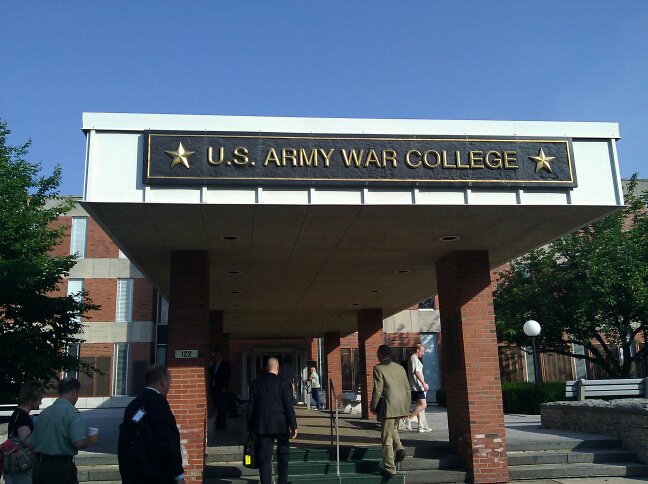
As noted previously, I was fortunate to attend the National Security Seminar at the the US Army War College this year and wanted to relay my impressions while they were still fresh.
First, in terms of reception and cordiality, I have rarely experienced such an extensive and personal outreach as was demonstrated by the War College staff, faculty, administration and students. Every new member had a “sponsor” – a student, usually a colonel or Navy captain, who acted as a liason and personal guide from the time their plane touched down until the moment they returned to the airport. My sponsor, the former commander of the Wolfhounds, Colonel Richard “Flip” Wilson, whom I consider a friend, really extended himself on my behalf, making me feel welcome and a full member of Seminar Group 20. Most of the students have multiple tours of duty in Iraq and Afghanistan under their belt and many can report the same for the first Gulf War, Panama, Bosnia or Kosovo.
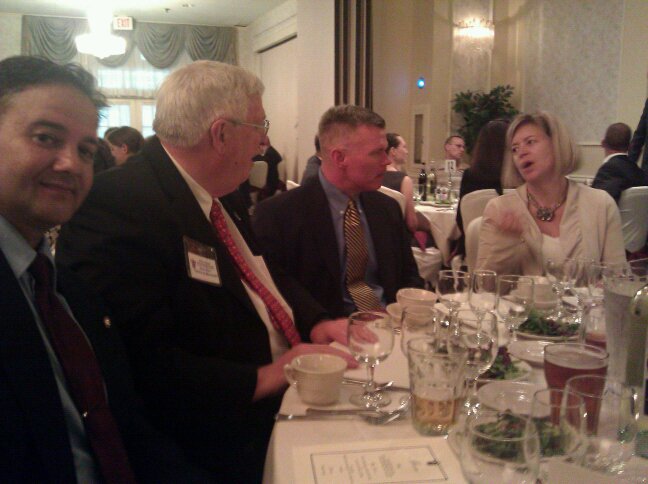
The War College, the Commandant and the Seminar Group all hosted receptions and dinners designed to get students and civilian new members to mix and further discuss issues raised in the seminar sessions or lectures. At these events I had the opportunity to meet and talk to the leadership of the Army War College including the Commandant Major General Gregg Martin, the Deputy Commandant for International Affairs, Ambassador Carol Van Voorst, the Executive Director of the Army Heritage Foundation, Mike Perry, the Director of SSI, Dr. Douglas Lovelace, the Chief of Staff and numerous faculty and seminar members. The New Members such as myself were exceedingly well fed at these events as I suspect the Army was attempting to prove that it really does march on it’s stomach.

The serious business of the National Security Seminar was divided into two segments, the talks given by distinguished speakers to the entire class of 2011 and the New Members and the Seminar Group sessions of approximately twenty students, New Members, academics and foreign visitors. We received a brief on the war in Afghanistan from the ISAF Chief of Staff, who was standing in last minute for General Petraeus who was called to meet with senior adminstration officials; and a very interesting concluding talk by Foreign Affairs Editor Gideon Rose, author of How Wars End, which covered issues of strategy, grand strategy and the disconnect with policy.
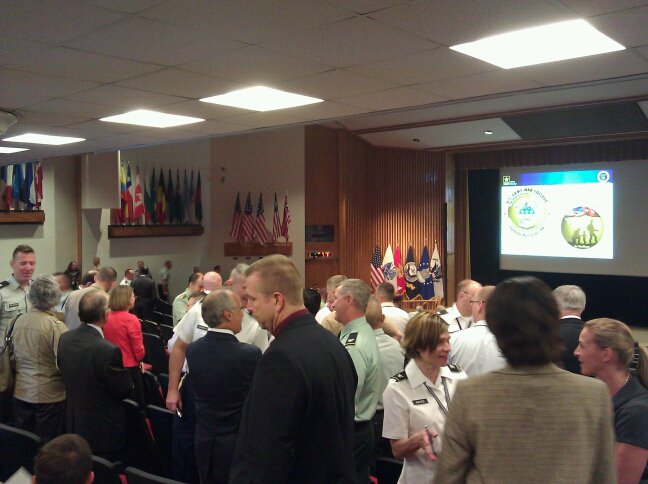
The National Security Seminar is run strictly on a non-attribution basis, in order to encourage candor and frank exchange of views, which handicaps my ability to discuss specifics here. I can say that my views on Pakistan ( which I compared to “North Vietnam” ) riled more than a few people – Pakistan is the only country in the world given 2 exchange student slots at the Army War College at the request of the most senior leadership of the US Army – and several students and faculty members took the time, outside of seminar sessions, to make certain I heard countervailing POV regarding Pakistan’s value as an ally. Other topics included, but were not limited to:
Defense budget cuts and force structure
Narco-cartels in Mexico: Insurgency or No?
Civil-Military Relations
Repeal of DADT
AfPak War
al Qaida and GWOT/US Strategy
COIN
Critical thinking and Leadership
Logistics
Libya and NATO
AWC Strategy Curriculum/Program
What the US public expects from their military
China as a peer competitor
Effects of ten years of war on officer corps/military
Illegal combatants and international law
PTSD
Battle of Gettysburg and Grand Strategy
Cyberwar
Differences in Armed Services strategy, command climate, discipline, leadership
The Arab Spring
US Global leadership and Economics
Interagency Operational jointness
Most of the discussion took place in the seminar groups, with Q&A periods in the mass sessions with featured speakers. I came away deeply impressed with the seriousness and insights as practitioners that AWC students brought to the table. The AWC strategic studies program seeks to broaden students who are assumed to arrive with tactical expertise and prepare them for higher command that carries operational, strategic and even policy responsibilities (at least in terms of interpreting and executing within policy guidelines). Many students were articulating ideas associated with Thomas P.M. Barnett, the “mission order” and “commander’s intent” style of leadership or Clausewitzian strategic premises during debates and discussion.
The National Security Seminar Week was for me, an enlightening and exceptionally enjoyable experience, one I would highly recommend to readers who may have such opportunities in future years.
Posted in 19th century, 2011, 20th century, 21st century, 3 gen gangs, 4GW, academia, Afghanistan, Air Force, al qaida, America, army, barnett, Clausewitzian, cognition, COIN, counterinsurgency, Cyberwar, defense, DIME, diplomacy, diplomatic history, education, Epistemology, foreign policy, government, historians, history, ideas, insurgency, intellectuals, intelligence, leadership, metacognition, military, military contractor, military history, military intelligence, military reform, national security, Network-centric Warfare, organizations, security, social science, strategist, strategy, Strategy and War, Tactics, theory, war, warriors | 12 Comments »


