zenpundit.com » Hipbone Games

Archive for the ‘Hipbone Games’ Category

The White House, Games, and HipBone/Sembl — today

Thursday, January 2nd, 2014

[ by Charles Cameron — a project of keen interest to me, and a request for your support ]
.

Something is going on in one corner of the White House that has me agog in a pleasant way.


.

Mark DeLoura, Senior Advisor for Digital Media at the WH Office of Science and Technology Policy is soliciting ideas about Games that Can Change the World. I’ve jumped in, and so have some old friends, one auld acquaintance and one new…

**

The home page for this project is hosted on its own Games for Impact site, and I’d invite you to take a look, and note in particular…

  • Games where ideas collide (& create new ideas)
  • This is my own page, for the HipBone / Sembl games and DoubleQuotes — and if you have found my style of analysis valuable, you may want to go there, (take the trouble to) log in, and upvote my idea — making a comment too, should you so wish.

  • Positive Impact and Game Evangelism
  • Similarly, you can log in and upvote the whole idea by supporting this proposal, the current “leading” concept…

    Part of what makes this entry so interesting is the fact that Chris Crawford, game designer and thinker non pareil, is discussing his own long-hoped-for paradigm shift in game design in this thread. Chris is the “auld acquaintance” I mentioned, and I met him via the good services of my old friend Mike Sellers late in the last century. It is good to read him again in the new millennium.

  • Games to increase understanding about emergent social systems
  • Mike’s own offering is this one, which I also highly recommend. Mike is one of the founding fathers of multiplayer games with graphical architecture, and has more recently been working to bring human psychology into gameplay with increasing subtlety. By all means give him a vote up if that sounds good.

  • Knecht/Connect – a playable version of the Glass Bead Game
  • As you know, my own games attempt to bring the game concept embedded in Hermann Hesse’s great novel, The Glass Bead Game / Magister Ludi into playable form, and my friend Paul Pilkington has been doing the same in a series of books [1, 2, 3] and a Twitter stream. Let’s help him get some recognition, too…

  • Try the Poietic Generator
  • This one’s a game concept I like, too — it’s based on Conway‘s Game of Life… and brings it alive!

    It was submitted by Olivier Auber, whom I hadn’t previously met — so he’s my new acquaintance, and I’m hoping his game ideas will flourish and that acquaintance will grow into friendship in as things unfold…

    **

    So that’s the overall project, along with a sampling of specific ideas that I admire and would invite you to support. I hope you’ll find (and support) some other game concepts of interest, too.

    In a follow up post honoring Chris Crawford — which may still take a while to write and post — I’ll be looking at some of the historical background of “serious games” — and of the HipBone / Sembl style of thinking in particular.

    Gaming the Connections: from Sherlock H to Nada B

    Sunday, December 29th, 2013

    [ by Charles Cameron — the game of Connect the Dots in play and practice ]
    .

    CIA's (now ret'd) Nada Bakos examines the Al Qaida board in the HBO docu, Manhunt

    .

    Manhunt, the HBO documentary, does what (not having been there and seen that at the time) appears to be a decent job of recreating some of the cognitive stratregies employed by CIA officers in the OBL hunt. The one I’m interested in here is the building of a “link chart” or cognitive map — law enforcement “evidence board” — the idea being (a) to note known connections visibly, and (b) to encourage the mind to make intuitive leaps that reveal previously unknown connections between nodes… or “dots”.

    Sophisticated software does this sort of thing algorithmically with regard to (eg) network connections via phone-calls, but the human mind is still better than AI at some forms of pattern recognition, and that’s the aspect that interests me here.

    Aside:

    For more on the cognitive significance of the link chart in Manhunt, see my post Jeff Jonas, Nada Bakos, Cindy Storer and Puzzles.

    **

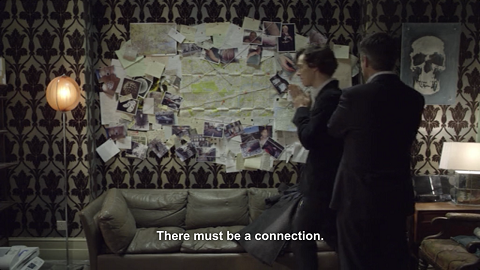
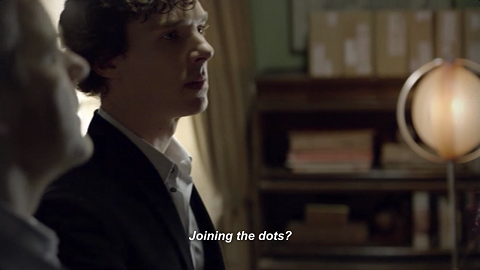
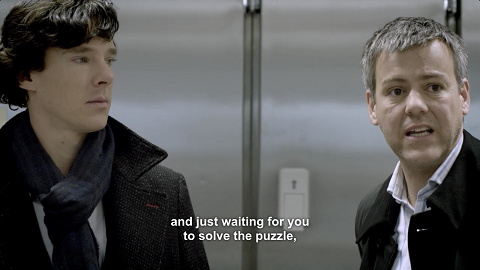
    Benedict Cumberbatch‘s Sherlock lays out the way it works —

    **

    Okay, so one way to visualize connections is to make a fairly random collage of relevant photos, names, dates and places, and tie it together with links of string or ribbon. That’s the equivalent of what in HipBone games terms we’d call a “free-form” game, and it works well for the “divergent”, initial brainstorming phase of thought. But it does little to bottle its own energy, to focus down, to force the mind — in the no less powerful “convergent” phase — into perceiving even more links than occur spontaneously in building the link chart in question.

    HipBone‘s preformatted boards take the cognitive process to that second stage. They work on one of the most powerful ingredients in creativity: constraint. Business writer Dave Gray of Communication Nation puts it like this:

    Creativity is driven by constraints. When we have limited resources — even when the limits are artificial — creative thinking is enhanced. That’s because the fewer resources you have, the more you are forced to rely on your ingenuity.

    But that premise doesn’t just hold true for business problem-solving — it’s at the heart of creative thinking at the Nobel level, too, in both arts and sciences. Consider mathematician Stanley Ulam, writing in his Adventures of a Mathematician:

    When I was a boy I felt that the role of rhyme in poetry was to compel one to find the unobvious because of the necessity of finding a word which rhymes. This forces novel associations and almost guarantees deviations from routine chains or trains of thought. It becomes paradoxically a sort of automatic mechanism of originality…

    Here’s how the poet TS Eliot puts it:

    When forced to work within a strict framework the imagination is taxed to its utmost – and will produce its richest ideas.

    A Hipbone Gameboard such as the Waterbird, Dartboard, or Said Symphony board is chosen precisely to challenge the mind with third, fourth and fifth rounds of “creative leaps” — thus adding both divergent and convergent cognitive styles to this form of graphical analysis.

    That’s my point here — and a plug for HipBone-Sembl style thinking.

    **

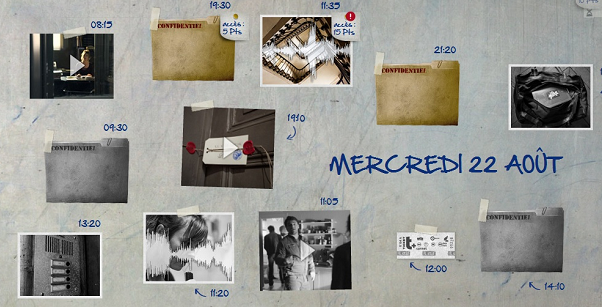
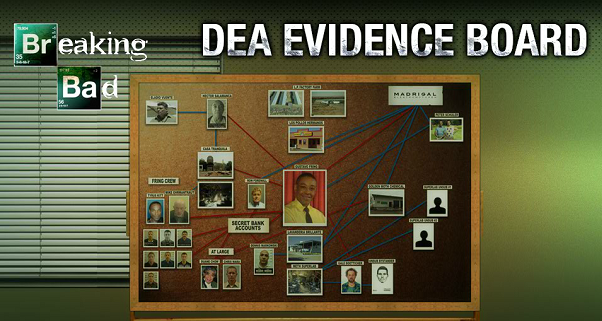
    I can’t resist adding a couple of instances in which the meme of “connecting the dots” via a link chart or evidence board has crept from TV series that I enjoyed into the world of games — this first one based on the terrific French detective series, Engrenages, retitled Spirals for British consumption:

    — and this one for fans of the US TV series, Breaking Bad:

    Glass Beads and Complexity

    Monday, May 27th, 2013

    [ by Charles Cameron — achieving something like closure on a post I started for Adam Elkus here, with a side dish along the way here ]
    .

    .

    It’s astonishing to me how closely complexity science is related to Hermann Hesse‘s Glass Bead Game.

    Adam Elkus recently pointed those who follow him to Cosma Rohilla Shalizi, Methods and Techniques of Complex Systems Science: an Overview, and just a quick dip there gave me the graphic I’ve put at the head of this post, together with this quote about “patterns” as Shalizi understands that term:

    I mean more or less what people in software engineering do: a pattern is a recurring theme in the analysis of many different systems, a cross-systemic regularity. For instance: bacterial chemotaxis can be thought of as a way of resolving the tension between the exploitation of known resources, and costly exploration for new, potentially more valuable, resources (Figure 1.2). This same tension is present in a vast range of adaptive systems. Whether the exploration-exploitation trade-off arises among artifcial agents, human decision-makers or colonial organisms, many of the issues are the same as in chemotaxis, and solutions and methods of investigation that apply in one case can profitably be tried in another. The pattern “trade-off between exploitation and exploration” thus serves to orient us to broad features of novel situations. There are many other such patterns in complex systems science: “stability through hierarchically structured interactions”, “positive feedback leading to highly skewed outcomes”, “local inhibition and long-rate activation create spatial patterns”, and so forth.

    **

    Let’s start with patterns. The “people in software engineering” Shalizi mentions gleaned their use of the term “pattern” from the architect Christopher Alexander, author of the extraordinary, seminal book A Pattern Language, which in turn has hugely influenced computer science. Alexander distilled the essence of his thinking in his “Bead Game Conjecture”:

    That it is possible to invent a unifying concept of structure within which all the various concepts of structure now current in different fields of art and science, can be seen from a single point of view. This conjecture is not new. In one form or another people have been wondering about it, as long as they have been wondering about structure itself; but in our world, confused and fragmented by specialisation, the conjecture takes on special significance. If our grasp of the world is to remain coherent, we need a bead game; and it is therefore vital for us to ask ourselves whether or not a bead game can be invented.

    Manfred Eigen, Nobel laureate in Chemistry, called his book with Ruth Winkler-Oswatitsch Laws of the Game — and it deals with molecular biology, cellular automata, game theory, and games. But not just that — it is specifically written with Hesse’s concept in mind:

    We hope to translate Hermann Hesse’s symbol of the glass bead game back into reality.

    While we’re on about cellular automata, what about Stephen Wolfram? I don’t know that he talks about the Glass Bead Game himself, but at least three people talk about Wolfram’s book, A New Kind of Science, and/or his search engine, Wolfram Alpha as being strongly analogous to Hesse’s game — Jason Dyer, Graeme Philipson, and most recently, Mohammed AlQuraishi. Here’s a key para from Quraishi’s piece:

    I think the Game is an intriguing concept, and I think it may one day be realized. In fact I think we are already on our way toward realizing it. In the simplest and most general sense, mathematics and programming languages allow us to formalize all knowledge. Contenders for the language of the Game already exist, at least in principle. But we are further along than that. Search engines like Wolfram Alpha have already begun the process of formalizing diverse pieces of knowledge, unifying them in a single medium, and providing the means to connect and reason about them. A repeated example in the book, the mapping of musical compositions to mathematical formulas or even historical events, is eminently doable within Wolfram Alpha. Much remains to be done of course, and there is no “game” yet that can be played across the vast sea of all human knowledge, but some enterprising individuals have already gotten started on creating it.

    And then there’s John Holland, the “father of genetic algorithms”. Holland told an interviewer:

    I’ve been working toward it all my life, this Das Glasperlenspiel. It was a very scholarly game, starting with an abacus, where people set up musical themes, then do variations on it, like a fugue. Then they’d expand it to where it could include other artistic forms, and eventually cultural symbols. It became a very sophisticated game for setting up themes, almost as a poet would, and building variations as a composer. It was a way of symbolizing music and of building broad insights into the world.

    If I could get at all close to producing something like the glass bead game I can’t think of anything that would delight me more.

    **

    I’ve been working on a playable variant on the Glass Bead Game too, for twenty years quite consciously, and more if you count subterranean stirrings. And I don’t think glass beads, or stones, or chess or go pieces, or beads on an abacus, or strings of ones and zeros, or cells in an agent-based model for that matter, are the way to go. Which is not to say those approaches shouldn’t be tried, or don’t have remarkable things to teach us. I just don’t believe they give us quite what Hesse envisioned:

    a direct route into the interior of the cosmic mystery, where in the alternation between inhaling and exhaling, between heaven and earth, between Yin and Yang, holiness is forever being created.

    I think what’s important in Hesse’s game is that concepts that humans can grasp should reveal their stunning interrelations to heart and mind. And for that reason, the “moves” in my games [Hipbone, and more recently Sembl] consist of concepts — musical, verbal, visual, mathematical — and the links, the analogies, the “semblances” between them.

    **

    And thus the game is a search for analogies.

    The human mind must inevitably perform what Shalizi calls the “trade-off between exploitation and exploration”. Some thoughts are proximate to others, they can be developed without any special insight by regular “linear” thinking. We do this every day, every minute — but it is not particularly revelatory. It doesn’t solve thorny problems, much less create beauty. There is another mode of thinking, however, that leaps between thoughts that are not so “close” but are nevertheless deeply related. To leap the apparent distance between such deeply related thoughts, we deploy analogy and creative thinking, and that is where the aha! of revelation occurs.

    So I would suggest there is a close analogy here with the point Shalizi is making with the diagram atop this post. The human mind, to slightly paraphrase Shalizi’s caption, will “exploit the currently-available patch of food” for thought by linear, inside-the-patch thinking, but at full stretch it will also “explore, in hopes of ?nding richer patches elsewhere” — the “elsewhere” being attained precisely by “creative leaps” — by seeing semblances, patterns, analogies.

    And to return to my earlier post, Thinking outside the cocoon, of which this post is a continuation, and perhaps the completion….

    Shalizi’s “random walk” is thus also the archangel’s “zig-zag wantonness” in that great poem, Tom O’Roughley — when William Butler Yeats asks, “how but in zig-zag wantonness / could trumpeter Michael be so brave?” and writes, “wisdom is a butterfly / and not a gloomy bird of prey”…

    The Abel Prize for a great Sembl move

    Wednesday, May 22nd, 2013

    [ by Charles Cameron — cross-posted from Sembl ]
    .

    You don’t have to be playing a Sembl or Hipbone game to make a great Sembl move — you just have to see a rich semblance between two concepts in (previously) widely separated fields of thought. Thus Pierre Deligne of Princeton’s Institute for Advanced Study, who won the Abel Prize in mathematics this year, did so by working on a rich Sembl-style insight from André Weil. As Scientific American reports today:

    Deligne’s most spectacular results are on the interface of two areas of mathematics: number theory and geometry. At first glance, the two subjects appear to be light-years apart. As the name suggests, number theory is the study of numbers, such as the familiar natural numbers (1, 2, 3, and so on) and fractions, or more exotic ones, such as the square root of two. Geometry, on the other hand, studies shapes, such as the sphere or the surface of a donut. But French mathematician André Weil had a penetrating insight that the two subjects are in fact closely related. In 1940, while Weil was imprisoned for refusing to serve in the army during World War II, he sent a letter to his sister Simone Weil, a noted philosopher, in which he articulated his vision of a mathematical Rosetta stone. Weil suggested that sentences written in the language of number theory could be translated into the language of geometry, and vice versa. “Nothing is more fertile than these illicit liaisons,” he wrote to his sister about the unexpected links he uncovered between the two subjects; “nothing gives more pleasure to the connoisseur.”

    **

    While I was still a schoolboy, my favorite place to visit on vacation was the great Abbaye St. Pierre de Solesmes, celebrated for its central part in the renewal of Catholic liturgy and of the Gregorian Chant in particular. Two of my fondest memories are of the terrific bowls of coffee served in the monastic refectory at breakfast, and of my opportunity to take a class in chant under the chironomic hand of Dom Joseph Gajard, then Choirmaster at Solesmes. The liturgy and the chant were sublime.

    I was an Anglican (“Episcopalian”) at the time, and just a wee bit concerned that the monks might want to convert me to the One Holy [Roman] Catholic and Apostolic version of the faith — but when I expressed my concern to one of the monks, I was reassured: they had had an earlier guest at the abbey, one Simone Weil, and she too had been unready to convert, though deeply moved by the liturgy…

    So I’ve felt a quiet kinship with Simone Weil ever since, and try to keep a copy of her Letter to a Priest nearby me at all times. She begins:

    When I read the catechism of the Council of Trent, it seems as though I had nothing in common with the religion there set forth. When I read the New Testament, the mystics, the liturgy, when I watch the celebration of the mass, I feel with a sort of conviction that this faith is mine or, to be more precise, would be mine without the distance placed between it and me by my imperfection.

    I love her for that — and I love, too, that her brother should make such a splendid Sembl move.

    **

    I suppose I’d better post my reading of Wiles’ Proof of Fermat’s Last Theorem viewed as a Glass Bead Game as a follow up.

    Playing a double game

    Monday, November 19th, 2012

    [ by Charles Cameron — a chess variant exploring the twinned human drives for competition and collaboration ]
    .

    I posted a neat piece of math the other day, showing how dogs might respond to conditions of combined fear and rage in terms of a catastrophe theory diagram, and Larry Dunbar pointed out in a comment that humans might respond differently in equivalent circumstances depending on whether they had a strategy going into the situation or not…


    .

    The idea that humans can have an override on such instinctive drives as fear and rage is obviously an important one, and Larry’s comment reminded me of a post I’ve been meaning to make about another “dualism” we humans are subject to…

    **

    Humans are not IBM machines: they have dual drives, responding to a greater or lesser extent at all times to competitive and collaborative motivations.

    I was attempting to capture something of that essential dualism in the simplest possible game format when I devised my story-telling chess variant for Ruth Catlow‘s Rethinking Wargames blog:

    My own chess variant, which would require two fairly accomplished story-tellers of roughly equal chess strength to play it, is one in which the game is played as in any chess game, following the usual rules, with the added proviso that at each move, the player should write a fictionalized account of the move, such that the combined narratives of the two players taken together in sequence of moves constitutes a story for publication.

    The point is that each player then has two motives in making each move — a chess-winning-motive, and a storytelling-collaborative-motive — and the way they play will thus reflect something that parallels human motivation, with its characteristic mix of survival drive and quest for selfactualization / spirituality.

    I’m neither a decent chess-player not a decent writer of fiction, but I believe I’m a first rate conceptual game designer, and that this game concept captures something essential about the human condition in simple form. I offer it as a thought-experiment with “live” game potential.

    **

    One last thought:

    I suspect that this game is in effect a game for exploring the intersection of zero-sum with non-zero-sum games, so playing with the interactions of collaboration and competition should also offer us insight into the interactions of quality and quantity.

    **

    For more on Ruth Catlow’s work, see her book Artists Re: thinking Games.


    Switch to our mobile site