zenpundit.com » iran

Archive for the ‘iran’ Category

Of games IV: the apocalyptic touch

Tuesday, June 19th, 2012

[ by Charles Cameron — some recent game references with seriously playful intent ]
.

Two things, really.

If you read the Jerusalem Post, you’ll likely have seen that:

Iran, Russia, China and Syria will hold the Middle East’s largest ever war game, Iranian news outlets reported quoting unnamed sources.

According to the report, 90,000 troops, 400 warplanes and 1,000 tanks from the four countries will take part in land and sea exercises. The war games will feature Russian atomic submarines, according to Iranian media, as well as warships, aircraft carriers and mine-clearing destroyers. Semi-official Iranian FARS news agency stated that the exercise was being planned in coordination with Egypt, which recently acceded to grant the passage of 12 Chinese warships through the Suez Canal. The report stated that the Chinese naval convoy is due to dock in Syrian harbors within the next two weeks.

That’s pretty much on the materiel side of things, IMO.

*

On the other hand, if you read Joel Rosenberg, you’ll have seen all that and more — and then this:

The story is particularly intriguing — and disturbing — in light of Bible prophecies in Ezekiel 38-39 that indicate a Russian-Iranian military alliance will develop in the “last days” to attack the nation of Israel. In my first nonfiction book, Epicenter, and in my novel, The Ezekiel Option, I describe these prophecies in detail. While it remains too early to know for certain if the “War of Gog and Magog” prophecies are going to be fulfilled in the near future, geopolitical trends in recent years and even in recent months have been curiously consistent with the ancient Biblical text. A militaristic Czar — Vladimir Putin — has risen to power in Russia. Putin is the only Russian leader in history to visit Israel (7 years ago), and is preparing to visit again on June 25, trying to make the Israelis feel comfortable with him. Yet Russia has been selling billions of dollars in arms to Iran and other nations described in the prophecies. Russia is currently sending naval ships and forces to Syria. Israelis are living more securely in the land, and are more prosperous, than ever in their modern history, also consistent with the prophecies.

Followed without a paragraph break by:

To learn more about the prophecies of Ezekiel 38-39, please click here.

And the headline?

That’s more morale than materiel, I’d say!

*

So that’s Thing One, as Dr Seuss might put it. But what about Thing Two?

The big, apocalyptic war games are for big fellows like Gog, Magog and Putin, guys who can afford to wear the big-boy pants.

What about the little guys and gals?

That, YNet tells us, is where a spot tourism might come in handy…

Gush Etzion has become a hot destination in recent months for tourists seeking an Israeli experience like no other: The opportunity to pretend-shoot a terror operative. Residents of the nearby settlements, who run the site, offer day-trippers a chance to hear stories from the battleground, watch a simulated assassination of terrorists by guards, and fire weapons at the range.

The fact that the tourist attraction is located beyond the Green Line only intensifies the thrill for the visitors, who often appear disappointed when told by their guides that they are not in any danger.

That strikes me as just a tad messianic, too… in a very post-modern sort of way.

Cute pic from that YNet article, photo credit Alex Kolomoisky:

To judge by the surrounding text, that young lady’s from Miami. She’s five.

Updating the Apocalypse

Tuesday, May 15th, 2012

[ by Charles Cameron — four shifts in apocalyptic thinking, us & them, sacred and secular ]
.


.

Every time something significant happens in Europe or the Middle East, those who have worked out their apocalyptic timelines ahead of time have to make appropriate adjustments.

1.

Today, the Christian apocalyptic writer Joel Richardson took note of recent events in Europe in a piece entitled The Collapse of the Euro = The Collapse of the Euro-Centered End-Time Perspective? and asked:

as the collapse of the Euro monetary unity appears to loom over all of us, how will such an global earthquake affect the popular, but equally collapsing Euro-centered perspective on the end times?

Joel may be onto something, we may be on the verge of a major shift in Christian end times emphasis — away from Europe and towards Joel’s Islamic Antichrist theory, as explored in his book The Islamic Antichrist: The Shocking Truth about the Real Nature of the Beast and his forthcoming Mideast Beast: The Scriptural Case For an Islamic Antichrist.

2.

I’ve put a screen shot at the top of this post from an end times video featuring Europe as the evil empire and the Pope as Antichrist – it’s a brilliant graphic pairing that illustrates the older theory visually and viscerally, and should you so wish, you can watch the whole thing here. Note also the comment from SyriacBoy10 below the video:

In the Bible and the Quran, it is said that the Antichrist will come from Europe which is expected to be in this generation due to the signs and global disasters.

Just what place names in scriptures might refer to just what places or entities in modern or far future times is always a matter of interpretation — as Joel himself neatly demonstrated with a variety of “biblical” maps in his Prophezine post Where is Magog, Meshech and Tubal?

And for that matter, is our Coptic friend speaking of the Antichrist in the Qur’an, or the Dajjal? The two are commonly inflated, which gets a bit confusing after a while…

3.

And here’s Joel on failed predictions of the EU as the pivotal demonic empire of the last days in prophecy:

Nearly 20 years ago, I intently watched as a very popular Christian television prophecy teacher declared, “The present formation of the European Union is literally the fulfillment of Bible prophecy right before our eyes!”

According to this teacher, the creation of the European Union represented a biblically prophesied revived Roman Empire. Because the last-days empire of the Antichrist, as described in the books of Daniel and Revelation, is portrayed as a 10-nation alliance, this teacher confidently declared that when the number of EU member states reached 10, this would signal the imminent return of Jesus Christ.

Soon, the number of EU member states reached the magic number 10, just as this teacher had predicted. Then the number reached 11, and then 12. Soon there were 20. Today there are 27 member states. The teacher’s very confident predictions failed.

4.

As it happens, I correspond with Joel on occasion and like the man, despite our holding very different theological opinions. In particular, I like to quote this passage from his description of an interview he gave on NPR:

I explained to my host that unless a supernatural man bursts forth from the sky in glory, there is absolutely nothing that the world needs to worry about with regard to Christian end-time beliefs. Christians are called to passively await their defender. They are not attempting to usher in His return. Muslims, on the other hand, are actively pursuing the day when their militaristic leader comes to lead them on into victory. Many believe that they can usher in his coming.

I’d be interested to know what GEN Boykin would make of that…

5.

All in all, I see four trends in apocalyptic thinking at the present time.

First, there’s a trend, suggested by Joel Richardson in his articles linked above, away from an earlier Eurocentric focus of end times interpretation, and towards his own view of Islam – and of the Mahdi (awaited by many Muslims) as Antichrist.

Second, there’s a trend noted by another occasional correspondent of mine, Julie Ingersoll, in one of her two recent articles on Kirk Cameron in Religion Dispatches – more precisely, a theological shift:

from the larger premillennialist evangelical world that he depicted in Left Behind to the postmillennialist dominion theology of the Reconstructionists.

Third, It seems to me that there’s a trend away from the “soon expectation” of the Mahdi of President Ahmadinejad in Iran, as the Supreme Jurisprudent, Khamenei, withdraws his support from his President and Ahmadinejad enters his lame duck phase…

And finally, there are mild signs that apocalyptic itself and religious motives more generally are slowly entering the discourse of the strategically minded, including those whose secular worldviews have hitherto all too often led them to dismiss both religious and apocalyptic drivers as irrational and unserious.

Columbia’s upcoming Hertog Global Strategy Initiative with its focus this year on Religious Violence and Apocalyptic Movements, which I mentioned recently, is one such sign – another is the attention paid to Khorasan — a name with strong Mahdist associations — in a post at the Long Wars Journal today.

6.

Luckily, we have Richard Landes‘ massive, brilliant Heaven on Earth: The Varieties of the Millennial Experience to educate us in the bewildering profusion of forms, both secular and sacred, that millennial hopes and fears can take.

And with Israel’s departing Shin Beth chief calling PM Netanyahu “messianic” – using the same term Netanyahu used for Ahmedinajad – it’s about time, too.

Book Review: The Hunt for KSM

Monday, May 14th, 2012

The Hunt for KSM: Inside the Pursuit and Takedown of the Real 9/11 Mastermind by Terry McDermott and Josh Meyer 

I received a review copy of The Hunt for KSM from  Hachette Book Group and was pleased to see that the authors, Terry McDermott and Josh Meyer, are investigative journalists, one of whom, Meyer, has extensive experience reporting on terrorism, while McDermott is also the author of the 9-11 highjackers book, Perfect Soldiers. So, I was looking forward to reading this book. My observations:

  • In the matter of style, McDermott and Meyer have opted to craft a novel-like narrative of their research, which makes The Hunt for KSM a genuine page-turner. While counterterrorism wonks used to a steady diet of white papers may become impatient with the format, they already know a great deal about operational methods of Islamist terror groups and the general public, who are apt to be engaged by the story, do not. While enjoying the yarn about Khalid Sheikh Mohammed, the villain behind 9-11 and his downfall, the general reader picks up a great deal of important information.
  • McDermott and Meyer deserve kudos for their fair and balanced handling of Pakistan – and I say this as a severe critic of the Pakistanis. While pulling no punches about the perfidy of Pakistan’s elite, the ties of the ISI and their religious extremist parties to terrorist groups including al Qaida, they give credit where credit is due to Pakistanis who made the difference in assisting the United States and it’s investigators in tracking down KSM and his AQ associates . “Colonel Tariq” of the ISI, in particular stands out as a courageous and sympathetic figure.
  • Khalid Sheikh Mohammed emerges in the story as a master adversary, part Bond villain, part sinister clown, who confounded the efforts of the FBI and the CIA for years with his prodigious ability to organize and orchestrate geographically diverse terrorist networks, fundraising, logistical support, bombings and murder like a one-man KGB while remaining as elusive as a ghost. His abilities, daring, good fortune and defiant resilience in captivity are impressive enough in McDermott and Meyer’s telling that they unfortunately tend to overshadow the fact that KSM is an enthusiastic mass-murderer. A facet that comes out to it’s true ghastly extent only in their description of KSM personally beheading kidnapped reporter Daniel Pearl.
  • The bureaucratic bungling and stubborn infighting of the FBI and CIA, with assistance from the DoD and Bush administration on particularly stupid decisions related to the interrogation and reliance upon torture while excluding AQ experts and experienced KSM case investigators from talking to KSM, makes for a profoundly depressing read. It contrasts poorly with the dedication and sacrifice demonstrated by law enforcement agents Frank Pellegrino, Matt Besheer, Jennifer Keenan and those who aided them.

The Hunt for KSM closes with Khalid Sheikh Mohammed as he is at the present time, on trial at Guantanamo Bay, a story with a climax but not yet an epilogue.

Well written, concise yet dramatic, The Hunt for KSM is warmly recommended.

Messianic symmetries

Sunday, April 29th, 2012

[ by Charles Cameron — Shin Bet’s Yuval Diskin calles Netanyahu messianic, Netanyahu called Ahmadinejad messianic, and other millenarian parallels and face-offs ]
.

One man’s Christ is another man’s Antichrist:

We’ll get to Diskin and Netanyahu, but first some background.

It is not uncommon to see the face-off between the West and Global Jihad — however you might prefer to name the opposing sides — as both asymmetrical (our kevlar vs their shalwar kameez, so to speak) and symmetrical (our crusaders vs their mujahideen, so to speak).

There are several aspects of these symmetries and asymmetries that interest me:

1.

The first is that the asymmetries are typically quantitative: one side has more firepower than the other, more troops and more sophisticated weaponry, and indeed, the conflict or flurry of conflicts in question does seem to fall under the rubric of asymmetric warfare, and those who write about asymmetries with the deepest understanding are typically those whose “loop” is to observe, orient, decide and act… while by way of contrast, the symmetries are most frequently observed by those whose “loop” is to observe, comprehend, describe and influence, and the symmetries they observe are typically qualitative, operating at the level of ideas.

I’ll get to a couple of examples shortly.

2.

The second is that within the asymmetries, it is not uncommon to find a reversal of polarities by which the lesser outsmarts and defeats the greater force. I’m thinking here of David and Goliath as the archetypal version, and of Nigel Howard, in Confrontation Analysis: how to win operations other than war, writing:

the problem of defense in the modern world is the paradoxical one of finding ways for the strong to defeat the weak.

A different aspect of asymmetry emerges when one can think of Israel as both the powerful high-tech occupier of a poorly-equipped and stateless mass of Palestinians, and a tiny emergent Jewish democracy surrounded on all sides (except the sea) by Arab and or Muslim once and future foes… a Goliath seen one way, a David the other…

What’s intriguing here is that in some ways everybody wants to be David, right?

3.

The third point of interest is the frequency with which the symmetries appear to contain explicit millenarian, messianic or apocalyptic elements.

Here are two examples. The first is from Gilles Kepel, who has been studying Muslim political movements for decades – he wrote The Prophet and the Pharaoh: Islamist movements in Sadat’s Egypt in 1984. In his 2010 Beyond Terror and Martyrdom: The Future of the Middle East, p. 10, he writes:B

ush, Cheney, and the neoconservatives on one hand, Bin Laden, Zawahiri, and Al Qaeda on the other — both sides staked their claim to power on a vision of global rectification through violent means. But the utopian ends that supposedly justified those means — universal democracy or a universal Islamist state — proved impossible to achieve, and in a few short years the opposing dreams of Bush and Bin Laden had devolved into an endless shared nightmare.

And then there’s Arundhati Roy, whose Guardian piece, The algebra of infinite justice, written less than a month after 9/11, asked:

What is Osama bin Laden? He’s America’s family secret. He is the American president’s dark doppelganger. The savage twin of all that purports to be beautiful and civilised. He has been sculpted from the spare rib of a world laid to waste by America’s foreign policy: its gunboat diplomacy, its nuclear arsenal, its vulgarly stated policy of “full-spectrum dominance”, its chilling disregard for non-American lives… Now that the family secret has been spilled, the twins are blurring into one another and gradually becoming interchangeable. … Now Bush and Bin Laden have even begun to borrow each other’s rhetoric. Each refers to the other as “the head of the snake”. Both invoke God and use the loose millenarian currency of good and evil as their terms of reference.

Note here that Kepel’s “vision of global rectification through violent means” and Roy’s “loose millenarian currency of good and evil” both have resonance that falls clearly within Richard Landes’ corpus of “varieties of millennial experience“.

4.

Even more explicitly messianic is the parallelism / opposition observed by Jean-Pierre Filiu, Kepel’s Sciences Po colleague, in his Apocalypse in Islam, where he notes that:

the emergence of al-Qaida has been accompanied by a millenarian rereading of jihadist terrorism that considers the Taliban sanctuary in Afghanistan to be only a first step toward the establishment of a universal caliphate… the Hour is near. The signs are there for all to see.

and writes with reference to Ahmadinejad and his Mahdist cohorts in the next paragraph:

These tragic visionaries share with the most farsighted of American neoconservatives the conviction that an implacable conflict is foretold in prophecy.

concluding (with regard to both, I would imagine):

It is therefor less a clash of civilizations that is now beginning to take shape than a confrontation of millenarianisms.

5.

Tim Furnish has a milder variant on the classic “One man’s Christ is another man’s Antichrist” theme as the opening sentence of his study of Mahdisms, Holiest Wars — he writes:

One man’s messiah is another man’s heretic…

which in turn reminds me of Jorge Luis Borges and his short classic, The Theologians, in which he describes the vicissitudes of two men deeply concerned with the nature of God — the heretic John of Panonia and the heresy-hunter Aurelian, his nemesis: Borges concludes his tale of these two intertwined lives with an extraordinary symmetry:

The end of this story can only be related in metaphors since it takes place in the kingdom of heaven, where there is no time. Perhaps it would be correct to say that Aurelian spoke with God and that He was so little interested in religious differences that He took him for John of Pannonia. This, however, would imply a confusion in the divine mind. It is more correct to say that in Paradise, Aurelian learned that, for the unfathomable divinity, he and John of Pannonia (the orthodox believer and the heretic, the abhorrer and the abhorred, the accuser and the accused) formed one single person.

But let there be no mistake about it, theologies differ. Safar Al-Hawali may use some of Hal Lindsey‘s exegetical devices to elucidate the end times from an Islamic perspective and proclaim “the Messiah = Christ Jesus Son of Mary, Allah’s servant and messenger” — but Islam’s Mahdi is pretty clearly Joel Richardson‘s Antichrist.

6.

What I hope to have accomplished thus far is to show two things: that keeping an eye out for symmetries and antitheses is a powerful tool for exploring conflict, especially at the qualitative and ideological level, and that messianic juxtapositions in particular have great force, and crop up with significant frequency in the literature of the “sacred vs secular war” also known to some as “jihad vs crusade”.

7.

But hey, we came here to talk about Netanyahu and his spy, right? I find the juxtaposition of these two quotes — one from the current Israeli Prime Minister shortly before he was elected, the other just a few days ago by the man who was recently his spy-chief — striking, particularly in the contex provided above:
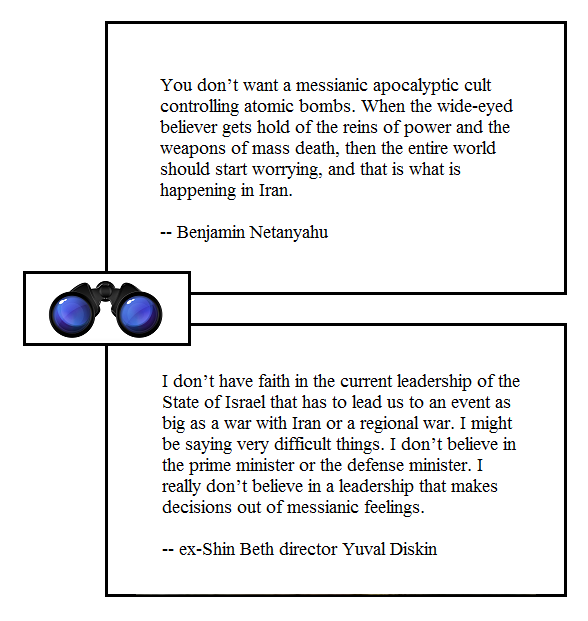
I try to read carefully. When I first saw the Yuval Diskin quote it was contextualized as suggesting that Benjamin Netanyahu and Ehud Barak were the leaders making “decisions out of messianic feelings” – but then for a moment it occurred to me that Diskin might have been saying “I don’t believe the prime minister’s accusation that the leadership of Iran makes decisions based on messianic feelings is correct – I see them as rational, persuadable actors.”

But no: Yuval Diskin is quite clear that it is Netanyahu and Barak he is talking about in this extended quote from Ha’Aretz:

My major problem is that I have no faith in the current leadership, which must lead us in an event on the scale of war with Iran or a regional war. I don’t believe in either the prime minister or the defense minister. I don’t believe in a leadership that makes decisions based on messianic feelings. They are two messianics – the one from Akirov or the Assuta project and the other from Gaza Street or Caesarea. Believe me, I have observed them from up close… They are not people who I, on a personal level, trust to lead Israel to an event on that scale and carry it off. These are not people who I would want to have holding the wheel in such an event.

Perhaps because I am more than usually sensitive to apocalyptic and messianic fervor, I find the implications of both Netanyahu’s and Diskin’s observations – if accurate as to the respective temperaments of the leaders concerned — quite chilling.

8.

As so often, I’m hoping to raise questions here — to prompt deliberative thinking, not to argue or persuade.

The Facebook pages of public diplomacy & the Billboards of unbelief

Monday, March 19th, 2012

[ by Charles Cameron — Facebook diplomacy between Israeli and Iranian individuals, atheist proselytizing in the US, popular media uses in a “monitory” world ]
.

I have long been intrigued by some of the unofficial ways in which we communicate with one another — some of you may recall an earlier post of mine on a spate of religious arguments carried out on “duelling buses“, while another more recent post noted some of the stencilled graffiti and at times quite sophisticated artwork featured on the walls around Tahrir Square during the demonstrations there…

1.

In much the same spirit, I’d like to offer here for your consideration four thumbnails of images recently posted on Facebook by individual citizens in Israel and Iran, in response to a posting (above) by two Israeli graphic artists, Ronnie Edri and Michal Tamir, which seems to have triggered quite a response in both countries.

The two Israeli posters appear to have posted images of individuals, perhaps themselves. The Iranian posters, interestingly, used images of Abdol-Hossein Sardari, the “Iranian Schindler” (upper image), with a caption that reads in part:

Abdol Hossain Sardari, a junior Iranian diplomat, found himself almost by accident in charge of Iran’s mission in Paris in 1940 and went on to help up to 2,000 Iranian Jews flee France…

and an image of the tomb of Esther and Mordecai — the tomb in Hamadan, Iran, of the same Jewish heroine recently celebrated at Purim, and pointedly referenced by Netanyahu in his gift of a Megillah to Obama — and a popular site of pilgrimage for Iran’s present day Jewish population.

Apparently there has been quite an exchange of these graphics, although some have been on the more caustic side, expressing what I can only call .. strangelove

2.

My other graphic examples are of a pair of billboards recently put up by American Atheists:

As we might expect, these were to be displayed (respectively) in or near Jewish (above) and Muslim (below) communities — the Jewish-oriented billboard in the Williamsburg area of Brooklyn, New York, and the Islamic-oriented billboard in Paterson, New Jersey.

According to the MSNBC report where I first ran across these billboards a couple of weeks ago, a Williamsburg rabbi said the sign in his district was “a disgrace. .. The name of God is very holy to us and to the whole world” — while the American Atheists’ president David Silverman reported he had not received “any blowback” from the Muslim Community in Patterson.

One imagines that some in each community would have had hurt feelings, while some in each community clearly had the good sense to show tolerance.

3.

These images tie in, I believe, with John Keane‘s notion of “monitory democracy” [link is to .pdf] that our blog-friend David Ronfeldt discussed in his post today… with our discussions here [1, 2] of the wicked complexity of many of the problems that face us… and also perhaps of the Slaughter doctrine [1, 2, 3]of the responsibility to protect


Switch to our mobile site