zenpundit.com » diplomacy

Archive for the ‘diplomacy’ Category

Johnston, Gorka and the need for specialist knowledges

Wednesday, August 10th, 2011

[ by Charles Cameron — religious knowledge, foreign policy, military ]

.

Dr. Douglas M. Johnston just posted a piece titled Religion a crucial tool in U.S. foreign policy in the Washington Post’s On Faith blog, and in it he quoted Dr. Sebastian Gorka‘s recent testimony to the HASC Subcommittee on Emerging Threats and Capabilities:

It is very difficult, if not impossible, to provide the contextual knowledge we need to understand and defeat our enemy if we rely solely upon anthropologists and social scientists…. Today our multi-disciplinary analysis of the enemy and his doctrine just as much requires — if not more so — the expertise of the regional historian and theologian, the specialist who knows when and how Sunni Islam split from Shia Islam and what the difference is between the Meccan and Medinan verses of the Koran. We should ask ourselves honestly, how many national security practitioners know the answers to these questions, or at least have somewhere to turn to within government to provide them such essential expertise.

I do appreciate that this was written by Dr Gorka for an audience that needs to keep up to speed on many, many topics.  What dismays me here isn’t the idea that “national security practitioners” should know these things — they should indeed, and should certainly also know specialists who know a great deal more — but that the bar is set so low, “a specialist” being, for that audience, someone “who knows when and how Sunni Islam split from Shia Islam and what the difference is between the Meccan and Medinan verses of the Koran”.

Let’s back up a bit.  Here’s a report on the Senate hearing on the appointment of GEN. Dempsey as Chief of Staff of the U.S. Army.

Gen. Martin Dempsey, tapped by the White House to be the next top military officer, acknowledged Tuesday that he and other senior officers failed to grasp the power dynamics among Islamic-based groups in Iraq.

After the U.S. military toppled the Saddam Hussein-led regime there in 2003, a powder keg erupted that was driven, in large part, by centuries-old power struggles and distrust among Iraq’s various Islamic sects.

It took American civilian and military leaders years to adapt and understand these dynamics, which experts say played a major role in both the length and violent nature of the Iraq war.

Driving the lack of understanding was a tendency of the military to “take five minutes to understand” an issue while immediately spending the next “55 minutes trying to solve it,” Dempsey said during his confirmation hearing before the Senate Armed Services Committee.

Those “five minutes to understand” might get you the basic difference between the Meccan and Medinan suras — but a specialist knows a little more than that, as one can gather from comments Dr Timothy Furnish posted just the other day on his MahdiWatch blog, commenting on Dempsey’s remarks:

One might reasonably wonder whether the US military and intelligence community (not to mention the State Department) truly does, finally, realize the importance of sectarian differences in the Islamic world. For example, the Syrian case pitting the pseudo-Shi`i Alawi rulers against the country’s Sunni majority only recently came to Washington’s attention; neither Libya’s history of Sanusiyah Sufi jihad against occupation, nor Mua`amar al-Qadhafi’s heretical Islamic teachings and rule, has been fully considered or acknowledged by the American government; and there are still commanders deploying to and from Afghanistan who seem blissfully ignorant of the fact that that country is 19% Shi`i (and that a substantial subset of that is not Twelver but Sevener, or Isma’ili, Shi`i).

But that’s one paragraph from a single blog post, and Furnish has written a book — has written, as they say, “the book” on Mahdism.  And that’s just one book, you don’t suppose Furnish’s knowledge is limited to what he managed to compress into a few hundred pages, do you?

Furnish is a specialist — that’s why I read and correspond with him.  I’m a generalist with, I hope, some decent insights into what to watch for and who to read for background — but Furnish is a specialist.

And the solution isn’t to add “specialist” to a checklist, find one on LinkedIn and check it off — the solution is widespread, ongoing conversation among specialists, with the help of generalists, across all silos and disciplinary boundaries, of the sort we try to promote here from time to time… until there are enough people, with enough parts of the puzzle, that we don’t get blindsided by our ignorances.

Ignorances, plural.  Knowledges, plural.

*

This just in…  Dr Furnish’s second book — The Caliphate: Threat or Opportunity? — is now available for pre-order. I hope to review it at some point here on ZP.
Possible Shifts in AfPak

Tuesday, July 12th, 2011

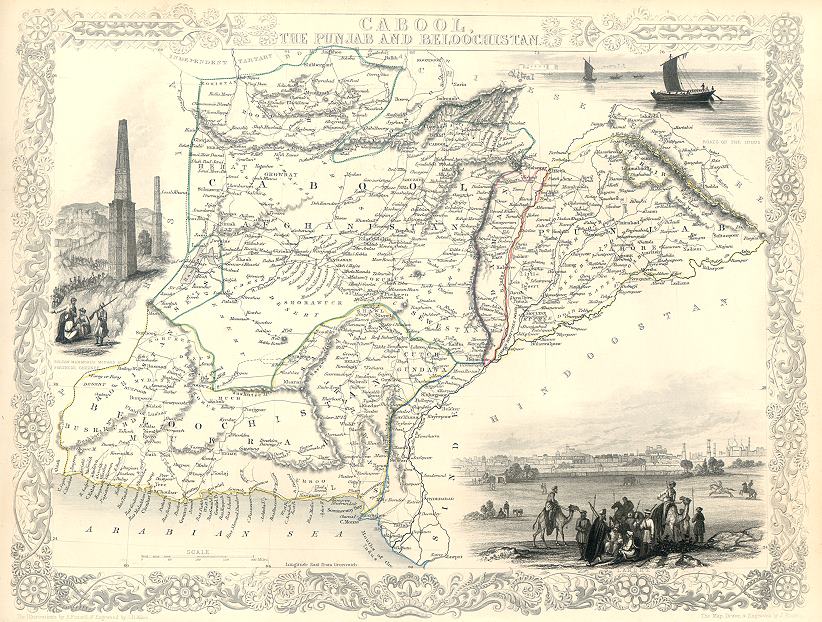
afpak.jpg

On Pakistan policy, credit where credit is due: the Obama administration has found the stones to respond to evidence of systemic and brazen bad faith on the part of our Pakistani “allies” and show their displeasure by witholding $ 800 million dollars in aid from Islamabad. There are already squeals of Pakistani unhappiness at this modest decrease of aid that all too frequently gets diverted to preparing to make war on India or, for that matter, on American soldiers and Marines. Former dictator General Pervez Musharraf, who cannot go back home to Rawalpindi for fear his brother officers will assassinate him, told a well appointed crowd in Houston that the aid cut “will be disastrous….if Pakistan is weakened, how will it fight terrorism?“.

Cynics might note that we could replace “fight” with “fund” in the former Pakistani ruler’s question and achieve greater historical accuracy.

On Afghanistan, it might be advisable for the new American commander, Lieutenant General John Allen, in carrying out his extremely difficult mission of “Afghanization” and “punitive raiding” the Taliban, to first ponder history and  “Remember Herat“.

In 1979, before the Soviet invasion of Afghanistan, the entire garrison of Soviet advisers in Herat was slaughtered, including the dependent women and children, by an angry mob that was aided by the local Afghan Communist Army units who, led by Ismail Khan, conveniently revolted and turned on their Russian allies. If British military history is more to Lt. General Allen’s taste, the Afghans massacred British garrisons in Kabul twice in the 19th century, Major Cavagnari’s in 1878 and that of Sir William McNaghten and Sir Alexander Burnes in 1841, though most of the British died to all but the last man on the retreat to Jalalabad in 1842.

The cape wearing, election-stealing, lotus-eater whom we thanklessly prop up, may be more incompetent than Nur Mohammed Taraki and less legitimate a client than Shah Shuja, but he has a demonstrated talent for inciting anti-western violence exceeded only by his enterprise in looting aid money. Is crazy Karzai above lighting a match to a tense situation the US military itself has already described as a “rapidly growing systemic threat“? Not in my view.

When the American drawdown begins in earnest, General Allen will need to watch the backs of his troops

ADDENDUM:

Ahmed Wali Karzai, the notorious fixer and feared enforcer of the Afghan regime and the brother of President Hamid Karzai was assassinated today. The Taliban claimed credit, but AWK has too many enemies to be certain yet.

Google Ideas SAVE conference

Friday, July 8th, 2011

[ by Charles Cameron — cross-posted with brief intro from Alix Levine‘s blog — topic: Google’s Summit Against Violent Extremism ]

.

Google Ideas — the Google “think/do tank” — recently co-hosted (with the CFR and Tribeca Film festival) a conference on countering radical extremism in Dublin, with a mix of “former extremists, activists, academics, survivors, executives and public sector officials” in attendance.  Blog-friend Matt Armstrong was there, live-tweeting with enthusiasm. Dr William McCants of Jihadica and CNA wasn’t terribly impressed with the outcome, and posted at Foreign Policy:

I am not ready to give up on the enterprise of countering violent extremism just yet, but I am less sanguine about its chances of success than I was before I started working on the problem. Google Ideas’ summit has not increased my optimism, but its resources and potential do.

Alix Levine of Cronus Global attended the event, and reported back on her blog. I’ve commented briefly on McCants’ piece on FP, but wrote a longer piece as a comment on Alix’ blog, and am cross-posting it here in the hope that it will stir further discussion…

*
I’m comparing Will McCants‘ response to the Google Ideas conference on FP with yours, and I’m glad you wrote as you did.

McCants – whose work I generally admire — opens his comments by quoting Jared Cohen to the effect that the purpose of the conference was to “initiate a global conversation”. McCants then more or less dismisses the conference itself a couple paragraphs later with the words “If these are indeed the conclusions of the conference, Google Ideas needs more thinking and less doing in its approach”.

Conclusions? How does he get so quickly from “initiate” to “conclusions”?

Okay, we all know that a conference can lead to a volume of proceedings read mostly by the authors themselves and a few aspiring students eager to follow-my-leader and dead end there – but this conference was very clearly intended to be the start of something, not the wrap-up.

So your comment, Alix, “Instead of critiquing Google’s effort, it will be more productive and valuable to work in unison with Google on their mission to ‘initiate a global conversation'” seemed to me to bring us back to the actual intent Google had announced for the conference, and you reinforce that when you write, “I hope that more people will join in on the conversation in a meaningful and (gasp) positive way.”

My questions are: how and where do we do this?

There will have been contacts made at the conference that will lead to an exchange of emails, no doubt – but that’s not a global conversation.

Here are some of the problems I foresee:

(a) siloing: the conversation limiting itself to a few constituencies, each of which talks mainly among its own members, leading to

(b) group think: in which the widely assumed gets even more firmly entrenched as “wisdom”, with

(c) secrecy: meaning that potentially relevant information is unavailable to some or all participants, all of which add up to

(d) blind spots: topics and approaches that still don’t get the attention and exploration they deserve.

The solutions would need to include:

(a) networked diversity: by which I mean a structured means of getting the unpopular or minority opinion front and center (compare business brainstorming in which a facilitator ensures even the “quiet ones” get heard, and that even poor ideas are expressed without critique until a later, evaluative stage),

(b) contrariety: meaning that whatever ideas are “easily dismissed” get special attention, with

(c) transparency: meaning that whatever could be redacted and made partially available is made available, not (as in US Govt “open source” material, closely held), so that

(d) oddballs and outriders get to participate…

Jami Miscik who was Deputy Director for Intelligence at the time, caught my attention when she said in 2004, “Embrace the maverick”. Oddballs aka mavericks make the best contrarians, because they start from different premises / different assumption bases. Miscik accordingly invited science fiction and film writers to interact with her analysts at CIA, and found that when they did, they produced 80% already known ideas, 10% chaff, and 10% new and “valid” scenarios. But even then, “science fiction and screen writers” is a box…

Cross-fertilization, questioning of assumptions, passion, reverie, visualization, scenario planning, play – the number of strategies that could be employed to improve the chances of a successful new insight emerging are many and various – unkempt artists probably know some of them better than suits with high IQs and clearances, and Google clearly knows this, too…

But where?

I mean, what Google+ circles do any of us join, to join this global conversation? What twitter hashtag brings us together under one roof? When’s the follow up in my neck of the woods, or yours?

What’s the method for getting the conversation widespread, well-informed – and scaleable, so the best of the grass roots and local ideas can find their way to the influential and informed, and the best insights of the influential and informed can percolate through to the grass roots and local?

Lastly, I’d like to thank Google for getting a dialog going between those with a range of subjective experiences of radicalization, and those whose job it is to understand and thus be able to interdict it. Demonization never got the situation in Northern Ireland anywhere near peace – listening did.

And thank you too, Alix, for your own contribution. Let’s move the conversation onwards.

The East Rising

Sunday, July 3rd, 2011

Gifts from a generous Meatball:


Hardcovers too. Nice.

The Party: The Secret World of China’s Communist Rulers by Richard McGregor

Monsoon: The Indian Ocean and the Future of American Power by Robert D. Kaplan

I have already dived a few chapters into the McGregor book and it is very good. What makes it good is that is running counter to the message of the herd in terms of popular Sinology, which is to emphasize that China is a) uniquely Chinese with deeply introspective Confucian civilizational traditions (that’s modern PC-speak for “inscrutable”) and b) the brave new world of liberal, globalized, capitalism with a benign technocratic face.

Now there’s important truths in both of the popular mass messages on China, incompatible as they can be with one another. The economic rise of China in a globalized economy is the most important story of the last quarter of the 20th century and the first quarter of the 21st ( collapse of the USSR is second; the Soviets were beaten before they imploded and imploded largely because they knew they were beaten). China is also not like America, not even when they imported stock options, blue jeans, McDonald’s and the American jobs that used to create all those things. China’s civilization is truly of a dizzying depth, complexity and scale that is best compared to Europe rather than a specific country. That in itself, is important because it points to how ignorant the average American policy maker is, never mind the average American, about what makes their Chinese counterpart tick.

[ Sidebar: Perhaps the Obama administration assembling a new senior “China/East Asia” diplomatic and national security team that does not include a single official with any professional knowledge of China was unwise? How is that better than the Bush II administration shunning Arabists during the run up to and occupation of Iraq? It is not that these diplomats and officers are poor, they are smart and experienced, but none of them are China specialists. Or Japan specialists, for that matter and only one has expertise in Korean affairs. These are the region’s great powers! This is like turning EU/NATO policy over to diplomats who speak Hindi and Swahili ]

What McGregor is doing in The Party that is important is reminding Westerners that the Soviet experience, particularly the Leninist Party model, is still deeply embedded in China’s political DNA. Not in an ideologically Marxist, Khrushchevian, shoe-pounding sense but in a functional sense. In a structural sense. In an instrumental governance sense. In a networking theory sense. And all these characteristics, which are largely innately hostile or indifferent to the values of liberal democracy, continue to shape Chinese policy, leadership succession, national security, defense strategy and geopolitical outlook to this day.

That doesn’t mean China is itching for a war with the United States, but it means they are playing a longitudinal strategic game where the first goal is to stay in power forever and the next is to advance one’s position relative to others.

We are the other.

China is not an enemy but she is no friend or ally of the United States either, yet it is the most important relationship the US has to manage for the next thirty years – and that relationship in a strategic context with rising India, Japan, South Korea and Australia.

It might help if America brought a team to the table that included people who could tell Han Fei Tzu from Mencius or spoke Chinese.

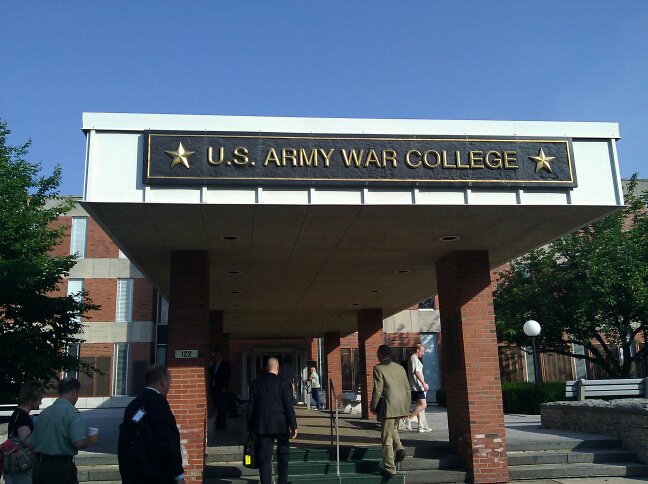
The US Army War College National Security Seminar 2011

Sunday, June 12th, 2011

warcollege.jpg

As noted previously, I was fortunate to attend the National Security Seminar at the the US Army War College this year and wanted to relay my impressions while they were still fresh.

First, in terms of reception and cordiality, I have rarely experienced such an extensive and personal outreach as was demonstrated by the War College staff, faculty, administration and students. Every new member had a “sponsor” – a student, usually a colonel or Navy captain, who acted as a liason and personal guide from the time their plane touched down until the moment they returned to the airport. My sponsor, the former commander of the WolfhoundsColonel Richard “Flip” Wilson, whom I consider a friend, really extended himself on my behalf, making me feel welcome and a full member of Seminar Group 20. Most of the students have multiple tours of duty in Iraq and Afghanistan under their belt and many can report the same for the first Gulf War, Panama, Bosnia or Kosovo.

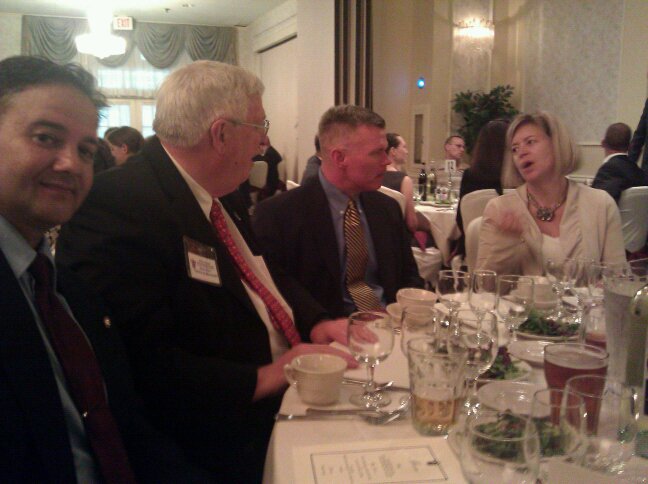
The War College, the Commandant and the Seminar Group all hosted receptions and dinners designed to get students and civilian new members to mix and further discuss issues raised in the seminar sessions or lectures. At these events I had the opportunity to meet and talk to the leadership of the Army War College including the Commandant Major General Gregg Martin, the Deputy Commandant for International Affairs, Ambassador Carol Van Voorst, the Executive Director of the Army Heritage Foundation, Mike Perry, the Director of SSI, Dr. Douglas Lovelace,  the Chief of Staff and numerous faculty and seminar members. The New Members such as myself were exceedingly well fed at these events as I suspect the Army was attempting to prove that it really does march on it’s stomach.


warparty.jpg

warparty2.jpg

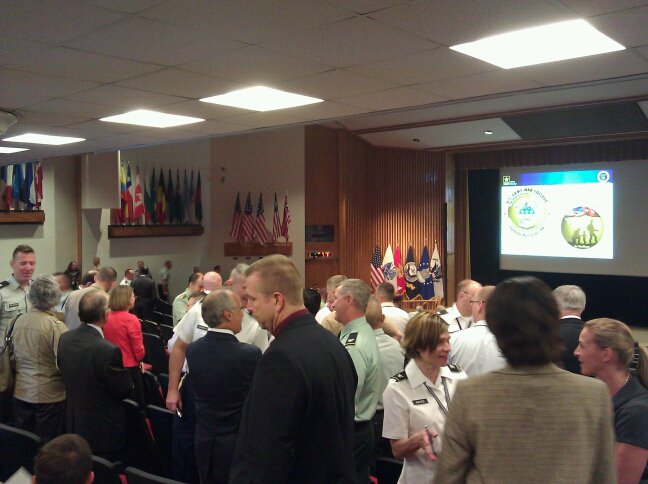
The serious business of the National Security Seminar was divided into two segments, the talks given by distinguished speakers to the entire class of 2011 and the New Members and the Seminar Group sessions of approximately twenty students, New Members, academics and foreign visitors. We received a brief on the war in Afghanistan from the ISAF Chief of Staff, who was standing in last minute for General Petraeus who was called to meet with senior adminstration officials; and a very interesting concluding talk by Foreign Affairs Editor Gideon Rose, author of How Wars End, which covered issues of strategy, grand strategy and the disconnect with policy.

warseminar.jpg

  The National Security Seminar is run strictly on a non-attribution basis, in order to encourage candor and frank exchange of views, which handicaps my ability to discuss specifics here. I can say that my views on Pakistan ( which I compared to “North Vietnam” ) riled more than a few people – Pakistan is the only country in the world given 2 exchange student slots at the Army War College at the request of the most senior leadership of the US Army – and several students and faculty members took the time, outside of seminar sessions, to make certain I heard countervailing POV regarding Pakistan’s value as an ally. Other topics included, but were not limited to:

Defense budget cuts and force structure
Narco-cartels in Mexico: Insurgency or No?
Civil-Military Relations
Repeal of DADT
AfPak War
al Qaida and GWOT/US Strategy
COIN
Critical thinking and Leadership
Logistics
Libya and NATO
AWC Strategy Curriculum/Program
What the US public expects from their military
China as a peer competitor
Effects of ten years of war on officer corps/military
Illegal combatants and international law
PTSD
Battle of Gettysburg and Grand Strategy
Cyberwar
Differences in Armed Services strategy, command climate, discipline, leadership
The Arab Spring
US Global leadership and Economics
Interagency Operational jointness

Most of the discussion took place in the seminar groups, with Q&A periods in the mass sessions with featured speakers. I came away deeply impressed with the seriousness and insights as practitioners that AWC students brought to the table. The AWC strategic studies program seeks to broaden students who are assumed to arrive with tactical expertise and prepare them for higher command that carries operational, strategic and even policy responsibilities (at least in terms of interpreting and executing within policy guidelines). Many students were articulating ideas associated with Thomas P.M. Barnett, the “mission order” and “commander’s intent” style of leadership or Clausewitzian strategic premises during debates and discussion.

The National Security Seminar Week was for me, an enlightening and exceptionally enjoyable experience, one I would highly recommend to readers who may have such opportunities in future years.


Switch to our mobile site