Booksbooksbooksbooks….
Monday, August 1st, 2011Two more for the pile….

Another Bloody Century by Colin Gray
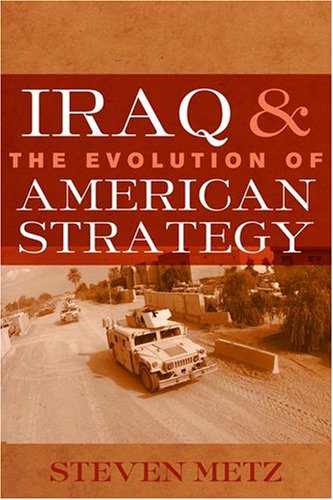
Iraq & the Evolution of American Strategy by Steven Metz
Comments or opinions?
Two more for the pile….
Another Bloody Century by Colin Gray
Iraq & the Evolution of American Strategy by Steven Metz
Comments or opinions?
Doing some heavy duty research…..Amazon will be doing well this year on my dime:


Architect of Global Jihad by Brynjar Lia
A Terrorist’s Call to Global Jihad by Jim Lacey
Modern Strategy by Colin Gray

The Profession by Steven Pressfield
Tequila Junction: 4th Generation Counterinsurgency by H. John Poole
Steve’s novel The Profession I have mentioned previously, but I confess that I am puzzled by the choice of book jacket on Tequila Junction, which looks somewhat like a children’s illustrated guide to COIN in 1980’s El Salvador. H. John Poole is a respected veteran and tactical expert and Tequila Junction carries the warm endorsements of General Anthony Zinni and William Lind. Maybe his grandson drew it? Odd.
In any event, small unit tactics are not a subject I pretend to know much about, so it will remedy a gap in my knowledge base.
My amigo and SWJ News co-columinst Crispin Burke recently put forth a very interesting and provocative jeremiad “Be honest: Who actually read FM 3-24?” and one of his targets, journalist and Iraq war veteran Carl Prine, has been duly provoked, Prine has responded in great detail yesterday at Line of Departure:
Starbuck is wrong.
And in his drive to keep getting it wrong, he’s trying to rewrite FM 3-24, the military’s chief doctrinal publication on counterinsurgency.
But that just makes him more wrong.
He’s wrong about me. He’s wrong about what I believe. He’s wrong about the literature that informs FM 3-24. He’s wrong about what the manual says and he’s wrong about what it left out. He’s wrong about historiography. He’s wrong about how a caste of top officers and diplomats came to understand “strategy” in the wake of the occupation of Iraq.
Let’s help get him right. Or, at least, less wrong. He’s a good man. We need to turn him and ensure he quits taking shots at me I don’t deserve!
….The problem to anyone who studies Malaya, however, is that since the publication of the memoirs of exiled communist leader Chin Peng a dozen years ago, we now know that the civic, military and political policies under the British “hearts and minds” approach didn’t defeat the revolution.
Instead, the revolt was irreparably broken by brutal operations against the guerrillas, then a most coercive “screwing down the people” phase that dispossessed or killed thousands of Chinese, followed by draconian “population control” measures that, as Peng put it, starved the guerrillas in the bush because they snapped their rat lines and cut off their rice.
The “hearts and minds” initiatives designed to bring medical care, education, social welfare and other aid to the resettled Chinese and woo them to the colonial government’s side from 1952 – 1954 didn’t crack the back of the insurgency, a point now pretty much beyond dispute.
Why? Because the previous “hearts and minds” claptrap as the cause of pacification in Malaya was contradicted by the Malayan Chinese, most especially those guerrillas who took up arms against the British regime!
You know, the people targeted by a population-centric counterinsurgency. The people most counter-insurgents in their pop-centric fantasies almost never discuss except as abstractions, the human yarn wefted and warped by their long needles of war.
One finds “Hearts and Minds” prominently mentioned 11 times in Dr John Nagl’s valentine to Templer and colonial Malaya, Eating Soup with a Knife; to Nagl it’s the stuff of police services and economic development and whatnot with the psychology of the people being the center of gravity those reforms are meant to snatch.
And Nagl would like the best burglar of hearts and minds to be a learning, nimble and evolving military-political institution such as the U.S. Army. It’s no small wonder, then, that Nagl became a dominant voice in FM 3-24 and that many of this thoughts in Eating Soup came to dominate the manual, too.
Or, as the introduction to FM 3-24 echoes soupily, “by focusing on efforts to secure the safety and support of the local populace, and through a concerted effort to truly function as learning organizations, the Army and Marine Corps can defeat their insurgent enemies.”
This is mere euphemism and wasn’t worth the ink that it cost taxpayers to print it. But it sets the stage for the rest of FM 3-24, which follows a hearts and minds template that Starbuck doesn’t apparently realize is borrowed from mid-century….
Ouch. Note to self: if I ever decide to square off against Carl, I will make sure to do my homework. Read the rest here.
First, I would point out to readers here for whom some of this in both essays is inside baseball, that the tone is less harsh and the substantive distance between Burke and Prine less great in the comments sections of both blogs than it first appears in reading their posts. It is a healthy, no-holds barred exchange and not a flame war.
Secondly, it is an important exchange, tying together COIN disputes over theory, historiography, empirical evidence, operational and tactical “lessons learned”, strategy, policy (Clausewitzian sense), politics (colloquial sense) and personalities that have raged for five years across military journals, think tanks, the media, the bureaucracy and the blogosphere. In some ways, these essays can serve as a summative of the debate. I say “some ways”, because what is the most important element or effect of America’s romance with COIN will differ markedly depending on whom has the floor. My own beef is not with doing COIN, it is with not doing strategy.
As Crispin and Carl’s vignette about General Creighton Abrams demonstrated, American historians are still having savagely bitter arguments about the war in Vietnam. For that matter, everyone who lived through the era did and still does. It is a wound that never seems to heal and has crippled our politics to this day, even as the veterans of Vietnam now turn to gray.
The 21st century COIN wars have not ripped American society apart down to the soul the way Vietnam did. As with the Korean War, the soldiers and marines in Afghanistan and Iraq fought bravely, at times desperately, to a general and mild approbation back home that sometimes looked a lot like indifference. Even the anti-war protestors mostly made a point of stating they were not against the troops, the venemous public malice of the 1960’s New Left radicals in the 2000’s was a property only of the lunatic fringe.
But COIN itself will be a historical argument without end.
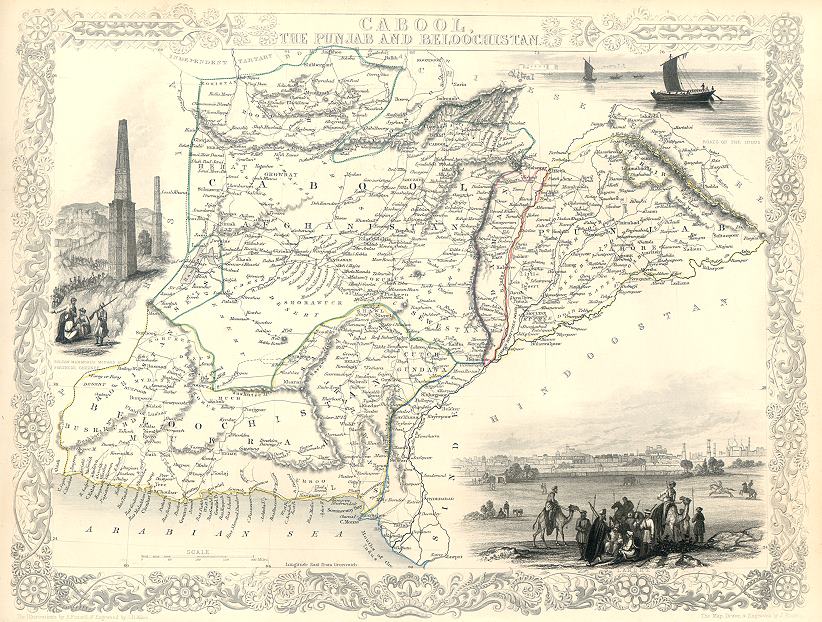
On Pakistan policy, credit where credit is due: the Obama administration has found the stones to respond to evidence of systemic and brazen bad faith on the part of our Pakistani “allies” and show their displeasure by witholding $ 800 million dollars in aid from Islamabad. There are already squeals of Pakistani unhappiness at this modest decrease of aid that all too frequently gets diverted to preparing to make war on India or, for that matter, on American soldiers and Marines. Former dictator General Pervez Musharraf, who cannot go back home to Rawalpindi for fear his brother officers will assassinate him, told a well appointed crowd in Houston that the aid cut “will be disastrous….if Pakistan is weakened, how will it fight terrorism?“.
Cynics might note that we could replace “fight” with “fund” in the former Pakistani ruler’s question and achieve greater historical accuracy.
On Afghanistan, it might be advisable for the new American commander, Lieutenant General John Allen, in carrying out his extremely difficult mission of “Afghanization” and “punitive raiding” the Taliban, to first ponder history and “Remember Herat“.
In 1979, before the Soviet invasion of Afghanistan, the entire garrison of Soviet advisers in Herat was slaughtered, including the dependent women and children, by an angry mob that was aided by the local Afghan Communist Army units who, led by Ismail Khan, conveniently revolted and turned on their Russian allies. If British military history is more to Lt. General Allen’s taste, the Afghans massacred British garrisons in Kabul twice in the 19th century, Major Cavagnari’s in 1878 and that of Sir William McNaghten and Sir Alexander Burnes in 1841, though most of the British died to all but the last man on the retreat to Jalalabad in 1842.
The cape wearing, election-stealing, lotus-eater whom we thanklessly prop up, may be more incompetent than Nur Mohammed Taraki and less legitimate a client than Shah Shuja, but he has a demonstrated talent for inciting anti-western violence exceeded only by his enterprise in looting aid money. Is crazy Karzai above lighting a match to a tense situation the US military itself has already described as a “rapidly growing systemic threat“? Not in my view.
When the American drawdown begins in earnest, General Allen will need to watch the backs of his troops
ADDENDUM:
Ahmed Wali Karzai, the notorious fixer and feared enforcer of the Afghan regime and the brother of President Hamid Karzai was assassinated today. The Taliban claimed credit, but AWK has too many enemies to be certain yet.

Zenpundit is a blog dedicated to exploring the intersections of foreign policy, history, military theory, national security,strategic thinking, futurism, cognition and a number of other esoteric pursuits.
Customized Web Site & Blog Design

