[ by Charles Cameron — the power of images in which overwhelming humanity is juxtaposed with overwhelming force ]
.
The image of Ieshia Evans standing truth to power became an instant icon last week, as did an earlier photo of a man facing down a line of tanks at Tienanmen Square. Now, that photo of individual courage in the face of a tank has a cousin from Turkey, and Kenneth Roth has paired the two of them in what I term a DoubleQuote in the Wild:
[ by Charles Cameron — religions taking other religions apart, stone by stone, image by image, song by song ]
.
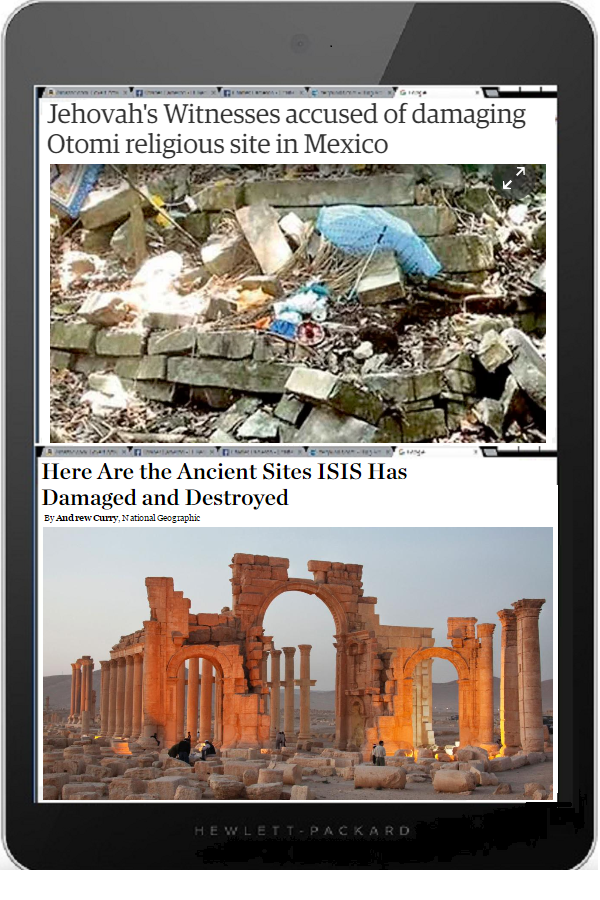
Some recently converted Jehovah’s Witnesses appear to have destroyed the altars of indigenous Otomi people in Mexico, an anthopologist has stated:
Assailants have damaged an ancient Otomi Indian religious site in Mexico, toppling stone structures used as altars, breaking carved stones and scattering offerings of flowers, fruit and paintings at the remote mountain shrine known as Mayonihka or Mexico Chiquito. [ .. ]
“I don’t know what religion they belong to, but they destroyed several images that were there,” said Daniel Garcia, the municipal secretary of the nearby township of San Bartolo Tutotepec. “The thing is, there are some religions that don’t believe in using idols.”
Luis Perez Lugo, a professor at the University of Chapingo, visited the site in May and talked to residents of a nearby hamlet, El Pinal, whose residents said they had carried out the attack.
“I was there, and the Jehovah’s Witnesses said they had done it,” Perez Lugo said, noting some were recent converts to the religion who used to go to the site for Otomi ceremonies.
See upper panel, below:
In the lower panel, above, we see a detail from a National Geographic listing of sites attacked by the Islamic State. Three quick notes:
the JWs, if they were JWs, were recent converts; converts often have a zeal all their own
the IS, like the Taliban at Bamiyan, destroys ancient religious sites even if no longer in use
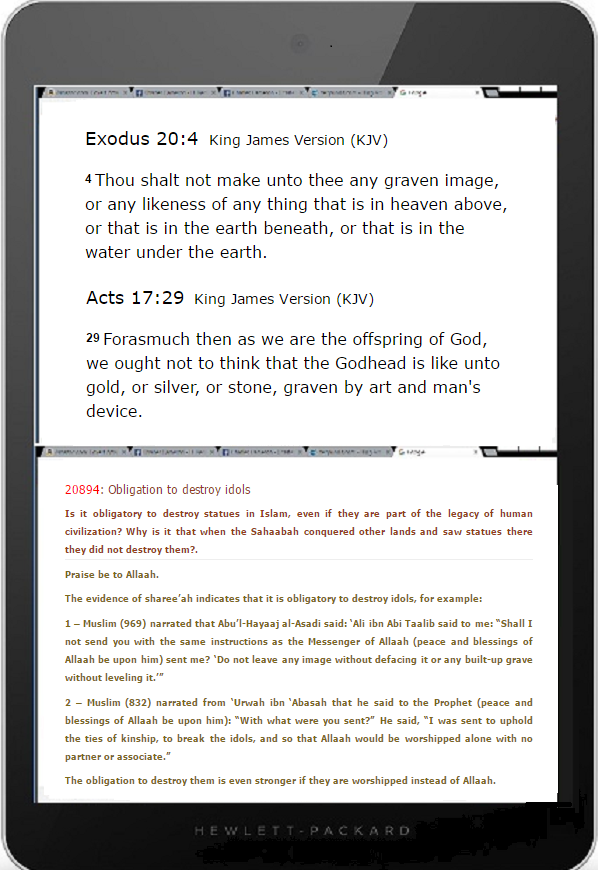
You already know this, but for the record — because Scripture:
In the upper panel, Jewish and Christian scriptures — from the Jewish Ten Commandments in Exodus, and St Paul‘s address to the Athenians, as recounted in the Acts of the Apostles.
In the lower panel — a hard-line contemporary Islamic commentary, citing two ahadith.
**
So it’s Jehovah’s Witnesses and hard-line Muslim literalists who approve of the destruction of monuments to false gods, is that what this means?
They are not alone. In the upper panel, below, recent news of the Chinese — avowed atheists — continuing their attacks on Tibetan Buddhism, this time by mandating the dismantling of Buddhism’s largest monastic university at Larung Gar:
In the lower panel, above, we see some of what remains of the great Abbey of Glastonbury, torn down during the Dissolution of the Monasteries under King Henry VIII.
Glastonbury has strong associations with Arthurian and Christian traditions:
William Blake’s dramatic poem ‘Jerusalem’ familiar nowadays as an inspirational hymn, draws on the myth that Christ himself may have visited Glastonbury with Joseph of Arimathea and ‘walked on England’s mountains green’.
The Gospels record that Joseph of Arimathea was a wealthy follower of Christ who buried Christ’s body in his own tomb after the Crucifixion.
In the Middle Ages Joseph became connected with the Arthurian romances of Britain. He first features in Robert de Boron’s Joseph d’Arimathie, written in the twelfth century, as the Keeper of the Holy Grail. He receives the Grail (the cup used by Christ at the Last Supper) from an apparition of Jesus and sends it with his followers to Britain.
Later Arthurian legends elaborated this story and introduced the idea that Joseph himself travelled to Britain, bringing the Holy Grail with him and then burying it in a secret place, said to have been just below the Tor at the entrance to the underworld. The spring at what is known as Chalice Well is believed to flow from there. In their quests King Arthur and the Knights of the Round Table searched for the Grail.
Glastonbury retains its place in English hearts to this day, albeit in contemporary guise — it is the Yasgur’s Farm of England’s ongoing Woodstock — mud, sex, drugs, rock and all — the yearly Glastonbury Festival —
It is also — in the form of Blake‘s hymn “And did those feet in ancient time” — a part of such ceremonial events as the Last Night of the Proms — and Royal Weddings:
But more on Blake’s poem — known as Jerusalem, and taken from his preface to Milton a Poem — in an upcoming post, Creek willing.
**
Finally, what an exceptionally lovely early DoubleQUote is this, returning us to the topic of sacred places and images and their destruction:
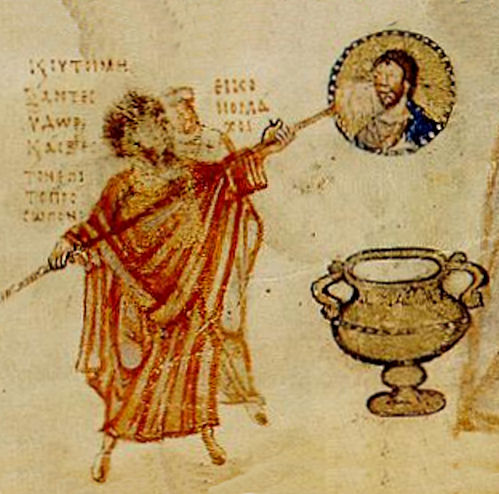
What we have here is a page from the Chludov Psalter — ask Wikipedia for that what means, I only just ran across it in the course of writing this piece — but it’s a 9th century Byzantine prayer book, illuminated with illustrations attacking the iconoclasts — those Christians who wanted to destroy icons and other Christian images for reasons not dissimilar ton those of the Taliban.
In the illustration to the right, the miniaturist illustrated the line “They gave me gall to eat; and when I was thirsty they gave me vinegar to drink” with a picture of a soldier offering Christ vinegar on a sponge attached to a pole. Below is a picture of the last Iconoclast Patriarch of Constantinople, John the Grammarian rubbing out a painting of Christ with a similar sponge attached to a pole.
Let’s take a closer look:
Both verbally and visually, then, we have a direct comparison of the Roman soldier mocking the dying Christ, and the icon-hating Patriarch erasing Christ’s image from a wall.. And they call him the Grammarian!
But let’s proceed:
John is caricatured, here as on other pages, with untidy straight hair sticking out in all directions, which was considered ridiculous by the elegant Byzantines.
No punks, apparently, these Byzantines!
And the coup de grâce? House the sacred book in a state museum..
Nikodim Kondakov hypothesized that the psalter was created in the famous monastery of St John the Studite in Constantinople. Other scholars believe that the liturgical responses it contains were only used in Hagia Sophia, and that it was therefore a product of the Imperial workshops in Constantinople, soon after the return of the Iconophiles to power in 843.
It was kept at Mount Athos until 1847, when a Russian scholar brought it to Moscow. The psalter was then acquired by Aleksey Khludov, whose name it bears today. It passed as part of the Khludov bequest to the Nikolsky Old Believer Monastery and then to the State Historical Museum.
I took note of the Kurzweil announcement in the upper panel above, because I’m due for some form of kidney dialysis myself — and the new report on Chinese harvesting of religious prisoners’ marketable organs, Bloody Harvest / The Slaughter, because I’m interested in Falun Gong and other religious movements in China that are under intense pressure from the Chinese authorities.
Here are a couple of excerpts from the 680-page report:
The narrative of pursuit, arrest, torture, and, in several cases, execution, illustrates that Falun Gong was putting up an increasingly effective resistance – even as the state’s structure of persecution was spinning out of control, and shedding any remaining inhibitions surrounding the mass exploitation of Falun Gong for their organs. The “self-immolation” of Falun Gong practitioners on Tiananmen Square is also examined in detail, with the conclusion that it was not only a set-up but a masterstroke of state propaganda.
What emerges is a picture of an organ harvesting regime that began giving discreet physical examinations of select Falun Gong practitioners in late 2000/early 2001, expanding into mass examinations (including Tibetan prisoners of conscience and the House Christian group “Eastern Lightning”) by 2003, and an organ harvesting regime wasn’t even being kept fully secret within the Laogai System by 2005
It’s worth noting that the Uyghur Muslims are caught up in the same situations, too.
**
Putting the two halves of this puzzle together — one of the aspects of the harvesting of organs from Chinese religious dissidents is that it attracts what the publishers of the report term organ tourism:
Governments should enact measures to criminalize the purchase of trafficked organs at home or abroad. They could also require reporting of ‘organ tourism’, ban entry of those involved in trafficking organs, and prohibit their pharmaceutical companies from doing transplant field tests and clinical trials in China.
The idea of extending one’s life by receiving the transplanted organ of a prisoner separated out for religious reasons and then killed to supply the tourist organ market is both deeply human, in the sense of serving the individual’s survival, and deeply abhorrent and inhuman, as (effectively) a paid enticement to mass murder.
**
At one point, the report says:
Falun Gong, also known as Falun Dafa, began in May 1992 with the teachings of Li Hongzhi. The two Davids [co-authors of the report] have described Falun Gong as a set of exercises with a spiritual and ethical foundation. Ethan Gutmann in The Slaughter states: “Falun Gong, simply put, is a Buddhist revival movement.”
Saying Falun Gong is “simply put .. a Buddhist revival movement” is a bit simplistic itself, though. Here’s an excerpt of a Time magazine article from 1999 — it appeared in the world edition, but not I think in the US — in which Li Hongzhi explains a major aspect of his concern about where the human race is heading:
The aliens come from other planets. The names that I use for these planets are different . Some are from dimensions that human beings have not yet discovered. The key is how they have corrupted mankind. Everyone knows that from the beginning until now, there has never been a development of culture like today. Although it has been several thousand years, it has never been like now.
The aliens have introduced modern machinery like computers and airplanes. They started by teaching mankind about modern science, so people believe more and more science, and spiritually, they are controlled. Everyone thinks that scientists invent on their own when in fact their inspiration is manipulated by the aliens. In terms of culture and spirit, they already control man. Mankind cannot live without science.
The ultimate purpose is to replace humans. If cloning human beings succeeds, the aliens can officially replace humans. Why does a corpse lie dead, even though it is the same as a living body? The difference is the soul, which is the life of the body. If people reproduce a human person, the gods in heaven will not give its body a human soul. The aliens will take that opportunity to replace the human soul and by doing so they will enter earth and become earthlings.
When such people grow up, they will help replace humans with aliens. They will produce more and more clones. There will no longer be humans reproduced by humans. They will act like humans, but they will introduce legislation to stop human reproduction.
I’m pretty sure the Falun Gong people worry the Chinese central authorities because they’re a substantial quasi-millennial sect that’s only too reminiscent of the Taiping sect of the mid-nineteenth century, whose rebellion the government of the day eventually put down at a total cost of somewhere between 20 and 30 million lives. throw in ~150 years’ worth of advances in weaponry, communications media and population size, and the head honchos wouldn’t like to see how wildly destructive a 2000 or 2020 repeat might get!
Neil Armstrong? Heard the Islamic Call to Prayer? On the moon?
**
Poets love the moon, almost by definition — the Chinese poet Li Po supposedly drowned while attempting (under the influence) to kiss her face in the Yellow River — so this alleged, though dubious, story was definitely too rich in possibilities for me to ignored. And the Islamic Call to Prayer? According to Nicholas Kristof in the NYT:
Mr. Obama described the call to prayer as “one of the prettiest sounds on Earth at sunset.”
You may or may not agree, but if you want to hear the Call and judge for yourself, you could try listening to one of these videos:
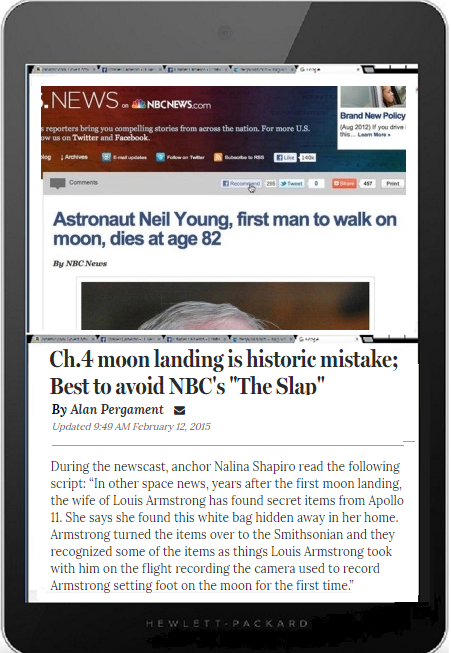
That’s what led me to my second discovery –one which might be excused by blaming autocorrect, twice, for suggesting that Neil Young — he of the voice, upper panel below — and Louis Arnmstrong — he of the trumpet, lower panel — were each the first man to land on the moon, per (in both cases) NBC.
In all fairness, it’s worth noting that other candidates for moon walks include Buzz Lightyear, Lance Armstrong, and Michael Jackson.
None of these mistakes are critical, however, if you believe the late Srila Prabhupada, who introduced Krishna Consciousness to the United States. As someone fascinated by different cosmologies and theologies, I remember reading of Prabhupada’s claim that the moon landing was faked in a California film studio in his magazine some time in the 1970s. No longer having access to the magazine, and looking for confirmation of that memory, I found this page, Srila Prabhupadas statements about the moon landing, of considerable interest:
Srila Prabhuapda himself said different things at different times. Sometimes he directly said they didn’t go and it was some kind of hoax. And at other times he said they didn’t go to the moon because they didn’t experience the higher dimensional nature of the moon planet, which is a rational way to harmonize the Vedic perspective with the idea of three dimensional space travel. At other times he just said the whole idea was foolish and a waste of money. He saw material space travel as a foolish attempt to reach higher dimensions which can only be reached by yogic practice.
Bear in mind too that both Joseph Smith and L Ron Hubbard also taught their followers about significant planets that do not form part of the standard astronomical account of deep space — or the heavens, in other words.
And Charles Williams — the brilliant Dante scholar, Arthurian poet, novelist, theologian of Romantic Love, and friend of JRR Tolkien and CS Lewis — offers a striking near-contemporary Christian example of the genre in the opening paragraph of his book, The Descent of the Dove: A Short History of the Holy Spirit in the Church.
The beginning of Christendom, is, strictly, at a point out of time. A metphysical trigonometry finds it among the spiritual Secrets, at the meeting of two heavenward lines, one drawn from Bethany along the Ascent of the Messias, the other from Jerusalem against the Descent of the Paraclete. That measurement, the measurement of eternity in operation, of the bright cloud and the rushing wind, is, in effect, theology.
…..McCain’s words echo those spoken by Secretary of Defense Ash Carter last week to the graduating midshipman at Annapolis. Read them both. Compare what they say. Behold the quickly crystallizing American narrative on China. This is a bipartisan message. It will be the starting point of a President Clinton’s policy. Whether a President Trump will endorse it is hard to say. In either case, it is a narrative whose momentum is building.
There is much that is good in this narrative. McCain proclaims that “no nation has done as much to contribute to what China calls its “peaceful rise” as the United States of America.” He is right to do so. No nation has done more toenable China’s rise than America has. No country’s citizens have done more for the general prosperity of the Chinese people than the Americans have. This is true in ways that are not widely known or immediately obvious. For example, the role American financiers and investment banks played in creating the architecture of modern Chinese financial markets and corporate structures is little realized, despite the size and importance of their interventions. Behind every great titan of Chinese industry—China Mobile, the world’s largest mobile phone operator, China State Construction Engineering, whose IPO was valued at $7.3 billion, PetroChina, the most profitable company in Asia (well, before last year), to name a few of hundreds–lies an American investment banker. I do not exaggerate when I say Goldman Sachs created modern China. [2] China has much to thank America for.
However, I cannot endorse all that is included in this emerging narrative, for part of it is deeply flawed. The flaw may be by design; if the purpose is to stir cold hearts and gain moral admiration of others, such flaws can be excused–that is how politics works. But this sort of things can only be excused if those delivering the speeches do not take the implications of their own words seriously when it is time to make policy. I speak of China’s “choice.” The thread that runs through all of these talks is that the Chinese have yet to choose whether they aim for order or disruption, the existing regime or the chaos beyond it. The truth is that the Chinese have already chosen their path and no number of speeches on our part will convince them to abandon it. They do not want our rules based order. They have rejected it. They will continue to reject it unless compelled by overwhelming crisis to sleep on sticks and swallow gall and accept the rules we force upon them.
China has made its choice. The real decision that will determine the contours of the 21st century will not be made in Beijing, but in Washington.
T. Greer, in my opinion is correct but this is not a message Beltway insiders are wont to harken – making strategic choices is for lesser nations. America is so rich, powerful, unipolar, indispensable, exceptional that we can pursue all objectives, in every corner of the globe, without choosing between the vital and the trivial. We can do this even if our goals are contradictory and ill-considered or serve manly as a prop for domestic political disputes, the business interests of political donors or career advancement of apparatchiks and politicians. We can safely delay and indulge in fantasy.
If this was true once, it is less so today and will be still less twenty years hence.
Greer sharpens his argument:
….Last spring it finally sunk in. Chinese illiberalism not only can endure, it is enduring. The old consensus cracked apart. No new consensus on how to deal with China has yet formed to take its place.
But old habits die hard. We see this at the highest levels of policy, as in the McCain speech, where American policy is justified in terms of giving China a chance to choose the right. The same spirit is invoked further down the line. Ash Carter, for example, recently described American tactics in the South China Sea as a “long campaign of firmness, and gentle but strong pushback… [until] The internal logic of China and its society will eventually dictate a change.” [3] In other words, American policy is a holding action until China sees the light. What if they never do?
The Chinese believe that our international order is a rigged system set up by the imperial victors of the last round of bloodshed to perpetuate the power of its winners. They use the system, quite cynically, but at its base they find it and its symbols hypocritical, embarrassing, outrageous, and (according to the most strident among them), evil. In their minds it is a system of lies and half-truths. In some cases they have a point. Most of their actions in the East or South China Seas are designed to show just how large a gap exists between the grim realities of great power politics and soaring rhetoric Americans use to describe our role in the region
….In simpler terms, the Chinese equate “rising within a rules based order” with “halting China’s rise to power.” To live by Washington’s rules is to live under its power, and the Chinese have been telling themselves for three decades now that—after two centuries of hardship—they will not live by the dictates of outsiders ever again. The Chinese will never choose our rules based order. That does not necessarily mean they want to dethrone America and throw down all that she has built. The Chinese do not have global ambitions. What they want is a seat at the table—and they want this seat to be recognized, not earned. That’s the gist of it. Beijing is not willing to accept an order it did not have a hand in creating. Thus all that G-2 talk we heard a few years back. The Chinese would love to found a new order balancing their honor and their interests with the Americans. It is a flattering idea. What they do not want is for the Americans to give them a list of hoops to jump through to gain entry into some pre-determined good-boys club. They feel like their power, wealth, and heritage should be more than enough to qualify for automatic entrance to any club.
Richard Nixon, who was the external strategic architect of China’s rise in order to use China as a counterweight against an increasingly aggressive Soviet Union, faced a similar situation that Greer described above with the Soviets. Nixon’s détente summits with the Russians were diplomatic triumphs where LBJ’s summit at Glassboro with Kosygin had been a failure because Nixon shrewdly understood Soviet psychological insecurity, a deep sense of paranoid inferiority and the hunger for respect as a superpower equal of the United States. Leonid Brezhnev, Kosygin’s ascendant rival was desperate for this American political recognition and Nixon and Kissinger played this card (along with the geostrategic shock of the China opening) to wrest concessions in arms control and restraint (for a time) in Soviet behavior from Brezhnev.
Playing this card is not possible with China.
While there seems some emergent rivalry between China’s prime minister Li Keqiang and China’s President Xi Jinping that loosely mirrors the Kosygin-Brezhnev dynamic, the analogy is otherwise a poor one. Despite sharing Marxist-Leninist DNA in their institutional structure, China is not at all like the Soviet Union in terms of culture, history or ambitions. The Chinese not only lack the national inferiority complex that drives the Russian psyche, they suffer from the opposite condition of a superiority complex that outstrips their actual capacity to project military or even economic power. This has given rise to popular frustration and manic nationalism in China, with bitter recriminations about “small countries” and “hegemonic powers”. It also has created a strategic lacunae where China has in a short span of time gone from enjoying good relations with most of the world to a state of habitually irritating almost all of its neighbors and periodically threatening two great powers – rising India and Japan – and one superpower, the United States.
In short, China already is as T. Greer argued, a committed revisionist power.
We cannot buy off or bribe China. Unlike Brezhnev who needed American credits for his domestic economic program to cement his place as supreme leader, Xi Jinping has carried out a ruthless purge of the party and government under the pretext of an anti-corruption drive. Xi does not need or want our help in his domestic squabbles. Nor would he or another Chinese leader be content with symbolic gestures of Beijing’s “parity” with Washington. “Parity” will not satisfy Chinese leaders unless it comes with attendant symbolic humiliations for America and an American retreat from Asia. Forever.
If American leaders do not wake up to this reality and do so quickly then it is time for a new leadership class with less sentimentality and clearer vision.
Zenpundit is a blog dedicated to exploring the intersections of foreign policy, history, military theory, national security,strategic thinking, futurism, cognition and a number of other esoteric pursuits.