zenpundit.com » diplomatic history

Archive for the ‘diplomatic history’ Category

Disputing Global Dystopia:Phillips on “Our Dark Age Future”

Sunday, August 23rd, 2009

Longtime reader Isaac recently alerted me to an important article in the most recent edition of PARAMETERS. Some excerpts:

Deconstructing our Dark Age Future” by LTC. P. Michael Phillips

….This article suggests that the system of Westphalian states is not in decline, but that it never existed beyond a utopian allegory exemplifying the American experience. As such, the Dark Age thesis is really not about the decline of the sovereign state and the descent of the world into anarchy. It is instead an irrational response to the decline of American hegemony with a naïve emphasis on the power of nonstate actors to compete with nation-states. The analysis concludes that because the current paradigm paralysis places a higher value on overstated threats than opportunities, our greatest hazard is not the changing global environment we live in, but our reaction to it.

….The state as described in this article differs greatly from the ideal imagined in the Westphalian paradigm. States do not universally enjoy unrestricted sovereignty. Nor are they equal. In fact, the sovereignty of a great number of the states in the international system is merely ascriptive.27 Because these imperfect conditions have more or less existed since long before 1648, it may be more helpful to think of any observed chaos in the international system as the natural condition, rather than a decline into disorder. If the system is not melting down, are so-called nonstate actors as significant for the long-term as they appear to be for the present?

….For some observers, this so-called NSA victory over a modern state underscores their warnings of impending global chaos. But in making this declaration, they fail to appreciate the source of Hezbollah’s strength: its dependent relationship with Iran, and to a somewhat lesser extent, Syria. Hezbollah did not create out of whole cloth its impressive array of modern weapons, nor did it independently develop the tactics, techniques, and procedures to employ them. Instead, Iranian weapons completed Hezbollah’s impressive arsenal, and Iranian Revolutionary Guard Corps advisers created the command and control center that coordinated the militiamen’s missiles.

Read the whole thing here.

This was an interesting read for me; many points with which to agree and disagree. A few thoughts in no particular order:

I am sympathetic to Col. Phillips’ criticisms of the overly abstract and detached nature of IR in regard to the nature of international law and sovereignty. You can certainly see that “arid” and “imperialistic” attitude in many academics and NGO activists who like to present their novel theories and interpretations as “international law” when they lack any historical basis whatsoever (and are usually gamed to be highly restrictive on the authority of Western sovereign states to use force and permissive/exculpatory of the actions of Marxist/radical/Islamist terrorists or insurgents).  Much of Phillips’ condemnation of IR smacking of unreality from a practitioner’s perspective is spot on.

That said, while definitely fuzzy and spottily adhered to in practice international law is not entirely “illusory”, nor is it a byproduct of 20th century Wilsonian American exceptionalism as Phillips argued. Perhaps Hugo Grotius rings a bell? Or Alberico Gentili? Or the long history of admirality courts? Like common law or an unwritten tribal code, international law has evolved over a very long period of time and does exert some constraint upon the behavior of sovereigns. Statesmen and diplomats think about policy in terms of the impression it will make on other sovereigns, and international law is one of the yardsticks they contemplate.  Admittedly, at times the constraint of international law is quite feeble but in other contexts it is strong. An American military officer, who can see firsthand the effect of creeping JAG lawyerism on command decisions on the battlefield ( in my view, greatly excessive and harmful ) and in the drafting of byzantine ROE, should know better than to make such a silly statement.

Phillips main argument is about the direction of international relations and non-state actors and he comes down firmly on the supremacy of states, at least the Great Powers and regional power states enacting an age-old realpolitik. Non-state actors are an overhyped and trendy threat and really amount to a continuation of traditional proxy warfare, where powers harass each other by subsidizing barbarian “raiders”; Phillips makes much use of Hezbollah as a modern example. Juxtaposed against the more extreme claims of the 4GW school or of Martin van Creveld, Phillips criticism looks reasonable because it is easy to make an empirical case that falsifies the absolutist claim that all states everywhere are in decline or that war is endemic.  They are not and war is not.

Matched against the real world however, Phillips’ argument suffers. In terms of sovereignty and legitimacy, the globe is a ball of swiss cheese – in what Thomas P.M. Barnett terms “the Gap” there are deep holes in Africa, Asia and even Latin America where states could be but are not. Somalia has not had a state since 1991. The Congo is a vast swath of warlordism and democide on a scale of millions (!). The Lebanese government is the de facto junior partner in Lebanon to the Hezbollah militia. Mexico next door is increasingly militarizing its law enforcement apparatus toward full-blown counterterrorism and COIN because of the erosion of state authority vs. the anarchy being spread by the narco-cartels. Are sovereign states more stable and authoritative than fifty years ago? Some are. Many are not. Others are relatively fragile potemkin villages. This is why 4GW theory, while historically flawed, retains analytical strategic resonance – in some regions of the world, the premises of 4GW apply very well. Better in fact, than the traditional schools of thought.

Again, Phillips has written an interesting and thought-provoking article with salient ideas. My problem rests more with the length to which he takes some of his assertions. Phillips swings the pendulum a little too far in the opposite direction where a synthesis would serve better.

ADDENDUM:

Dr. Charli Carpenter at The Duck of Minerva, weighs in on Phillips with  Westphalian Illusions.

Diplomatic History and IR

Tuesday, June 2nd, 2009

 Social scientist and eminent IR scholar Robert Jervis gave an interesting keynote speech to the H-Diplo Conference on the relationship between diplomatic history and IR.

International Politics and Diplomatic History: Fruitful Differences” (PDF)

….We both want to explain international history. When I said this at Williams, Randy Schweller objected that IR scholars seek to develop and test theories rather than to explain events. I do not entirely disagree with him, but would reply that although we have differences in our stance towards facts and generalizations, IR scholars want to develop theories that are not only parsimonious and rooted in general social science, but that shed light on (i.e., explain at least in part) events and patterns in international history.
There are important differences in style, aesthetics, and approaches, and my brief remarks can hardly do justice to all
of them. But a minor point may be worth making at the start. It seems to many of us in IR that historians are gluttons for punishment, and we marvel at their linguistic competence and ability to penetrate and synthesize enormous amounts of material. Years ago I was talking to my good friend Bob Dallek about whether he was going to take a break now that he had finished the enormous effort of producing his two-volume biography of Lyndon Johnson. He said he had originally planned to, “but I just learned that they are opening a million new pages of material on Kennedy and I just can’t resist.” Most of us in IR would have a quite a different reaction, but we are very glad that Bob and his colleague produce such books.

There is a perhaps associated difference between the scholars in their stance toward facts. I do not want to get into the difficult and important question of what exactly we mean by facts, whether they can exist independently of our interpretations, and related issues of epistemology and ontology. But for all the debate, everyone agrees both that facts do not speak for themselves and that not all interpretations have equal claims on our beliefs. That said, Schweller’s point is relevant here. IR scholars generally seek theories of some generality and in pursuit of them the field has provided license to do some but not unlimited injustice to facts and individual cases. There is no easy way to sum up community norms here, and I will just say that while IR scholars cannot give the facts the third degree to get them to tell us what we need for our theories, we can rough them up a bit. We should be aware of what we are doing, however, and alert our readers of this, taking special care to point them to alternative interpretations. Since we are often painting in broader strokes and looking for ways to explain a great deal with a relatively few factors and relationships, we can utilize understandings of history that simplify and trim it. In this way, IR scholars have something in common with postmodernists in our willingness to draw on interpretations that we know are partial and contested

Read the rest here.

I am no IR or polisci guy but my intellectual predispositions have always been more speculative or predictive than most historians are comfortable with, while being too historical in my argumentation to be even close to IR. Therefore, any effort to close the gap between these cognate fields is welcome from my perspective.

Recommended…Reads.

Sunday, December 21st, 2008

              boydbook.jpg       

 Need a last minute gift idea for….yourself?  Some highly recommended books that I’ve perused in the past year or so:
Great Powers: America and the World After Bush by Thomas P.M. Barnett 

Having read an advanced copy, this is easily Tom’s best work, surpassing his bestselling The Pentagon’s New Map in sweep and historical depth. A book with a provocative analysis that is definitely going to challenge the comfortable assumptions of the defense and foreign policy establishments and enrage not a few partisans. I will have a full review in mid-January after I see the “final edit” version.

Caesar: Life of a Colossus by Adrian Goldsworthy

Goldsworthy, a British military historian, gives Julius Caesar the same comprehensive and magisterial treatment that Alan Schom rendered with his landmark biography of Napoleon (Napoleon Bonaparte, incidentally, was an admirer of Hannibal, not Caesar) A biography and work of military history that is a page turner.

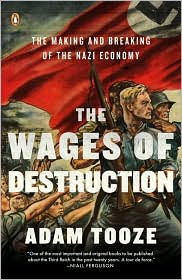
The Wages of Destruction: The Making and Breaking of the Nazi Economy by Adam Tooze

Dan from Madison at Chicago Boyz has reviewed Wages of Destruction, which led me to pick up a copy recently and start reading. Like Niall Ferguson, Tooze puts economic history into a dramatic explanatory context. If you have doubts, pick up a copy and flip to the chapter entitled “The Grand Strategy of Racial War” and read. You’ll walk out of the store with it.

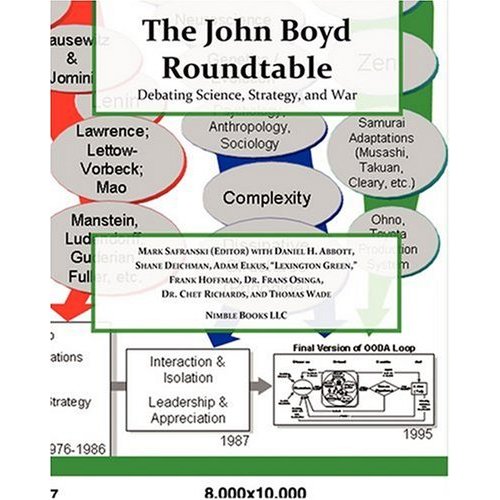
The John Boyd Roundtable: Debating Science, Strategy, and War by Mark Safranski, Daniel Abbott, Chet Richards, Shane Deichman, Thomas Wade, Frans Osinga, Adam Elkus and Frank Hoffman. Foreword by Thomas P.M. Barnett

A refinement and extension of the online roundtable at Chicago Boyz dedicated to reviewing Science, Strategy and War by Col. Frans Osinga (see below) and debating the ideas of the late strategic theorist Colonel John Boyd. Great for both the “Boyd expert” and those wanting a quick primer before tackling Osinga’s monumental work of strategic studies and intellectual history [ Full Disclosure: for newer readers who may not be aware, I was the editor and I’m shamelessly self-promoting here  🙂 ] 

Science, Strategy and War: The Strategic Theory of John Boyd (Strategy and History)  by Frans Osinga

Dr.Osinga has delivered a meticulously researched tome that William Lind called “the book Boyd would have written” that explains Colonel John Boyd as “the first postmodern strategist”. Osinga walks the reader through Boyd’s intellectual journey into fields as far removed from classical military studies as cybernetics, knowledge theory and the work of mathematician Kurt Godel and explains how Boyd distilled a strategic worldview on the nature of conflict and competition.


The Culture of War by Martin van Creveld

Eminent and controversial Dutch-Israeli military historian Martin van Creveld expands upon his body of work that is often described as “prophetic” these days in order to argue the intrinsic cultural value of war.

The Black Swan: The Impact of the Highly Improbable by Nassim Nicholas Taleb

This was the “must read” book of the blogosphere in 2007- 2008, widely cited (though perhaps first by John Robb) for the Black Swan concept itself. Taleb is an idiosyncratic, wide-ranging, writer interested in counterintuitive perspectives and is deeply skeptical of the validity of existing epistemological methodologies. Parts of the book will be of interest only to those with advanced backgrounds in probabalistic analysis and mathematics but there is much else that is intriguing and entertaining along the way while Taleb explains the characteristics of Extremistan and Mediocristan. A friend who moves among quite a few “thought leaders” described Taleb to me as “arrogant” but with something of value to say. Agreed.

On War (Oxford World’s Classics) by Carl von Clausewitz

Pick up a copy and join us during the Clausewitz Roundtable in January!!

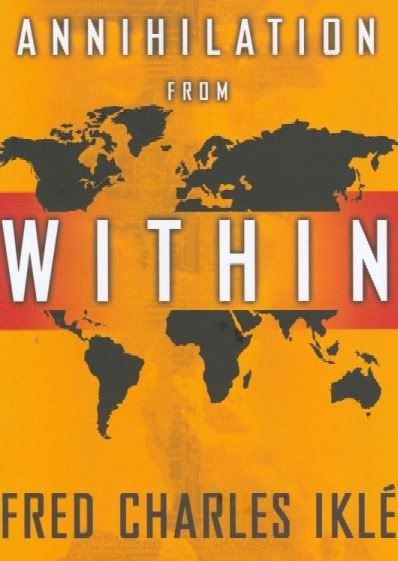
Annihilation from Within: The Ultimate Threat to Nations by Fred C. Ikle

Ikle, a senior Defense Department official in the Reagan administration tackles apocalyptic threat scenarios including the one coming from our own best efforts to avoid them. A gloomy but thought-provoking read.

The Cold War: A New History by John Lewis Gaddis

Gaddis intended to write a book for the college undergraduate or layman that concisely explains the Cold War and the “why ?” of the victory of the West and generally does a superb job of it.  The undercurrent or background that may not be obvious to the layman is that Gaddis is sticking a thumb in the collective eye of the revisionist diplomatic historians of the New Left – notably Walter LaFeber, Lloyd Gardner, Gabriel Kolko and Robert Buzzanco and others descending at least vaguely from the school of thought founded by William Appleman Williams.

Stalin: The Court of the Red Tsar by Simon Sebag Montefiore

A brilliant example of Soviet studies scholarship. I’ve read innumerable books on Stalin and the USSR and I still learned things from  Montefiore. Highly recommended.

The Third Reich in Power, 1933-1939 by Richard J. Evans

The second book in his trilogy on the history of Nazism, Evans looks at the Nazi state and party apparatus and German society during the years of peace. Evans, along with Michael Burleigh, Ian Kershaw and Adam Tooze are revising our understanding of the Third Reich and illuminating that as evil as Hitler’s regime was in fact, it ultimately was intended to be several orders of magnitude worse had Germany won the Second World War.

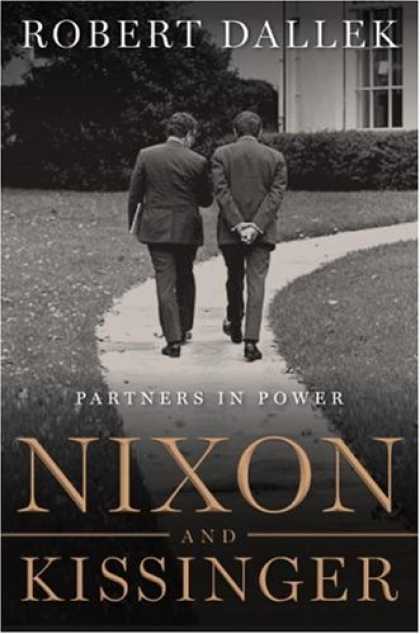
Nixon and Kissinger: Partners in Power by Robert Dallek

A deeply partisan work of history, Dallek makes little effort to be fair (especially in the first half of the text) to either Richard Nixon or Henry Kissinger, both whom he characterizes as mentally and emotionally unstable, if highly intelligent, personalities and makes an argument that Nixon’s mental state during the Watergate crisis required his removal from office under the 25th amendment. It’s difficult to imagine Dallek treating Bill Clinton or LBJ in similar fashion, regardless of their personal behavior or abuses of power because seldom does Nixon ever get the benefit of the doubt ( in comparison Richard Reeves’ devastating profile, Nixon: Alone in the White House is a work of hagiography).

Why read Nixon and Kissinger then ? Because Dallek, despite his biases, has done an outstanding job in presenting new sources and evidence and his delving into the China Opening and Nixon and Kissinger’s very complicated personal relationship, remains a first-rate work of scholarship. Therefore, I say “Read it” ( just do not let it be the only book you read on Richard Nixon).

That’s it!


At the Risk of being called a Guy who just Links to Cool Articles….

Thursday, April 17th, 2008

Lexington Green sent me this PARAMETERS review essay by Colonel Arthur C. Winn – on the five volume series on Strategic Intelligence [Five Volumes] (Intelligence and the Quest for Security) , edited by Dr. Loch K. Johnson and issued by Praeger Security International.

The five volumes present empirical inquiries, historical views, theoretical frameworks, memoirs, case studies, interviews, legal analyses, comparative essays, and ethical assessments. The authors come fromvarying backgrounds, including academia, intelligence agencies, think tanks, Congress, the State Department, the National Security Council, the legal field, and from seven countries. Each author has different personal experiences andwrites fromhis or her own perspective. The books provide an excellent reference for students of the military, political affairs, foreign policy, or strategic planning. The supporting notes at the end of each chapter are especially helpful and should not be overlooked by the reader.

Lex kidded me about putting this on my Christmas List but it looks to be a “must read” or at least a “must have reference” set for scholars of intelligence, IR, diplomatic or military history. Very DIME oriented format. I’m impressed as this is exactly what I was looking for years ago when I shifted outside of diplomatic and economic history to delve into intelligence and strategic studies.

Maybe a corporate card or institutional account order is a good idea with this one ($ 360 – Ouch!).

Primary Source Docs: A High Interest FRUS

Friday, February 22nd, 2008

The Department of State recently released Foreign Relations of the United States, 1969-1976, Volume XVIII, China, 1973-1976. This volume covers the critical period of the Nixon Adinisrtion’s watershed “China Opening”. I could have used this about ten years ago but better late than never.


Switch to our mobile site