zenpundit.com » diplomatic history

Archive for the ‘diplomatic history’ Category

NSDD-32 as Ronald Reagan’s Grand Strategy

Wednesday, February 9th, 2011


[Cross-posted to the Ronald Reagan Roundtable at Chicago Boyz]

Big Peace blogger Sun Tzu has dug into the historical archives to post NSDD-32, the cornerstone document for coordinating the Reagan administration’s foreign, defense and intelligence policies ( Hat tip to Col. Dave).

“NSDD” stands for “National Security Decision Directive”. In essence, the document is an executive order issued through the National Security Council to executive branch agencies represented or under the supervision of the NSC. A NSDD (or “PDD” in Democratic administrations) carries the force of law and is often highly classified, frequently being used for presidential “findings” for approving covert operations, as well as to set national security policy.

NSDD-32: Ronald Reagan’s Secret Grand Strategy

CLASSIFIED:  TOP SECRETTHE WHITE HOUSE
WASHINGTON

May 20, 1982

National Security Decision
Directive Number 32

U.S. NATIONAL SECURITY STRATEGY

I have carefully reviewed the NSSD 1-82 study in its component parts, considered the final recommendations of the National Security Council, and direct that the study serve as guidance for U.S. National Security Strategy.

Our national security requires development and integration of a set of strategies, including diplomatic, informational economic/political, and military components.  NSSD 1-82 begins that process. Part I of the study provides basic U.S. national objectives, both global and regional, and shall serve as the starting point for all components of our national security strategy.

The national security policy of the United States shall be guided by the following global objectives:

  • To deter military attack by the USSR and its allies against the U.S., its allies, and other important countries across the spectrum of conflict; and to defeat such attack should deterrence fail.
  • To strengthen the influence of the U.S. throughout the world by strengthening existing alliances, by improving relations with other nations, by forming and supporting coalitions of states friendly to U.S. interests, and by a full range of diplomatic, political, economic, and information efforts.
  • To contain and reverse the expansion of Soviet control and military presence throughout the world, and to increase the costs of Soviet support and the use of proxy, terrorist, and subversive forces.
  • To neutralize the efforts of the USSR to increase its influence through its use of diplomacy, arms transfers, economic pressure, political action, propaganda, and disinformation.
  • To foster, if possible in concert with our allies, restraint in Soviet military spending, discourage Soviet adventurism, and weaken the Soviet alliance system by forcing the USSR to bear the brunt of its economic shortcomings, and to encourage long-term liberalizing and nationalist tendencies within the Soviet Union and allied countries.
  • To limit Soviet military capabilities by strengthening the U.S. military, by pursuing equitable and verifiable arms control agreements, and by preventing the flow of militarily significant technologies and resources to the Soviet Union.
  • To ensure the U.S. access to foreign markets, and to ensure the U.S. and its allies and friends access to foreign energy and mineral resources.
  • To ensure U.S. access to space and the oceans.
  • To discourage further proliferation of nuclear weapons.
  • To encourage and strongly support aid, trade, and investment programs that promote economic development and the growth of humane social and political orders in the Third World.
  • To promote a well-functioning international economic system with minimal distortions to trade and investment and broadly agreed and respected rules for managing and resolving differences.

In addition to the foregoing, U.S. national security policy will be guided by the operational objectives in specific regions as identified in Parts I and III of the study.

Read the rest here.

Normally, for important NSDD, there will be several preliminary meetings of principals (the statutory members of the NSC) or their key deputies, before the text of the NSDD is prepared by the NSC adviser or executive director (sort of the chief of staff of the NSC) and the White House Counsel before it is formally approved by the NSC and signed by the President. This however, is not set in stone. Presidents are free to determine the NSC procedures of their administrations or ignore them if it suits their purpose. It is hard to imagine Richard Nixon fully briefing his SECSTATE William Rogers on anything of importance, much less doing it through Kissinger’s NSC, or JFK permitting any kind of bureaucratic structure to constrain his prerogatives.

NSDD-32 was prepared under the auspices of Reagan’s second NSC Adviser, “Judge” William P. Clark, who succeeded the hapless William V. Allen. Clark was the most conservative of Reagan’s many NSC Advisers and, as a California political crony of the president, the only Washington outsider. As a result, Clark was in tune with DCI William Casey and UN Ambassador Jeanne Kirkpatrick, hostile toward the views of State Department Soviet experts and far more interventionist than the top officials at Cap Weinberger’s OSD (Office of the Secretary of Defense). Clark had previously served at State as Deputy Secretary under Al Haig, an experience that did not leave him with a good impression of the loyalty of senior State Department officials to the administration’s foreign policy goals.

The activist “we win, they lose” strategy laid out NSDD-32 reflects Clark’s alignment with William Casey and it is very hard to credit Reagan’s national security strategy looking like NSDD-32 if it had been concocted by Colin Powell, Frank Carlucci and George Schultz, making Clarks brief tenure of critical historical importance. Powell, Carlucci and Schultz are all fine public servants but were disinclined by temperment and institutional loyalty to have articulated a strategy that “went on offense”; though, in fairness to Schultz, as SECSTATE he made very effective diplomatic use of Reagan Doctrine programs that State consistently opposed ( Contra aid, covert aid to the Afghan Mujahedin, UNITA and RENAMO) to extract concessions from the Soviets at the bargaining table.

Broke Down and Bought

Wednesday, January 12th, 2011

Grand Strategies: Literature, Statecraft, and World Order by Charles Hill

Heard way too many good things about this book from regular commenters like Scott Shipman (read his review here) to ignore it. The blurbs on the dust jacket are from some genuine heavyweights (and provoked an amusing academic political tantrum masquerading as a review  in FP.com from some minor departmental nemesis of Hill’s at Yale, where Hill is one of the founding lecturers of their Grand Strategy Program).

I will upjump this in my antilibrary queue to be read after I finish with Luttwak.

A Short Analysis on The Whyte-Barnett Sino-American Grand Strategy Proposal

Tuesday, January 4th, 2011


A few comments on the proposed Whyte-Min-Barnett Grand Strategy Executive Agreement for a Sino-American partnership that Dr. Barnett has been deeply engaged with the past few months.

First, a caveat: while Tom has involved me in aa few of his past projects, I was not involved in this one and know only what I have read recently. Secondly, while I know a bit about China in an academic sense, it is not an area of research for me nor am I up to speed on the  current politics of China’s generational transfer of power/power struggle. Those readers who are avid China watchers should chime in with comments.

As an overview, I think the proposal’s specific terms should be viewed less seriously individually than the gesture itself, which represents in my view a very significant trial balloon signal from China’s leadership that they see a need to negotiate a successor to the long outgrown cornerstone of Chinese-American relations, the Shanghai Communique, signed during Nixon’s historic summit with Mao. A new agreement would provide some updated “rules of the road” that would defuse potential and existing tensions and allow the US and China to tackle some urgent problems in the global economy. By using a semi-official independent set of pundits ( Whyte and Min) and a maverick private sector American geostrategist ( Tom) with close ties to the Pentagon, China can advance it’s talking points and interest in negotiating without any loss of face that an official inquiry risks as a result of America’s fractious domestic partisan politics.

Read up on the secret diplomatic minuet that ensued between the US and China 1969-1972.

China’s leadership seems to have invested a sizable heavyweight participation in this proposal, Tom cites:

– Former Minister of Foreign Affairs;
  – Former UN ambassador,
  – Former U.S. ambassador,
  – Former Deputy Chief of the General Staff of the PLA,
  – Former Military Attaché to North Korea and Israel,
  – Former Vice Minister of Commerce,
  – President of Shanghai Institutes of International Studies,
  – China’s Central Party School Institute of International Strategic Studies,
  – Chinese People’s Institute of Foreign Affairs,
  – China Center for International Economic Exchanges,
  – China Institute For International Strategic Studies,
  – China Foundation for International & Strategic Studies,
  – Boao Forum,
  – China Institutes of Contemporary International Relations.

This has resulted in a document that unsurprisingly leans strongly towards China’s interpretation of a good Sino-American partnership but this proposal is not holy writ, it is a red flag ( pun intended) for bargaining to begin. A plea, really by a leadership craving greater certainty, medium term security and “recognition” ( i.e. “face” or “respect” – this is very much like Brezhnev and Kosygin deeply desiring that the USSR be seen as an equal to the US, except unlike the Soviets, China actually has a productive economy) Imagine a US doc shepherded by a comparable set of former and current powerbrokers, the Council of Foreign Relations, CNAS, Carnegie, CNA, SSI, Brookings, AEI, Hoover, the chairmen of the Republican and Democratic Parties and the president of Harvard. Would that catch the attention of foreign observers?

I am not sure if it is being received that way over here. My perception – and I freely admit to having large gaps of knowledge – is that US policy toward China is determined below the NSC level and not in a strategic fashion by a) Treasury b) the Fed c) PACOM in that order , pursuing contradictory policy goals and without proper coordination while State, which should be taking a lead role, is a quiet secondary voice relegated to managing lower level, day to day, routine problems in ad hoc fashion. Some carping and special pleading from Congress is erratically inserted into the mix. If someone in the Obama administration is the China policy “czar” it is obscure to me. It must be obscure to Beijing as well or they would be having their ambassador or foreign minister pushing these proposals to their American counterparts in a normal fashion instead of Tom.

Barnett, Whyte and Min devote a great deal of space to bilateral and global economics relationships. They should. The magnitude of the Sino-American monetary and trade relationship and it’s evolved distortions between two nations that are radically dissimilar, understand one another poorly and are not allied are actually scary. Immense quanties of locked up capital – and we are talking epic figures  that dwarf the interwar period European “dollar gap” or even that of the postwar era remedied by the Marshall Plan – ultimately create money scarcity elsewhere in the global economy until trade breaks down in political reaction or the ebb of a medium of mutual exchange.  That money needs to begin circulating via productive investment and Chinese policies creating this structural imbalance need to be phased out. How exactly this should be done is beyond my ken, but that something needs to be done is obvious.

Dr. Barnett, as I understand his strategic thinking, takes the long view and is willing to concede in the short term what would be impossible to sustain in the long term anyway (“locking in tomorrow’s China at today’s prices” ) and is concerned about defense contractors eager to make China the justification for hyperexpensive weapons mega-platforms ultimately inculcating over time thinking that carelessly slides the United States toward a needless great power war with China. A position mirrored by China’s own ambitious self-dealing military asshats.

Is Tom’s view the last word? No. but it is disturbing to me that a strategic relationship as we have with China is not being handled by American officials with the same attention and degree long term focus we give to Europe.

What do the Sinologists out there say?

Now Reading Luttwak

Thursday, December 23rd, 2010

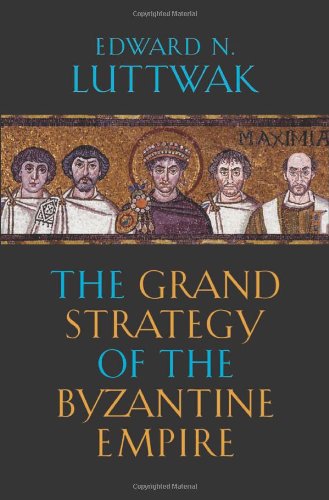
The Grand Strategy of the Byzantine Empire by Edward Luttwak

Just starting reading this magnum opus by eminent strategist Edward Luttwak and I am thoroughly enjoying it; particularly, the context-building historical digressions that enrich the text.  Highly recommended.

Book Review: Magic and Mayhem by Derek Leebaert

Monday, November 22nd, 2010

Magic and Mayhem: The Delusions of American Foreign Policy From Korea to Afghanistan by Derek Leebaert

As I mentioned previously, I enjoyed Derek Leebaert’s earlier Cold War history, The Fifty Year Wound, so I was pleased to be sent a courtesy review copy of his latest work, Magic and Mayhem:The Delusions of American Foreign Policy from Korea to Afghanistan. Leebaert, a professor of government who teaches foreign policy at Georgetown university, does not disapoint; Magic and Mayhem is a lively and highly provocative excoriation of of the dysfunctional political culture of making foreign and national security policy in America.  While I found many fine points of disagreement with Leebaert in Magic and Mayhem, his broad themes constitute a healthy challenge to a dolorous status quo in Washington.

In Leebaert’s view, American foreign policy suffers from being crafted under two related evils: a culture of “magical thinking” and a cadre of professional alarmists, the “Emergency Men” who constitute a kind of self-appointed, adrenalin-addicted, national security ecclesia who exploit the magical thinking of the public and labor under its delusions themselves. It is this dual embrace of ends without a priori examination of means or ways and a lust for action that leads our foreign policy elite to embrace all manner of costumed charlatans with polished English language skills who are allegedly willing and able to be America’s “partner” in dangerous neignorhoods. From South Korean autocrats to African kleptocrats to figures of a more recent vintage. Leebaert writes:

Afghan president Hamid Karzai, with his Western-style technocrats and talk of democracy, was immensely appealing to Washington after the Taliban was ousted.  For more than seven years, reports the Times Dexter Filkins, Karzai was a “White House favorite – a celebrity in a flowing cape and dark grey fez” a dramatic outfit that he had designed himself but that had no origin in Afghani dress…..

….”We thought we had found a miracle man” moaned one diplomat. On closer inspection, the sorcerer proved unconvincing as the opium trade and corruption flourished.

I have always wondered where the hell that cape came from.

Leebaert takes aim at a wide variety of targets. I definitely do not agree with his assessments of everything and everyone who has caught his ire, but it is a list that is breathtaking in expanse; a parade of names and terms that includes, but is not limited to:

George Kennan
Douglas MacArthur
Paul Nitze
Detente
Robert McNamara
McGeorge Bundy
Peter Rodman
Brinkmanship
Donald Rumsfeld
COIN
Richard Holbrooke
Henry Kissinger
The CIA
NSC-68
John McCain
Arms Control
John F. Kennedy

Richard Nixon
Curtis LeMay
Defense intellectuals
Lyndon Johnson
Maxwell Taylor
Dick Cheney
Cyrus Vance
George W. Bush
Neocons
Oliver North
Revolution in military affairs
Richard Perle
Crisis management
MAD theory
Strategic/Security Studies
Walt Rostow
Wiliam Westmoreland
Robert Kennedy
Bernard Lewis
Thomas P.M. Barnett
Lawrence Summers
George Tenet
Robert Kaplan
Samuel Huntington
John Abizaid
Stan McChrystal
Barack Obama
David Ignatius
Thomas Friedman
David Brooks
US Public Diplomacy
Jimmy Carter
Michael O’Hanlon

That, by the way, was not comprehensive.

It would be a much shorter list to cite those statesmen of whom Leebaert approved – men like Henry Stimson, Dean Acheson, Matthew Ridgway, Omar Bradley, George Marshall, Dwight Eisenhower, George Schultz and Ronald Reagan. The book is not flawless. There are minor factual errors. Not every person or doctrine in Magic and Mayhem is considered in depth.  At times, Leebaert comes across as glib or superficial in his criticism, but predominantly, as with the cases of Kissinger or Rumsfeld, his bitter jeremiads are skewering their targets.

Leebaert argues for a considered retreat from policy alarmism and the cult of emergency, and for a reduction of ambitious American policy grandiosity that would flow from recognizing and respecting the agency of other nation’s leaders and peoples. Implicitly, a call not so much for isolationism, as for restraint and a sense of proportion, coupled with a dimunition of status and power for national security “celebrities” and the cottage industry of think tank consultancy for which they stand.

Magic and Mayhem is a book that was written to demystify shibboleths and smash idols.


Switch to our mobile site