zenpundit.com » military intelligence

Archive for the ‘military intelligence’ Category

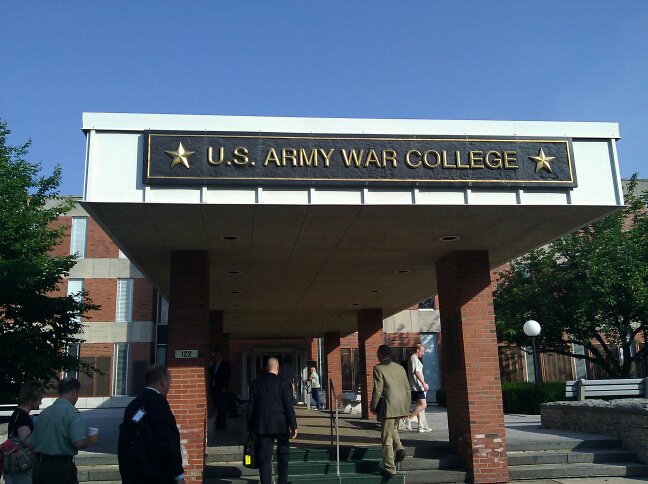
The US Army War College National Security Seminar 2011

Sunday, June 12th, 2011

warcollege.jpg

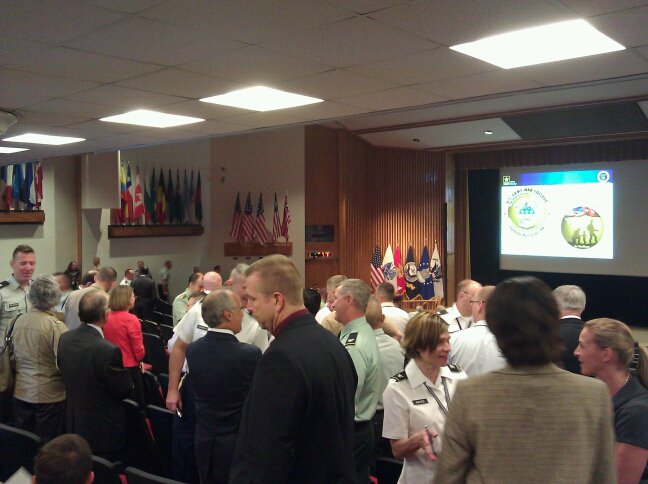
As noted previously, I was fortunate to attend the National Security Seminar at the the US Army War College this year and wanted to relay my impressions while they were still fresh.

First, in terms of reception and cordiality, I have rarely experienced such an extensive and personal outreach as was demonstrated by the War College staff, faculty, administration and students. Every new member had a “sponsor” – a student, usually a colonel or Navy captain, who acted as a liason and personal guide from the time their plane touched down until the moment they returned to the airport. My sponsor, the former commander of the WolfhoundsColonel Richard “Flip” Wilson, whom I consider a friend, really extended himself on my behalf, making me feel welcome and a full member of Seminar Group 20. Most of the students have multiple tours of duty in Iraq and Afghanistan under their belt and many can report the same for the first Gulf War, Panama, Bosnia or Kosovo.

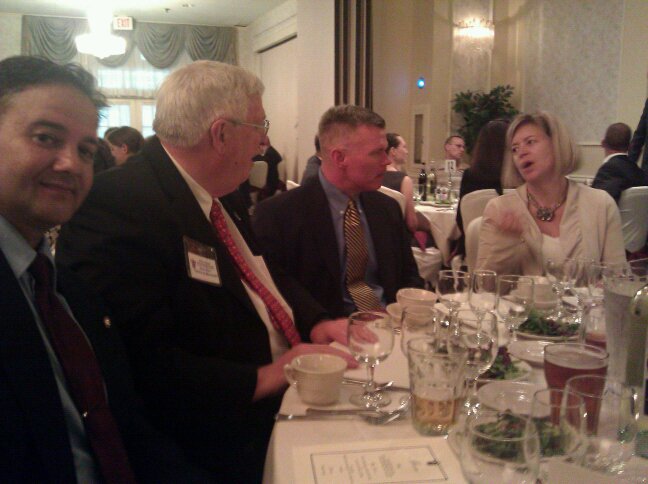
The War College, the Commandant and the Seminar Group all hosted receptions and dinners designed to get students and civilian new members to mix and further discuss issues raised in the seminar sessions or lectures. At these events I had the opportunity to meet and talk to the leadership of the Army War College including the Commandant Major General Gregg Martin, the Deputy Commandant for International Affairs, Ambassador Carol Van Voorst, the Executive Director of the Army Heritage Foundation, Mike Perry, the Director of SSI, Dr. Douglas Lovelace,  the Chief of Staff and numerous faculty and seminar members. The New Members such as myself were exceedingly well fed at these events as I suspect the Army was attempting to prove that it really does march on it’s stomach.


warparty.jpg

warparty2.jpg

The serious business of the National Security Seminar was divided into two segments, the talks given by distinguished speakers to the entire class of 2011 and the New Members and the Seminar Group sessions of approximately twenty students, New Members, academics and foreign visitors. We received a brief on the war in Afghanistan from the ISAF Chief of Staff, who was standing in last minute for General Petraeus who was called to meet with senior adminstration officials; and a very interesting concluding talk by Foreign Affairs Editor Gideon Rose, author of How Wars End, which covered issues of strategy, grand strategy and the disconnect with policy.

warseminar.jpg

  The National Security Seminar is run strictly on a non-attribution basis, in order to encourage candor and frank exchange of views, which handicaps my ability to discuss specifics here. I can say that my views on Pakistan ( which I compared to “North Vietnam” ) riled more than a few people – Pakistan is the only country in the world given 2 exchange student slots at the Army War College at the request of the most senior leadership of the US Army – and several students and faculty members took the time, outside of seminar sessions, to make certain I heard countervailing POV regarding Pakistan’s value as an ally. Other topics included, but were not limited to:

Defense budget cuts and force structure
Narco-cartels in Mexico: Insurgency or No?
Civil-Military Relations
Repeal of DADT
AfPak War
al Qaida and GWOT/US Strategy
COIN
Critical thinking and Leadership
Logistics
Libya and NATO
AWC Strategy Curriculum/Program
What the US public expects from their military
China as a peer competitor
Effects of ten years of war on officer corps/military
Illegal combatants and international law
PTSD
Battle of Gettysburg and Grand Strategy
Cyberwar
Differences in Armed Services strategy, command climate, discipline, leadership
The Arab Spring
US Global leadership and Economics
Interagency Operational jointness

Most of the discussion took place in the seminar groups, with Q&A periods in the mass sessions with featured speakers. I came away deeply impressed with the seriousness and insights as practitioners that AWC students brought to the table. The AWC strategic studies program seeks to broaden students who are assumed to arrive with tactical expertise and prepare them for higher command that carries operational, strategic and even policy responsibilities (at least in terms of interpreting and executing within policy guidelines). Many students were articulating ideas associated with Thomas P.M. Barnett, the “mission order” and “commander’s intent” style of leadership or Clausewitzian strategic premises during debates and discussion.

The National Security Seminar Week was for me, an enlightening and exceptionally enjoyable experience, one I would highly recommend to readers who may have such opportunities in future years.

Inspire #5: between front and back covers

Thursday, March 31st, 2011

[ by Charles Cameron ]

*

Okay. When what goes into the opening paragraphs of an editor’s note at the front of a magazine corresponds pretty exactly to what’s on the back cover, you have a sort of conceptual bracket that’s “holding” the rest of the content, and it pays to pay attention.

Here are the first paras of the “Letter from the Editor” that is featured on page 5 of the latest issue of AQAP’s English language magazine, Inspire, immediately after the front cover and index pages:

The cover of this issue is about the Tsunami of change that is sweeping the Arab world. With the removal of the despots, the ummah will speak its voice, and when it does, it will chant: Here we start and in al-Aqsa we’ll meet.The biggest barrier between the mujahidin and freeing al-Aqsa were the tyrant rulers. Now that the friends of America and Israel are being mopped out one after the other, our aspirations are great that the path between us and al-Aqsa is clearing up.

There could be no freeing of Palestine with the presence of the likes of King Abdullah to the East, Hosni Mubarak to the West and al-Saud to the South. Now that Hosni is gone, we heard the Imam of the Friday prayers praying: “O Allah we ask you to allow us to meet in al-Aqsa,” and the millions in Tahrir square roared with one voice: Amin.

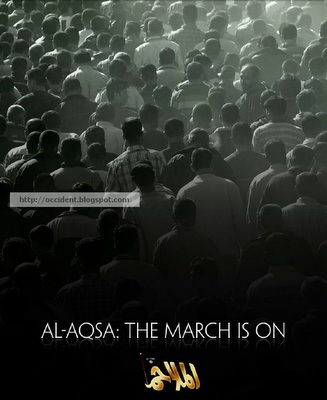
Note that this explicitly ties the front cover (“about the Tsunami of change that is sweeping the Arab world”) with the back (“Here we start and in al-Aqsa we’ll meet”), shown here:

inspire-5-al-aqsa-the-march-is-on.jpg

[ graphic courtesy of Ibn Siqilli ]

As I’ve noted before, al-Aqsa isn’t just the focal point of the Palestinian / Israeli question, nor it is only the place at which the Prophet alighted from his steed, Buraq, and ascended to receive the divine instructions for prayer in the Miraj — it is also the destination of the Mahdi‘s victorious army in the Khorasan strand of ahadith.

Indeed, it has been suggested that the Pierced Rock of the Dome of the Rock in al-Aqsa is closely related to the Black Stone of the Kaaba. Kanan Makiya, in his part-fictional part-documentary book, The Rock, quotes Charles Matthews‘ translation of Burhan al-Din ibn Firka al-Fazari‘s Kitab Ba’ith al-Nufus ila Ziyarat al-Quds al-Mahrus (The Book of Arousing Souls to Visit Jerusalem’s Holy Walls) from Matthews’ Palestine: Mohammedan Holy Land:

Verily, the Kaaba is in an equivalent position to the Frequented House in the Seventh Heaven, to which the angels of Allah make pilgrimage. And if rocks fell from it, they would have fallen on the place of the Rock of the Temple of Mecca [i.e. the Black Stone]. And indeed, Paradise is in the Seventh Heaven in an equivalent position to the Holy Temple (in Jerusalem) and the Rock; and if a rock had fallen from it, it would have fallen upon the place of the Rock there. And for this case the city is called Urushalim, and Paradise is called Dar al-Salam, the House of Peace.

Indeed, David Roxburgh mentions all these matters, writing in Salma Khadra Jayyusi et al., The city in the Islamic world, vol. 1. p 756:

This movement corresponded to other efforts — before, during, and after the Crusades — to establish “geo-theological” connections between Jerusalem and Mecca, whose preeminent sanctity was inviolable up until the end of days. Examples linking Mecca to Jerusalem include the Prophet Muhammad’s nocturnal journey from Mecca to Jerusalem (isra) and his ascension from Jerusalem to the throne of God (miraj); the underground joining of the waters of Zamzam to Silwan (var. Siloam) during the “feast of the sacrifice” (id al-adha); and the transfer of the Kaba and its black stone from Mecca to Jerusalem during the last days. these various traditions linked Jerusalem to Mecca, sometimes by sets of doubled features, in a near symmetry and in a calendar that will culminate during the end of days.

So there’s an eschatological dimension to all these parallelisms, too…

*

And if for no other reason, then because I happen to love doubled features, symmetries and analogies of all sorts (and we were already speaking of graphics and Inspire #5), let me add this:

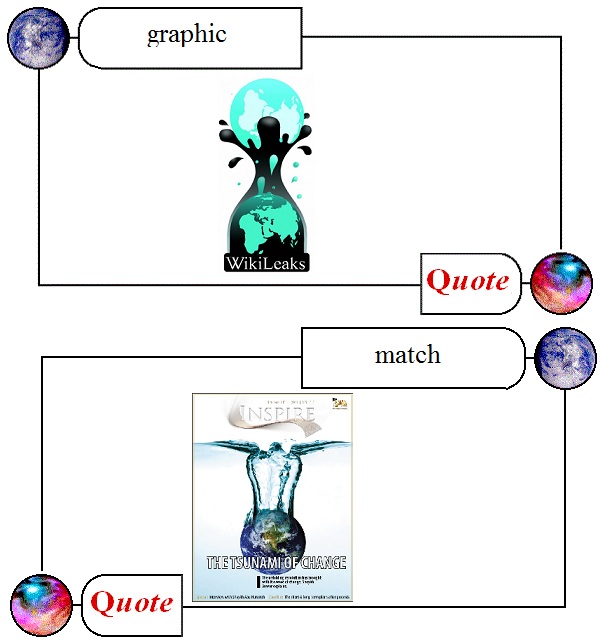
A tweet from @webradius via @azelin that I saw today noted that “the cover of Inspire 5 is remarkably similar to a wikileaks logo”.

I liked it.  And I’ve translated it here into my own DoubleQuotes format:

quographic-match.jpg

For those who are unfamiliar with the phrase, graphic match is another term for match cut — the gambit whereby one shot in a movie is directly juxtaposed to another with which it bears a close resemblance – essentially, a film director’s equivalent of rhyme.

Wikipedia gives two classic examples which are of particular interest to me because there is a “rhyme” between them, too, albeit a far more indirect one – the second being an hommage to the first.

Stanley Kubrick‘s 2001: A Space Odyssey contains a famous example of a match cut. After an ape discovers the use of bones as a tool and a weapon, there is a match cut to a spacecraft or satellite in orbit. The match cut helps draw a connection between the two objects as exemplars of primitive and advanced tools respectively.

Michael Powell and Emeric Pressburger‘s A Canterbury Tale contains the influence for the 2001: A Space Odyssey match cut in which a fourteenth century falcon cuts to a World War II aeroplane. The sense of time passing but nothing changing is emphasised by having the same actor, in different costumes, looking at both the falcon and the aeroplane.

*

Conclusion:

Parallelisms really are worth watching — always bearing in mind that one thing is never quite the same as another…

Of war and miracle: the poetics, spirituality and narratives of jihad

Wednesday, March 30th, 2011

[ by Charles Cameron ]

*

Issue #5 of the AQAP magazine Inspire is now available for viewing.

I am reasonably confident that with attention focused on such things as al-Awlaki‘s response to the various uprisings across the middle east, the delightful computer graphic (a throw back to the era of green print on black screens) which shows Ben Ali and Mubarak “booted” and Gadhafi and Saleh “in progress” – and the translation of a chunk of Abu Musab as-Suri on “Individual Terrorism Jihad and the Global Islamic Resistance Units” – a lot of eyes will glaze over during the course of reading “My Life In Fallujah” (pp. 56 ff).

The piece sounds promising – something to read about Fallujah from the enemy viewpoint for after action / lessons learned purposes… but then it gets into miracles:

The brothers received extraordinary miracles from Allah as a sign to strengthen them and these miracles were in all different forms. It got to the point where some of the things that occurred might not have been believable to the brothers had they not seen them with their own eyes but that is the grace of Allah which He bestows on whom He wills.

… and my bet is that snoring ensues…

Though not among the readers to whom it is pitched.

.
One:

What if we don’t regard the piece as a mirror for our own knowledge of events in Fallujah, but as an opening into the enemy’s grand narrative and – gasp – spirituality?

The piece continues:

Now let me relate some of the stories of fighting with the enemy and the miracles some of the brothers received. I will start mentioning some of these great miracles

There was a brother named Abu az-Zubair as-Sana’ani. He was killed at the beginning days of the battle. We used to go out in the daytime to engage with the enemy. Hardship and severe exhaustion were afflicting us due to the hot weather that was in the beginning of Ramadan.

So that brother came at the time of afternoon and sought permission from the Amir to break his fast. Some brothers advised him to have patience and suggested to him that he could have a shower and then rest for a while. The brother went inside to sleep out of fatigue and we were sitting in front of that house. The brother didn’t sleep long and we saw him coming out towards us with a cheerful face saying to us that he had seen a dream while he was asleep. The brothers asked him what was it; he told them that he saw a very beautiful woman coming to him, carrying a plate full of all kinds of fruits. She was waking him up, standing by his head and telling him: O Abu az-Zubair, don’t break your fast. You are invited to break your fast with us today. The brother then said that he felt comfort and relief. There was a brother called Abu Tariq who interpreted dreams so he told him that by Allah’s will, it will be something good. After that the brother decided to continue fasting.

We had a timetable for twelve people to cook food and that day was his turn. He went to the kitchen and we stayed outside, sitting next to the wall of that house so that we weren’t seen by the spy planes. We stayed there until it was about time to break fast. Suddenly an F-16
jet showed up in the horizon and targeted that kitchen with a missile where that brother was! A while after when the dust had settled, we went in the kitchen and saw that brother had been martyred. It was amazing how the smell of musk was all over the room, how the smile was on his face!

Thereupon the brothers’ moral was raised and they were making takbir. These were from the unforgettable moments.

It seems wise to compare this with the Miracle of Uthmaan recounted by Abdullah Azzam on p. 27 of his book, The signs of Ar-Rahmaan in the Jihad of Afghanistan — indeed, I’m surprised Inspire didn’t make the connection:

One morning Uthmaan (ra) said: Last night I saw Rasulullah sallAllaahu alayhi wa sallam in my dream, and he said: Oh Uthmaan, break your fast with us. He was martyred that same day, whilst in the state of fasting.

If one considers such stories not as “superstitious” or examples of “magical thinking” – one easy way to discount them – nor as “diabolic” and emblematic of a “false religion” – another – if, in fact, one reads them with some empathy for their content as faith-narratives, they are profoundly moving, and will no doubt be so to many of their intended readers.

This particular narrative – an earthly fast broken in heaven – could well be a motif in the Aarne-Thompson classification system for folkloric motifs.

Note also the reliance on dreams and dream interpretation – a reliance which also figures prominently in the transcript of bin Laden‘s discussion of 9/11.

.
Two:

Another miracle was the incident of Abu Abd ar-Rahman at-Turki who was a student of knowledge that memorized the Qur’an and the six books of hadith. He was amongst a group that went out to confront a breakthrough of the enemy. While the brothers were gathered to organize a defensive plan, this brother made takbir and rushed towards the enemy. Some brothers called him back but he didn’t pay attention to their words. He shouted back to them saying “I am seeing the hoor! I am seeing the hoor!” When this brother reached the enemy’s area, he was shot by a tank shell leaving his lower body completely severed. Some brothers managed to drag him out of there to a safe house which I was in. Even though the brother was between consciousness and unconsciousness, he was still advising brothers to fear Allah and to keep firm upon the truth. His lower half was ripped out, yet he was still reassuring the brothers and would always raise his vision upwards telling them that he is seeing the hoor coming, and that they should keep firm because this is the path of jannah. At hearing that, the brothers’ spirits were high and they felt relieved. Abu Abd ar-Rahman declared the shahada and then kept fainting until his soul departed his body. At that point we smelled the musk coming out of him and saw peace on his face. This smell of musk from the mujahidin would be something that was smelt regularly.

This “smell of musk” too (also found in the story of Abu az-Zubair above) is a regular feature of martyrdom tales, and features in the same work by Azzam, for instance in this report:

Moulana Arsalaan narrated to me:A student named Abdul Baseer attained shahaadat while with us. It was very dark. Fathullah, another mujaahid, and I went in search of his body. He said to me: “Is the Shaheed close. I perceive a fragrant scent”. I picked up the scent, and we reached the body by following the scent. In the darkness, I could see a noor (light) in the blood, which was gushing forth from his wound.

Indeed, as I have pointed out before, this motif has a parallel in the Catholic tradition of the “odor of sanctity” – “the perfume-like scent given forth by the bodies of saints during their lifetime or after death … symbols of the fragrance of extraordinary virtue” [as defined in Fr. John Hardon’s Modern Catholic Dictionary].

It appears in the Arthurian legends, too, as Malory describes the death of Sir Lancelot – notice here, too, the motif of the joyous dream:

And so after midnight, against day, the Bishop [that] then was hermit, as he lay in his bed asleep, he fell upon a great laughter. And therewith all the fellowship awoke, and came to the Bishop, and asked him what he ailed. Ah Jesu mercy, said the Bishop, why did ye awake me? I was never in all my life so merry and so well at ease. Wherefore? said Sir Bors. Truly said the Bishop, here was Sir Launcelot with me with mo angels than ever I saw men in one day. And I saw the angels heave up Sir Launcelot unto heaven, and the gates of heaven opened against him. It is but dretching of swevens, said Sir Bors, for I doubt not Sir Launcelot aileth nothing but good. It may well be, said the Bishop; go ye to his bed, and then shall ye prove the sooth. So when Sir Bors and his fellows came to his bed they found him stark dead, and he lay as he had smiled, and the sweetest savour about him that ever they felt.

.
Three:

There was a brother named Abu Dujanah at-Taifi. As soon as he entered Fallujah at the beginning of the battle, he asked the brothers to let him go to the front lines but the brothers told him that he had to learn shooting first. He replied, “By Allah! I won’t be anywhere except the front lines.” His brother was present there so they agreed to his request and allowed him to go there.Thereupon he said: ”By Allah! If the Americans come forward, then Allah will see from us that which He loves.” He then went to stay inside a trench to keep an eye on the front lines.On the second day when he saw the enemy breaking through, he jumped out and got ready to strike them with an RPG but before he could fire it, he was struck by a tank, and as a result, his body was torn apart. His body stayed there for six days before we were able to retrieve it.

To our surprise, blood was still coming out of his body even though the weather was so hot that if you were to place a piece of meat outside for half a day, it would eventually get rotten.

His blood was seeping as if he was just killed and his index finger was in the position of tashahud [that section of Muslim prayer where the index finger is raised while reciting the shahada or confession of faith]. His brother was a little bit sad at hearing the news but once he saw his body, he felt so much comfort.

E Cobham Brewer’s Dictionary of Miracles: Imitative, Realistic, and Dogmatic looks to be a terrific source for the kind of research I’m doing here – that’s the “Brewer” of Brewer’s Dictionary of phrase and fable – and p 372 of the 1894 edition has a section on “Bodies of Saints Incorruptible” prefaced by a quotation from Psalm 16.10: “Thou wilt not suffer Thy Holy One to see corruption”.

His body preserved, his finger raised in the gesture of  salat … powerful.

.
Four:

Another incident that has to be mentioned is when the Americans were breaking-through from the direction of the Shuhada district. The brothers in that area were few in numbers so they were attacked fiercely and their lines were nearly broken but all praise be to Allah, it started drizzling all of a sudden, and then the brothers were strengthened and encouraged. The enemy was fleeing so we did not know whether they fled because of the brothers fighting or because they saw something else. The enemy acted as though they had been frightened by something. The brothers only numbered six. The enemy was massive as they were accompanied by tank corps and armoured vehicles but their withdrawal was bizarre. At that time we remembered the verse of the Qur’an where Allah says:

And sent down upon you from the sky, rain by which to purify you and remove from you the evil [suggestions] of Shaytan and to make steadfast your hearts and plant firmly thereby your feet [8: 11].

Once again, the motif of merciful rain should not be unfamiliar to us – if not from the New Testament‘s “He makes His sun rise on the evil and on the good, and sends rain on the just and on the unjust” then at least from Shakespeare‘s “The quality of mercy is not strain’d, / It droppeth as the gentle rain from heaven / Upon the place beneath…”

.
Five:

How many references to literary analysis, or archetypal analysis for that matter, can you find in Heuer‘s classic Psychology of Intelligence Analysis?
Guest Post: DARPA, STORyNet and the Fate of the War by J. Scott Shipman

Wednesday, March 2nd, 2011

J. Scott Shipman, the owner of a boutique consulting firm in the Metro DC area that is putting Col. John Boyd’s ideas into action, is a longtime friend of this blog and an occasional guest-poster. Scott has an important report regarding the “war of ideas” against the Islamist-Takfirist enemy in Afghanistan after attending a workshop hosted by DARPA.

DARPA, STORyNet and the Fate of the War

by J. Scott Shipman

 I had the opportunity to attend a DARPA workshop yesterday called STORyNet. The purpose was to survey narrative theories, to better understand the role of narrative in security contexts, and to survey the state of the art in narrative analysis and decomposition tools (see below): 

This STORyNET workshop has three goals:

1. To survey narrative theories.

These empirically informed theories should tell us something about the nature of stories: what is a story? What are its moving parts? Is there a list of necessary and sufficient conditions it takes for a stimulus to be considered a story instead of something else? Does the structure and function of stories vary considerably across cultural contexts or is there a universal theory of story?

2. To better understand the role of narrative in security contexts.

What role do stories play in influencing political violence and to what extent? What function do narratives serve in the process of political radicalization and how do theyinfluence a person or group’s choice of means (such as violence) to achieve political ends? How do stories influence bystanders’ response to conflict? Is it possible to measure how attitudes salient to security issues are shaped by stories?

3. To survey the state of the art in narrative analysis and decomposition tools.

How can we take stories and make them quantitatively analyzable in a rigorous, transparent and repeatable fashion? What analytic approaches or tools best establish a framework for the scientific study of the psychological and neurobiological impact of stories on people? Are particular approaches or tools better than others for understanding how stories propagate in a system so as to influence behavior?

I was alerted to the meeting by a member at one of my “groups” at LinkedIn and just barely made the registration cut-off. It was a good meeting, but not reassuring on our situation in Afghanistan—you’ll see why  below.

As a “hobby” I’ve been tinkering with the implications of patterns with respect to language and communications. Just about every presumption I have articulated over the last several months is being pursued in one way or another—which is good news for our guys. While the on-going research is good, I do believe there is room for better and more imaginative thinking, although I didn’t say anything during the meeting for once, I kept my mouth shut and just listened.

This is exceptionally brief and decidedly non-techincal.  Here are some observations of interest:

  • In Afghanistan, stories (those who tell them and those who believe) are central to our geopolitical strategy and policies.
  • There is underway, a “battle of the narratives,” where any “counter” narrative developed by the US must have credibility. This seems obvious, but the speaker observed the “story telling” was more important than the story. Given the high illiteracy rate, this makes sense.
  • We [DARPA] are reviewing chants (which are wildly popular), video, magazines, poetry, the Internet, and sermons as thematic vehicles for analysis.
  • The language of the Taliban is not secular, and not the language of the insurgency—for the Taliban everything hangs on the legacy of jihad and religious struggle.
  • The Taliban not willing to negotiate on matters of jihad. They are using a unified vision of Islam giving their struggle a noble foundation against the corruption of outsiders who want to “Christianize” the nation.
  • The Taliban uses symbology to portray the struggle as a cosmic conflict against Christian invaders and US puppets (those cooperating with the US). Framing this symbology to communicate clearly the frame of the righteous vs. the infidels.
  • The Taliban manipulates the language to connect the current struggle to previous struggles of “warrior poets.” There is hope a “discourse” can be created that will counter this framing [personal note: I’m not optimistic]. The Taliban uses different language to subjugate rural and urban dwellers, and actually have standard operating procedures for dealing with villages that resist.
  • The cognitive patterns of rural Afghanistan are “foreign” to most Westerners and they use alien methods of knowledge transfer (chants, often under the influence of hashish).
  • We are adding a geospatial element to our analysis of local and personal narratives (which includes subject, verb, object) with respect to identified “master narratives.”
  • Internet data is indexed, with an eye toward predictive analysis and situational awareness (and interestingly, “sentiment” analysis). We are finding predictive power from the topology of “networks”  used in models.
  • From a neuroscience perspective, there was an amazing talk on empathy. It turns out, based on fMRI testing that empathy is quite predictable across subjects. Research indicates people “care more” about an “in-group” to which they belong more than an “out group.” The speaker defined the brain as a “parliament” of competing parties and nuanced spectrums [personal note: this elegant description tracks with everything I’ve read on the topic.]. 
  • One presenter observed that after 10 years of war, we’re finally “getting” the importance of Pashtun culture and language. This presenter also noted US is still in need of people with language skills sufficient to adequately support the effort.

– End

COMMENTARY:

Zen here:

First, I’d  like to cordially thank Scott for letting me share his insights gleaned from the workshop here with ZP readers. This is one of those fascinating events largely unavailable to those folks residing outside a reasonable driving distance from the Beltway.

Secondly, I am heartened that the brilliant folks at DARPA are taking the theological-ideological discourse of the enemy seriously in analyzing the power of narrative. Charles Cameron makes that point here with regularity. Michael Scheuer, Gilles Kepel and Olivier Roy did so even before 9/11. Our political appointees and policy makers remain steadfastly allergic to this reality, unable to process or discuss in public with coherence how religious ideas are a root for political extremism. Col. David Kilcullen, who certainly understands political Islam better than most and whose creative and analytical acheivements in structuring a framework for countering insurgency are second  to none, eschews dealing with the topic in his theoretical writings on COIN where it can be avoided. That is the cost imposed by the political correctness to which our ruling elite are psychologically welded.

 It comes as no surprise to me that only after “10 years of war” are we finally “getting the importance of Pashtun culture”. 

Maybe at the dawn of the 22nd century we will be “old hands”.

Farrall in Foreign Affairs:How al Qaida Works

Thursday, February 24th, 2011

Leah Farrall, the Australian former counterterrorism official who blogs at All Things Counterterrorism (and is a friend of Charles Cameron ) has an important analytical article in Foreign Affairs (hat tip to the oratorical Josh Foust):

How al Qaeda Works

Despite nearly a decade of war, al Qaeda is stronger today than when it carried out the 9/11 attacks. Before 2001, its history was checkered with mostly failed attempts to fulfill its most enduring goal: the unification of other militant Islamist groups under its strategic leadership. However, since fleeing Afghanistan to Pakistan’s tribal areas in late 2001, al Qaeda has founded a regional branch in the Arabian Peninsula and acquired franchises in Iraq and the Maghreb. Today, it has more members, greater geographic reach, and a level of ideological sophistication and influence it lacked ten years ago.

Still, most accounts of the progress of the war against al Qaeda contend that the organization is on the decline, pointing to its degraded capacity to carry out terrorist operations and depleted senior leadership as evidence that the group is at its weakest since 9/11. But such accounts treat the central al Qaeda organization separately from its subsidiaries and overlook its success in expanding its power and influence through them. These groups should not be ignored. All have attacked Western interests in their regions of operation. Al Qaeda in the Arabian Peninsula (AQAP) has also long targeted the United States, but its efforts have moved beyond the execution stage only in the last two years, most recently with the foiled plot to bomb cargo planes in October 2010. And although al Qaeda in the Islamic Maghreb (AQIM) has not yet attacked outside its region, al Qaeda in Iraq (AQI) was reportedly involved in the June 2007 London and Glasgow bomb plots.

It is time for an updated conception of al Qaeda’s organization that takes into account its relationships with its subsidiaries. A broader conceptual framework will allow for a greater understanding of how and to what degree it exercises command and control over its expanded structure, the goals driving its expansion strategy, and its tactics.

AL QAEDA’S LOST DECADE

Although al Qaeda had tried to use other groups to further its agenda in the 1980s and early 1990s, Osama bin Laden’s first serious attempts at unification began in the mid-1990s, when the organization was based in Sudan. Bin Laden sought to build an “Islamic Army” but failed. Al Qaeda had no ideology or manhaj (program) around which to build lasting unity, no open front of its own to attract new fighters, and many of its members, dissatisfied with “civilian work,” had left to join the jihad elsewhere. Faced with such circumstances, bin Laden instead relied on doling out financial support to encourage militant groups to join his army. But the international community put pressure on Sudan to stop his activities, and so the Sudanese government expelled al Qaeda from the country in 1996. As a result, the group fled to Afghanistan.

By mid-1996, al Qaeda was a shell of an organization, reduced to some 30 members. Facing irrelevance and fearing that a movement of Islamist militants was rising outside of his control, bin Laden decided a “blessed jihad” was necessary. He declared war on the United States, hoping this would attract others to follow al Qaeda. It did not. A second effort followed in 1998, when bin Laden unsuccessfully used his newly created World Islamic Front for Jihad Against Jews and Crusaders to lobby other groups to join him. Later that year, al Qaeda launched its first large-scale attacks: the bombings of the U.S. embassies in Kenya and Tanzania, which it hoped would boost its fortunes. But these, too, failed to attract other groups to join, with some instead criticizing al Qaeda for the attacks and its lack of a legitimate manhaj.

With no coherent ideology or manhaj to encourage unification under his leadership, bin Laden instead pursued a predatory approach. He endeavored to buy the allegiance of weaker groups or bully them into aligning with al Qaeda, and he attempted to divide and conquer the stronger groups. In the late 1990s, he tried and failed to gain control over the Khalden training camp, led by the militants Ibn al-Shaykh al-Libi and Abu Zubaydah, and over the activities of Abu Musab al-Suri and Abu Khabab al-Masri, senior militant figures who ran their own training programs. Bin Laden’s attempts in 1997-98 to convince Ibn al-Khattab, a Saudi militant who led an international brigade in Chechnya, to come under al Qaeda’s banner also failed. His efforts in 2000-2001 to gain control over a brigade of foreign fighters in Afghanistan met a similar fate: the Taliban leader Mullah Omar, who had supreme authority over the brigade, instead handed the leadership of it to the Islamic Movement of Uzbekistan, another group bin Laden was attempting to convince to align with al Qaeda. Around the same time, bin Laden also unsuccessfully lobbied the Egyptian Islamic Group and the Libyan Islamic Fighting Group to join al Qaeda’s efforts. And although al Qaeda supported the militant Abu Musab al-Zarqawi in his establishment of an independent training camp in Afghanistan, bin Laden was unable to convince him to formally join the organization.

The only real success during this period was al Qaeda’s mid-2001 merger with Egyptian Islamic Jihad, led by Ayman al-Zawahiri, now al Qaeda’s second-in-command. The merger was possible thanks to Egyptian Islamic Jihad’s weakened position and its reliance on bin Laden for money. The decision was nevertheless contentious within Egyptian Islamic Jihad, and several of its members left rather than join with al Qaeda. In the end, al Qaeda’s only successful merger during its Afghanistan years added just five people to its core membership. Compared to this dismal record, the past decade has been highly successful….

Read the rest here (subscription required) or for a brief time in full, for free, here.

First, I’d like to say congratulations to Ms. Farrall who has been working hard researching the nuances of ideological, theological, tactical and organizational differences and personal rivalries that existed within the mutable and murky subterranean world of professional Islamist revolutionaries. It’s important work. Her recognition in FA is deserved and American terrorism experts should give her arguments close scrutiny.

Secondly, I will say her article shows the extent to which our takfirist enemies, not just al Qaida,  take seriously the ideas behind their global insurgency and that, to them, it is both global and local. The “internationalist” jihadis like Bin Laden seek to weld themselves together with the parochial “Nationalist-Islamists” and David Kilcullen’s local “accidental guerrillas” with a “eucumenical” radical Islamism. As many USG officials seek to ignore or promote an official line of ignoring the ideological and theological motivations of our enemies, they will probably dismiss Farrall unless she gains enough media prominence that this is no longer feasible – at which point, they will make nasty and anonymous criticism about her on background to The New York Times and The Washington Post.

Thirdly, Farrall has a very important point here when she wrote:

….They drew from takfiri thought, which justifies attacking corrupt regimes in Muslim lands, and on materials that outline the Muslim requirement to target the global enemy: in this case, the United States and the West. (This was framed in the context of defensive jihad, the need for which was reinforced by the 2003 U.S. invasion of Iraq.) The hybrid ideology and manhaj that emerged make little distinction between targeting local enemies and targeting global ones and have a one-size-fits-all solution — jihad. Partnering with al Qaeda does not, therefore, require a local group to abandon its own agenda, just broaden its focus. This helped assuage other groups’ fears that merging with al Qaeda would mean a loss of autonomy to pursue their own local goals.

This is what Global Guerrilla theorist John Robb would call “a Plausible Promise“, a required step in building an “open source insurgency” which can attract groups with differing agendas, opportunitic actors and ideologically motivated, socially alienated “lone wolves” to their banner. Al Qaida has tacticians who apparently agree, having formally adopted “Open Source jihad” in late 2010. So far, the executive branch departments of the USG seem to be studiously determined to ignore that as well, a stance that corrupts our analytical integrity and cripples our operational effectiveness. Lying to oneself is rarely a good way to get an advantage over an opponent.

I think I can speak for Charles Cameron in that we here at zenpundit.com hope to see more articles from Ms. Farrall in the near future.

ADDENDUM:

SWJ BlogThe Hasan Slide Presentation A Preliminary Commentary by Charles Cameron


Switch to our mobile site