zenpundit.com » geopolitics

Archive for the ‘geopolitics’ Category

Guest Post: Pundita: Missing Something?

Sunday, August 28th, 2011

We’re delighted here at Zenpundit to present a cross-post from our blog-friend Pundita — of whom it has been said that “What Julia Child did for French cooking, Pundita is doing for foreign policy discussion. She’s opened a haute pursuit to ordinary people.”

Pundita quotes Mark in this post, and also raises some interesting issues with regard to America and monarchism — and as I have been prepping a series of posts on “the impact of ritual and ceremonial in church, military and state,” we all agreed it would be good to bring this post across to ZP in the hope of stirring some discussion — and see how things develop from there.

Pundita’s epigraph for this post is as follows:

Alan Rickman‘s Sheriff of Nottingham to a scribe: “Wait a minute. Robin Hood steals money from my pocket, forcing me to hurt the public, and they love him for it? That’s it then. Cancel the kitchen scraps for lepers and orphans, no more merciful beheadings, and call off Christmas.”

We bid her welcome.

— Charles Cameron

___________________________________________________________________________________________

Pundita writes:

The title of this post refers to the punch line in a series of TV commercials in the USA for Sears Optical eyeglasses. The ads feature amusing skits of people in serious need of a pair of glasses, such as the woman who mistakes a police patrol car for a taxicab. But helped along by bravura performances from Tara L. Clark as a blind-as-a-bat cat owner and Squirty as a wild racoon who can’t believe his luck, one of the skits is so funny it’s gone viral on the internet:

 Oh look it’s a democracy! Come snuggle with the United States!

There is nothing funny, however, about American officials who are so blind to what the United States stands for they snuggle with governments that march to a very different drumbeat than their own. Yet the officials are supported in their blindness by an equally blind populace. So in this post I’m going to break a taboo and wrestle with topics that are only whispered about in this country: monarchism and America’s involvement with it. To set the stage I’ll start with quotes from two recent news reports:

From the Globe and Mail (Canada), August 19, 2011:

Stephen Harper is working to recast the Canadian identity, undoing 40 years of a Liberal narrative and instead creating a new patriotism viewed through a conservative lens.Restoring the “royal” prefix to the navy and air force this week is just part of the Prime Minister’s attempt at “creating a new frame” for Canada and Canadians. …

From the New York Times, August 17:

A photograph taken last Friday of Gary F. Locke, the new United States ambassador to China, buying coffee with his 6-year-old daughter and carrying a black backpack at a Starbucks in the Seattle airport, has gone viral on the Chinese Internet. The seemingly banal scene has bewildered and disarmed Chinese because they are used to seeing their own officials indulge in privileged lives often propped up by graft and bribery and lavish expense accounts.

[…]

The first impression from the Starbucks episode has been bolstered by another photograph that shows Mr. Locke, his wife, Mona, and their three children carrying their own luggage after landing at Beijing Capital International Airport.Chinese who saw them then spread the word that the family had gotten into an anonymous minivan because a formal sedan that had been sent to pick them up was too small.

“To most Chinese people, the scene was so unusual it almost defied belief,” Chen Weihua, an editor at China Daily, an official English-language newspaper, wrote in an article Wednesday.

Cheng Li, a scholar at the Brookings Institution who studies Chinese elite politics, said in an e-mail: “Ambassador Locke’s photo contrasts sharply with the image of the Chinese officials who often live in a secret, insulated, very privileged fashion.

Often I’ve heard it asked why Britain’s political Right doesn’t seem much less socialist than the country’s Left. I’d say the answer is that the United Kingdom’s welfare state has as much to do with Marxism as bread and circus did under the Roman emperors. I’d also say the same answer would apply to the welfare state in the Kingdom of Norway and the Kingdom of Sweden and a number of other countries that are constitutional monarchies.

Yet my fellow Americans have such difficulty seeing monarchism that they confuse it with something else. The same blindness can afflict Americans who insist that China is not much different from the United States. In his 2008 article for the May/June issue of Good magazine (Ten Reasons Why China Matters To You), Thomas P.M. Barnett, an American security analyst, wrote that “China’s transformation echoes much of America’s past. … right now, China is somewhere in the historical vicinity of ‘rising America’ circa 1880.”

In my retort (The National Petition Bureau will see you now, Dr Barnett), I pointed out that Chinese make the pilgrimage to a bureau that’s a CCP placemarker for an emperor’s go-fers. I added in exasperation, “Ah yes, I remember as if just yesterday the tens of millions of American peasants in the 1880s who pilgrimaged to the nation’s capital every year to seek redress from the emperor.”

Dr Barnett turned out to have a sense of humor or at least a fair-minded attitude about receiving criticism because he linked my post at his blog. Yet that did little to allay my concern that Washington’s foreign policy establishment was blind as a bat to the fact that modern China is an imperial society with a frownie face of Communist Party dictatorship painted on it, and that modern Britain and a good number of other NATO-member countries are basically monarchist societies with a smiley face of democracy plastered on them.

One could even make an argument that modern Mexico’s most entrenched problems are rooted not in the rule of the Spanish but in indigenous imperial civilizations that predated Spain by thousands of years.

In fact, the more one starts looking around the world for societies that are not holdovers from the days of kings the more one appreciates that the United States of America has very few natural allies; i.e., countries that represent a real break with monarchism and the class systems that uphold it.

Norwegians might bristle at their society being described as monarchist. They would point out that their noble class has no political power anymore and that Norway today is an egalitarian society. However, it is an egalitarianism so rigidly enforced that the Norwegian mass murderer Anders Behring Breivik believed after he set off a bomb in Oslo that he would be caught and killed by the police before he reached Utoya island.

His faith in the omniscience of Norway’s government was dashed but the point is that the country’s egalitarian “open society” is maintained by the second largest deployment of public-space CCTV cameras outside the United Kingdom. And Norway’s generous public welfare system means that from cradle to grave Norwegians are easily monitored by the state, which helps the government make sure Norway stays an open, egalitarian society.

Yet Americans insist on describing such states as Leftist! Karl Marx would roll in his grave if he saw what passes today for many Leftist governments.

These same Americans decry their government’s close alliance with absolute monarchies such as the Kingdom of Saudi Arabia. They do so without realizing that there is a long history of the United States being closely allied with monarchies; that many of these are no longer “absolute” but “constitutional” with parliamentary forms of government and voting rights makes them no less monarchist.

Americans were also miffed at what they considered snobbishness when they heard the Swedish Chairman of BP, Carl-Henric Svanberg, expressing concern for the victims of the Gulf oil spill by referring to them as “the small people.”

Translation malfunction, explained his apologists. There was no malfunction; English is Svanberg’s second language. And he wasn’t being snobbish, he was being Swedish. Noblesse oblige and all that; one must always look after the basic needs of the small people so they don’t revolt.

None of the above is meant as a criticism of the countries I’ve mentioned or their people, and one would be hard-pressed to find nicer peoples than the majority of Swedes or Norwegians — and Canadians for that matter, who also live under a constitutional monarchy. I see no harm in people upholding traditions that provide them with a sense of order and give them continuity with their past, which is why I cheered on the royal pomp associated with the marriage of William and Kate. If it helped Britons get clearer on their values I was all for that.

The harm comes when Americans are so unclear on their own values, their own past and traditions, they can’t engage closely with the rest of the world without becoming terribly confused. One consequence is that the more the U.S. government has tried to mesh with the “international community,” the lower America’s standing in the world has fallen.

Americans can’t turn the situation around without first acknowledging that the international community is in large measure of bunch of royalists. Arriving at this realization doesn’t mean Americans should eschew friendly relations with people in such societies or that official Washington should spurn engaging with the governments on issues of mutual interest. It does mean that Americans are asking for ever greater trouble by lumping “democratic” monarchies” with American democracy.

Over at ZenPundit, Mark Safranski has again expressed concern about what he calls an emerging American oligarchy, an elite that’s manipulating the rest of the American populace to accept its rule. Meanwhile, Fareed Zakaria is seriously proposing that America replace its president with a prime minister and Congress with a parliament — with an upper house, I suppose, to be stuffed with Mark’s oligarchs, duly elected of course, so that Americans will stop the troublesome habit of vehemently disagreeing with one another.

Now just see how one thing leads to another. First you’re snuggling with liberal monarchies, then authoritarian ones, then one day you’re asking, ‘Why is there no USA anymore? Why is there only the international community?’

Missing something?

The Debate over the Influence and Extent of “Realism”

Tuesday, August 16th, 2011

 Kudos to Dan Trombly of Fear, Honor and Interest. Why?

First, for drawing attention to the debate between Dan Drezner and Anne-Marie Slaughter over, hmm, “Real-world Realism” in American foreign policy:

Dan DreznerMeet the new foreign policy frontier…. same as the old foreign policy frontier

….Well, this is… this is… I’m sorry, I got lost among the ridiculously tall strawmen populating these paragraphs.   I’ll go out on a limb and posit that not even Henry Kissinger thinks of the world the way Slaughter describes it.  Just a quick glance at, say, Hillary Clinton’s recent speech in Hong Kong suggests that actual great power foreign policies bear no resemblance whatsoever to that description of “traditional foreign policy.” 

Slaughter knows this very well, given that she was Clinton’s first director of policy planning.  She also knows this because much of her writing in international relations is about the ways in which traditional governments are becoming more networked and adaptive to emergent foreign policy concerns.  

Rebuttal time…..

Anne-Marie SlaughterThe Debate Is On! A Response to Dan Drezner

….I’ll take that bet. I think it’s exactly how Henry Kissinger still thinks of the world. Indeed, he has just published a book on China — of course, because from the traditional realist perspective China is by far the most important foreign policy issue in the 20th century, as it is the only possible military and economic competitor to the United States. Hence, as realists/traditionalists never tire of repeating, the U.S.-China relationship is the most important global relationship of the 21st century: what matters most is ensuring that as both nations pursue their power-based interests they do not collide catastrophically. Never mind that an avian flu virus that is both fatal and aerosol-borne arising anywhere in Asia could do far more damage to global security and the economy than China ever could — just see the forthcoming movie Contagion.
The second reason for giving Mr. Trombly props is that his excellent post in response to the above was a lot more interesting and substantive than their pleasantly jocular and Friedmanesque exchange:

Old School realism and the problem of society

….Waltz cares about states because states, in the time periods he examines, are the primary bearers of power. Power, not the state, is likely the more long-standing differentiation between the liberal/idealist and realist schools of international affairs. Realists generally care more about who has power, and particularly coercive power, because in the realist view, it is the power to control – not to collaborate, connect, or convince – which is the final arbiter and source of other forms of  socio-political-economic behavior.

For most of the history of thinkers identified with realism, the state did not exist, nor did the conception of the state as a unitary actor. Thucydides, long identified as one of the fathers of Western realism, was not a Waltzian structural realist in the slightest. As most early realists did, he cited the origins of political behavior in irrational and rational drives, which originate in the hearts and minds of men. There were no states in Thucydides’s day, but city-states, empires, and various other forms of political organization which did not survive to the present day. Thus one had to be quite conscious not just of particular parties and factions, but even individuals, who, in a polis such as Athens could completely upturn the designs of the Athenian state. In his description of the varying governments and systems of organization at play, Thuycdides actually shows a keen awareness of how regime types and the social composition can influence international politics, but only insofar as it involves the exercise of power. The exchange of goods, culture, and ideas matters far less to him. Slaughter does offhand mention that an Avian flu could kill far more than a war and be more likely. Interestingly enough, the plague of Athens does play an important role in Thucydides’s history

….This pessimism about the dangers of those lacking political virtue, or restraint of their passions, from acquiring power colors, in one way or another, much of the subsequent 2,500 years of realist thought. Ultimately, the interactions and aims of the various interest groups that Slaughter describes, and Drezner dismissed, are not necessarily prescriptively ignored but the subjects of active disdain, fear, and scorn

Much to like in this fairly lengthy post, which  I recommend you read in full.

Now for my two cents.

First, as a factual matter, it would not be hard to establish that Dr. Slaughter is correct and Dr. Drezner is not that Henry Kissinger does think like that. He most certainly did while he was in power, as is amply recorded in the National Archives, Kissinger’s memoirs and secondary works by historians and biographers who made Kissinger their subject. To all appearances, Brent Scowcroft, Kissinger’s protege thinks the same way, as did Kissinger’s master, Richard Nixon, whose private remarks regarding the unimportance of ephemeral actors to geopolitics were brutal. The UN, for example, Nixon dismissed as a place for “just gassing around” and Nixon was happy to use the UN (and George Bush the Elder) as unwitting props in his China Opening.

Policy makers do not think like IR academics do, even when they are IR academics like Dr. Slaughter or Dr. Kissinger. They don’t have the time or luxury of remove from events. The cool, detached, analytical, Harvard intellectual who wrote Nuclear Weapons and Foreign Policy became the emotive, egoistic, domineering, slightly hysterical, bureaucratic operator and diplomatic tactician as National Security Adviser. I suspect a six days a week, sixteen hour days of crisis management culture as Policy Planning Director at State likewise tempered Slaughter’s time for theorizing speculations.

That said, there is some room present for Dr. Drezner’s skepticism and Mr. Trombly’s “active disdain, fear and scorn”of non-state actors (which I think is a spot on gestalt of the Metternich-worshipping Henry the K).

The state as an organization of coercion and defense is unrivaled in human history by any other political form except the tribe. The state is fine-tuned to be a beast of prey and open challeges to the state, in all it’s panolpy of might, without a long preparatory period of eroding it’s legitimacy and attriting it’s will to power, seldom turn out well unless the challenger is another state. Non-state actors who challenge state authority tend to survive and thrive initially only by being elusive, deceptive, adaptive, faster and by inflicting moral defeats until they accumulate enough armed power to co-opt, thwart, deter or topple the state by force. This requires the challenger engaging the state in such a way that it habitually reacts with excessive restraint punctuated by poorly directed outbursts of morally discrediting excessive violence ( see Boyd’s OODA Loop)

When non-state actor challengers gain sufficient political momentum and break into a full-fledged armed insurgency, a dangerous tipping point has been reached because insurgencies are generally very difficult, expensive and bloody to put down, often representing a much larger pool of passive political discontent. The advantage begins to turn to the challenger because the mere existence of the insurgency is itself an indictment of the state’s competence, authority and legitimacy. Some states never manage to regain the initiative, slipping into state failure and co-existing with the insurgency for decades or being ignominously defeated.

We live in an era of state decline, or at least an era of erosion of the state’s willingness to use force in self-defense with the unconstrained savagery of a William Tecumseh Sherman or a Curtis LeMay. While overall, the zeitgeist favors the non-state actor, challenging the state a much harder trick when it is ruled by a charismatic sociopath, an authoritarian lunatic or when the machinery of security is organized on the basis of extreme and homicidal paranoia. Very little political “room” exists in such circumstances for non-state actors of any size to emerge because the state has used terror to atomize society and dissolve natural bonds of social trust; dissidents, if they are to be effective, often must rely upon external support and patronage.

This is not to say that the power Dr. Slaughter commends, to “collaborate and connect” is unimportant. Far from it, as it represents a very formidible long term threat to the omnipotence of states by permitting a highly networked and wealthy global civil society to self-organize to check their power. At the inception though, “collaboration and connection” is very fragile and vulnerable to state interdiction. Representing oneself as a political challenge to the state before power is acquired to any significant degree is unwise; if empowering civil society in tyrannies through “collaboration and connection” is the goal of the USG, it ought to be done under the radar with plausible pretexts and without an obvious affiliation to American sponsorship.

That would only be…..realistic.

Booksbooksbooksbooks….

Monday, August 1st, 2011

Two more for the pile….


Another Bloody Century by Colin Gray

Iraq & the Evolution of American Strategy by Steven Metz

Comments or opinions?

Book Review: The Profession by Steven Pressfield

Monday, July 25th, 2011

The Profession by Steven Pressfield

We should begin this review with “Full Disclosure“:

I just finished reading The Profession by Steven Pressfield, which I enjoyed a great deal. Steve sent me an earlier draft doc of the book and I consider Steve a friend. Furthermore, in an extremely gracious gesture, Steve granted me (or at least zenpundit.com) the novelist’s equivalent to a walk-on cameo appearance in his book. Therefore, if you the reader believe that I cannot review this book objectively…well….you are right. It’s not possible 🙂 . Here are some other reviews by Shlok Vaidya, Greyhawk of Mudville Gazette and Kirkus if you want greater impartiality.

Nor am I going to delve into the mechanics of the plot structure and action sequence in The Profession. For one, I think too much of the story in a review of a work of fiction spoils the enjoyment for the group of readers who would be most interested. And you can get the blow by blow elsewhere.

Instead, I would like to draw your attention to how Pressfield has written this novel differently. And why that matters.

There is plenty of action in The Profession and the book really moves. It is violent, but not at a Blood Meridian level of cruelty and the murky political intrigue that surrounds the hero, the mercenary’s mercenary and “pure warrior” Gilbert “Gent” Gentilhomme, is a nice counterpoint to physical combat and technical military details. Many people will enjoy the novel on this level and The Profession would make for an exciting action film. Or perhaps a series of films along the lines of The Bourne Identity or those Tom Clancy movies with Harrison Ford. All well and good. But that is not why The Profession is worth reading – that’s merely why it is fun to read.
What surprised me initially about The Profession was how unlike Killing Rommel it was. Killing Rommel also had war and adventure, but it was a deep study in the character development of Chap, the protagonist, who had enough of a textural, cultural, authenticity as a young gentry class British officer of the WWII period as to make Killing Rommel seem semi-biographical. As a reader, I didn’t much care if Chap and his men succeeded in killing Rommel, only that I would be able to continue to see the story unfold from Chap’s perspective. Many artists believe characters and character interaction are the most important element in a story, from Saul Bellow to Quentin Tarantino. Their stories are captivating even though their narratives are not always particularly logical or centered on a grand conflict.

The Profession is not like that at all. In my view, Pressfield turned his creative energies, his knowledge for military affairs and his formidible ear for history away from character development and toward theme. This difference may or may not explain his own reports of difficulty in wrestling with this novel.

Reaching back to the lessons learned from late Republican Rome, Thucydides, Xenophon and seasoning it liberally with Machiavelli, Pressfield’s 2032 near-future is also jarringly allegorical with America of 2012. Like Rome of the 1st century BC or Athens after it’s defeat in the Peloponnesian War, America in The Profession is strategically paralyzed, politically polarized and teetering on the precipice of decay and decline. These historical inspirations have been mashed up with a dystopian 4GW world, filled with mercenary PMCs like Force Insertion and The Legion, terrorists, drones, tribes, criminal corporations and and a devious and cowardly global financial elite. A future more evenly distributed from the present.

The antagonist against whom the plot is structured is not the story’s nominal villain terrorist, but Gent’s Homeric father-figure, former Lieutenant General James Salter, USMC,  “the crawling man” who was martyred, disgraced, exiled and redeemed as the new master of Force Insertion’s Mideast deployed “armatures” (combined arms divisions) and the book’s geopolitical apex predator, who boasted:

” I was obeying a more ancient law” 

This marks a drastic shift in Pressfield’s use of characters from people existing in themselves with humanistic nuances to their use as philosophical archetypes to better express the theme, more like the technique of Fyodor Dostoyevskii, Victor Hugo or Ayn Rand.

The interplay between the kinetic Gent and the increasingly totemic Salter elucidates a theme that is creating tectonic political shifts in America and the world; a theme which is expressed explicitly to Gent at one point by the ex-Secretary of State, Juan-Estebaun Echevarria. The ex-Secretary plays Cicero to Salter’s Caesar, but Gent is ultimately cast in the role of a very different Roman by the manipulative Salter. Pressfield, in honing the various characters, including AD, Maggie Cole, El-Masri and others, is also drawing on Alcibiades, Critias, Livy, Homer, Robert Graves, Joseph Conrad and the pattern of mythic epics. Salter is at once a pagan chieftain and a philosopher-king, a civilized Kurtz or a barbaric John Galt, who after continuous dissembling, in a brutally honest speech, gives his followers, his enemies, Gent and even himself, no opportunity to morally evade what he has become or his reasons for what he proposes to do. A speech that resonates with the negative trends we see today.

The Profession is a cautionary tale outfitted in kevlar.

2083 Graphics — a first look

Sunday, July 24th, 2011

[ by Charles Cameron — index of graphics, first 800 or so pages of the “2083 European Declaration of Independence”, with some analysis ]

.

A great deal of work needs to be done on the 2083 European Declaration of Independence, and I thought a useful place to start would be a catalog of images.

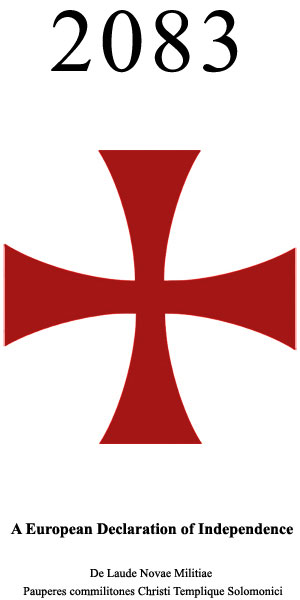
The document opens with a graphical title:

000-2083-cross-tp.jpg — title page —

That’s probably the largest single graphic in the entire work, and it puts the work squarely in the context of the Knights Templar — with e Templar cross and the full name of the order, “Pauperes commilitones Christi Templique Solomonic” or Poor Fellow-Soldiers of Christ and of the Temple of Solomon.  The Templars were a Western Christian chivalric order strongly associated with the Crusades — and the topic more recently of much historical, occult and fictional speculation.

The date 2083 is a date SFE (in the Science Fictional Era) as was 1984 before it — but it was almost certainly chosen for its echo of the 1683 Battle of Vienna, which is commonly taken to represent the turning back of the Ottomans by the Habsburgs, and thus the victory of Christendom over Islam.  Two maps show the Umayyad Conquests:

umayyad-conquests-p-228.jpg — p 228 —

and the Second Islamic Wave, turned back in Spain and at the gates of Vienna:

243-1683-second-islamic-wave-p-243.jpg — p 243 —

These can fruitfully be contrasted with a map of “tomorrow”:

demain-p-487.jpg — p 487 —

it being the author’s contention that France will be the first European country to fall to Islamic dhimmitude.  I suspect much the same is implied in this version of the French tricolore:

flag-face-p-781.jpg — p 781 —

There are some pointed attacks on leftist intellectuals:

033-academic-reform-p-33.jpg — p 33 —

and on media perceived as left-leaning, notably the BBC:

bbc-flag-w-crescent-p-384.jpg  — p 384

— that’s the Saudi flag mashed up with the BBC logo and star and crescent — and:

804-bbc-02-p-804.jpg  — p 804 —

giving both “ancient” and “modern” variants on the theme…

There are some strange items which I’ll drop in here for a breath of fresh air…

free-pluto-equal-gravity-for-all-planets-p-381.jpg  — p 381 —

which appears to be a commentary on the respective attractions of Venus and Mars, since it’s situated in a commentary on Feminism…

this really is a strangely mythic document… and…

global-warming-voidka-p-657.jpg

with its reference to “mind control agents” — and those whose minds have been controlled are clearly sheep:

wake-up-p-803.jpg — p 803 —

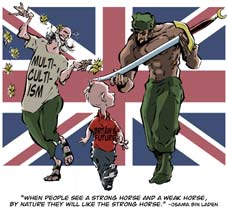
which may be the right moment to mention that the British, too, come in for a measure of contempt, via a quotation from none other than Osama bin Laden:

when-people-see-a-strong-horse-p-707.jpg  — p 707 —

“When people see a strong horse and a weak horse, by nature they will like the strong horse”.  Perhaps its unsurprising that the author is something of an admirer of bin Laden’s means, if not his ends.

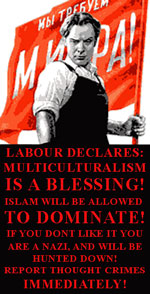
Of course, that’s largely the fault of the Labour party:

labour-declares-multiculturalism-is-a-blessing-p-373.jpg

But that’s probably enough for one post — in my next, I’ll consider how weak we are, what the jihadist strategy against us is, and how the new Templars hope to turn the tide

against:

worst-threats-to-mankind-p-674.jpg — p 674 —

the worst threats to mankind.


Switch to our mobile site