zenpundit.com » geopolitics

Archive for the ‘geopolitics’ Category

Siloviki and Turkish Generals Building a Pan-Turanism ?

Saturday, May 31st, 2008

A recent report from The Jamestown Foundation put a spotlight in the activities of Neo-Eurasian ideologist, the politically connected extremist Aleksandr Dugin, to build bridges with Turkey’s Pan-Turkic movement:

“….On the one hand, attempts are made to turn the two “Eurasias” into allies rather than competitors; on the other hand, there has been a Dugin-style ideologization of the term in response to American ascendancy. The question is whether the concurrence of these two modes of “Russification” of the Turkish Avrasya is incidental, or whether they are two sides of the same coin. In the 1990s, articles on the Turkish variety of Avrasya systematically criticized Russian Eurasianism; in the early 2000s, the tone changed noticeably. Several Turkish advocates of a more militant Eurasianism called upon their fellow citizen to emulate Russia in developing a specifically Turkish interpretation of this concept [6]. In 2002, at the conference “How to Establish a Peace Belt around Turkey” held by the Military Academies Command, the secretary general of the National Security Council, General Tuncer Kilinc singled out Russia as Turkey’s most strategic partner. In 2005, Turkish analyst Anar Somuncuoglu from the Russia-Ukraine Research Department at the National Security Strategies Research Center (TUSAM) published an article in Strateji Dergisi proving the need of rapprochement with Russia [7].

The term Avrasya has also become popular with religious circles that were not previously linked to the pan-Turkic extreme right. Thus the modernizing Islamists around Prime Minister Erdogan have been publishing the newspaper Avrasya kusagi since 2000, and partisans of a Turko-Islamic synthesis edit Yeni Avrasya [8]. Fethullah Gulen’s movement publishes DA Diyalog Avrasya in Russian and Turkish, which has already carried several interviews with Dugin [9]. Other proponents of this movement include the Ahmed Yasawi Foundation and the Marmara Group Foundation, directed by Akkan Suver, which regularly organizes “Eurasian economic summits.” In November 2006, this NGO was the first to be accorded an observer member status by the Parliamentary Assembly of the Black Sea Economic Cooperation (PABSEC). There are also two social-democratic newspapers-Avrasya  Etnografya Vakfi and Avrasya Dergisi-as well as the above-mentioned Zaman [10].

Dugin participated in this reorientation in his own way, managing to have his book on geopolitics translated into Turkish (and Arabic). The translation was published in Ankara in 2003 as Rus Jeopolitigi Avrasyaci Yaklasim, and seems to have gone over well with part of the Turkish military.There have been several conferences on Eurasianism that called for cooperation with Russia, all of which included participants from the military. The first visit of the International Eurasianist Movement took place in December 2003. It received quite widespread media coverage in Turkey, due in particular to the presence of writer and journalist Atilla Ilhan (1925-2005). Over many decades, Ilhan consistently wrote on the subject of the Turkish-Russian alliance, even during the Cold War. Through his books, he popularized the idea of a Turkish-Russian alliance preordained by geopolitics and insisted on “Eurasianist” heroes such as Ismail Gasprinskii, Sultan Galiyev and Mulla Nur Vahidov [11]. This rapprochement between Dugin and Ilhan consequently helped Russian Eurasianism to reach some Turkish political and intellectual elite”

Read the whole thing here.

Of the obscure figures mentioned in the last paragraph, Gasprinskii was a Silver Age “jadid” ( Modernist) who sought an awakening of the Russian Empire’s Tatar-Turkic Muslim peoples; Vahidov and Sultan-Galiev, were Old Bolshevik Tatars who developed a Muslim variation of “national Bolshevism” that challenged Stalin’s ideas on Soviet nationalities ( Sultan-Galiev was ultimately shot during the Great Terror, unsurprisingly). These men represent historical failures whose intriguing ideas were suppressed by Tsarist and Stalinist authorities long before they could acquire political traction. Why is any of this important ?

In a nutshell, both Putin’s siloviki regime and Turkey’s Kemalist establishment are feeling the need for ideological rejuvenation  these days, in the former case to fill a vacuum in the public mind left by the collapse of Soviet Communism and in the latter to fend off a creeping Islamism that is undermining Turkish adherence to hallowed, secular, Kemalist traditions. The Neo-Eurasianism of Dugin is a frankly authoritarian, anti-western and quasi-fascist witch’s brew and synthesizing it with the Pan-Turkism of Turkey’s own nationalist fringe can only be unhelpful to Western interests and the prospects for liberalism and democracy in the region.

The Establishment’s Flagship Embraces 4GW

Wednesday, April 30th, 2008

Richard Haass  jumps the shark in Foreign Affairs:

The principal characteristic of twenty-first-century international relations is turning out to be nonpolarity: a world dominated not by one or two or even several states but rather by dozens of actors possessing and exercising various kinds of power. This represents a tectonic shift from the past.

….At first glance, the world today may appear to be multipolar. The major powers — China, the European Union (EU), India, Japan, Russia, and the United States — contain just over half the world’s people and account for 75 percent of global GDP and 80 percent of global defense spending. Appearances, however, can be deceiving. Today’s world differs in a fundamental way from one of classic multipolarity: there are many more power centers, and quite a few of these poles are not nation-states. Indeed, one of the cardinal features of the contemporary international system is that nation-states have lost their monopoly on power and in some domains their preeminence as well. States are being challenged from above, by regional and global organizations; from below, by militias; and from the side, by a variety of nongovernmental organizations (NGOs) and corporations. Power is now found in many hands and in many places.

Read the rest here.

Fragile States, Failed States and Spatial Anthropology

Sunday, April 27th, 2008

A pleasant downstream effect of having blogged for a while is that readers will send you interesting things from time to time. Like the following…

Check out: The Complex Terrain Laboratory

Snippets:

This is muddled and confusing. Human Terrain is “an emerging area of study”? No it’s not. Human “terrain” is a label, a metaphor, for guess what? History, geography, anthropology, sociology, psychology, communications, etc., etc. It’s “major goal is to create operational technologies”? No it’s not. That’s what mathematicians and engineers can deliver on multimillion dollar DoD contracts. Human terrain is, just in case anyone hasn’t read a newspaper or wireclip over the last few years, about people, what they think, their perceptions, their loyalties, the consequences they bear in wartime, the support they may or may not provide to insurgents, the physical, cultural, and informational spaces they create and occupy in  times of conflict and crisis. 

Freaking mad scientists. They’re everywhere. Technology is a tool, not the answer

and

What is really meant by ‘fragile’ states is ones that have acquired legal sovereignty but that have lost, or more probably never acquired, the effective powers attached to that status. There are more and more such states. How many depends on one’s definition of fragility. The United Kingdom’s government development agency, the Department for International Development (DFID), one of the smartest outfits in the business, estimates that 46 states, over one quarter of the world’s total, fall within its definition of ‘fragile states’. The population of these 46 states is over 870 million. DFID bases its definition of fragility on a state’s record in combating poverty. Others define fragility not by reference to poverty, but to security. Referring to the slightly different concept of ‘failure’, in the United States’ 2002 National Security Strategy, President Bush stated that America ‘is now more threatened by weak and failing states than…by conquering ones’.

Human Terrain Mapping” is one of those relatively new concepts I’ve been meaning to investigate and CTLab – run by a distinguished trio of scholars and authors Stephen D.K. Ellis, Michael A. Innes and Brian Glyn Williams – fits the bill. Definitely a “blogroll-worthy” site for all of the Intel/COIN/IO/DIME/Foreign Policy bloggers and of interest to the history blogosphere as well since two of the three gentlemen are professional historians.

I look forward to many enjoyable and profitable visits.

UPDATE:

Mike Innes has written in to explain that CTLabs is still expanding their team of SME’s as well as the working on the aesthetic and functionality aspects of the site itself, which will be formally “rolled out” with a higher level of interactivity and collaboration.

At the Risk of being called a Guy who just Links to Cool Articles….

Thursday, April 17th, 2008

Lexington Green sent me this PARAMETERS review essay by Colonel Arthur C. Winn – on the five volume series on Strategic Intelligence [Five Volumes] (Intelligence and the Quest for Security) , edited by Dr. Loch K. Johnson and issued by Praeger Security International.
The five volumes present empirical inquiries, historical views, theoretical frameworks, memoirs, case studies, interviews, legal analyses, comparative essays, and ethical assessments. The authors come fromvarying backgrounds, including academia, intelligence agencies, think tanks, Congress, the State Department, the National Security Council, the legal field, and from seven countries. Each author has different personal experiences andwrites fromhis or her own perspective. The books provide an excellent reference for students of the military, political affairs, foreign policy, or strategic planning. The supporting notes at the end of each chapter are especially helpful and should not be overlooked by the reader.

Lex kidded me about putting this on my Christmas List but it looks to be a “must read” or at least a “must have reference” set for scholars of intelligence, IR, diplomatic or military history. Very DIME oriented format. I’m impressed as this is exactly what I was looking for years ago when I shifted outside of diplomatic and economic history to delve into intelligence and strategic studies.

Maybe a corporate card or institutional account order is a good idea with this one ($ 360 – Ouch!).

Fisking McCaffrey’s Futurism

Monday, March 24th, 2008

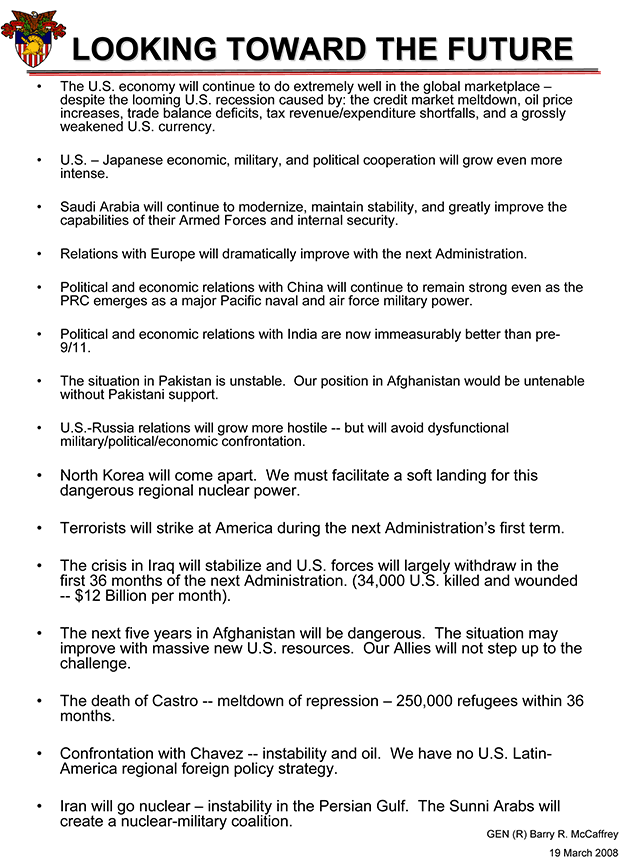
Yesterday, The SWJ Blog ( and blogfriends on Twitter, one of whom characterized it as “weak”) aleted me to a futurist slide by General Barry McCaffrey with his predictions of potential national security events faced by the United States in the near term. I’m certain this was in the context of a much larger presentation, given to a specific group with stated policy concerns; unfortunately, those particulars are unknown to me:

futurism.gif

My commentary:

First of all, one notes the number of “safe” predictions in the sense that none of these represent even the likeliest of outliers much less scenarios representing true, statistical rarity, “Gray Swans”. There’s a certain probalistic logic to doing so – the status quo more often than not in any given scenario will continue uninterrupted except by minor adjustments. On at least half of this list, given the breadth and/or vagueness, I’m certain that McCaffrey will be able in five years to say that he was more right then wrong. Unfortunately, the narrow number of domains from which he is extrapolating – nothing on cutting edge tech, applied science, the environment, macrodemographics, religious fundamentalism or interesting “intersectional” possibilities – leaves  policy makers with a vision that may be more susceptible to a Black Swan event than before by reinforcing previously held expectations.

Sidebar: I’d love to see Art Hutchinson, Tom Barnett, John Robb , Michael Tanji and the gents at Kent’s Imperative also critique the slide.

Now, in fairness, to the good General, a few of his bullet points are more interesting than others. I think McCaffrey’s called a hard landing for Cuba correctly unless Raul Castro has a secret admiration for Deng Xiaoping and the comprehension of economics to execute a Deng-like transition. It will be difficult for Cuba to really open up without the economic logic of the American market and favorable asylum policies for Cubans immediately kicking in as it did for the East Germans when the other Soviet bloc states ceased cooperating with Honecker’s repressive policies. With Chavez too, I think General McCaffrey is correct given that there is a little remarked friction between Venezuela the oil producer and America the refiner of Venezuelan oil ( refining capacity is itself a choke point along with oil production nor is all crude created equal; some is more expensive to refine than others). Finally, the temptation for al Qaida to “send a message” to the new administration and create downstream political effects may prove well-nigh overwhelming; it may even override their present policy of waiting until to pull off a catastropic level act of terror.

How do you see it ? Comments, questions, rants are all welcome.


Switch to our mobile site

