zenpundit.com » geopolitics

Archive for the ‘geopolitics’ Category

Water and people

Thursday, May 9th, 2013

[ by Charles Cameron — and then of course there are animals and plants, too, and wildfires, and the Grand Canyon ]
.

Just a couple of things to think about:

Sources:

  • More than half of the world’s population lives inside this circle

    Even more mindblowing: said circle is mostly water.

  • All of the World’s Water

    Spheres showing:
    (1) All water (sphere over western U.S., 860 miles in diameter)
    (2) Fresh liquid water in the ground, lakes, swamps, and rivers (sphere over Kentucky, 169.5 miles in diameter), and
    (3) Fresh-water lakes and rivers (sphere over Georgia, 34.9 miles in diameter).

  • In the lower panel, the “all water” sphere is obvious, the “fresh liquid” sphere is visible, but the “freshwater lakes and rivers” — did you even notice it?

    **

    Some paras I wrote for John Petersen while at The Arlington Institute around the turn of the millennium:

    Water is our most precious resource. Our bodies are largely made of it; we thirst for it, and die when it is withheld more rapidly than we die for lack of food; and our food itself — whether animal or plant — also relies on it for nourishment and survival. Not surprisingly, water features in religious scripture and poetic mythology as among the highest symbols of purity and blessing: the Psalmist declares “There is a river, the streams whereof shall make glad the city of God” (Psalms 46: 4), Jesus in the New Testament speaks of his own teachings as “a well of water springing up into everlasting life” (John 4:14), while Allah declares in the Koran, “We made from water every living thing” (Al-Anbiyáa 30). For Lao-tzu in the Tao te ching, it is the analog of wisdom: “In the world there is nothing more submissive and weak than water,” he writes, “yet for attacking that which is hard and strong nothing can surpass it.”

    We consume water in ever increasing amounts, while polluting it as though its very purity was a reproach to us – and simultaneously beginning to recognize that this most precious of resources is just that – a limited, physical resource that we are squandering. Such significant indicators of hydrologic activity as , salinity, sea levels, snowmelt, glacial melt, and rainfall are not merely changing but accelerating their rates of change. We are fast running our of fresh water to drink and to irrigate our crops. And when World Bank vice president Ismail Serageldin declared in 1995 that “The wars of the next century will be over water”, he was giving advanced notice of a looming problem which we overlook at our peril.

    Syria is Not Rwanda

    Monday, April 29th, 2013

    Anne-Marie Slaughter had a short but bombastic WaPo op-ed on Syria and chemical weapons use that requires comment:

    Obama should remember Rwanda as he weighs action in Syria 

    ….The Clinton administration did not want to acknowledge that genocide was taking place in Rwanda because the United States would have been legally bound by the Genocide Convention of 1948 to intervene to stop the killing. The reason the Obama administration does not want to recognize that chemical weapons are being used in Syria is because Obama warned the Syrian regime clearly and sharply in August against using such weapons. “There would be enormous consequences if we start seeing movement on the chemical-weapons front or the use of chemical weapons,” he said. “That would change my calculations significantly.”

    ….But the White House must recognize that the game has already changed. U.S. credibility is on the line. For all the temptation to hide behind the decision to invade Iraq based on faulty intelligence about weapons of mass destruction, Obama must realize the tremendous damage he will do to the United States and to his legacy if he fails to act. He should understand the deep and lasting damage done when the gap between words and deeds becomes too great to ignore, when those who wield power are exposed as not saying what they mean or meaning what they say.

    This is remarkably poorly reasoned advice from Dr. Slaughter that hopefully, President Obama will continue to ignore.
    .
    The President, on the basis of advice very much in the spirit of this op-ed, drew a public “red-line” about chemical weapons use for Bashar Assad, or some variation of that, on six occasions, personally and through intermediaries. On the narrow point, Slaughter is correct that this action was ill-considered, in that the President wisely does not seem to have much of an appetite for jumping into the Syrian conflict. Bluffing needlessly is not a good practice in foreign policy simply to pacify domestic critics, but it is something presidents do from time to time. Maybe the POTUS arguably needs better foreign policy advisers, but doubling down by following through with some kind (Slaughter fails to specify) military intervention in Syria is not supported in this op-ed by anything beyond mere rhetoric.
    .
    First, as bad as the Syrian civil war is in terms of casualties it does not remotely approximate the Rwandan Genocide in scale, moral clarity, military dynamics or characteristics of the major actors. This is a terrible analogy designed primarily to appeal to emotion in the uninformed. Syria is engaged in civil war, not genocide.
    .
    Secondly, the “credibility” argument has been lifted by Slaughter from it’s Cold War historical context where the United States capacity to provide a nuclear umbrella and effective deterrent for allied states was tied to the perception of our political will to assume the appropriate risks, which in turn would help avoid escalation of any given conflict to WWIII. This psychological-political variable of “credibility” soon migrated from the realm of direct US-Soviet nuclear confrontation in Europe to all manner of minor disputes (ex. –Quemoy and Matsu, civil unrest in the Dominican Republic) and proxy wars. It was often misapplied in these circumstances and “credibility” assumed a much greater exigency in the minds of American statesmen than it it did in our Soviet adversaries or even our allies, to the point where American statecraft at the highest level was paralyzed by groupthink in dealing with the war in Vietnam. By 1968, even the French thought we were mad.
    .
    Absent the superpower rivalry that kept the world near the brink of global thermonuclear war, “credibility” as understood by Johnson, Rusk, Nixon and Kissinger loses much of it’s impetus. If “credibility” is the only reason for significant US intervention in Syria it is being offered because there are no good, hardheaded, reasons based on interest that can pass a laugh test.
    .
    The historical examples President Obama should heed in contemplating American intervention in Syria is not Rwanda, but Lebanon and Iraq.

    Only Amateurs Negotiate in Public

    Friday, April 26th, 2013

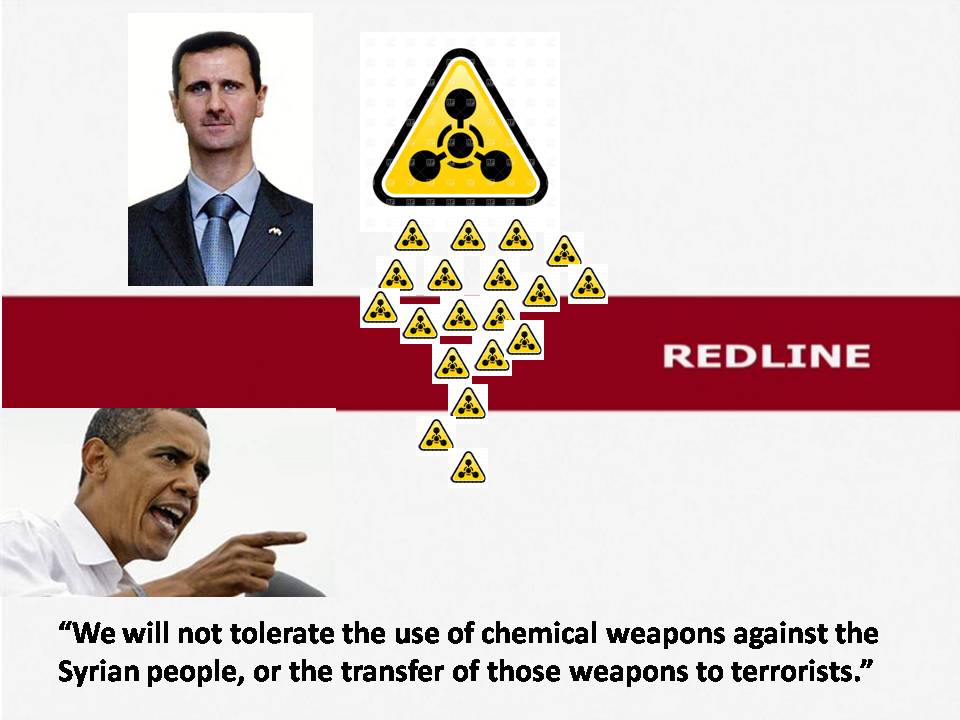
    There is much buzz right now about whether the cruel Syrian Baathist-Alawite regime of Bashar Assad, struggling to hold on to power in the midst of civil war against rebel Sunni forces, crossed   President Obama’s “red line” by using Sarin gas, a war crime. That is not really the important point for Americans. There are two things to consider here.

    First, specifically how would intervening militarily in Syria’s awful civil war be in American national interest?

    It is important to get a clear cut answer here because everyone arguing that Assad has “crossed a red line” that we will “not tolerate” is making a de facto argument for some kind of intervention on our part. Maybe if no one can define such an interest it is because there isn’t any and intervening will bring the US nothing but costs in blood and treasure without gaining anything of strategic value. I’m not against intervention per se but there really ought to be a coherent reason so we can rationally measure it against the potential costs which, from where I sit, look rather large.

    Secondly, in important matters of state, you don’t negotiate in public with a potential adversary if you really hope to gain a concession from them and if you reach the point of issuing a public ultimatum, you don’t bluff.

    The people who have advised President Obama to make these “red line” statements to Syria through the media instead of quietly through diplomatic channels are either professionally incompetent at statecraft or they were hoping to manipulate the President by getting him to back himself into a corner with tough rhetoric so that if Assad did not blink then Obama would have the choice of looking weak and foolish or of approving some kind of action against Syria. Either way, the President was poorly served by this advice. Maybe he needs some new foreign policy and national security advisers who actually know something more about the world than domestic politics and being lawyer-lobbyists.

    As a result that the President never really had any intentions of, say, invading Syria this year, we are now being treated to nervously asserted, lawyerly parsing of what really counts as “red lines” and what technical level of Sarin gas particulates constitutes “use”. It is an embarrassing climb down for the administration but also for the United States that never needed to happen. Empty posturing is not a substitute for a policy. Saying “Do something!” is not a strategy.

    This is no brief for Assad’s regime. He’s definitely a bad actor and runs a nasty and now democidal police state he inherited from his mass-murdering father, Hafez Assad. I’m open to hearing why the US should aid in a regime change because the outcome will be in our interests in some concrete and definable way. Oh, yeah, and it might help if the person making the pitch knew something about Syria and regional geopolitics, or was at least consulted about it.

    Let’s think long and hard this time.

    Hermit Kingdom of Darkness

    Sunday, April 7th, 2013

    North Korea’s shopworn game of bluster, threaten, bully, violate international norms and eventually be rewarded with concessions and bribes has stopped working, which is why there now is a crisis. With the suckers (ROK, USA and Japan) refusing to play three card monty and with even  Pyongyang’s confederate China wearying of the scam when they have their own fish to fry, Kim Jong Eunhas few options to save face except to double down on painting himself into a smaller and tighter corner. There are some who would like to play the game of appeasement for a temporary respite but both Seoul and Washington are taking a harder line on North Korean antics.

    One gets the impression that -unofficially, mind you – Beijing would not mind “Fatty the Third” getting a comeuppance that could push him from power and lead to the ascension of a more mature, more reasonable, more seasoned and more Sinicized leader of the Kim dynasty.

    Here is a round up of more intelligently thought out (or at least interesting) articles and posts about the Nut of the North and possible war with North Korea:

    Colonel Dave Maxwell– north Korean Leadership Assessment and The Realist Prism: North Korea Gambles on Strategic Assumptions and U.S. would seek regime change in North Korea if attack occurs

    Colonel Maxwell is an area specialist on the DPRK, these are the “must read” pieces

    Robert Baer –Viewpoint: North Korea’s Gaddafi Nightmare 

    Gordon Chang –Is Kim Jong Un’s Bluster Really a Prelude to Reform?

    Thomas PM Barnett –The Tricky Thing about Kim Jon Eun 

    Patrick Cronin – Tell me How this Starts

    IHT –Detecting Shift, U.S. Makes Case to China on North Korea 

    Let me try my hand at reading the tea leaves. I don’t know that much, relatively speaking, about the “sovietology” of analyzing North Korean nuances which I will leave for experts like Colonel Maxwell to concentrate on other angles. Some points i no particular order:

    • First, any hope of an internal coup against Eun is probably nonexistent. Not only for the the consistent ruthlessness and lavish bribery which the Kim Family regime has treated it’s military, but the fact that coups of this nature have a poor track record in Communist states, even weird ones like the DPRK. From the inception of Communist power in the USSR, Soviet leaders fretted about “Bonapartism” by counterrevolutionary generals on white horses from Kornilov to Tukhachevskii to Zhukov. That these plots were mostly imaginary did not matter and Communist rulers neutralized this threat by binding the military leadership into the Party leadership at a level subordinate to the Politburo and periodically shooting likely upstarts. The political space for successful military coups do not exist in Communist regimes even for the key insiders, just ask Lin Bao. The North Korean military does not have the will to do this except in conjunction with massive Chinese intervention. Perhaps not even then.
    • For all the talk of irrationality, North Korea has been been playing this game as a survival strategy for sixty years and only miscalculated once, with the original invasion of South Korea in 1950 – which only happened, after Kim Il-Sung received the blessing of Stalin and promise of massive support from Mao ZeDong – and it was an unmitigated disaster for North Korea and China. Pointedly, the North has not initiated a war since and their subsequent violent provocations, while infuriating, have been quixotic and weird rather than existential threats that would guarantee a crushing military response.
    • The “win” for the US and ROK here is in frustrating the regime’s grasp for status, however self-deluded, in extorting more material concessions by acting like the international community’s equivalent of a crazy, menacing, homeless person ranting on a street corner. We need to make this charade appear to be a diplomatic sure-fire loser this time in the eyes of Pyongyang’s elite with an endgame where the North emerges empty handed and Eun feels that pressing further risks a greater loss of face. We do this by making moves where the spillover costs of North Korean intransigence and public lunacy drift in China’s direction; a tightly constrained North Korea out of diplomatic and economic options is really Beijing’s problem.
    • The strategic equation for “victory” from the North’s perspective depends heavily upon the reaction of the US and ROK governments to get drawn into tiresome negotiations before the North ceases it’s behavior, something they ultimately cannot control. Washington and Seoul cold hold firm or even (conceivably) take a harder line. If frustrated in their quest for concessions, the regime could exercise several options a) shift gears to a different propaganda campaign to distract internal audience b) engage in an act of terrorism elsewhere in the world, such as against a ROK embassy c) engage in a military demonstration that while provocative, like ballistic missile test, is not a casus belli d) all of the above e) undertake a military strike under the mistaken impression the ROK will not retaliate.

    Comments welcomed.

    US Foreign Policy, Egypt and the Muslim Brotherhood

    Wednesday, January 30th, 2013

    The Obama administration, though they would not characterize it as such nor have much desire to acknowledge it at all, have attempted  a strategic detente with the “moderate” elements of political Islam.

    This policy has not been entirely consistent; Syria, for example, is a quagmire the administration has wisely refrained from wading directly into despite the best efforts of R2P advocates to drag us there.  But more importantly, under President Obama the US supported the broad-based Arab Spring popular revolt against US ally, dictator Hosni Mubarak, and pushed the subsequent ascendancy of the Muslim Brotherhood in Egypt and the Libyan revolution against the entirely mad Colonel Gaddafi. These appear to be geopolitical “moves” upon which the Obama administration hopes to build.

    I would like to emphasize that there is one legitimate and valid strategic pro to this sub rosa policy; namely, if everything went well, it would provide the United States with powerful triangulation against revolutionary, apocalyptic, radical Islamism as expressed by al Qaida and various Salafi extremist movements. There are reasons, rooted in takfirism, strategy and the politics of lunacy that our terrorist enemies frequently hate and revile the Brotherhood as traitors, apostates or whatever. Isolating the most actively dangerous and violent revolutionary enemies from a large mass of potential allies is, at least, a good strategic goal.

    It is also my view, that this “outreach” is as politically sensitive  to the Obama administration as was the China Opening was to Nixon and about which they have been equally opaque and misleading for fear of a domestic backlash. The weird, foot-dragging, dissembling, embittered, kabuki drama inside the Beltway about public statements and intelligence on whether Benghazi was caused by obscure crackpot Islamophobic film makers or a well-orchestrated terrorist attack  is in my view due to a major foreign policy strategy never having been framed in public for what it is. I’m sure people will differ strongly with me on this (which is fine), but I would characterize detente with Islamists as a strategic shift on par with the “Pivot to Asia”.

    The downside here is that first, things are not likely to come out well at all, as unfinished revolutions tend to give birth to monsters; and secondly, any detente with “moderate” political Islam is an uncertain gamble based on certain exceptionally optimistic conceptions of not only what the Brotherhood might do, but about it’s very nature.

    While the removal of Arab dictators resonated with American values , it was questionable realpolitik while the administration’s de facto support of  Egypt’s Muslim Brotherhood faction over poorly organized secular liberal modernists was an act of realpolitik that required a compromise of the democratic values so recently invoked to justify abandoning Mubarak. This was cynical diplomatic flexibility worthy of Talleyrand.

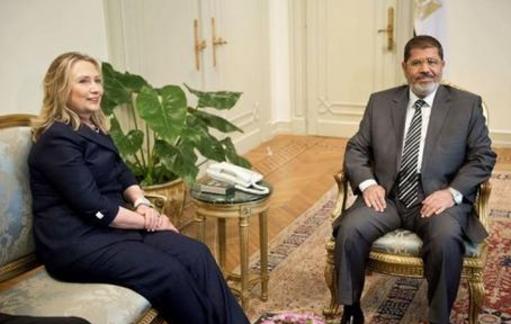
    Unfortunately, the most democratic thing – perhaps the only thing – about Mr. Morsi and his Brotherhood supporters was his election.

    The Egyptian people who are subjected now to thuggery from both Morsi’s Islamist stormtroopers and from the security forces of the Egyptian military are less sanguine than are the Brotherhood’s cheerleaders inside the administration. The Egyptian people, in fact, seem to be in revolt against domination by the Muslim Brotherhood’s shadow government.

    The first question to ask in assessing if the Obama administration policy here is wise would be “What is the nature of the Muslim Brotherhood?” Americans love to personalize foreign policy, but if  Morsi were to be toppled or die, the Brotherhood will remain what it currently is, the best organized political force in Egypt and one widely influential throughout the Arab world and the West itself.

    I am not an expert on the Muslim Brotherhood, nor am I an Arabist by education. Most of us aren’t – a group that I fear includes most of the Obama administration officials involved in shaping this policy. Almost fifty years after King Faisal determined to export Wahhabism, more than thirty years since Khomeini’s Revolution and more than ten years since 9/11 the USG still has less in-house expertise related to Islam than it did about the Soviet Union and Communism a decade after the Berlin Blockade.

    Perhaps we all should begin learning more?

    Here is an analysis from FPRI; it is extremely critical but it touches on organizational aspects of the Muslim Brotherhood that I have not seen elsewhere (hat tip to David Ronfeldt). Feel free to suggest others, both for and against. The Brotherhood is a very large group with a long history that includes violence , terrorism and subversion on one hand and peacefully representing expressions of pious, middle-class, social conservatism in other places and times:

    Lecture Transcript: What Every American Should Know about Egypt’s Muslim Brotherhood, Delivered by Eric Trager 

    ….Two years ago when I was doing my dissertation fieldwork in Cairo, I sought out interviews with leaders from the Muslim Brotherhood, and I was referred to a man named Muhammad Morsi, now the President of Egypt. At the time, President Mubarak was ill and had gone off to Europe for operations amid a lot of mystery surrounding his health. I asked Muhammad Morsi whether the Muslim Brotherhood would run a presidential candidate if Mubarak died tomorrow. Here is what he said:

    [From an audio file played by Trager]

    Eric Trager: You don’t see the Muslim Brotherhood nominating a presidential candidate [if Mubarak dies tomorrow]?

    Muhammad Morsi: No… because society is not ready… Our society is not ready yet to really defend its worth. We want a society to carry on its responsibilities, and we are part of this society. Another thing, if we are rushing things, then I don’t think that leads to a real stable position.

    When he made that statement, I don’t think he was lying, and I don’t think he was being coy. I think that he didn’t expect that he would be faced with this reality in a mere six months. He did not expect that Mubarak would step down six months later and, to be completely honest with you, neither did I. My dissertation was entitled “Egypt: Durable Authoritarianism”—until the revolution.

    What did Morsi mean when he said that the Brotherhood was trying to build a society? Let me give you some background on the Muslim Brotherhood. It was founded in 1928 by Hassan al-Banna, who was a schoolteacher in Ismailia. The Muslim Brotherhood’s goal was then—and remains now—to establish an Islamic state in Egypt. The way it pursues this goal is by trying to Islamize Egyptian society. Through social services, education, and the mosque, it sought to make Egyptians more religious and more Islamic as a grassroots strategy for building an Islamic state. That’s very, very different from a strategy that says, “We’re going to run for president, run for the Parliament, and use that power to transform society.” Rather, the Brotherhood says, in effect, “We’re going to Islamize society to build towards power.” It was a long-term strategy; it took them 84 years before they ran for and won the presidency. So Morsi told me in 2010 that the Muslim Brotherhood was not going to run for the presidency because it was not done Islamizing Egyptian society….

    Read the rest here.


    Switch to our mobile site