zenpundit.com » war

Archive for the ‘war’ Category

Review: Senator’s Son by Larson

Monday, March 15th, 2010
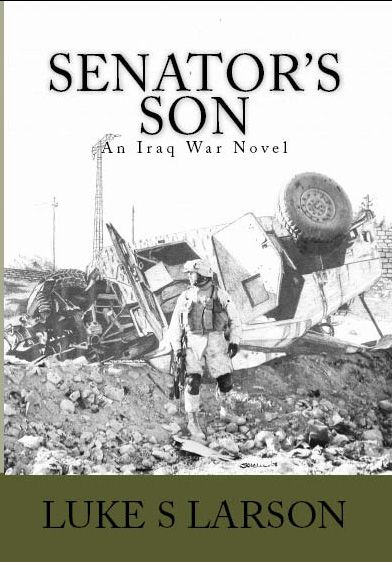
larson.jpg

Senator’s Son: An Iraq War Novel by Luke S. Larson

Fiction is not a genre that I usually review here, or get an opportunity to read often, but I received a courtesy review copy of a book Senator’s Son, by Iraq war vet, Marine officer and new novelist Luke Larson and was curious. The Iraq War and the War on Terror have produced a fine array of thoughtful books by veterans, war reporters and military thinkers like FiascoOne Bullet Away  and The Strongest Tribe, all of which were non-fiction memoirs, journalistic histories and quasi-policy books. By virtue of writing Senator’s Son as a novel, Larson was taking a different path in explaining his war.

There are two books at once in Senator’s Son. The first, is of course, a story, with characters and a plot and rising action, action, tragedy and theme – all the usual aspects of literature which I am not especially practiced at evaluating here. The second part is a contextual explanation of COIN by an author who lived the Iraq War. To his credit, Larson contacted me personally to request a “No bulls**t review”, so I will give the man what he asked for.

As an explanation of COIN, I think the book is a must read for anyone unfamiliar with the subject and the nuanced complexities that COIN entails. The gritty, unforgiving, human suffering and moments of triumph of soldiers waging “pop-centric” COIN that gets lost in powerpoint slides, in the dry abstractions of journal articles and blogospheric arguments far removed from the ground is present in ample measure in Senator’s Son. Many times, I paused in a passage and thought, “hmmm….I did not consider that”. Or “This is what the soldiers bear up under without complaint”. More people need to read that and digest what we ask of our men and women in Iraq and Afghanistan.

Senator’s Son also lays out, fairly methodically, how COIN theory may have been interpreted and debated by soldiers outside the wire, including cameo appearances or mention of real life COIN leaders woven into the story. The characters Bama, Cash, Rogue, Isaac, Gonzo the Iraqi and more, resist and adapt, struggling with their environment, unseen enemies and the political pressures of higher authorities, registering both frustration and progress in executing the mission of Golf Company. There’s even diagrams. If Senator’s Son is not on official COIN reading lists, it should be.

As a pure novel, judged on literary standards, Senator’s Son reflects its’ status as a “first novel” of a talented author whose vision of the craft is emerging. Larson excels at creating scenarios, staccato vignettes for the characters to act ( Larson may also have a future as a screenwriter – his book naturally flows in the mind like a movie). There’s always a believable, environmental, “texture” present that exceeds that of short story and science fiction writers, yet as a novelist, Larson leaves enough to the reader’s imagination so that the story moves at a dramatic pace.

Characterization in Senator’s Son is uneven. It takes a while for the individual personalities of the characters to shine beyond their common “Marine-ness” and we get only the briefest glimpse of the malign nature of the enemy, and that secondhand through the eyes of an Iraqi character. That probably is an accurate representative of the experience of most US soldiers and Marines in Iraq who are not interrogators; furthermore, having the antagonist that the characters struggle against be the total environment is perfectly legitimate. It would have been interesting for me to have seen how Larson would develop and utilize a figure who was the focus of evil; however that task would be fairly incompatible with getting an effective message across regarding COIN, success of which does not hinge on the defeat of super-villains or the resolution of black-white moral absolutes but is complexity written in shades of gray.

Finally, as an avid reader, I found Senator’s Son to be a page-turner. Several times, I looked at the clock while reading for what seemed to me a short time, noted it was 1:30 am and was regretful that I had to put it on my bedstand ( I always finished the chapter first though 🙂 ) only to repeat the process the following night.  Strongly recommended.

ADDENDUM – OTHER REVIEWS of SENATOR’S SON by:

Thomas P.M. Barnett 

Shrinkwrapped 

Shane Deichman

Mackinlay’s Insurgent Archipelago & Other Books

Tuesday, March 9th, 2010

The Insurgent Archipelago by John Mackinlay

At the strong recommendation of Colonel Gian Gentile, I ordered The Insurgent Archipelago: From Mao to Bin Laden by Dr. John Mackinlay of King’s College, London and a hardcover copy just arrived this afternoon. Judging from the table of contents and the sources in Mackinlay’s endnotes, The Insurgent Archipelago will present a tightly written argument on the nature of COIN. For a well regarded  and informative review, see David Betz of Kings of War blog, brief excerpt below:

Review: The Insurgent Archipelago

….The book is sweeping, as the subtitle ‘From Mao to Bin Laden’ suggests; yet it is also admirably succinct at 292 pages including notes and index.[2] In design it is exceedingly clear, consisting of three parts-‘Maoism’, ‘Post-Maoism’, and ‘Responding to Post-Maoism’, which reflect the basic components of his argument. Insurgency’s classical form is the brainchild of the carnivorously ambitious strategic and political genius Mao Zedong who gave meaning to the now familiar bumper sticker that insurgency is ’80 per cent political and 20 per cent military’. Mao’s innovation was to figure out what to fill that 80 per cent with: industrial scale political subversion by which he was able to harness the latent power of an aggrieved population to the wagon of political change, to whit the victory of the Chinese Communist Party in the Chinese Civil War which ended with the proclamation of the People’s Republic of China in 1949

….The problem is that what we now face in the form of ‘global insurgency’ is not Maoism but Post-Maoism-a form of insurgency which differs significantly from that which preceded it.[6] We have, in essence, been searching for the right tool to defeat today’s most virulent insurgency in the wrong conceptual tool box. This is perhaps the most uncomfortable truth to be laid out in this book; another worrying one is that the security interests of Western Europe differ markedly from those of the United States-because the threat in the former emerges from their own undigested Muslim minorities which are alienated further by their involvement in expeditionary campaigns which, arguably at least, serve the needs of the latter well enough

Oddly, this will be the second book by a former British Gurkha officer that I’ve read in the last six months; the first being The Call of Nepal: My Life In the Himalayan Homeland of Britain’s Gurkha Soldiers by Colonel J.P. Cross, which I played a minor role in getting reissued here by Nimble Books, along with Lexington Green. After just thumbing through a few pages, Dr. Mackinlay already strikes me as a far less mystically inclined military author than does the esteemed but eccentric Colonel Cross.

I am way behind in my book reviews. Fortunately, Charles Cameron is stepping up with a new series of posts this week, which will give me some time to write reviews at least for Inside Cyber Warfare: Mapping the Cyber Underworld and Senator’s Son: An Iraq War Novel and then read Mackinlay. Ah, this designated guest blogger business is proving to be most convenient! 🙂

Armed Forces Journal en Fuego!

Monday, March 8th, 2010

AFJ has an intellectually provocative set of articles up. Bravo to the editors!:

Frank G. HoffmanEXPEDITIONARY ETHOS

The geo-strategist Halford McKinder once divided major states between Land and Sea Wolves. States that have an expeditionary capability are not limited to either/or status. They crossbreed their wolf packs to swim if needed and conduct operations ashore far from home when called upon. This expeditionary capability allows a state to apply strategic leverage across the physical domains. Most critically, expeditionary capabilities allow powers to deal with or minimize geographical and environmental constraints. Expeditionary forces allow maritime powers the opportunity to exploit their mastery of the seas to their advantage. Equally important, expeditionary forces can help offset the disadvantages of a purely maritime-based approach and provide even Continental Elephants the ability to project power when their interests are served by that capability 

….Combinations. The neat distinctions or intellectual bins we make between conventional and irregular warfare are useful, but only to a degree. The future portends potentially aggravating circumstances that will make the neat distinction between state and nonstate moot, and the delineation between conventional and irregular adversaries irrelevant. Thanks in part to globalization and the rapid transmission of ideas and technology, there is a recognizable fusion or blurring of regular and irregular modes of combat, into what might be called “combinational” or hybrid warfare.

Hybrid threats incorporate combinations of different modes of warfare including conventional capabilities, irregular tactics and formations, terrorist acts including indiscriminate violence and coercion, and criminal disorder. These multimodal operations display a novel degree of operational and tactical fusion in time and space. They may confound purely conventional approaches and kinetic solutions, and may also foil today’s emphasis on population-centric counterinsurgency strategies.

This article will probably aggravate the Big Army Clausewitzians. Not because Hoffman does not take their concerns seriously, he does and sides with Colin Gray over the more utopian predictions of the end of interstate warfare, but because Hoffman regards their concerns as only one significant nodal point on a wide spectrum of national security threats.

Ionut C. PopescuTHE LAST QDR? WHAT THE PENTAGON SHOULD LEARN FROM CORPORATIONS ABOUT STRATEGIC PLANNING 

….Unfortunately, even though the U.S. military improved its ability to develop emergent strategies in recent years, particularly when it comes to dealing with tactical and operational challenges, the Pentagon’s formal strategic planning process remains grounded in the outdated premises of the rational design model. Despite its repeated manifest failures in achieving the integration of strategy, programs and budgets, the Planning, Programming and Budgeting System (PPBS), a holdover of the McNamara era, continues to represent the management approach used to build up defense budgets. Similarly, the QDR exercises, another attempt to “make strategy” through a top-down rational design model, have been so overtaken by the bureaucratic rivalries among the military services that they served little strategic purpose once they were finalized. Despite the frustration with this traditional form of planning, both among civilian and military participants, the Defense Department at an institutional level has not yet found a way to adapt its strategic planning mechanisms to meet the demands of today’s rapidly changing external environment.

….This focus on “competitive strategy” has been advocated in the debates on U.S. defense strategy by Andrew Marshall, Barry Watts and Andrew Krepinevich, among others, who have urged the U.S. military to focus on creating and exploiting asymmetrical advantages as the key to successful strategy-making. While these authors’ have been remarkable in their attempt to shift the focus away from the 1950s and 1960s traditional model of planning, recent developments in the business literature in the past decade have now moved away from this emphasis on competitive advantage (prevalent in the 1980s and 1990s) to an emphasis on strategic innovation and planned emergence.

The “learning model” of emergent strategy formation is based on Mintzberg’s premise that the “complex and unpredictable nature of the organization’s environment, often coupled with the diffusion of knowledge bases necessary for strategy, precludes deliberate control; strategy making must above all take the form of a process of learning over time, in which, at the limit, formulation and implementation become indistinguishable.”

Sharp work by newcomer Popescu. Most discussions of strategy are left disconnected from the cloying morass of Pentagon internal bureaucratic process, which ultimately needs to be addessed is performance and operational capabilities are to improve. Popescu excavates the intellectual origins and limitations of current planning models that hail from the salad days of IBM’s man in a gray flannel suit.

Joseph J. CollinsEssay: Afghan reconciliation

….Negotiators will have to deal with a number of complicating factors. For one, the Taliban has many factions. In the South, we have the original Taliban, but in the East and the Northeast, the fighters come from the Haqqani network and Gulbuddin Hekmatyar’s faction of Hezbi Islami, which has been at war since 1978. Complicating the issue, there are now multiple Pakistani Taliban factions, some of which operate in both countries. When we talk to the Taliban, we will have to deal with its many parts. The divisions provide us opportunities for divide-and-conquer tactics, but it also means that some factions may reconcile while others continue to fight

….Third, the Taliban regime also conducted numerous crimes against humanity for which there has never been an accounting. In addition to the extreme repression of the entire Afghan citizenry – no kites, no music, no female education, bizarre human rights practices, executions at soccer matches etc. – thousands of Afghans, especially non-Pashtuns, were killed by the Taliban. Compounding that problem, the contemporary Taliban usually try to win hearts and minds through terror tactics and repression. Even today, when they are trying to attract more followers with propaganda and Sharia-based dispute resolution, the Taliban’s approval ratings in most polls does not reach 20 percent. The Taliban rule of about five years was also a practical disaster for Afghanistan. Along with their bloody record as insurgents, the Taliban’s leaders no doubt remember that five years into their “rule,” only three countries had recognized them.

…. Political reconciliation between the Afghan government and the Taliban (or any of their factions) should require a number of key conditions. First, the Taliban must verifiably lay down their arms. They must accept the Afghan Constitution and agree to operate within it. War criminals and close associates of al-Qaida will be ineligible for reintegration. The Taliban must also forsake the criminal enterprises that have become their lifeline and agree to become a legitimate political party inside Afghanistan. There can be no offers of territorial power sharing or extra constitutional arrangements, but later, Taliban cabinet officers and appointed provincial or district governors should not be ruled out. Taliban fighters could clearly be integrated into the ethnically integrated Afghan security forces after retraining and indoctrination. Taliban farmers can be given stipends or even land as an incentive.

Col. Collins is offering a strong dose of realism regarding talks with the Taliban(s) and possible outcomes. In my view, negotiations might be better regarded as “peeling an onion” than an all-or-nothing deal.

Reflecting on Neo-COIN and the Global Insurgency, Part I.

Saturday, February 27th, 2010

Read a very interesting theoretical paper critiquing the merits of “Neo-Classical COIN” contrasted with the concept of “Global Insurgency” by Dr. David Martin Jones and Dr. M.L.R. Smith in The Journal of Strategic Studies, which drew a sharp rebuttal from Dr.John Nagl, the president of CNAS, and Brian M. Burton in defense of a universally applicable COIN paradigm (big hat tip to Steve Pampinella). 

The papers deserve much wider circulation and I encourage you to find yourself a copy. Unfortunately, they are behind an irritating subscription wall, so we have to do this in 20th century, stone-age, fashion….

David Martin Jones* and M.L.R. Smith**. “Whose Hearts and Whose Minds? The Curious Case of Global Counter-Insurgency”. The Journal of Strategic Studies. Vol. 33, No. 1, 81-121, February 2010.

*University of Queensland, Australia. ** King’s College London, UK.

John A. Nagl and Brian M. Burton. “Thinking Globally and Acting Locally: Counterinsurgency Lessons from Modern Wars – A Reply to Jones and Smith.  The Journal of Strategic Studies. Vol. 33, No. 1, 123-138, February 2010.

Center for New American Security (CNAS), Washington, DC, USA.

Jones and Smith are dissecting “the extraordinary renaissance of counter-insurgency thinking within the U.S. military establishment” which they argue has “produced two distinctive schools of thought about counter-insurgency”; the “neo-classical” which constructs a framework for waging COIN from the historical understanding of Maoist guerrilla warfare, and “global counterinsurgency” which is “post-maoist”, conceptual and networked rather than territorial and hierarchical and centered in the ideological turmoil or radical salafist-jihadi Islamism. Together, the two schools comprise “neo-COIN” which yields an “incoherent” and “confused and contradictory understanding” of insurgency which is rooted in a hostility and miscomprehension of Clausewitzian thought.

The breezy summary above was, by the way, a gross simplification of a forty page, heavily footnoted, academic argument, which really needs to be read in its entirety.

Jones and Smith go into considerable depth investigating the intellectual orgins of “neo-COIN” and the leading personalities who shaped the doctrine, including Nagl, Sewall, McFate, Kilcullen, Hoffman and commanding generals like Petraeus and Chiarelli.

Of the two schools, the authors find greater flaws on the neo-classical approach to COIN:

….Ultimately though, excessive deference to Maoist theories of guerrilla warfare led neo-classicism into a strategic, Iraq-centric, cul-de-sac….

….Such crude reductionism, ultimately leads to a cdrude Maoist/Counter-Maoist paradigm that assumes holding on to physical territory, no matter the cost, is the ultimate goal of any combatant. This neo-classical reductionism not only implies that any withdrawal of forces from an occupied territory represents a defeat, it also risks inducing the kind of certainties that influenced the French approach to COIN during the Algerian War with manifestly disastrous consequences

But the global insurgency school, while more accurately conceptualizing the transnational nature of the enemy in the view of Smith and Jones, is not without problems either:

However, when it comews to identifying the drivers of jihadism, global COIN theorists are surprisingly coy. Significantly, global neo-COIN writing goes to great lengths to dismiss the religious and ideological motivation for Islamist activism. Instead, it focuses upon organizational characteristics, social networks, psychological profiling, and patterns of recruitment to understand the new global threat….Like the notion of a War on Terrorism, global counter-insurgency denotes an amorphous threat, conceals hidden assumptions and obfuscates the object of the war, namely militant, ideologized Islam or Islamism.

This “negation of ideological motivation” identified by Jones and Smith in global counter-insurgency, is blamed on two sources. First, Dr. David Kilcullen, the deeply influential Australian Army officer and anthropologist who has been the COIN adviser to the Departments of State and Defense and CENTCOM, who argues for the primacy of “sociological characteristics” as drivers to jihadism; secondly, on a fear of the implications of Clausewitzian theory that causes neo-COIN advocates to purposefully “misunderstand” On War:

From a political perspective, however such neo-COIN misunderstanding is not so strange at all. McFate evidently recognizes Clausewitz’s central premise that  ‘War is a continuation of political intercourse, carried on by other means’. It is this recognition though, that unsettles COIN theorists. The reluctance to attribute religious motives to jihadist action, the emphasis on post-Maoism and the dismissal of Clausewitz, all evince a profound neo-COIN discomfort with the political dimension of war. It is the politics of modern jihadi resistance that contemporary counter-insurgency theorists wish to avoid: for politics denotes complexity, particularity, ambiguity, controversy and the need to challenge or defend specific value systems.

COMMENTARY:

Smith and Jones have identified some real weaknesses in COIN theory, a useful service. However, either they commit the same error in diagnosing the inability of COIN theorists to wrestle frankly with Islamism as they accuse Kilcullen, Nagl, McFate etc. of having made and do so for the same reason, or they evince a childish understanding of politics. I lean toward the former.

The ignorance of irhabi-salafist radical religious ideas and internal debates is a very serious analytical problem for the United States. Few scholars or analysts can boast of simultaneously having fluency in critical langues, a deep understanding of Islamist theology and expertise/experience in terrorism/counter-terrorism studies. And really, to make astute judgments, you need to have a grasp on all three. Avoiding the religious ideology dimension is a serious error on the part of COIN thinkers and Smith and Jones are right to call them out on it.  It would be very helpful, if COIN theorists in crafting doctrine, would avail themselves of the deep understanding of Islamism offered by a Gilles Kepel or an Olivier Roy.

That said, the religious ferment of Islamism applies more to the “professional” and not the “accidental” guerrilla. To the recruiter, ideologists, operational planner and other senior leaders of al Qaida and the Taliban and far less to the rootless cannon fodder, idle adventurers, middle-class losers, itinerant tribals and other flotsam and jetsam who compose the foot soldiers of modern jihad. Applying social network analysis or organizational theory adds a useful perspective to understanding to the mass-movement characteristics of violent Islamist groups.

That is not why Kilcullen or Nagl de-emphasize religious motivations though. It is not that COIN gurus at CNAS do not understand or are uncomfortable with political dimensions or are mystified about Islam and Islamism. That’s an absurd assessment. To the contrary, they understand politics exceptionally well. COIN advocates downplay the religious motivations of Islamist terrorists and insurgents because emphasizing them will cost COIN strategy the political support of many liberal-left Democrats in Congress whose PC ideology cannot tolerate such arguments to be heard, the facts be damned. To make such an analysis, before a group that is not overly supportive of the war to begin with, is to be tagged an “Islamophobe” or a “racist” (even though the latter insult makes no sense whatsoever).

For the same reason, academia having its own PC fetishes to an even greater degree than politicians, Smith and Jones do not specifically identify the domestic political incentives COIN advocates have for ignoring religious ideology.

Arquilla on the New Rules of War

Thursday, February 25th, 2010

John Arqilla, along with David Ronfeldt, was the pioneering military and security theorist who forseaw the rise of networked non-state adversaries, which they detailed in their now classic book, Networks and Netwars. Below, in a Foreign Policy mag article, Arquilla expounds on the failure of the Pentagon to adapt sufficiently to leverage the power of networks or counter those opponents who have done so.

The New Rules of War

When militaries don’t keep up with the pace of change, countries suffer. In World War I, the failure to grasp the implications of mass production led not only to senseless slaughter, but also to the end of great empires and the bankruptcy of others. The inability to comprehend the meaning of mechanization at the outset of World War II handed vast tracts of territory to the Axis powers and very nearly gave them victory. The failure to grasp the true meaning of nuclear weapons led to a suicidal arms race and a barely averted apocalypse during the Cuban missile crisis.
 
Today, the signs of misunderstanding still abound. For example, in an age of supersonic anti-ship missiles, the U.S. Navy has spent countless billions of dollars on “surface warfare ships” whose aluminum superstructures will likely burn to the waterline if hit by a single missile. Yet Navy doctrine calls for them to engage missile-armed enemies at eyeball range in coastal waters.


 
The U.S. Army, meanwhile, has spent tens of billions of dollars on its “Future Combat Systems,” a grab bag of new weapons, vehicles, and communications gadgets now seen by its own proponents as almost completely unworkable for the kind of military operations that land forces will be undertaking in the years ahead. The oceans of information the systems would generate each day would clog the command circuits so that carrying out even the simplest operation would be a terrible slog.
 
And the U.S. Air Force, beyond its well-known devotion to massive bombing, remains in love with extremely advanced and extremely expensive fighter aircraft — despite losing only one fighter plane to an enemy fighter in nearly 40 years. Although the hugely costly F-22 turned out to function poorly and is being canceled after enormous investment in its production, the Air Force has by no means given up. Instead, the more advanced F-35 will be produced, at a cost running in the hundreds of billions of dollars. All this in an era in which what the United States already has is far better than anything else in the world and will remain so for many decades.
 
These developments suggest that the United States is spending huge amounts of money in ways that are actually making Americans less secure, not only against irregular insurgents, but also against smart countries building different sorts of militaries. And the problem goes well beyond weapons and other high-tech items. What’s missing most of all from the U.S. military’s arsenal is a deep understanding of networking, the loose but lively interconnection between people that creates and brings a new kind of collective intelligence, power, and purpose to bear — for good and ill…..”

Read the rest here.

It was nice to see Arquilla give some props to VADM Art Cebrowski, who is underappreciated these days as a strategic thinker and is much critricized by people who seldom bothered to read anything he actually wrote. Or who like to pretend that he had said a highly networked Naval task force is a good way to tackle an insurgency in an arid, mostly landlocked, semi-urban, middle-eastern nation.

It also occurs to me that one of the reasons that the USAF resisted drones tooth and nail is that robotics combined with swarming points to en end ( or serious diminishment) of piloted warplanes. Eliminating the design requirements implicit in human pilots makes for a smaller, faster, more maneuverable, more lethal aircraft that will probably be infinitely cheaper to make, more easily risked in combat and usable for “swarming”. Ditto attack helicopters.

Of course, nuclear bombers will probably stay in human hands. Probably.

ADDENDUM:

Contentious Small Wars Council thread on Arquilla begun by “student of war” and defense consultant Wilf Owen. I have weighed in as has Shlok Vaidya.


Switch to our mobile site
