Archive for the ‘politics’ Category
Book Review: A Terrorist’s Call to Global Jihad
Thursday, December 29th, 2011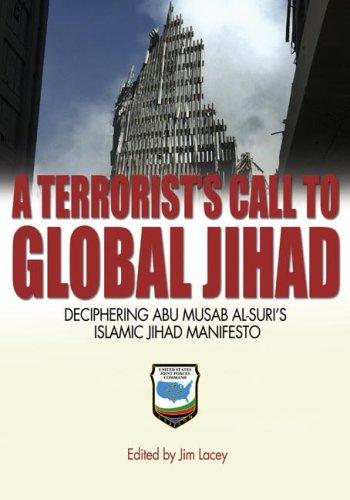
A Terrorist’s Call to Global Jihad: Deciphering Abu Musab al-Suri’s Islamic Jihad Manifesto by Jim Lacey (Ed.)
Previously, I read and reviewed Brynjar Lia’s Architect of Global Jihad, about Islamist terrorist and strategist Abu Musab al-Suri. A sometime collaborator with Osama bin Laden and the AQ inner circle, a trainer of terrorists in military tactics in Afghanistan and an advocate of jihadi IO, al-Suri was one of the few minds produced by the radical Islamist movement who thought and wrote about conflict with the West on a strategic level. Before falling into the hands of Pakistani security and eventually, Syria, where al-Suri was wanted by the Assad regime, al-Suri produced a massive 1600 page tome on conducting a terror insurgency, The Global Islamic Resistance Call, which al-Suri released on to the jihadi darknet.
Jim Lacey has produced an English digest version of al-Suri’s influential magnum opus comprising approximately 10 % of the original Arabic version, by focusing on the tactical and strategic subjects and excising the rhetorical/ritualistic redundancies common to Islamist discourse and the interminable theological disputation. There are advantages and disadvantages to this approach.
First, Lacey has produced a concise and readable book from a large mass of sometimes convoluted and repetitive theorizing that al-Suri strung together piecemeal, sometimes on the run or in hiding. For those interested in getting to the heart of al-Suri’s nizam la tanzim strategic philosophy, A Terrorist’s Call to Global Jihad is an invaluable resource for strategists, counter-terrorism specialists, tactical operators, law enforcement and laymen. Secondly, it is also a useful reference for policy people to see through al-Suri’s eyes the internal political and philosophical divisions within the radical jihadi community. al-Suri himself writes very ambivalently about 9/11 as a great blow against America and yet a complete calamity in it’s effects for the “jihadi current” that destroyed everything the Islamist revolutionaries had so painstakingly built, including the Taliban Emirate. Thus a climate was created by the American counter-attack where old methods of struggle were no longer useful and jihadis must adopt radically decentralized operations ( what John Robb terms Open-Source Warfare; indeed it is clear to an informed reader that al-Suri, a wide-ranging intellectual rather than a narrow religious ideologue, was influenced by Western literature on asymmetric warfare, 4GW, Three Block War and COIN).
The drawback to this approach is more for scholars looking at the deeper psychological and ideological drivers of jihadi policies, strategy and movement politics. The religious questions and obscure Quranic justifications cited by Islamist extremists that are so tedious and repetitive to the Western mind are to the jihadis themselves, of paramount importance in establishing both the credentials of the person making an argument but also the moral certainty of the course of action proposed. al-Suri himself had some exasperation with the degree to which primarily armchair ideologues, by virtue of clever religious rhetoric, could have more influence over the operational decisions of fighting jihadis than men with field experience like himself. By removing these citations, an important piece of the puzzle is missing.
The Musab al-Suri whose voice appears in A Terrorist’s Call to Global Jihad is consistent with the one seen in Lia’s book, dry, sardonic, coldly hateful toward the West and highly critical of the jihadis own mistakes, laden with overtones of pessimism and gloom. al-Suri did not envision a quick victory over the West and wrote his manifesto as a legacy for future generations of Islamist radicals because the current one was nearly spent after the American onslaught and poorly educated in comparison with predecessors like the generation of Sayid Qutb.
Strongly recommended.
The Networks of Nations
Wednesday, December 28th, 2011Military theorist John Arqilla offers a provocative piece in Foreign Policy:
….How the new pattern will unfold is still unclear, but just as the first nation-states were often tempted to become empires, there may be a pattern in which nations and networks somehow seek to fuse rather than fight. Iran, in its relations with Hezbollah, provides perhaps the best example of a nation embracing and nurturing a network. So much so that, in parsing the 2006 Lebanon war between Israel and Hezbollah, most of the world — and most Israelis — counted it as a win for the network. China, too, has shown a skill and a proclivity for involving itself with networks, whether of hackers, high-sea pirates, or operatives who flow along the many tendrils of the Asian triads’ criminal enterprises. The attraction may be mutual, as nations may feel more empowered with networks in their arsenals and networks may be far more vibrant and resilient when backed by a nation. All this sets the stage for a world that may have 10 al Qaedas operating 10 years from now — many of them in dark alliances with nations — a sure sign that the Cold War–era arms race has given way to a new “organizational race” to build or align with networks.
Can’t say that I disagree with that in big picture terms. Looking long term to 2100, I wrote in Threats in the Age of Obama that the geopolitical position of nation-states would undergo a transformation:
….Nation-states in the 21st century will face a complex international ecosystem of players rather than just the society of states envisioned by traditional Realpolitik. If the predictions offered by serious thinkers such as Ray Kurzweill, Fred Ikle or John Robb prove true, then technological breakthroughs will ensure the emergence of “Superempowered Individuals”[1] on a sizable scale in the near future. At that moment, the reliance of the State
on its’ punitive powers as a weapon of first resort comes to an end. Superemepowered individuals, separatist groups, insurgents and an “opting-out” citizenry will nibble recalcitrant and unpopular states to death, hollowing them out and transferring their allegiance elsewhere.While successful states will retain punitive powers, their primary focus will become attracting followers and clients in whom they can generate intense or at least dependable, loyalty and leverage as a networked system to pursue national interests. This represents a shift from worldview of enforcement to one of empowerment, coordination and collaboration. States will be forced to narrow their scope of activity from trying to supervise everything to flexibly providing or facilitating core services, platforms, rule-sets and opportunities – critical public goods – that the private sector or social groups cannot easily replicate or replace. Outside of a vital core of activity, the state becomes an arbiter among the lesser, interdependent, quasi-autonomous, powers to which it is connected.
States and their oligarchic elites seem to be attempting to counter this trend of eroding omnipotence by increasing omniscience by building panopticon societiesof 24 hour surveillence. Rulers will (theoretically) have the awareness to strike first and break up opposition movements or dissent before they can crystallize and gain the critical mass to overthrow a regime or accumulate enough countervailing power to force concessions or honest negotiation in place of stage-managed, political kabuki theater
Ruminating on Strategic Thinking
Wednesday, December 21st, 2011
“Let the Wookiee win….”
Warning! Thinking out loud in progress…..
Strategy is often described as the alignment of “Ends-Ways-Means” and “planning” to achieve important goals and several other useful definitions related to matters of war, statecraft and business. That great strategists have come in many forms, not just between fields but demonstrating tremendous variance within them – ex. George Marshall vs. Alexander the Great vs. Carl von Clausewitz – indicates that strategic thinking is a complex activity in terms of cognition.
What are some of the mental actions that compose “strategic thinking” or “making strategy”? A few ideas:
- Recognition of important variables
- Assessment of the nature of each variable
- Assessment of the relative importance of each variable
- Assessment of the relationships among the variables
- Assessment of the relationship between the variables and their strategic environment
- Assessment of current “trajectory” or trend lines of variables
- Assessment of costs to effect a change in the position or nature of each variable
- Assessment of the strengths and weaknesses of the variables as a functioning system
- Recognition of systemic “choke points”, “tipping points” and feedback loops.
- Probabilistic estimation
- Logical reasoning
- Introspection
- Extrapolation
- Simplification
- Metacognition
- Horizontal Thinking
- Insight
- Imagination (esp. at “grand strategic” level)
- Logistical estimation of costs
- Normative evaluation of potential benefits
- Understanding of temporal constraints
- Recognition of opportunity costs
- Recognition of boundary conditions
- Recognition of physical constraints of strategic environment (terrain, weather, distance etc.)
- Recognition of patterns in the history of the strategic environment
- Net assessment of the maximum capabilities of a political community (first ours, then theirs)
- Understanding of organizational structure of a political community
- Recognition of stakeholders in the political community
- Understanding of decision making process of the political community
- Understanding the power relationships of the decision making process of the political community
- Understanding the distribution of resources within the political community
- Recognition of the touchstone points of the cultural identity of the political community (positive and negative) and worldview
- Assessment of morale of the political community and the community’s moral code
- Assessment of psychology of individual adversary decision makers
- Identification of points of comparative advantage
- Recognition of how different bilateral outcomes/shifts will affect third parties
- Assessment of relationship between the adversaries and between them and third parties
This list is not comprehensive. In fact, I have a question for the readership, particularly those with military service and/or a good grasp of military history:
Where do the interpersonal skills or “emotional intelligence” abilities that comprise the activity we term “leadership” fit into strategic thinking? Or is it a separate but complementary suite of talents? We often assume that great strategists are the great leaders, but we tend to forget all of the generals who were popular yet mediocre in the field and gloss over the human faults of those who won great glory.
I have some ideas but I would like to hear yours. Or any additional suggestions or comments you would care to make.
Maxwell on North Korea
Tuesday, December 20th, 2011
Fatboy Kim II
(Photo hat tip to Robert Young Pelton)
Colonel Dave Maxwell, now retired from active duty and working at Georgetown University as Associate Director of the Center for Peace and Security Studies and the Security Studies Program in the School of Foreign Service, is an expert on the esoteric subject of North Korea ( which he habitually writes as “north Korea”) and the idiosyncratic dynastic Communist system he terms “the Kim Family regime”. In the past few years, I can say my knowledge of the DPRK has improved markedly largely from reading Dave’s posts on The Warlord Loop.
SWJ Blog has just published an analysis by Colonel Maxwell on what the demise of Kim Jong-il portends:
The Death of a Dictator: Danger, Opportunity or Best Timing Possible?
….There are two scenarios that are likely to play out within North Korea. The first scenario depends on the strength and power of Jang Song-taek who, along with his wife and the late Kim Jong-il’s sister, is the de facto “regent” for the young Kim Jong-un. Has he been able to help Kim Jong-un establish sufficient legitimacy within the Regime and will they be able to consolidate power? It is very likely that if Kim has sufficient strength and control of the
security apparatus there are very likely arrests and purges taking place even as we try to figure out what is happening.The second scenario is that he has not been able to consolidate sufficient power and will be
faced with internal threats from other senior members of the regime who are unwilling to allow a 27 year old four star general rule the party and the military. If there is a power struggle many scenarios can play out ranging from internal chaos, civil war, and “implosion” to an external “explosion” – e.g., spillover of the effects of chaos and civil war into China and the ROK or the worst case: the desperate execution of the regime’s campaign plan to reunify the peninsula as the only means left to ensure survival of the Kim Family Regime. Finally, regime collapse will occur when there is the loss of the ability of the regime to centrally govern and the loss of control and support of the military and security apparatus. We have seen cracks in the system like hairline cracks in a dam. The recently reported alleged defection of eight armed guards is but one indication of such cracks with water slowly dripping from through the regime’s dam – the question is are those cracks repairable or will they cause the dam to crumble and collapse; unleashing such a torrent on the peninsula that will make 1950-53 look like a minor skirmish in terms of scale of potential conflict and devastation.Either scenario will ensure the continued suffering of 23 million north Korean people and the second scenario will expand the tragedy to the Republic of Korea and its 46 million citizens and significantly affect the other countries in Northeast Asia as well as have global effects…..
Read the rest here.


