zenpundit.com » anthropology

Archive for the ‘anthropology’ Category

Follow-up: Martyrdom, messianism and Julian Assange

Friday, December 24th, 2010

[ by Charles Cameron ]

This is a follow-up to my earlier post on Zenpundit and ChicagoBoyz, picking up on some comments made on both sites, explaining my own interests, and taking the inquiry a little further.

On Zenpundit, Larry said, “Your need to destroy Assange is getting embarrassing. Why not make lemonaid?” and JN Kish, “The real story here should be about the data – and who is helping Assange – not Assange himself.” Meanwhile on ChicagoBoyz, a certain Gerald Attrick commented, “Ah, but as we say in in art crit: Deal with the Art and not the Man…”

To Larry I would say, I think that my post WikiLeaks: Counterpoint at the State Department? — in which I point up the irony inherent in the same State Department spokesman celebrating World Press Freedom Day and chiding Assange for “providing a targeting list to a group like al-Qaida” on the same day — could as easily be read as pro-Assange as today’s post, Martyrdom, messianism and Julian Assange can be read as calling for his destruction.

More generally, it seems to me that there are a whole lot of stories to be told here: the ones I wish to tell are those where I have a reasonably informed “nose” for relevant detail, and which tend to be overlooked by others — and thus have the potential to blindside us.

*

My own main interest is in tracking religious, mythic and apocalyptic themes in contemporary affairs, where they are all too easily overlooked, misunderstood or dismissed. Thus I have posted on Tracking the Mahdi on WikiLeaks, and added related material in section 1 of my post today.

I am also interested in concept mapping, games and creative thinking — interests which led me to post WikiLeaks: Critical Foreign Dependencies and The WikiLeaks paradox, and more lightheartedly to take an amused sideways glance at WikiLeaks in The power of network visualization.

And I certainly find Assange himself an interesting figure, and have done what I can to illuminate his background in mythology, religion and games in Wikileaks and the Search for a Cryptographic Mythology, again in Update: Wikileaks and Cryptographic Mythology and (again light-heartedly) in A DoubleQuote for Anders.

*

Let me be more explicit: I have no wish to lionize Assange, nor to feed him to the lions — I would like to understand him a little better.

I come from a scholarly tradition that doesn’t favor the demonization of new religious movements, and believes (for instance) that it is entirely plausible that the Waco inferno could have been avoided if the religious beliefs of David Koresh and the Branch Davidians had been taken seriously as such, and not dismissed out of hand as “bible babble”.

James Tabor and Eugene Gallagher in Why Waco for instance, write:

The Waco situation could have been handled differently and possibly resolved peacefully. This is not unfounded speculation or wishful thinking. It is the considered opinion of the lawyers who spent the most time with the Davidians during the siege and of various scholars of religion who understand biblical apocalyptic belief systems such as that of the Branch Davidians. There was a way to communicate with these biblically oriented people, but it had nothing to do with hostage rescue or counterterrorist tactics. Indeed, such a strategy was being pursued, with FBI cooperation, by Phillip Arnold of the Reunion Institute in Houston and James Tabor of the University of North Carolina at Charlotte, one of the authors of this book. Arnold and Tabor worked in concert with the lawyers Dick DeGuerin and Jack Zimmerman, who spent a total of twenty hours inside the Mount Carmel center between March 29 and April 4, communicating directly with Koresh and his main spokesperson, Steve Schneider. Unfortunately, these attempts came too late. By the time they began to bear positive results, decisions had already been made in Washington to convince Attorney General Janet Reno to end the siege by force.

Jane Seminaire Docherty’s Learning Lessons from Waco, similarly, “offers a fresh perspective on the activities of law enforcement agents. She shows how the Waco conflict resulted from a collision of two distinct worldviews-the FBI’s and the Davidians’—and their divergent notions of reality. By exploring the failures of the negotiations, she also urges a better understanding of encounters between rising religious movements and dominant social institutions.” [Syracuse UP]

I’d therefore be hesitant to drag Assange into a somewhat murky association with the “cult milieu” – but Assange himself was quite open in talking with Raffi Khatchadourian of the New Yorker about the man his mother lived with and had a child by, then ran away from, after her marriage to Assange’s father broke up. Khatchadourian writes:

When I asked him about the experience, he told me that there was evidence that the man belonged to a powerful cult called the Family—its motto was “Unseen, Unknown, and Unheard.” Some members were doctors who persuaded mothers to give up their newborn children to the cult’s leader, Anne Hamilton-Byrne. The cult had moles in government, Assange suspected, who provided the musician with leads on Claire’s whereabouts.

Wikipedia’ has an account of that group, also known as the Santiniketan Park Association.

And as you might expect, there’s a bizarre and frankly conspiracist take on this connection already out and about on the web.

*

For a more detailed and indeed harrowing view of the Santiniketan Park Association from a member who left, see this excerpt from Sarah Moore’s book, Unseen, Unheard, Unknown.

A couple of odd remarks here strike me:

Some of us had multiple birth certificates and passports, and citizenship of more than one country. Only she knows why thus was and why we were also all dressed alike, why most of us even had our hair dyed identically blond.

The motto of the sect is ‘Unseen, Unheard and Unknown’, and even now the thought of the consequences of betraying that motto still worries me sometimes.

We weren’t often allowed to see newspapers, in fact that happened only after we were quite a bit older and even then they’d been censored .

and:

Looking back, I can see that any game or hobby that we started we would get hooked on, playing it over and over again in our limited spare time. If we got into a game or fantasy we tended to want to keep on with it and it assumed the utmost importance in our lives.

It might have appeared that we were obsessive kids but it was understandable considering the malevolent reality we faced outside our games. Usually Anne and the Aunties saw to it that as soon as we started enjoying ourselves, it was stopped, and a new rule would be made, forbidding us from playing that particular game. We would thus be forced to try and make up a new one within the boundaries of the rules that governed our lives, still knowing that eventually this new one would be banned also.

*

Speaking of “cults” – there are several WL cables that make reference to a cult or cults, generally in the context of a “cult of personality” (Mao, eg), and in one case with reference to Scientology. There’s also – and this where things get interesting from my POV — one intriguing reference to a cult in Iran:

Though stressing that he is not an opponent of the Islamic system, he warned that the Revolutionary Guard-based faction which “stole the election,” and is now seeking total control is “extremely dangerous to both us and you.” He repeatedly characterized this group as “a criminal cult,” motivated by its fanaticism, ignorance, and the monetary self-interest of its members. He added that the group is intent on exporting revolution. According to source, both Ahmedinejad and Ayatollah Mesbah-Yazdi are affiliates rather than “leaders” of this group, and neither will likely end up with significant power if the group successfully consolidates control over the state and its economy (see reftel).

A religious group of which “both Ahmedinejad and Ayatollah Mesbah-Yazdi are affiliates” sounds suspiciously like the Hojjatiyeh.

But that’s the topic for another upcoming post, I promise.

Martyrdom, messianism and Julian Assange

Thursday, December 23rd, 2010

[ by Charles Cameron ]

Martyr and messiah are two of the more intense “roles” in the religious vocabulary, and unlike mystics and saints, both martyrs and messiahs tend to have an impact, not just within their own religious circles but in the wider context of the times.

Martyr and messiah are also words that can be bandied about fairly loosely — so a simple word-search on “messiah” will reveal references to a third-person platform game with some gunplay and the white messiah fable in Avatar, while a search on “martyr” might tell you how to become a martyr for affiliate networks, just as a search on “crusade” will turn up crusades for justice or mental health – my search today even pointed me to a crusade for cloth diapers.

1. Martyrdom and messianism in WikiLeaks

Unsurprisingly, perhaps, both terms crop up occasionally in WikiLeaks, with the Government of Iraq, for instance, banning use of the word “martyr” for soldiers who died in the war with Iran, and US diplomats wiring home a report by an opposition psychiatrist to the effect that “Morally, Chavez [of Venezuela] combines a sense of tragedy and romanticism (a desire for an idyllic world) to project a messianic image.” Indeed, the whole paragraph is choc-a-bloc with that kind of imagery, and worth quoting in full:

Ideologically, Chavez wants to project an image of a “utopian socialist,” which de Vries described as someone who is revolutionary, collectivist, and dogmatic. In reality, de Vries argues, Chavez is an absolute pragmatist when it comes to maintaining power, which makes him a conservative. Coupled with Chavez’ self-love (narcissism), sense of destiny, and obsession with Venezuelan symbolism, this pragmatism makes Chavez look more like fascist, however, rather than a socialist. Morally, Chavez combines a sense of tragedy and romanticism (a desire for an idyllic world) to project a messianic image. De Vries, however, said Chavez is a realist who uses morals and ethics to fit the situation.

PM Netanyahu of Israel was using the term “messianic” with a little more precision when he described the Iranian regime as “crazy, retrograde, and fanatical, with a Messianic desire to speed up a violent ‘end of days.'”

2. Julian Assange in the role of martyr

The words martyr and messiah, then, carry a symbolic freight that is at the very least comparable to that of flags and scriptures – so it is interesting that both terms crop up in the recent BBC interview with Julian Assange.

My reading of the interview suggests that it is Assange himself who introduces the meme of martyrdom, though not the word itself, when he answers a question about the impact of the sexual accusations against him, “What impact so you think that will have on your organisation and what sort of figure do you think you, Julian Assange, cut in the face of all this. How will you be regarded? What will it do to you?” with the response, “I think it will be quite helpful for our organisation.”

In the follow up, interviewer John Humphrys twice uses the word “martyr” explicitly:

Q: Really? You see yourself as a martyr then?

JA: I think it will focus an incredible attention on the details of this case and then when the details of this case come out and people look to see what the actions are compared to the reality of the facts, other than that, it will expose a tremendous abuse of power. And that will, in fact, be helpful to this organisation. And, in fact, the extra focus that has occurred over the last two weeks has been very helpful to this organisation.

and:

Q: Just to answer that question then. You think this will be good for you and good for Wikileaks?

JA: I’ve had to suffer and we’ve had incredible disruptions.

Q: You do see yourself as a martyr here.

JA: Well, you know, in a very beneficial position, if you can be martyred without dying. And we’ve had a little bit of that over the past ten days. And if this case goes on, we will have more.

3. Julian Assange in the role of messiah

If the role of martyr implies, at mimimum, that one suffers for a cause, that of messiah implies that one leads it in a profound transformation of the world. Both terms are now found in association with the word “complex” – which applies whenever a individual views himself or herself as a martyr or messiah – but a “messianic complex” is presumably more worrisome than a “martyr complex” if only for the reason that there are many more martyrs than messiahs, many more willing to suffer for a cause than to lead it.

It is accordingly worth noting that it is the interviewer, John Humphrys, who introduces both the word “messianic” and the concept of a “messianic figure” into the interview, although Assange makes no effort to wave it away…

Q: Just a final thought. Do you see yourself… as some sort of messianic figure?

JA: Everyone would like to be a messianic figure without dying. We bringing some important change about what is perceived to be rights of people who expose abuses by powerful corporations and then to resist censorship attacks after the event. We are also changing the perception of the west.

Q: I’m talking about you personally.

JA: I’m always so focussed on my work, I don’t have time to think about how I perceive myself… I had time to perceive myself a bit more in solitary confinement. I was perfectly happy with myself. I wondered what that process would do. Would I think “my goodness, how have I got into this mess, is it all just too hard?”

The world is a very ungrateful place, why should I continue to suffer simply to try and do some good in the world. If the world is so viciously against it ,why don’t I just go off and do some mathematics or write some books? But no, actually, I felt quite at peace.

Q: You want to change the world?

JA: Absolutely. The world has a lot of problems and they need to be reformed. And we only live once. Every person who has some ability to do something about it, if they are a person of good character, has the duty to try and fix the problems in the environment which they’re in.

That is a value, that, yes, comes partly from my temperament. There is also a value that comes from my father, which is that capable, generous men don’t create victims, they try and save people from becoming victims. That is what they are tasked to do. If they do not do that they are not worthy of respect or they are not capable.

4. Julian Assange, martyr and messiah?

I think it is clear that both Assange and his interviewer are in effect reframing the religious terms “martyr” and “messiah” in non-religious, basically psychological senses — although I don’t suppose Assange is exactly claiming to have the two “complexes” I mentioned above.

Here’s what’s curious about this reframing, from a religious studies point of view:

Assange’s implicit acceptance of a “messianic” role undercuts the specific force of the role of “martyr” – one who gives his life for the cause. “Everyone” he says, “would like to be a messianic figure without dying.” Assange wouldn’t exactly object to being a martyr without dying, too.

A brief fugue on the graphics of coexistence

Saturday, December 4th, 2010

by Charles Cameron
[ cross-posted from ChicagoBoyz ]

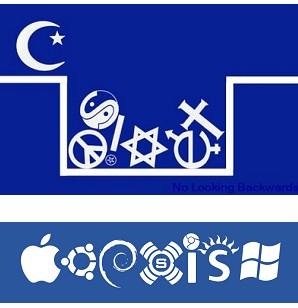
A great many people will have seen (or designed) some variant of the “coexist” bumper-sticker / tee-shirt design:

Coexist

— the first of which can be found on acsapple‘s photobucket — and hey, the “aum” sign for “oe” is a brilliant bit of graphic substitution! – while I nabbed the second here.

What with a thousand flowers blooming, the importance of preserving memetic variations, peaceful coexistence and all, it’s only natural that some will have different takes on the matter —

coexist variants

— the first of these comes from the blog of a gun-toting political refugee from the People’s Progressive Republic of Massachusetts, while the second is a tee-shirt design by Matt Lussier, and you can get your tee-shirt here

*

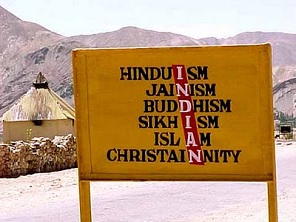
As for myself, I have fond memories of India, and was accordingly heartened to see this on an Indian Muslim site

india calling-religious unity

which is what set me thinking about “coexistence” graphics in the first place.

*

Did I ever tell you about the sign I saw over a shop in Delhi, advertising the sale of mythelated spirits?

I frequently feel just a tad mythelated myself.

What the Dickens? Symbolic details in Inspire issue 3

Sunday, November 21st, 2010

by Charles Cameron
.
It’s easily missed. It’s part of the “small print” that most small-format paperbacks carry on the copyright page:

The sale of this book without its cover is unauthorized. If you purchased this book without a cover, you should be aware that it was reported to the publisher as “unsold and destroyed.” Neither the author nor the publisher has received payment for the sale of this “stripped book.”

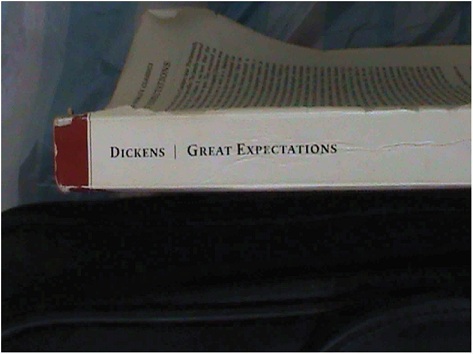
Here’s the picture that AQAP took of the copy of Dickens’ novel Great Expectations they inserted into one of their bombs recently – which they then published in issue 3 of their English language magazine Inspire:

Dickens

And here’s the explanation that accompanies that photo, in a piece titled “The Objectives if Operation Hemorrhage” by their “Head of the Foreign Operations Team”:

This current battle fought by the West is not an isolated battle but is a continuation of a long history of aggression by the West against the Muslim world. In order to revive and bring back this history we listed the names of Reynald Krak and Diego Diaz as the recipients of the packages. We got the former name from Reynald de Chatillon, the lord of Krak des Chevaliers who was one of the worst and most treacherous of the Crusade’s leaders. He fell into captivity and Salahuddeen personally beheaded him. The name we used for the second package was derived from that of Don Diego Deza, the Inquisitor General of the Spanish Inquisition after the fall of Granada who along with the Spanish monarchy supervised the extermination and expulsion of the Muslim presence on the Iberian Peninsula employing the most horrific methods of torture and done in the name of God and the Church. Today we are facing a coalition of Crusaders and Zionists and we in al Qaeda of the Arabian Peninsula will never forget Palestine. How can we forget it when our motto is: “Here we start and in al-Aqsa we meet”? So we listed the address of the “Congregation Or Chadash”, a Gay and Lesbian synagogue on our one of our packages. The second package was sent to “Congregation B’nai Zion”. Both synagogues are in Chicago, Obama’s city.
.
We were very optimistic about the outcome of this operation. That is why we dropped into one of the boxes a novel titled, Great Expectations.

They may not have read the book or seen the movie, as Ibn Siqilli comments at the link above, but they do have long memories and/or a taste for history, and they are indeed sending signals with small details like the fictitious names of their addressees.

*

This is in line with one of the basic premises of Islamic thought: that the world we inhabit is a world of ayat or symbols (the singular is ayah, and the word is also used to refer to the verses of the Qur’an, each of which is viewed as a symbolic utterance). Here, for instance, is a passage from Fazlun Khalid’s paper, Islam and the Environment, from the website of Jordan’s Royal Aal al-Bayt Institute for Islamic Thought:

The Qur’an refers to creation or the natural world as the signs (ayat) of Allah, the Creator, and this is also the name given to the verses contained in the Qur’an. Ayat means signs, symbols or proofs of the divine. As the Qur’an is proof of Allah so likewise is His creation. The Qur’an also speaks of signs within the self and as Nasr explains, “… when Muslim sages referred to the cosmic or ontological Qur’an … they saw upon the face of every creature letters and words from the cosmic Qur’an … they remained fully aware of the fact that the Qur’an refers to phenomena of nature and events within the soul of man as ayat … for them forms of nature were literally ayat Allah”. As the Qur’an says, “there are certainly signs (ayat) in the earth for people with certainty; and in yourselves. Do you not then see?” (Adh-Dhariat, 51:20, 21).

*

BTW, I don’t think Penguin (or, for that matter, Charles Dickens) got paid for that book… whatever their expectations may have been.

Al-Awlaki has a Phineas moment

Wednesday, November 10th, 2010

Posted by Charles Cameron

Here’s a meme worth noting when it crops up in the advocacy of religious violence:

You don’t need permission from a religious authority…

1

This particular idea came up in the video of Anwar al-Awlaki that was released yesterday, Nov. 8th.

Flashpoint Partners translated the comment in question, “do not consult anyone in killing the Americans. Fighting Satan does not require a jurisprudence. It does not require consulting. It does not need a prayer for the cause. They are the party of Satan … It is the battle between truth and falsehood.”

The AFP translation of the key phrase here reads, “Killing the devil does not need any fatwa (legal ruling).”

2

My interest was piqued because of the correspondence between this comment from al-Awlaki, and the case of Phineas in the biblical Book of Numbers, chapter 25.

Phineas is “the son of Eleazar, the son of Aaron the priest” – but when he recognizes that the Lord would be infuriated by the interracial and interreligious copulation of Zimri, “a prince of a chief house” in Israel, with Cozbi, the daughter of the “head over a people, and of a chief house in Midian”, he does not go to the priest his grandfather seeking permission to kill them – he knows it is his Lord’s wish that they should die, and so he takes the responsibility for his action entirely upon himself, and kills them.

3

As I shall recount in greater detail in two future posts on the topic of Phineas, it is the fact that Phineas acts without first requesting permission that pleases his Lord so much that He grants to Phineas and his seed “the covenant of an everlasting priesthood”.

It is precisely this acting without requesting permission that is emphasized in modern Christian Identity writings on the topic of “Phineas Priests”:

So a Phinehas priest is a MAN who acts on personal initiative to execute Yah’s judgment on violations of Yah’s laws which are adversely affecting His people.

And according to Ehud Sprinzak, the eminent scholar of modern Jewish terrorism, it was reading the “Balak portion” of the book of Numbers, in which the story of Phineas is recounted, that convinced Yigal Amir that he could legitimately assassinate Yitzhak Rabin without first obtaining rabbinic approval (which would have put the rabbi who granted him permission at risk).

4

So. We have one more piece of the puzzle by which a mind with its own interpretation of God’s will can come to the conclusion that some specific act or acts of violence – accurately termed “terrorism” by others – are not only divinely sanctioned, and indeed mandatory, but can be undertaken without the requirement of prior verification from an appropriate religious authority.

And in this case — the religious authority, such as it is, of Sheikh al-Awlaki proposes this.

5

Aaron Zelin‘s post on the Qur’anic text invoked by al-Awlaki’s title and the commentaries on that verse by ibn Kathir and others, is well worth your time, if you have not already seen it.


Switch to our mobile site