zenpundit.com » COIN

Archive for the ‘COIN’ Category

Visualizing Strategy

Saturday, September 25th, 2010

warstrategy2.jpg

Is it right? Horribly wrong? Missing variables?

Fire away in comments.

ADDENDUM:

Joseph Fouche offers up his graph of schools of strategy at The Committee of Public Safety. Note that unlike me, he has placed them in terms of “Influence…..Coercion…Violence”:

Dr. Chet Richards, in his turn, kindly drew my attention back to graph he created -if memory serves – around the time he wrote Neither Shall the Sword, but I am still trying to figure out how to convert the file to something I can post here. Until I do, go to slide 89 in the link below:
4GW and Grand Strategy

Summer Series 2010: WAR by Sebastian Junger

Wednesday, September 8th, 2010

Summer Series 2010: Reviewing the Books! has begun. This review was originally posted in June, 2010 and is being re-posted as part of Summer Series:

WAR by Sebastian Junger

I just finished reading my courtesy review copy of WAR by journalist and author Sebastian Junger, on his firsthand observation of the war against the Taliban in the Korengal Valley, waged by the soldiers of the 2nd Platoon of Battle Company. I cannot say that I found WAR to be an enjoyable read – though Junger is a polished writer – a more accurate description is that WAR is powerful, thought-provoking, at times moving and, ultimately, a very disturbing account of the war in Afghanistan.

Junger, whose previous works include The Perfect Storm: A True Story of Men Against the Sea and Fire, was embedded along with photojournalist Tim Hetherington, with 2nd Platoon during their COIN campaign in Korengal, a mission that resulted in some of the bloodiest firefights and highest American casualties of the Afghan war and withdrawal from a rugged valley sometimes known as “Afghanistan’s Afghanistan”. The Korengalis, related to the people of Nuristan, are noted for their xenophobic hostility to outsiders, which was directed at times toward the Taliban as well as Americans. Junger reports that the US only succeeded in controling a quarter of Korengal and contesting roughly half of the six mile by six mile valley with the Taliban and local “accidental guerrillas”motivated by money, excitement, religious zeal or revenge to attack the Americans.

WAR is not an especially “political” or “policy” book discussing the war from some remove. Junger’s primary interest are the men of second platoon at Restrepo, an outpost dedicated to the memory of a valorous medic who had been killed. O’Byrne, Anderson, Stitcher (who has “INFIDEL” tattooed across his chest), Jones, Moreno, Bobby to name just a few soldiers Junger interviewed and witnessed how they lived in the moment. That moment could comprise the adrenaline high of combat, agonies of grief, anticipatory tension before the next ambush, the angst of boredome behind the wire and especially the iron bonds of brotherhood in a small unit tempered by fire.

What comes through in War, aside from the extremity of the terrain and the uncertainty of ever-present danger, men being shot without warning by the enemy, even in Restrepo, is how very few men are actually involved in combat. Battle Company is the vaunted “tip of the spear” but when only a few hundred men were taking a wildly disproportionate percentage of all combat contacts in a nation the size of Afghanistan ( Junger cites 20 %) the spear begins to look more like a tiny sewing needle connected to a Leviathan-like noncombatant-administrative tail, surreally outfitted with fast food courts.

There’s a peculairly granular quality to Junger’s WAR, the grittiness of the squalid conditions in which soldiers live, the depths of their physical sufferings and mental exhaustion, their primal fear of letting their comrades down in battle and being responsible for getting friends killed. There are also epiphanies of bravery and carrying the day against the odds, men living who but for chance would have died on some rock strewn hill and lusty celebration after the deaths of their enemies. The sort of politically incorrect, atavistic, jubilation that is culturally frowned upon by people who are comfortably safe and far away.

What disturbed me most about WAR was not just how few Americans are carrying the burden of the combat in Afghanistan but how disconnected these few soldiers and their sacrifices are from the rest of the military itself. Junger’s epilogue with O’Byrne, a fine soldier who is a major figure in the book, and his inability to readjust and shift from the battlefield to garrison or civilian life is deeply depressing. “The Army’s trying to kill me” O’Byrne declared, finding a momentary refuge in alcohol, but little help from the military bureaucracy.

Junger attempted to show the war in Korengal as seen from the perspective of the privates, NCO’s and junior officers of Battle Company who lived and died there, from his interviews and his own participation in their patrols as they came under fire or as they gingerly parleyed with Korengali elders in isolated villages. Eschewing theory or a historian’s search for causation, Junger attempts to let the soldiers words and actions drive the narrative.

Sebastian Junger’s WAR is raw and undecorated by sentiment.

Reminder: Chicago Boyz Roundtable – Defeat in Afghanistan? The View from 2050

Thursday, August 5th, 2010


From Lexington Green:

Defeat in Afghanistan? The View from 2050

As previously announced, ChicagoBoyz will be hosting a roundtable discussion of the American campaign in Afghanistan, looking back from a forty year distance, from 2050.

In the few weeks since the initial post went up, we have had several dramatic events occur: The end of Gen. McChrystal’s command, the rise of Gen. Petraeus for a historic second command of a very troubled war, the apparent abandonment of President Obama’s timetable, the appearance of the Wikileaks document trove … . These are major developments.

Yet, looking back at any historical events from a long enough distance, all the details get ironed flat, the granularity milled to smooth powder, the larger patterns emerge, while the roles of key individuals sometimes come into clearer focus.

But for now, we don’t know how this war is going to play out. We are doomed to live history marching backward, facing only the past, and not knowing what we will trip over next.

Imagining possible outcomes, and possible explanations for those outcomes, can help us understand what is happening now, and help to clarify what we should be doing.

Our Roundtable contributors will publish their posts and responses during the third and fourth weeks of August, 2010.

Some New Additions…..

Tuesday, August 3rd, 2010

To the ominously increasing antilibrary and the waning summer reading bookpiles:


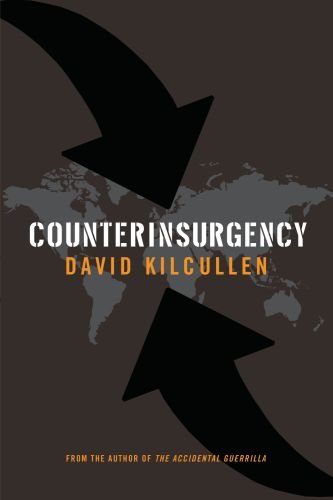
Counterinsurgency by David Kilcullen

The Grand Strategy of the Byzantine Empire by Edward Luttwak

Spook Country by William Gibson

Hope to start  a couple of these by the end of the month. A number of other books to be finished first.

I have a new decentralized reading strategy that seems to be helping me wad through books faster. Books that I am reading are distributed to be read in different places – one in my gym bag for the treadmill; one in my car in case there’s time to kill at an appointment or at a restaurant; one or two books downstairs to read on the couch or outside on the deck; one to take to the pool with the kids and four of five on my bedstand. There are also a store of books on my iPad, “just in case”.

The strategy allows me to concentrate on finishing several books – my “primary” reads – even as I steadily chip away at the rest and there are enough choices available to suit my mood on any given day so it doesn’t feel like I am doing a literary marathon. Books that I am focusing on, usually histories, strategic studies and social science works, I will mark up with marginalia and the others are just read without recourse to notation.

How do you handle your reading time?

Ucko on Counterinsurgency and its Discontents

Friday, July 23rd, 2010

At Kings of War, Dr. David Ucko has a must-read post on the kulturkampf of COIN (hat tip SWJ Blog):

Counterinsurgency and Its Discontents

….It might be interesting to trace how an idea so welcome less than four years ago has since fallen from grace. Was it the perceived confidence with which the concept was rolled out? Was it the perceived automacity of its widespread acceptance? Is it anger at the arguably simplistic explanation that counterinsurgency, and counterinsurgency alone, won the day in Iraq? Or is it due to a perception of counterinsurgency experts gaining power and prestige in DC by peddling a theory that is not working so well in Afghanistan?

I strongly suggest reading Ucko’s post in its entirety, but here are a few highlights:

Attempts to disaggregate theory and practice has in turn engendered the accusation that counterinsurgency is like Marxism, in that its supporters insist on the doctrine’s infallibility and claim it simply hasn’t been implemented properly. It is a powerful analogy: a concept that survives only on paper has very limited worth.

But counterinsurgency principles have shown practical value, not just in ‘counterinsurgency campaigns’, but also in other campaigns concerned with stabilisation, pacification, peacebuilding – call it what you want. This is not wholly surprising, as many of these principles are quite banal, even commonsensical:

Agree with Ucko here. If COIN’s promise has at times been oversold by its advocates, its critics have occasionally swung in the opposite direction, penning highly ideological jeremiads equating the American use of COIN in Afghanistan and Iraq with the history of 19th century  European colonialism, capitalist-imperialism a la Lenin and Hobson, as a Democratic trojan horse for GOP neoconservatism and as Ucko mentioned, even Soviet Communism. This is dressing up the less exciting valid criticisms that can be made about COIN, in theory and execution, with highly polemical nonsense typical of cable TV news shoutfests.

A powerful reason why counterinsurgency today is so unpopular is because its principles are looked upon as strategy in their own right. As should be clear, the principles and theory of counterinsurgency are only relevant as a means toward a strategic end, which itself may be more or less realistic: to help a country recover from protracted conflict; to bolster the legitimacy and reach of a government, etc. Even then, the theory is not a silver bullet but mere guidance – a collection of lessons learned – that may help in the design and implementation of an effective campaign plan, a plan that must, as counterinsurgency theory clearly stipulates, be adapted for specific environments.

Strong agreement. I have written much the same in the past as have many others. Hopefully, if it is repeated often enough the ongoing COIN debate can begin to generate more light and less heat.

But if counterinsurgency theory is just ‘useful guidance’ or ‘some ideas’, what good is it? I think our own Faceless Bureaucrat hit the nail on the head in a previous post: ‘I have suspected for a long time that COIN itself is merely the knee-jerk answer to a previous question, “Do kinetic/conventional/body-count campaigns work?”‘. I’m currently reading Keith L. Shimko‘s The Iraq Wars and America’s Military Revolution, which provides a bitter reminder of the muddy RMA-type thinking on war within the Pentagon as it invaded Iraq. The discovery of counterinsurgency as a body of theory and lessons was definitely a step forward, but today it is no longer the antithesis, but itself the thesis. Its function as a reaction to muddy thinking is still being served, but it is also being held up in its own right and subjected to critical scrutiny.

….So there is definitely a need for criticism, but the aim of such a debate should be to improve on rather than kill the scholarship. There seems to be a desire to resign the whole ‘counterinsurgency’ concept to the intellectual wastebasket, which risks sacrificing what the concept has provided: a useful starting point to understand and discuss armed conflict and political violence, issues that today need to be discussed, whether in terms of ‘counterinsurgency’ or not.

Some of this desire to “resign the whole counterinsurgency concept to the intellectual wastebasket” is actually an indirect political campaign for other things. Namely, a more isolationist/non-interventionist foreign policy and secondly, a Weinberger-Powell military posture where the US is geared up to fight the Soviet Union’s closest facsimile of the moment, is buying a half-dozen aircraft carriers and F-35’s by the hundreds and the military “doesn’t do windows” – i.e. the 95 % of security threats since the end of the Cold War. Well this is policy for a world COIN critics wished we inhabited and not the one in which we have to live.

I’m not excerpting Ucko’s conclusions, to better incentivize your reading them for yourself.

What I would add to Ucko’s list of the reasons COIN is currently under harsh scrutiny are the variables I sugggested in The Post-COIN Era is Here – economics and the tie-in to domestic politics. States like California, Illinois, Michigan, New York, New Jersey are in varying degrees of financial meltdown, as are some EU/NATO nation-states, which has brought belt-tightening back into vogue, whether it is coming from tea party rallies or pious lectures by the German Chancellor. Increased competition for scarcer dollars (or euros) is already impacting defense budgets which have to be weighed with other societal needs.  COIN, which is intensive in terms of both time and personnel, begins to look less attractive to politicians than does FID, CT, drone and cruise missile strikes or the huge contracts going to shipyards and defense companies which employ their constituents back home.

Islamist insurgency may be global but all politics remain local.


Switch to our mobile site