zenpundit.com » al qaida

Archive for the ‘al qaida’ Category

North Korea: the missing words

Wednesday, April 17th, 2013

[ by Charles Cameron — at times the missing pieces of a puzzle are right there in plain sight — might it be a good idea to notice them? — oh, and Carthage! ]
.

Carthage Ports Puniques, 1958, personal collection of Bertrand Bouret, via Wikimedia


I recently wrote about the failure of many translators of jihadist texts to include the specific Qur’anic citations on which they were based — something I noticed because I’m keenly interested in theologies, but which doesn’t seem to concern those who are trying to understand jihad. A week ago I saw a neat parallel from the world of political propaganda, as noted by Patrician Kushlis at Whirledview:

one of the experts at the conference in describing the unique characteristics of the North Korean propaganda barrage pointed out that the country’s threats always concluded with the phrase: “if the Americans attack.” But the speaker added that these four final words are not reported in the media or government statements we see in the West.

What is it with these people, that they keep on uttering phrases that can safely be ignored at the beginnings and endings of statements?

I mean, would anyone in Carthage have bothered to translate into Punic — the language the Carthaginians spoke — an utterance like the Elder Cato‘s repetitive and obviously phatic Carthago delenda est ?

Close reading, Synoptic- and Sembl-style, for parallels, patterns

Monday, March 25th, 2013

[ by Charles Cameron — if we omit all mention of the Qur’an, will the jihad perhaps disappear, you think? ]
.

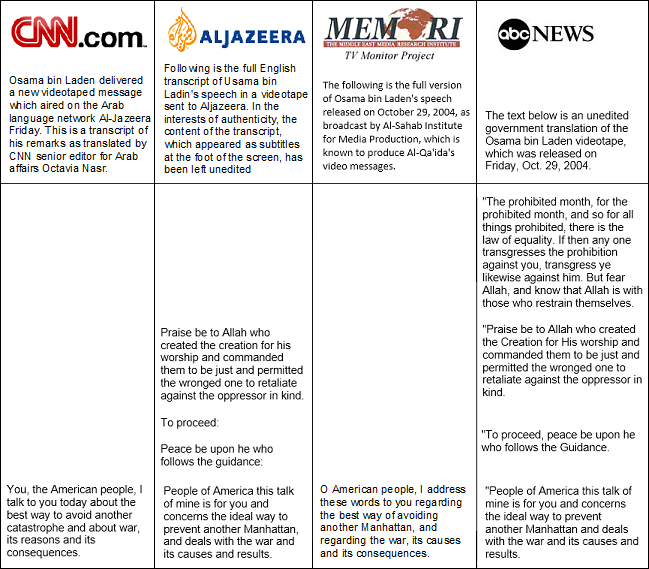
On Friday, Oct. 29, 2004, just before the 2004 US Presidential Election, a videotaped speech by Osama bin Laden was released online and variously reported:
.

.

Being a theologian at heart, I’ve formatted these versions in the style used in comparisons of the Synoptic Gospels, to give you an immediate sense of the differences I’ll be discussing…

**

Just how important was this particular speech by bin Laden?

It was important to bin Laden himself, as it was his first statement after his invitation to the US to convert to Islam. As I have noted before — quoting Michael Scheuer‘s Al-Qaeda’s Completed Warning Cycle – Ready to attack? — bin Laden had been criticized for failing to issue such an invitation:

After 9/11, bin Laden received sharp criticisms from Islamist scholars that dealt with the al-Qaeda chief’s failure to satisfy several religious requirements pertinent to waging war. The critique focused on three items: (1) insufficient warning; (2) failure to offer Americans a chance to convert to Islam; and (3) inadequate religious authorization to kill so many people. Bin Laden accepted these criticisms and in mid-2002 began a series of speeches and actions to remedy the shortcomings and satisfy his Islamist critics before again attacking in the United States.

MEMRI picks up the story here:

The Islamist website Al-Islah explains: “Some people ask ‘what’s new in this tape?’ [The answer is that] this tape is the second of its kind, after the previous tape of the Sheikh [Osama bin Laden], in which he offered a truce to the Europeans a few months ago, and it is a completion of this move, and it brings together the complementary elements of politics and religion, political savvy and force, the sword and justice. The Sheikh reminds the West in this tape of the great Islamic civilization and pure Islamic religion, and of Islamic justice…”

This video is also a significant “first” for bin Laden. In Raymond Ibrahim‘s words in his The Al Qaeda Reader:

This message also marks the first time bin Laden publicly acknowledged his role in the 9/11 strikes; previously he had insisted that he was merely an “inciter” and that it was the Muslim umma in general who had retaliated in defense of their faith.

It was important to the US because of the election four days later. The following exchange occurred on NBCNews’ Meet the Press, Jan 30th, 2005:

MR. RUSSERT: At the Clinton Library dedication on November 18, a few weeks after the election, you were quoted as saying, “It was the Osama bin Laden tape. It scared the voters,” the tape that appeared just a day before the election here. Do you believe that tape is the reason you lost the race?

SEN. KERRY: I believe that 9/11 was the central deciding issue in this race. And the tape–we were rising in the polls up until the last day when the tape appeared. We flat-lined the day the tape appeared and went down on Monday. I think it had an impact

The speech was important, in sum, both to bin Laden himself and to the US electorate: it deserves a close reading.

**

Sadly, however…

Posted, translated transcripts of Al Qaida and other jihadist materials often leave out the salutation and envoi (or other choice bits such as quotes from the Qur’an or Hadith) because they’re too religious or perhaps too Muslim — but when these same pieces of the puzzle are added back into the text, the whole document may cohere to a degree that is otherwise unapparent.

We tend not to “get” religious language. What do Daniel Benjamin and Steven Simon tell us in their book The Age of Sacred Terror?

So much of what was heard from al-Qaeda after the attacks sounded to Americans like gibberish that many chords of the apocalypse were missed.

Our prejudice against alien religious sentiment, or the assumption that it is ritualistic and hence irrelevant, or even worse, “babble” — the term FBI agents used to describe David Koresh‘s religious interpretation of events during the Waco siege — can blindside us to its very real discursive and exegetical power.

That’s the reason I’m offering you this post — years later — as a counter-example of the power of “Sembl thinking” — essentially, the power of pattern recognition as a key to understanding.

**

I read three versions of bin Laden’s videotaped speech of Oct. 29, 2004 at the time: those provided by CNN, MEMRI, and Al Jazeera — one “western secular” source, one with some degree of Israeli association, and one with roots in the Arabic cultures.

CNN cited al-Jazeera as having aired the video, and posted “a transcript of his remarks as translated by CNN senior editor for Arab affairs Octavia Nasr” which, as you can see above or at the link, began, “You, the American people, I talk to you today… “ MEMRI offered The Full Version of Osama bin Laden’s Speech followed by a transcript which began, “O American people, I address these words to you…” And Al Jazeera posted “the full English transcript of Usama bin Ladin’s speech in a videotape sent to Aljazeera” and noted, “In the interests of authenticity, the content of the transcript, which appeared as subtitles at the foot of the screen, has been left unedited” – above a transcript that began:

Praise be to Allah who created the creation for his worship and commanded them to be just and permitted the wronged one to retaliate against the oppressor in kind. To proceed: Peace be upon he who follows the guidance: People of America this talk of mine is for you…

That in itself is interesting — Al-Jazeera has two sentences with religious significance, one of them saying that God “permitted the wronged one to retaliate against the oppressor in kind” — with no mention of them in the MEMRI and CNN accounts.

**

As I read the Al Jazeera version, which seemed to me to be the one most likely to be accurate to bin Laden’s meaning, I came across the phrase:

We want to restore freedom to our Nation and just as you lay waste to our Nation, so shall we lay waste to yours.

There were several other parts of the speech which seemed to make (rhetorical) use of symmetry. There were the comments about “punishing the oppressor in kind” by destroying towers in the US, since towers in the Lebanon had been destroyed (which seems a pretty literal-minded reading of “in like manner”):

And as I looked at those demolished towers in Lebanon, it entered my mind that we should punish the oppressor in kind and that we should destroy towers in America in order that they taste some of what we tasted and so that they be deterred from killing our women and children.

There was a passage pointing up analogies between the Bush dynastic presidencies and similar dynastic rulerships in “our countries”:

… we have found it difficult to deal with the Bush administration in light of the resemblance it bears to the regimes in our countries, half of which are ruled by the military and the other half which are ruled by the sons of kings and presidents. Our experience with them in lengthy and both types are replete with those who are characterized by pride, arrogance, greed and a misappropriation of wealth.

And there was the comment translated in the CNN version:

Your security is not in the hands of [Democratic presidential nominee John] Kerry or Bush or al Qaeda. Your security is in your own hands. Any nation that does not attack us will not be attacked.

Each of these excerpts is couched in an analogical, symmetrical format, but it was the first one that really rang a bell for me — that phrase “just as you lay waste to our Nation, so shall we lay waste to yours” reminded me very strongly of one verse from the Qur’an, which contains the phrase, “And one who attacketh you, attack him in like manner as he attacked you” — the whole verse, Qur’an 2.194, has also been translated thus:

For the prohibited month, and so for all things prohibited, there is the law of equality. If then any one transgresses the prohibition against you, transgress ye likewise against him. But fear Allah, and know that Allah is with those who restrain themselves.

**

Okay, I’d read three versions of bin Laden’s text, and made a mental leap to a Quranic verse — and then I finally ran across ABC’s transcript, which opens with the very verse from the Quran my mind had leaped to.

Here’s where you can find the entire text, which ABC describes as “an unedited government translation of the Osama bin Laden videotape” – presumably from the Foreign Broadcast Information Service (then the FBIS, now the Open Source Center). It is certainly the most complete version I’ve seen:

Full Transcript of Bin Laden Video: ABC News Obtains Complete Text of Bin Laden’s Oct. 29 Video.

I don’t know for sure whether bin Laden used that verse himself (although I’d bet on it), or whether it was “framing matter” added by in the studio by Al-Jazeera (I very much doubt it) — either way, it confirmed my association, and reading the whole speech as a sermonette on that scriptural text gives it, in my view, notable added coherence.

**

Here’s what I wrote after I read the ABC transcript:

I’m particularly interested to note that bin Laden “opens” with the Qur’anic verse which says “for the prohibited month, and so for all things prohibited, there is the law of equality. If then any one transgresses the prohibition against you, transgress ye likewise against him. But fear Allah, and know that Allah is with those who restrain themselves” [Baqara 194].

That’s the central statement of the Islamic view of symmetrical morality in warfare, and prior to reading your full text, I thought I’d detected echoes of it in the OBL text in question — my own analytic process leans heavily on analogy and symmetry — and specifically in the passages I’ve quoted above…

The analogical, symmetrical format is present in each of these excerpts, and indicates how deeply the Qur’anic process runs in bin Laden, even here in a speech which attempts to present that very Qur’anic insight in secular terms to a western audience — explaining the first of the four excerpts above, for instance, with these following words:

No one except a dumb thief plays with the security of others and then makes himself believe he will be secure whereas thinking people when disaster strikes make it their priority to look for its causes in order to prevent it happening again.

and saying again, towards the end of the speech:

you may recall that for every action, there is a reaction.

We do indeed recall that phrase: in its complete form, as given in Isaac Newton‘s memorable Third Law of Motion:

For every action, there is an equal and opposite reaction.

**

For what it’s worth, the Qur’anic verse in question is not present in either Ibrahim’s Al Qaeda Reader, nor in Bruce Lawrence, Messages to the World: the Statements of Osama bin Laden. Ibrahim opens his version with the words, “Praise be to Allah, who created the worlds for his worship…” and Lawrence with, “Peace be upon those who are rightly guided. People of America…”

But no mention of Qur’an 2.194. It has just vanished. Gone. It has been ignored.

Isn’t that pretty much the definition of ignorance?

Words fail me.

The White Paper and its Critics

Monday, February 11th, 2013

Someone for reasons unknown last week leaked the classified Department of JusticeWhite Paper” on targeting with drone attacks the numerically tiny number of US citizens overseas who have joined al Qaida or affiliated groups. The leak set off an outburst of public debate, much of it ill-informed by people who did not bother to read the white paper and some of it intentionally misleading by those who had and, frankly, know better.

Generally, I’m a harsh critic of the Holder DOJ, but their white paper, though not without some minor flaws of reasoning and one point of policy, is – unlike some of the critics – solidly in compliance with the laws of war, broader questions of international law and the major SCOTUS decisions on war powers. It was a political error to classify this document in the first place rather than properly share it with the relevant Congressional committees conducting oversight

Here it is and I encourage you to read it for yourself:

Lawfulness of Lethal Operation Directed Against a US Citizen Who is a Senior Operational Leader of al-Qa’ida

Much of this white paper debate has been over a legitimate policy dispute (“Is it a good idea if we use drones to kill AQ terrorists, including American ones?”) intentionally being mischaracterized by opponents of the policy (or the war) as a legal or constitutional question. It is not. The law is fairly settled as is the question if the conflict with AQ rises to a state of armed conflict, which SCOTUS dealt with as recently as Hamdi and for which there are ample precedents from previous wars and prior SCOTUS decisions to build upon. At best, framed as a legal dispute, the opponents of the drone policy would have a very long uphill climb with the Supreme Court. So why do it?

The reason, as I discern it, is substituting a legalistic argument and judicial process (“FISA court to decide drone killings”) to conceal what is really a debate over American war policy   and the President’s war powers in order to accrue domestic political advantage or at least avoid paying the costs of advocating a potentially unpopular position. Otherwise, opponents have to argue on the merits that the US should not as a matter of policy kill al Qaida terrorists sheltered by Pakistan or beyond the reach of government control in Yemen. Or that we are not “really” at war or that Federal judges are better suited for picking bombing targets than Air Force and CIA analysts and that “due process” should apply to enemy combatants on the battlefield. Many of these arguments are valid ones to raise and debate but are unlikely to be persuasive to the public or Congress; if they were, they would have prevailed in 2010 (drones) or 2001 (“are we at war?).

A straightforward legal analysis begins and stops with ascertaining whether or not we are in a state of armed conflict with al Qaida. The white paper used a “kitchen sink” approach to try and cover all legal bases, perhaps to create a basis for a later freewheeling peacetime use of armed drones – which incidentally, I am not in favor of – but it is not required here and actually distracts from the strongest legal argument – the administration is lawfully fighting an enemy in an armed conflict declared by Congress.
.
If we are in an armed conflict under international law with al Qaida – and the evidence appears here in fact, legislative action, context, historical and legal precedent to be overwhelming – renders most of the other justifications cited in the white paper for the policy regarding due process as well as nearly all of the criticisms of it moot, at least in terms of legality. Wartime enemy combatants are in a qualitatively different legal status vis-a-vis the United States government acting as a belligerent than are non-combatants or are civilians in peacetime (even civilians who commit criminal acts). No American citizen has a right to pick up arms and join an enemy army or armed group during a war, period. Or a subsequent right to be treated as anything but a combatant if they do. Combatant status is not determined by nationality under international law but by behavior and adherence to a belligerent party’s military forces and their physical disposition ( hors d’ combat, in the act of surrender etc.).
.
American citizens fought in enemy armies, notably the Wehrmacht and Waffen-SS, against the United States in WWII and a handful defected to the enemy in the Korean and Vietnam Wars. While some of these men were tried for treason after these wars ended, others were treated as enemy POWs or simply allowed to come home at a later date, but none were accorded judicial due process *during* the conflict as potential targets of an American military attack. Only after capture, as with the saboteurs in the Ex Parte Quirin case, did judicial review and due process come in to play.. We see a similar phenomena with the Civil War where, even under the Lincolnian theory that the Confederacy merely represented “Combinations too powerful to be suppressed” (i.e. a private insurrectionist conspiracy and not the states themselves as corporate, legal, sovereign entities in rebellion), we do not see SCOTUS insisting on normal, civilian, judicial due process in Ex Parte Milligan except where “civil courts are in operation” (i.e. away from the battlefield). This was to prevent the application of martial law in civilian areas in the North, not to stop martial law in theater or occupational zones.
.
Had this issue of due process for active enemy combatants been raised during WWII or even Vietnam, it would have been likely (and properly) regarded by US officials as ludicrous; if true, the logic would imply that enemy units could immunize themselves from attack (or substantially delay them)  by recruiting American citizens into their ranks. It would also beg the question why the US could lawfully bomb enemy targets and risk killing American POWs via collateral damage, but not directly target enemy fighters who happened to be American citizens. It would further beg the question why it would be lawful to indirectly target an American citizen in a group of enemy fighters with, say, artillery or gravity bombs from 52,000 feet but be an unlawful violation of due process to aim at him directly with a drone missile or a sniper rifle. Is a Marine rifleman who happens upon Adam Gadahn in Afghanistan and kills him therefore an “assassin” (to use Glenn Greenwald’s description of targeted killings) to be charged with murder?
.
Even as a matter of “due process” (!) – never mind fighting a war – how could this legal argument possibly make any sense? What precedent under military law or international law from prior conflicts supports it?
.
How would inserting judicial review – even SCOTUS – over operational planning and target selection as a step in the President’s exercise of his Constitutional authority as Commander-in-Chief likely to affect the Separation of Powers? This is not a trivial question – in military terms it is analogous to the judiciary usurping the position of the Rules Committee in the House of Representatives over legislative matters. How would this innovation impact our ability to fight our next war or wars?
.
Much like the white paper’s lengthy, but entirely irrelevant discourse into the nature of threat “imminence” and “breadth”, this argument is sheer invention if a state of armed conflict with al Qaida exists. Most criticisms and not a few of the white paper’s own legal justifications consist of novel restraints alien to the historical practice of states prosecuting an armed conflict that we would be extremely unwise to adopt and sanctify as precedents for waging future wars.
.
Let us take one of the more intellectually serious and responsible expert critics as an example, Steve Vladeck of American University. Not everything he has to say in his lengthy post is wrong and I even agree with some of his points, but things like this strike me as specious, or at least a very weak reed upon which to rest an argument that alters the constitutional balance:
.

….First, many of us who argue for at least some judicial review in this context specifically don’t argue for ex ante review for the precise reasons the white paper suggests. Instead, we argue for ex postreview–in the form of damages actions after the fact, in which liability would only attach if the government both (1) exceeded its authority; and (2) did so in a way that violated clearly established law. Whatever else might be said about such damages suits, they simply don’t raise the interference concerns articulated in the white paper, and so one would have expected some distinct explanation for why that kind of judicial review shouldn’t be available in this context. All the white paper offers, though, is its more general allusion to the political question doctrine. Which brings me to…

.

Second, and in any event, the suggestion that lawsuits arising out of targeted killing operations against U.S. citizens raise a nonjusticiable political question is almost laughable–and is the one part of this white paper that really does hearken back to the good ole’ days of the Bush Administration (I’m less sold on any analogy based upon the rest of the paper). Even before last Term’s Zivotofsky decision, in which the Supreme Court went out of its way to remind everyone (especially the D.C. Circuit) of just how limited the political question doctrine really should be, it should’ve followed that uses of military force against U.S. citizens neither “turn on standards that defy the judicial application,” nor “involve the exercise of a discretion demonstrably committed to the executive or legislature.” Indeed, in the context of the Guantánamo habeas litigation, courts routinely inquire into the very questions that might well arise in such a damages suit, e.g., whether there is sufficient evidence to support the government’s conclusion that the target is/was a senior operational leader of al Qaeda or one of its affiliates…

My first criticism would be that Vladeck’s premise that the question of a targeting decision of an American citizen who is a senior leader of al Qaida during a state of armed conflict who is active outside the territory of the United States is a matter for adjudication by US courts is incorrect. He is essentially arguing that the political question doctrine does not cover the exercise of the Constitutionally specified war-making powers of the executive and legislative branches during a war. I am highly skeptical this is an argument any Supreme Court would entertain lightly, much less the Roberts Court.
.
My second criticism is more practical – that Vladeck in seeking judicial review of the decision process by which an American citizen is determined to be senior or not senior leader in al Qaida leadership is a distinction without a difference from a court having a priori judicial review of the larger military operation in wartime but with the added detriment of exposing the intelligence process, to discovery. Targeting decisions involve assessment of intel about the target from a variety of perspectives – confidence, effect, probability of success/costs and the “fusion” of (usually) USAF and IC in a targeteering shop. Why  judicial scrutiny should apply only to drone strikes targeting a specific US citizen among other al Qaida operatives in wartime vice simply bombing an al Qaida safe house in which a US citizen might be employs a legal reasoning that is obscure to me. If a US citizen being a potential casualty is the critical constitutional variable here, then not also judicial review of a bayonet charge?
.
The proposal for judicial review of potential attacks during an armed conflict (not peacetime) is rife with a host of counterproductive second and third order constitutional and military effects. It represents a sweeping change in our political order by a technical legal fiat. It would also be an exceedingly dumb way to run a war. It might test our powers of imagination, but somehow, we faced down Hitler and the Imperial Japanese without Federal judges running our strategic bombing campaigns.
.
This preference for legalistic arguments is partly a product of over representation of lawyers among the American political elite. Highly competent attorneys are very skilled at framing arguments on behalf of clients so that they begin litigation not only from a favorable explicitly stated position but, where possible, with several layers of one-sided implicit premises built in that you accept uncritically only at your peril. When a lawyer comes into a public policy debate saying that a political question is a legal question, he is making a political argument to remove a political dispute in a democratic polity to the courts where the matter will be decided under very different procedures and will remain as a legal question thereafter.
.
Sometimes, this is the constitutionally correct thing to do; more often, it is simply an expedient thing to do that diminishes democratic accountability while rendering policy and process needlessly more complex and adversarial than even open public debate. It is also a self-aggrandizing feedback loop for lawyers as a class – when all political questions are legal questions, then should we not all defer to their superior expertise and training? It is the road to technocracy and the rule of law becoming “rule by lawyers”.
.
Does that mean the critics have no point whatsoever regarding the use of drones in “targeted killings”? No. The idea that targeting American citizens is bad *policy* because it might, for example, be poorly employed against innocent people by mistake or, in slippery slope fashion, lead to a normalization and extension of the practice of targeted killing outside of an officially recognized armed conflict is a completely valid *political* argument. It is even, in my view, a very wise caution. It just does not hold water as a legal argument on behalf American citizens who go overseas and pick up arms and wage war against the US by joining al Qaida.
.
More importantly, there are better, simpler remedies to a “slippery slope” with drone attacks that can be employed legislatively and through vigorous oversight that can be enacted that will strengthen rather than undermine and confuse our constitutional system of governance. First, the Obama administration, for it’s part, should allay critics fears by removing “targeted killings” from the arbitrary hands of unnamed “senior officials” (code for the President? The National Security Adviser? A random White House lawyer?) and either return to a more traditional Pentagon target assessment procedure or use the NSC process with a PDD/NSDD and a properly and timely “finding” being presented to Congress.
.
Secondly, the proper body to review the judgement of the administration in tactics, operations, and strategy is not the judicial branch, but the legislative, which has done so in prior conflicts and holds the power of the purse to control the extent of campaigns and the raising of armies. The Joint Committee on the Conduct of the War was the oversight mechanism the Congress employed during the Civil War to review and influence the actions of the Lincoln administration. I would argue that the US Congress is more than sufficient to do the same task today with a far less existential conflict, if it chose to do so. Congress could, if it wished, forbid these operations or cease funding them. Quite pointedly, they have done neither.
.
If Congress does not engage in rigorous oversight, it does not follow that a Federal Court is the appropriate constitutional substitute for Congress abdicating it’s wartime responsibilities. Targeted killings of enemy combatants during a declared armed conflict is a question of war policy, not due process, and is the purview of the political branches, not the judiciary
.
Thirdly, the “slippery slope” danger is genuine and should be interdicted with legislation prohibiting or severely restricting the use of armed drones at home or forbidding their use against civilians resident in the territory of the United States entirely. A definition from Congress of under which circumstances that terrorism is a matter for law enforcement or military action is something that is likewise years overdue.
.
Congress should be taking up it’s weighty responsibilities in war policy and not punting them to the executive or the judiciary, so that the actions of the US government in a matter of extreme gravity like a war are constitutionally clothed in democratic consent.

Talk about interlocking nightmares…

Friday, February 8th, 2013

[ by Charles Cameron — when the world doesn’t divide quite so nicely into us and them ]
.

Artist credit: Toby Hazel, for link see below
Nah, not nightmarish, dreamlike abstract Interlocking Figures

**

Today, let’s talk about interlocking nightmares…

Consider the tugs and tensions in this article by Iranian-Israeli Middle East analyst Meir Javedanfar, which appeared in Al Monitor about a week ago titled Iran, Israel and Their Red Lines Over Syria. I’ll just quote you the tail end of the piece:

Syria’s WMD stockpile falling into the hands of al-Qaeda is a red line which Iran and its adversaries in Syria must draw together, and make sure that Al Qaeda does not cross that.

If al-Qaeda does persistently try and the only other viable option to avoid this scenario is to transfer Syria’s WMD to Iran, than the West may have no option but to accept. That is an infinitely better scenario than al-Qaeda getting its hands on such a weapons. Al-Qaeda is a suicidal non-state actor with nothing to lose by using such weapons, however the opposite is true about Iran. As unpleasant as it may be, this is one scenario which the West should not draw a red line around.

**

Insights?

** ** **

Image source:

Toby Hazel, Interlocking Figures

US Foreign Policy, Egypt and the Muslim Brotherhood

Wednesday, January 30th, 2013

The Obama administration, though they would not characterize it as such nor have much desire to acknowledge it at all, have attempted  a strategic detente with the “moderate” elements of political Islam.

This policy has not been entirely consistent; Syria, for example, is a quagmire the administration has wisely refrained from wading directly into despite the best efforts of R2P advocates to drag us there.  But more importantly, under President Obama the US supported the broad-based Arab Spring popular revolt against US ally, dictator Hosni Mubarak, and pushed the subsequent ascendancy of the Muslim Brotherhood in Egypt and the Libyan revolution against the entirely mad Colonel Gaddafi. These appear to be geopolitical “moves” upon which the Obama administration hopes to build.

I would like to emphasize that there is one legitimate and valid strategic pro to this sub rosa policy; namely, if everything went well, it would provide the United States with powerful triangulation against revolutionary, apocalyptic, radical Islamism as expressed by al Qaida and various Salafi extremist movements. There are reasons, rooted in takfirism, strategy and the politics of lunacy that our terrorist enemies frequently hate and revile the Brotherhood as traitors, apostates or whatever. Isolating the most actively dangerous and violent revolutionary enemies from a large mass of potential allies is, at least, a good strategic goal.

It is also my view, that this “outreach” is as politically sensitive  to the Obama administration as was the China Opening was to Nixon and about which they have been equally opaque and misleading for fear of a domestic backlash. The weird, foot-dragging, dissembling, embittered, kabuki drama inside the Beltway about public statements and intelligence on whether Benghazi was caused by obscure crackpot Islamophobic film makers or a well-orchestrated terrorist attack  is in my view due to a major foreign policy strategy never having been framed in public for what it is. I’m sure people will differ strongly with me on this (which is fine), but I would characterize detente with Islamists as a strategic shift on par with the “Pivot to Asia”.

The downside here is that first, things are not likely to come out well at all, as unfinished revolutions tend to give birth to monsters; and secondly, any detente with “moderate” political Islam is an uncertain gamble based on certain exceptionally optimistic conceptions of not only what the Brotherhood might do, but about it’s very nature.

While the removal of Arab dictators resonated with American values , it was questionable realpolitik while the administration’s de facto support of  Egypt’s Muslim Brotherhood faction over poorly organized secular liberal modernists was an act of realpolitik that required a compromise of the democratic values so recently invoked to justify abandoning Mubarak. This was cynical diplomatic flexibility worthy of Talleyrand.

Unfortunately, the most democratic thing – perhaps the only thing – about Mr. Morsi and his Brotherhood supporters was his election.

The Egyptian people who are subjected now to thuggery from both Morsi’s Islamist stormtroopers and from the security forces of the Egyptian military are less sanguine than are the Brotherhood’s cheerleaders inside the administration. The Egyptian people, in fact, seem to be in revolt against domination by the Muslim Brotherhood’s shadow government.

The first question to ask in assessing if the Obama administration policy here is wise would be “What is the nature of the Muslim Brotherhood?” Americans love to personalize foreign policy, but if  Morsi were to be toppled or die, the Brotherhood will remain what it currently is, the best organized political force in Egypt and one widely influential throughout the Arab world and the West itself.

I am not an expert on the Muslim Brotherhood, nor am I an Arabist by education. Most of us aren’t – a group that I fear includes most of the Obama administration officials involved in shaping this policy. Almost fifty years after King Faisal determined to export Wahhabism, more than thirty years since Khomeini’s Revolution and more than ten years since 9/11 the USG still has less in-house expertise related to Islam than it did about the Soviet Union and Communism a decade after the Berlin Blockade.

Perhaps we all should begin learning more?

Here is an analysis from FPRI; it is extremely critical but it touches on organizational aspects of the Muslim Brotherhood that I have not seen elsewhere (hat tip to David Ronfeldt). Feel free to suggest others, both for and against. The Brotherhood is a very large group with a long history that includes violence , terrorism and subversion on one hand and peacefully representing expressions of pious, middle-class, social conservatism in other places and times:

Lecture Transcript: What Every American Should Know about Egypt’s Muslim Brotherhood, Delivered by Eric Trager 

….Two years ago when I was doing my dissertation fieldwork in Cairo, I sought out interviews with leaders from the Muslim Brotherhood, and I was referred to a man named Muhammad Morsi, now the President of Egypt. At the time, President Mubarak was ill and had gone off to Europe for operations amid a lot of mystery surrounding his health. I asked Muhammad Morsi whether the Muslim Brotherhood would run a presidential candidate if Mubarak died tomorrow. Here is what he said:

[From an audio file played by Trager]

Eric Trager: You don’t see the Muslim Brotherhood nominating a presidential candidate [if Mubarak dies tomorrow]?

Muhammad Morsi: No… because society is not ready… Our society is not ready yet to really defend its worth. We want a society to carry on its responsibilities, and we are part of this society. Another thing, if we are rushing things, then I don’t think that leads to a real stable position.

When he made that statement, I don’t think he was lying, and I don’t think he was being coy. I think that he didn’t expect that he would be faced with this reality in a mere six months. He did not expect that Mubarak would step down six months later and, to be completely honest with you, neither did I. My dissertation was entitled “Egypt: Durable Authoritarianism”—until the revolution.

What did Morsi mean when he said that the Brotherhood was trying to build a society? Let me give you some background on the Muslim Brotherhood. It was founded in 1928 by Hassan al-Banna, who was a schoolteacher in Ismailia. The Muslim Brotherhood’s goal was then—and remains now—to establish an Islamic state in Egypt. The way it pursues this goal is by trying to Islamize Egyptian society. Through social services, education, and the mosque, it sought to make Egyptians more religious and more Islamic as a grassroots strategy for building an Islamic state. That’s very, very different from a strategy that says, “We’re going to run for president, run for the Parliament, and use that power to transform society.” Rather, the Brotherhood says, in effect, “We’re going to Islamize society to build towards power.” It was a long-term strategy; it took them 84 years before they ran for and won the presidency. So Morsi told me in 2010 that the Muslim Brotherhood was not going to run for the presidency because it was not done Islamizing Egyptian society….

Read the rest here.


Switch to our mobile site