zenpundit.com » culture

Archive for the ‘culture’ Category

Educating Divided Minds for an Illiberal State

Friday, May 4th, 2012

Adam Elkus had well-constructed argument about the Thomas Friedman-Andrew Exum exchange:

Education and Security

Andrew Exum’s has a useful critique of Thomas Friedman’s recent piece. In a nutshell, Friedman makes the old argument that the US could buy friendship and allegiance by giving Middle Easterners more education and scholarship opportunities. To this, Exum has a rather terrific rejoinder:

“I am a proud graduate of the American University of Beirut, but do you know who else counted the AUB as their alma mater? The two most innovative terrorists in modern history, George Habbash and Imad Mughniyeh. U.S. universities and scholarship programs are nice things to do and sometimes forge important ties between peoples and future leaders, but they can also go horribly wrong and do not necessarily serve U.S. interests. There is certainly no guarantee a U.S.-style education leads to greater tolerance or gender and social equality.”

Habbash and Mughniyeh are hardly alone. Diego Gambetta and Steffen Hertog famously observed an distinct overrepresentation of scientists, engineers, and other highly educated professionals in both violent and nonviolent groups with illiberal ideologies. Gambetta and Hertog make an argument that the black-and-white mindset of certain technical groups correlate well with extremist ideologies, but I am unfamiliar with how this has been academically received so I won’t endorse their claims. To be sure, a look at 20th century history would also reveal a significant confluence of intellectuals in the humanities and social sciences being involved in either state or non-state illiberal movements. 

Indeed, the problem here may be the imbalance of educational systems that produce divided minds, where lopsided cultures of thought interact with enough disturbed individuals with a will to power. Stalin demonstrated what Communism looked like when a former Orthodox seminarian presided over a police state run by engineers; Mao one-upped him with Communism as the mystical rule of an all-powerful poet.

One of the more unfortunate trends among many bad ideas currently advertised as “education reform” is the denigration of the humanities and the reduction or elimination of the arts and history in public schools in favor of excessive standardized testing of rote skills and reasoning at the lowest levels of Bloom’s taxonomy, mostly due to Federal coercion. That this has become particularly popular with GOP politicians (though many elitist Democrats echo them) would have appalled erudite conservatives like William F. Buckley and Russell Kirk or old school libertarians who would have seen nationalization of k-12 education policy as worse than the status quo.

In an effort to appear genuinely interested in improving education, some politicians couple this position with advocacy for STEM, as the teaching of science has also been undermined by the NCLB regime and a grassroots jihad by religious rights activists against the teaching of evolution in high school biology classes. While STEM in and of itself is a good thing and better science instruction is badly needed, STEM is no more a substitute for teaching the humanities well than your left hand is a substitute for your right foot.

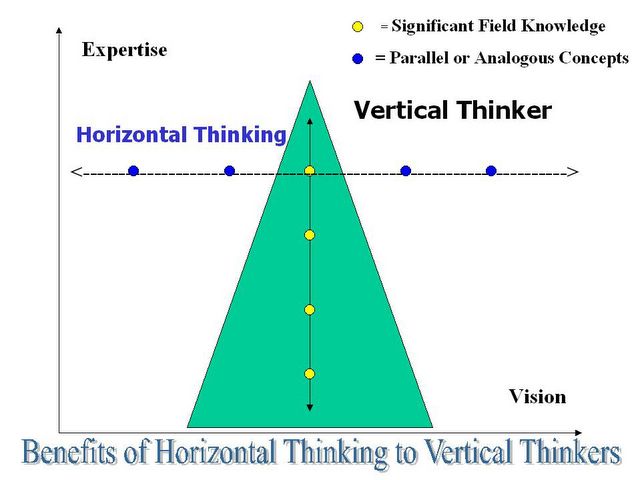
The modes of thinking produced by quantitative-linear- closed system-analytical reductionist reasoning and qualitative-synthesizing-alinear-imaginative -extrapolative are complementary and synergistic. Students and citizens need both. Mass education that develops one while crippling the other yields a population sharing a deeply entrenched and self-perpetuating lacunae, hostile and suspicious of ideas and concepts that challenge the veracity of their insular mental models. This is an education that tills the soil for intolerance and authoritarianism to take root and grow

Education should be for a whole mind and a free man.

Before Disruption….Thinking

Monday, April 23rd, 2012

“What you think, you become”

    – Buddha

“We are what we frequently do”

    – Aristotle

There has been a lively and still evolving debate in the milblogosphere regarding “disruptive thinkers”, starting with Benjamin Kohlman’s post at SWJ whose editor Peter J. Munson has done a fine job steering, collecting and commenting upon. A selection:

The Military Needs More Disruptive Thinkers by Benjamin Kohlman

Disruptive Thinking, Innovation, Whatever You Want to Call It is Needed for a Military in Crisis by Peter J. Munson 

The focus on disruptive thinkers coincided with a different but relevant debate over professional military education (PME) when a scathing blast was recently  leveled at the US Army War College by Major General Robert Scales (ret.) , himself the former commandant and a strong advocate of rigorous PME.  A few of the criticisms made by General Scales at a gathering at FPRI were mentioned in a post by Thomas Ricks who believes in shutting down the service academies and war colleges and maybe just sending everyone to Yale, Princeton and Harvard for MBAs. Or something.
.
What was interesting to me is that many authors and their points had less to do with a close examination of cultivating cognitive skills than related topics of changing organizational culture, the perils of groupthink, rehashing ideas from Frans Johanssen’s The Medici Effect and John Kao’s Innovation Nation, the superiority of entrepreneurshiphidebound military bureaucracy and other tangents to indirectly create an environment in which insightful or innovative behavior might happen.  Only Mike Mazarr zeroed in to the heart of the matter, writing:
….We need to improve, for example, in the detail and specificity of critical and creative thinking methodologies that we integrate into the curriculum.
Bingo!
.
There’s nothing wrong -in fact, much to the good – with the call of Kohlman and others like Joan Johnson-Freese to deliberately combine students and faculty of radically different professional backgrounds. Such a personnel mix is a good base for horizontal thinking to take place, where discussions can range across fields generating insights and analogies and accelerating learning.
However, just assembling a broad mix of talent and putting them together in a building is not enough because it is not any more goal oriented than a MENSA social. Good things might happen, sure, but just as easily not. This is why DARPA is a lot more productive of an organization on an annual basis than the Institute for Advanced Study. There needs to be a mixture of problem-solving and play, free inquiry or experimentation and unifying goals. Communities of interest have to first have a sense of community for the vibrantly sharing and inspiring “minds on fire” effect to take place.
.
If the military or more broadly, American society, wants a larger number of creative, innovative, “disruptive”, strategic or whatever kind of thinker, then the answer is to actively and purposefully teach students creative, critical, insight-generating and strategic thinking skills and to value intellectual curiosity, skepticism, imagination and empiricism over ideology and conformity. The other indirect, “better environment”, stuff certainly improves your chance of success, but systemic improvement will only come about by making such objectives the focus of instruction and learning rather than a haphazard byproduct.
UPDATE:
At Best Defense, Ricks has provided a copy of his prepared remarks on PME as well as a link to the audiofile that I could not pull up the other day. Check out what he has to say.

“Gamification”

Thursday, April 19th, 2012

Embedding games in education and everyday life.


One quick illustrated quote from Secretary Clinton

Wednesday, March 14th, 2012

[ by Charles Cameron — sometimes i post things so obvious they might actually be useful ]
.

One quick annotated quote from Sec. Clinton‘s speech at the U.S. Institute of Peace China Conference, March 7th:

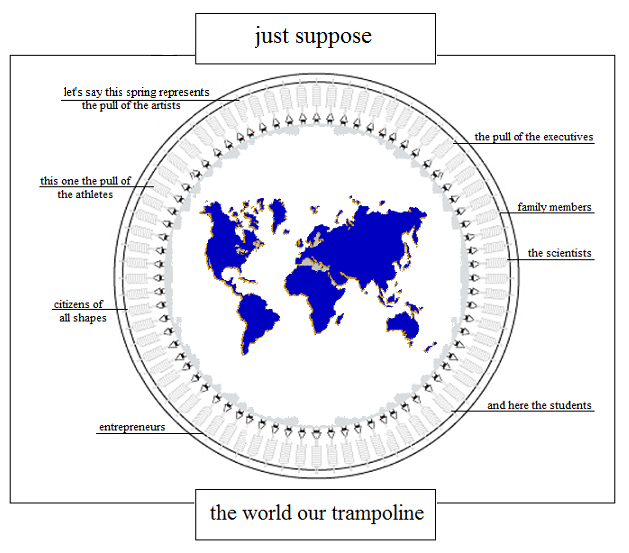
Now when I say “we,” I do not mean only our governments, as important as they are. Every day, across both of our countries, executives and entrepreneurs, scientists and scholars, artists and athletes, students and teachers, family members and citizens of all kinds shape and pull and add to this relationship. Together, they represent a vast range of priorities, concerns, and points of view. And they are all stakeholders in how we build toward a shared future.

It’s really that list I’m after…

There are seven billion individuals bouncing up and down on our trampoline, some of them holding hands, some of them in gangs that want to trip up rival gangs, or make a clearing for themselves and themselves alone, some too weak to bounce much at all…

and each time each one of us lands, we impact the trampoline from a different angle, stretch it a different way – tugging it to the will of the artist, the entrepreneur, the child, the retiree, the curious, the aggressive, the meek…

As we know, the earth is round, which is to say three-dimensional – but the tugs on it, the tensions, are more complicated than that, in fact they’re complex, n-dimensional – and constantly shifting.

Hilary Clinton wants to wake up in the morning, have coffee – and model that! – along with, and in balance with, her counterpart in another huge mass of population, half a globe and at least six philosophies away…

The coffee’s good, but it’s not enough — what we all could use is a new mode of thinking.

*

Maps courtesy of www.theodora.com/maps used with permission

The Era of the Creepy-State is Here

Tuesday, March 6th, 2012

George Orwell was more right than he knew….

Congress passed a law – by unanimous consent in the Senate and by a suspension of rules in the House – to permit the Federal government to arbitrarily arrest and imprison for up to ten years members of the serf class (formerly known as “American citizens”) whose presence annoys or offends specally designated members of the elite and foreign dignitaries. A list that will no doubt expand greatly in future legislation to include very “special” private citizens.

Think about that, future “Joe the Plumbers” or Cindy Sheehans, before you ask an impertinent question of your betters or wave your handmade cardboard sign. Is ten seconds of glory on your local ABC affiliate news at 5 o’clock worth that felony arrest record and federally funded anal exam?

No? Then kindly shut your mouth, sir. Learn your place.

Two nebbish Representatives, one Republican and one Democrat, distinguished only by their lack of legislative or political importance, sponsored the bill on behalf of the big boys who fast-tracked it under the radar (they learned from the SOPA debacle). Forget ideology or boasts about carrying a copy of the Constitution in the breast pocket of their suit, whether you are in an archconservative Congressional district or an ultraliberal one, almost every member of Congress voted “aye” to trash multiple amendments in the Bill of Rights.

Almost every one.

This is an accelerating trend in recent years and in particular, a bipartisan theme of the 112th Congress, which views Constitutional rights of nobodies as an anachronistic hindrance to the interests (or convenience) of their powerful and wealthy political supporters. Our elected officials and their backers increasingly share an oligarchic class interest that in important matters, trumps the Kabuki partisanship of  FOXnews and MSNBC and inculcates a technocratic admiration for the “efficiency” of select police states.

It is from this demographic-cultural root of incestuous corruption that our creeping – and increasingly creepy – manifestations of authoritarianism in American life springs. The SOPA/PIPA internet censorship bills, naked scanners at airports, Stasi-like expansion of expensively wasteful TSA security theater, proposed 24/7 monitoring of  every American’s online activities, migration of police powers to unaccountable private firms, replacement of elected municipal governments with “emergency managers” (favoring financiers over taxpayers), Federal agencies monitoring political critics , the Department of Justice retro-legalizing corporate racketeering, fraud, perjury and conspiracy on a national scale, plus other infringements of liberty or gross corruption that I could list, ad nauseum.

We have reached the point where we as Americans need to stop, step back from moment by moment fixation on nonsensical, “white noise” fake political issues like “contraception” ginned up to keep the partisans distracted and become seriously involved in determining the direction in which our nation is headed. Our elite are telegraphing their strong preference for a “soft dictatorship” but we still have time to check their ambitions and rein in their looting.

It is almost quaint these days to pick up Friedrich von Hayek’s classic,  The Road to Serfdom and thumb through it. The libertarian antistatists of the 20th century were so focused on the clear and present dangers of totalitarianism that the idea of a weak state that endangered liberty through a mixture of corruption and regulatory capture eluded them. The Westphalian state at it’s apex was so overweening that the enemy of free societies, after foreign monsters like Hitler and Stalin, could be ambitious intellectual pygmies like Harold Laski or Tom Hayden. The state was so omnipotent that even it’s efforts at benevolence, to build a “Great Society” of the Welfare State were injurious to individual freedom because the expanse of statism crowded and weakened civil society , the market and private life. The argument gained political traction because, to varying degrees, it was true and looked prophetic when the Welfare-state began to crash economically in the 1970’s on stagflation.

Give the Welfare-state liberals and Social Democrats of the past their due though, their intentions by their own lights were benign. They wanted to make a safer, more secure, more equal, more just life through a more powerful state (whether that was a good idea or a realistic endeavor was the central political question between right and left). The current elite in comparison is so inferior in moral character and overconfident in their abilities that they may soon make us yearn for the former’s return.

What have now in our ruling class,  are the  builders of a Creepy-state and their intentions are not benign, except toward themselves, for as long as the looting of the American economy can last.

Unlike the Welfare-state, the Creepy-state, shot through with corruption, is  not omnipotent  because it is to be the servant and gendarme of the emerging oligarchy and not their master – but it is to be omniscient and omnipresent, constantly watching, monitoring, investigating, recording, interrogating, coercing, sorting, muzzling, gatekeeping and shearing the sheep on behalf of the shepherds.

Or the wolves.

The Creepy-state is not there to protect you or give you a higher standard of living or ensure justice or democracy, but to maintain a hierarchical public order from “disruption” (formerly known as “politics” or “democracy”). If the classical liberal ideal was the night watchman state, this state is the shadowy and ill-disposed watcher in the night.

The American political elite, Democrat and Republican, Conservative and Liberal, are in are largely in consensus that the government should, in regard to the American people:

Read your email
Listen to your phone calls
Track your movements on GPS
Track your online activity
Track your spending
Track your political activity
Read your medical records
Read your financial records
Scan your body
Scan your house
Scan your DNA
Keep you under video surveillance in public
Detain you at random in public places for security checks
Close off public spaces for private use
Seize private property for private use
Censor your speech
Block your access to judicial relief
Determine your educational and career path
Regulate your diet, place of residence, lifestyle and living standards (ever downwards)
Charge you with secret crimes for breaking secret regulations
Share or leak information about you at will

Is this the America we wish for our children or grandchildren? One that epitomizes the values of our Constitution or Declaration of Independence, or is it some kind of tawdry and shameful dime store fascism of a small Latin American country? Perhaps life is finally imitating fiction?

Fortunately, it is not too late. Irrevocable changes in the constitutional order have yet to be engineered. Our politicians are followers, not leaders here. They are a small and cowardly lot for the most part and will recoil in fear from this authoritarian ethos if a sufficiently large number of elected officials are thrown out of office at once. We can still roll this back – at least the most egregiously anti-American aspects – if we get sufficiently angry come November.

Self-interest is their only lodestone.


Switch to our mobile site