zenpundit.com » warriors

Archive for the ‘warriors’ Category

America the Home of the Brave?

Sunday, February 3rd, 2013

An excellent op-ed in the Washington Post by Small Wars Journal editor and author of War, Welfare and Democracy,  Peter J. Munson 

An America Cramped by Defensiveness by Peter J. Munson 

….Since I returned home, a darkness has grown in me as both I and our nation have failed to live up to the sacrifices of these young men and women. I had no expectation of “victory” in Afghanistan or Iraq, whatever that would mean. Nor did I expect some epiphany of strategic insight or remorse from the nation’s brain trust.

I just found that I could not square the negativity, pettiness and paranoia in the discourse of our country’s elders with the nobility and dedication of the men and women I had seen and served with in Afghanistan.

Over time, as I listened to the squabbling, I realized that about the only thing Americans agree on these days is gratitude bordering on reverence for our military. It troubled me that the sum total of consensus in our discourse is deference toward the defenders of our nation.

Eventually, it dawned on me that the focus on defense was the root of our problem.

After the Sept. 11, 2001, attacks, the United States sent its military off to war and fretted about post-traumatic stress disorder — but paid little attention to the fact that America itself was traumatized. Americans became angry and withdrawn. We are fearful and paranoid because after a strike on our nation we chose to focus on defense rather than the resilience and vitality that made America great. In our defensive mind-set, we bristle at every change in a world undergoing an epochal transformation.

We have little reason to be so negative. Certainly the rest of the world is gaining on us, but this represents the success of explicit U.S. policies. After World War II, the United States sought to create a world of economic interdependence and prosperity, hoping to banish the malaise that helped precipitate a global conflict. The prospect of rapid growth in the developing world was not viewed as a threat but rather offered the promise of robust markets for American goods and ingenuity. We were confident and focused on the positive tasks of expanding our economy rather than fearing change…..

If you go back and look at news coverage of September 11, you will be struck by the calmness of ordinary citizens in New York in the face of carnage, their lack of panic and firm determination to help. The bravery and sacrifice of firefighters, EMT and police, the dogged resolution of rescue workers digging for victims, the sheer heroism of the passengers of  United Airlines Flight 93 who, led by Todd Beamer, stopped the al Qaida hijackers from ramming another plane into another skyscraper or perhaps the Capitol Building.

All of the security theater, the attacks on liberty, the surveillance state machinations, creeping normalization of government thuggery, bureaucratization, centralization and paternalism that have since been justified in the name of 9/11 were not needed on that day nor wanted by the overwhelming mass of American citizens afterwards.  It was wanted by our “leaders” – who were largely irrelevant to events on September, 11 – because it conformed to their worldview and overweening personal need for “control” of a democratic citizenry they would prefer to be less autonomous and more passive, docile, compliant and disengaged.

We need to revive the American spirit and the first steps are rolling back much of the illiberalism of the past decade.

Boyd and Beyond Local DC Event

Tuesday, December 18th, 2012

[by J. Scott Shipman]

Jim Hasik’s White Board Outline


At the suggestion of Adam Elkus, we were privileged to host our first “local” Boyd and Beyond event on 15 December. We had 14 attend, and five speakers. Logistically, we turned our family room in to a fairly comfortable briefing area, using a wall with Smart Sheets as a temporary white board. In keeping with our October events, we took up a collection and had pizza delivered for lunch. Coffee, soft drinks light snacks were provided. Each speaker was allotted 50 minutes, but given the participation of the audience, most talks lasted about 90 minutes. I should emphasize to those planning one of these events, to keep a lean speaker’s list, as the Q&A and discussion can easily double the time of a presentation—-and I believe all who attended would agree the comments/discussion made already great presentations even better.

My sincere thanks go out to my wife and partner, Kristen, for making this event look easy! She was the one who made sure everything was moving along and that folks felt at home. I would encourage others around the country to schedule and hold events through the year. We’re looking to do another in March 2013.

Our speakers were:

Jim Hasik, Beyond Hagiography: Problems of Logic and Evidence in the Strategic Theories of John Boyd

Francis Park, The Path to Maneuver Warfare in the U.S. Marine Corps

Robert Cantrell,  Which Card Will You Play?

Terry Barnhart, Designing and Implementing Maneuver Strategy in Transforming Major Organizations

Marshall Wallace, Theories of Change and Models of Prediction

I led off with a few comments on the military professional and intellectual rigor. I recommended the best book I’ve read this year: Inventing Grand Strategy and Teaching Command, by Jon Tetsuro Sumida, and the challenges he suggests in the realm of intellectual rigor. He writes:

“It remains to be seen whether readers exist with the mind and will to accept his guidance on what necessarily is an arduous intellectual and moral voyage into the realm of war and politics.” (emphasis added)

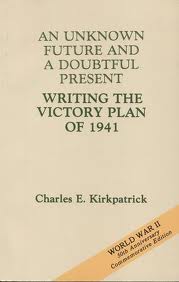
I followed with the example from An Unknown Future and a Doubtful Present: Writing the Victory Plan of 1941, by Charles E. Kirkpatrick. Mr. Kirkpatrick’s little book provides an excellent primer to the formulation of the United States’ WWII strategy and a refreshing insight into the education of an master strategist, then Major Albert C. Wedemeyer, attached to the War Plans Division, the Army chief of staff’s strategic planners, who wrote the Army strategy for WWII in 90 days. (read the review here) I suggested that military professionals should start something akin to a book club, where they can discuss and debate strategic issues and concept.

Following my comments, Jim Hasik offered his critique of John Boyd’s work. Adam tweeted that we were a “tough crowd,” but Jim was able to discuss his misgivings with respect to Boyd’s work and a lively discussion got us started. For those unfamiliar, Jim is the author of a paper called, Beyond Hagiography, which generated controversy in the Boydian community following this year’s October event at Quantico. (reviewed here and at zenpundit.comHere is a link to the paper. (see Hasik’s white board outline above).

According to Hasik, Boyd erred when extrapolating from physical processes/science to social processes. He reviewed Boyd’s use of science in his essay, Destruction and Creation, and suggested no literal correlation between Clausius’ Second Law of Thermodynamics (entropy), Gödel’s Incompleteness Theorem, and Heisenberg’s Uncertainty Principle and human behavior (on this I concur with Hasik, as analogy or metaphor these scientific principles enlighten).  Hasik asked if OODA scales from air-to-air combat to large scale events, and whether OODA was original (compared to PDCA, for example). One point that generated quite a bit of discussion was whether one could “like” Clausewitz or Sun Tzu and Boyd. Hasik questioned whether Boyd’s work should be judged as social science, history, or war studies, and suggested that further work was needed to fill in the gaps in his work. In October, someone suggested Boyd needed a “Plato,” someone to address Boyd’s work with less emphasis on science (as in Osinga’s book), thereby making Boyd’s work more accessible. The Strassler model was suggested; Strassler is an “unaffiliated scholar” who has written exhaustively referenced versions of ThucydidesHerodotus, and Arrian. [personal note: I believe a Strassler-like book on Boyd’s ideas would be a great resource] A great thought-provoking conversation.

Francis Park’s White Board


Francis Park’s talk on on maneuver warfare, the evidence of history began with “I’m a historian and I have a problem.” The irony wasn’t lost on the audience, as Francis is an active duty Army officer, speaking on the history of the USMC’s adoption of maneuver warfare (MW). Park called the Marine Corps “the most Darwinian of the services.” The venue for for the Corps discussion between MW advocates, and the “attritionists” was the Marine Corps Gazette. This venue was “unofficial,” otherwise the debate may have never happened. The Gazette’s forward-thinking editor made space and encouraged the debate, which was a “long, bitter, and complex fight.”

Park listed and discussed the champions of MW Michael D. Wyly, G.I. Wilson, William Woods, William Lind, and Alfred M. Gray. Park recommended Fideleon Damian’s master’s thesis, THE ROAD TO FMFM 1: THE UNITED STATES MARINE CORPS AND MANEUVER WARFARE DOCTRINE, 1979-1989. (Adam Elkus recommended Eric Walters essay in the Small Wars Journal, titled Fraud or Fuzziness? Dissecting William Owen’s Critique of Maneuver Warfare.)

Park called the USMC adoption of MW a “confluence of fortune” that may have never happened without the vigorous efforts of proponents.

Robert Cantrell’s Which Card Will You Play? was an instructive and interactive example of Robert’s strategy cards. Cantrell has two decks of strategy playing cards, one devoted to strategy, the other to sales strategy. The user’s guide is at www.artofwarcards.com.

Robert provided examples of how the cards are used to spark strategic thought and ideas. Volunteers pulled first one, then two cards from the decks, and read aloud and commented on how the statement(s) on the cards could be used in practice. For example, “Muddy The Water To Hide the Nets” was drawn (the 8 of clubs, a bit more on card suits from Robert below). The “strategy” is to “confuse your adversary so he cannot perceive your intentions. The “Basis” is “Confused adversaries make mistakes they would not make if they grasped your intentions.”

Longtime friend of this blog, Fred Leland at Law Enforcement Security Consulting is using the cards with success. Fred’s goal is “to get cops thinking more strategically and tactically in their work. I have been pulling a card from the deck and writing my thoughts and sharing them with cops who have been passing them along to their officers.” He is using Robert’s cards for “in-service” training, and providing a low cost entry into strategic thinking.

I followed up with Robert and asked for an explanation of the card suits. Here is his response:

Hi Scott – although they are gray delineations, the Hearts are oriented on the shaping self, the Clubs on shaping the field of contest…the diamonds are isolation strategies, and the spades are elimination strategies. This is the wolf pattern on the hunt: wolf becomes all the wolf it can be, shapes the hunt, isolates a member from the heard, brings that member down. With aces high – and again also gray – the higher cards tend to be strategies used from a greater abundance of strength and the lower numbers from comparative weakness in strength. Of course from here we can talk about gaining relative advantage if we cannot have absolute advantage to gain strength for a critical moment…and so on

Terry Barnhart spoke on Boydian organizational applications in a talk called Designing and Implementing Maneuver Strategy in Transforming Major Organizations. Terry said any organizational change had to be accomplished on the realms of the moral, mental, and the physical. With that in mind, he advised mapping the social networks of the organization and speaking in “the language of the culture” and “asking for what you need” when attempting to transformation. The end goal is “aligned autonomy,” and Terry’s recommended method of choice is taken from Boyd’s Patterns of Conflict,Slide 80:

Patterns of Conflict, Slide 80


Search out the “surfaces and gaps”, as reference from Slide 86, POC. In Boyd’s language:

•Present many (fast breaking) simultaneous and sequential happenings to generate confusion and disorder—thereby stretch-out time for adversary to respond in a directed fashion.

•Multiply opportunities, to uncover, create, and penetrate gaps, exposed flanks, and vulnerable rears. [emphasis added]

Create and multiply opportunities to splinter organism and envelop disconnected remnants thereby dismember adversary thru the tactical, grand tactical, and strategic levels. [emphasis added]

In Terry’s words, “be everywhere at once” and establish relationships that result in buy-in, avoiding “no,” as Terry advised it can take a couple of years to overcome an objection. As aligned autonomy is reached, word will get around about the successes, and all of sudden what was a single agent of change becomes a movement. So Terry is recommending methods in maneuver warfare as a method in transforming organization culture.

During Terry’s talk, Dave recommended Orbiting the Giant Hairball, by Gordon MacKenzie as a guide in navigating the bureaucracy and obstacles often found in large organizations.

Marshall Wallace’s White Board


Marshall Wallace’s Theories of Change and Models of Prediction was our final presentation. Marshall has emerged as one of the leading thinkers among Boydeans. Wallace said, “people are lazy” as he led off his discussion of change models. [personal note: I’ve come to refer to this laziness as “neurological economy”] His thinking was influence by Daniel Kaneman’s Thinking, Fast and Slow and the Heath brother’s Switch: How to Change Things when Change is Hard. When change is desired, clarity is an absolute must have. Wallace offered the four models above as example of change. He said we must ask: “What is the change we want to see?” and ” What are the pre-conditions?”—instead of this model, most people begin with the idea, which more often than not, fails.

Wallace walked our group through the models and emphasized the importance of tempo and used his wife’s efforts to establish dog parks in their city. Everything in government has a process, and Wallace said in this case “going slower than the politicians” paid off. Also, for programs of change, it is best if there is 100% transparency of goals. Both Marshall and Terry recommended a book called The Progress Principle, by Teresa Amabile and Steven Kramer. The most powerful model for me was the one in the lower right corner—particular the use of “more people” and “key” people in any effort to affect change.

Post meeting, Wallace posted the following to our Facebook group wall, that rounds out and expands his thinking:

I was on the plane back to Boston yesterday morning, deeply engrossed in Terry’s book [Creating a Lean R&D System] when a phrase leapt into my head: “Target the whole organism”.

As the Michaels in our lives (Moore and Polanyi) remind us, “we know more than we can say”. I feel that quite clearly and I constantly struggle with language. I am never satisfied with any presentation I give because I know that, due to failures on my part to use the perfect word at the right moment, I left some understanding on the table.

Somehow the weekend, with spectacular conversation, a good night’s sleep, the enforced idleness of air travel, and Terry’s superb book, shook something loose.

Target the whole organism.

What flashed through my mind at that moment were pieces of the talks.

Jim prompted discussion of what the next set of books about/on/adding to Boyd should look like.

Francis drew a pie wedge with “firepower” on one edge of the pie and “maneuver” on the other. He was describing two schools of thought on conflict as represented by these extremes. Everybody seemed to agree that the balance lay somewhere in the middle and was definitely related to the context.

Robert’s exercises with his strategy decks shook countless examples of strategic action and insight loose in our minds. The combination of cards, taking one from each of the competition and collaboration decks, was especially exciting.

Terry laid out his plan to blitzkrieg his company, and invited us to make it better.

I ended with a 4-cell matrix demonstrating the four basic categories under which all Theories of Change operate (more on this later). Experience has shown that most people operate out of an implicit Theory that traps them in one quadrant, whereas social change only occurs if all four quadrants are affected.

Target the whole organism.

I got home and opened up “The Strategic Game of ? and ?”. Interaction and Isolation.

Firepower and maneuver – at the same time. Competition and collaboration at the same time.

Boyd side-by-side with his sources and several commentators. CEO, discouraged middle-managers, and the line at the same time. More People and Key People at both the individual level and the structural level all at the same time.

Target the whole organism.

A force that uses maneuver to confuse and firepower to destroy will dominate. A force that can swing rapidly between extremes and also find balance is even more slippery than one that acknowledges the “necessary” balance. The two practices can be in separate parts of the battlespace (context matters), but because both are occurring, the confusion generated may well be more intense. It looks as though the force is two distinct armies and communication among the enemy may be unintelligible because the threats being faced are so different.

Bringing collaborative concepts into competitive spaces or vice versa while not abandoning the underlying logic of the space opens up more options, challenges notions, and expands horizons. Can we interact and isolate at the same time? What does that snowmobile look like?

If we want to effect social change, we need to target the whole system. We can sequence our efforts in time, though we can’t forget to move as quickly as the circumstances allow. At the same time, every effort must be connected to the whole organism.

The target is not the target. I do not aim at the eye of the fish. I don’t wan’t to hit the bullseye.

I want to pick up the whole madding crowd of intense archers, cynical kings, and wildly cheering spectators and move them.

This was the first “local” event, and based on the response, we’ll be doing these a few times a year. Many thanks to all who participated, and Merry Christmas and a Happy New Year to  you all!

UPDATE: Dave shared these with our group. Francis said, “We live and die by bumper stickers.” Here is a good example:


Here is Dave’s interpretation of the Sufi elephant:


Cross-posted at To Be or To Do.

New Book: The Violent Image by Neville Bolt

Friday, December 14th, 2012

The Violent Image by Neville Bolt 

Columbia University Press just sent me a review copy of The Violent Image, by Dr. Neville Bolt of King’s College vaunted War Studies Department.  Initially, I was amused by the colorful book jacket, but flipping through, it belies a very weighty, heavily footnoted, academic exploration of the iterative relationship between propagandistic imagery and insurgency. Even a casual perusal indicates that The Violent Image is a book many readers of ZP will  like to  get their hands on.

From the jacket:

….Neville Bolt investigates how today’s revolutionaries have rejuvenated the nineteenth century “ptopaganda of the deed” so that terrorism no longer simply goads states into overreacting, thereby losing legitimacy. Instead the deed has become a tool to highlight the underlying grievances of communities

A small sampling of some of the section titles:

Strategic Communications:the State
Strategic Communications: the Insurgent
Networks in Real and Virtual Worlds
Images as Weapons
POTD as Insurgent Concept of Operations
Anonymity and Leaderless Revolutions
The Arab Uprisings and Liberation Technology
POTD as Metaphor

Endnotes run slightly over 90 pages and the bibliography tips the scales at 50, for those interested in such things.

Looking forward to reading this and seeing how Bolt presents his case.

Point and Counterpoint on Defining War

Saturday, December 8th, 2012

A quick note. There’s a provocative article at SWJ by a USAF Lt Col., Jill Long that attempted to pose an alternative definition of war and Jason Fritz at Inkspots has written a tough rebuttal; both are worth reading:

Jill Long – What is War? A New Point of View

….The Spectrum of War in the Global Era

Michael Howard summarizes the changing environment as shifting from one centered on the control of territory, to one focused not only on territorial control but the effective exploitation of the resources of that territory.[8]  This concept leads to a new approach to view and define war…within the context of globalization.  As the global finance crisis illuminated, economies can no longer be managed/controlled internally but in fact are impacted by events and decisions made across the world.[9]  One only needs to reference the so called “CNN effect,” the Arab Spring or current anti-American protests to understand the impact digital communications and the 24-hour news cycle have had on regional and world affairs.[10]  The bottom line: “interconnected systems of trade, finance, information, and security” demand a larger perspective when considering the engagement of imposing national will on others.[11]

One method to approach this broader perspective is to view war as a spectrum of discord, a continuum where unrestrained armed conflict and world peace are at opposing ends.  By establishing this graphic scale, it is relatively easy to conceptualize that as a nation approaches peace (or harmony) with other entities’ values, objectives, and ideals, there is an abeyance of hostilities.  War is not over, a nation’s desire to impose its will remains; it simply does not require the use of armed conflict to achieve its goals.  What might appear on the surface to be the age old argument between Thomas Hobbes’ theory of man’s natural state as one of war and John Locke’s more peaceful perspective, is actually providing the answer to that debate…both may be right.  If a nation’s will is in harmony with other entities’ then the natural tendency will lean towards world peace.  As discord develops between a nation’s will and other nation-states or non-state actors the natural tendency will increasingly lean towards more aggressive national engagement and armed conflict.  This theory purposefully focuses on nation-states and/or non-state actors versus the individual.  While one may argue it can be applied to individual interaction, this is not the author’s intent. 

This spectrum facilitates understanding that the art of war encompasses much more than the concept of armed conflict and acknowledges a nation’s capability to change their “natural state” based on the will of the people, political landscape, as well as a nation’s strength, ability, and desire to project power. […]

And now, from the other side……

Jason Fritz–  Our definition of war is pretty good as it is

…..Long fails to adequately describe how the world has changed or how the “Global Era” plays into this. She states that the terrorist attacks on September 11, 2001 have changed how we should perceive the world. It seems that the she believes that that day should have awakened Americans to the threat of non-state actors. Long also states that “‘interconnected systems of trade, finance, information, and security’ demand a larger perspective when considering the engagement of imposing national will on others.” Both of these points are stated in defiance of history. Globalists enjoy selling the greatness and threats of our “interconnected systems” in the modern day, but that presumes that the world is newly interconnected. We know this is not true. Interconnection in today’s world may be faster and easier, but it is not new. States and other political groups have interacted over the elements listed for millennia – look only to the period of global colonization to see how long we as humans have been at this. Long does not describe how today’s globalization is unique and why that changes how we define war.The issue of state versus non-state actors, as pertains to the definition of war, is a silly discussion. The idea that this new “globalization” has resulted in the rise of non-state actors is also historically inaccurate and is prima facie absurd.  Civil wars have raged as long as long as humans have fought wars (indeed, civil war comprise a significant proportion of the wars humans have fought). Who are these wars supposed to have been fought by if not by non-state actors? Insurgencies and terrorism are also not new to the 21st Century (or even the Common Era) and it would take a peculiar interpretation of history to argue otherwise.

It is important to note that in his definition, Clausewitz does not describe war as act of force between states. War is engaged between enemies as the means to achieve political objectives. Of course, political objectives are not the sole purview of states as many non-state groups have exhibited and Mao so logically codified. This is not to say that Clausewitz did not intend his definition and the rest of the book to discuss war between states in the best traditions of the post-Westphalian world. He clearly speaks of states throughout the book, as indicated in the parenthetical comment in his definition of war (I did say I would return to that point). But this does not limit On War solely to war between states as mean scholars have, most prominently historian John Keegan and strategist Martin van Creveld to name a couple. It does not take that large of a leap of thought to read On War and understand that states can be any organized political group, that princes can be any leaders of those political groups, and armies can be the armed elements of those political groups. A literalist reading of Clausewitz would be as unwise as a literalist reading of Plato or Aristotle and saying their writings do not apply to the modern world because we are no longer city-states. A non-literalist exegesis of On War easily provides for the incorporation of non-state war into Clausewitz’s thesis. As a last point on non-state actors, Long indicates that these offspring of globalization are driving this need for a new definition of war and yet her new definition specifies that means required are to bring about “sufficient adherence to a nation’s will.” This suggests that only nations have wills or that the means of war could only be used to achieve national wills. Ergo, only nations can be at war. I suspect that non-state actors would like to know how to label their activities if “war” is closed to them. [….]

I am pressed for time, as usual, this morning, but i will try to offer my own comments later tonight.

An Unknown Future and a Doubtful Present: Writing the Victory Plan of 1941 — a review-lite and a few questions

Tuesday, November 20th, 2012

[by J. Scott Shipman]

An Unknown Future and a Doubtful Present: Writing the Victory Plan of 1941, by Charles E. Kirkpatrick

Mr. Kirkpatrick’s little book provides an excellent primer to the formulation of the United States’ WWII strategy and a refreshing insight into the education of an master strategist, the focus of this post. At 138 pages (plus bibliography/index), Kirkpatrick provides an overview of the enormous contribution of Major Albert C. Wedemeyer, then attached to the War Plans Division, the Army chief of staff’s strategic planners. In the spring of 1941, General George C. Marshall wanted a “more clear-cut strategic estimate of our situation”. Wedemeyer placed his work in the context of four questions:

1. What is the national objective of the United States?
2. What military strategy will be devised to accommodate the national objective?
3. What military forces must be raised in order to execute that military strategy?
4. How will those forces be constituted, equipped, and trained?

Wedemeyer understood that number 4 was not possible without a clear understanding of 1 through 3. Number 1 did not exist (probably still does not), so Wedemeyer made his best guess. Wedemeyer placed his task in context and produced a plan in the prescribed 90 days (!).

No Ordinary Major

Wedemeyer was no ordinary major. He was a voracious reader and student of history; familiar with Clauzewitz, von der Glotz, Fuller and Sun Tzu. He was fortunate to have a mentor (who happened also to become his father-in-law), MG Stanley Embick. Embick encouraged Wedemeyer to “organize discussion groups of officers during the years on Corregidor. Professional reading served as the context for such social gatherings of Wedemeyer’s peers intelligent and articulate men who met periodically to discuss current events, the books they had been reading, and professional interests.”

Wedemeyer was an honor graduate of the Command and General Staff College, and his performance earned him the opportunity to attended the Kriegsakademie, the German staff college. However, coupled with impressive academic preparations, Kirkpatrick writes that Wedemeyer’s curiosity exposed him to a “kaleidoscope” of ideas and methods. Kirkpatrick summed-up Wedemeyer: “Competence as a planner thus emerged as much from conscientious professional study as from formal military education…” Going on to say:

In common with many of his peers, much of Wedemeyer’s professional and intellectual education was less the product of military schooling than of personal initiative and experience in the interwar Army.

Wedemeyer’s intellectual development was purposeful and paid off. In Wedemeyer’s deep study of his profession he used the prescribed paths, but also explored on his own. How common is that today? What is the real intellectual foundation supporting our professional warriors? Is it the minimum one will glean from the service schools, or we encouraging our people to go a step further.  In an earlier post I wondered aloud, and echoed a remark posed by Jon Sumida with respect to Alfred Thayer Mahan:

“It remains to be seen whether readers exist with the mind and will to accept his guidance on what necessarily is an arduous intellectual and moral voyage into the realm of war and politics.” (emphasis added)

Against this backdrop, Tom Ricks in an interview at the Washington Post said:

The U.S. Army is a great institution. The rebuilding of the U.S. Army after the Vietnam War was an epic struggle and was enormously successful. Today we have great frontline soldiers. They are well equipped, they are well trained and they are in cohesive units.

The problem is at the very top. This magnificent rebuilding of the U.S. military after Vietnam really did recreate the force, but they kept the old head. The one thing they didn’t really change after Vietnam was how they shaped their generals. What we got was a generation of officers who thought tactically and not strategically. It’s the difference between being trained and being educated. You train people for known attacks. You educate people for the unknown, the complex, the ambiguous, the difficult situation. (emphasis added)

No intention of singling out the Army, I would cast the net of this question to include the other services, and ask whether we have Major Wedemeyer Majors/Lieutenant Commanders in the pipeline. If we do, are we nurturing and encouraging them? How many of our professional warriors study independently, and like Wedemeyer host/encourage frequent independent fellowship/discussions around books and ideas independent of the academy? As I mentioned in an earlier post, there is no app for intellectual development. We should at least expose our officers to the Wedemeyer method, if you will, and go deeper than service schools, blogs, and the constant chatter in our information laden world. Colleagues gathering to discuss and debate; educating and enlightening each other.

On strategy, Kirkpatrick quotes Wedemeyer:

…strategy, properly conceived, thus seemed to me to require transcendence of the narrowly military perspectives that the term traditionally implied. Strategy required systematic consideration and use of all the so-called instruments of policy–political, economic, psychological, et cetera, as well as military–in pursuing national objectives. Indeed, the nonmilitary factors deserved unequivocal priority over the military, the latter to be employed only as a last resort.

Wedemeyer’s net was wide and comprehensive and worthy of emulation. While his accomplishment(s) are impressive, so was his preparation.

Wedemeyer went on to a successful Army career, retiring as a 4-star. In 1985, he was presented the Presidential Medal of Freedom by President Reagan. (See the New York Times obituary.)

This is an important and accessible introduction to the nuts-and-bolts of strategic planning and has my strongest recommendation.

A free electronic copy can be found here (pdf).


Switch to our mobile site