Archive for the ‘warriors’ Category
Thursday, November 3rd, 2011
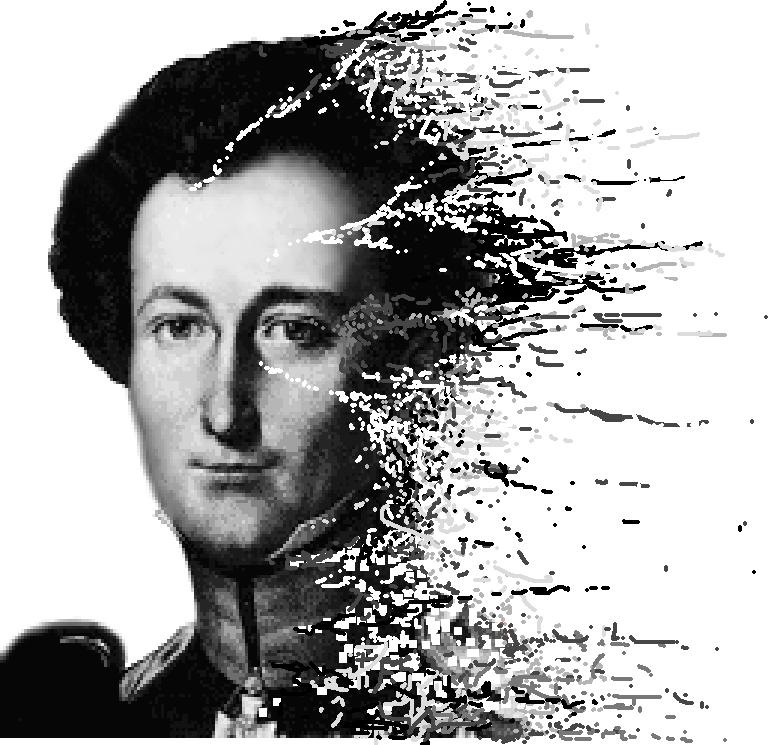
On War by Carl von Clausewitz has been the most influential book on strategy and war of all time.
We can say this because On War is the standard by which all other works of strategy are measured and only a few compared – notably Sun Tzu’s Art of War and The Peloponnesian War by Thucydides. The odd thing is that we can say this despite the fact that On War is more frequently shelved, cited or understood secondhand rather than read, even by military professionals. And furthermore, within the narrow demographic that reads Clausewitz seriously and critically, there can be heated dispute over what he meant, due to the difficulty of the text. Then there are the secondary effects, historical and military, of Clausewitz having been misunderstood, forgotten, ignored or at times, his strategic philosphy consciously rejected.
The shadow cast by On War is all the more remarkable given it’s circumstances of publication. Clausewitz died in 1831, at fifty-one, of 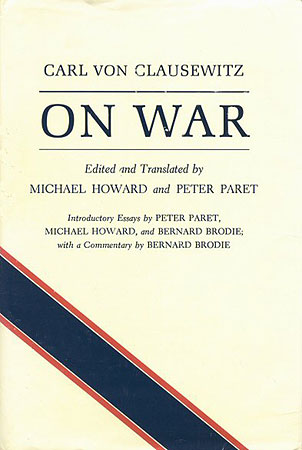 cholera, having finally risen to a military post his talents merited. He had been writing On War since 1816 and it was far from completed or refined to his satisfaction and it is highly unlikely, in my view, that Clausewitz would have consented to it’s publication in the condition in which he left it. His determined and intellectually formidible widow, Marie von Clausewitz, further shaped the manuscript of On War, guided by her intimate knowledge of her husband’s ideas and was likely the best editor Clausewitz could have posthumously had.
Nevertheless, to my mind On War remains a magnificent unfinished symphony.
What would On War have looked like if Clausewitz had lived another twenty-five or thirty some years? Assuming continued good health, Clausewitz would have seen, perhaps commanded in, the First Schleswig War and at least studied the Crimean War from afar. He would have had another quarter-century of reading and mature reflection on his subject. Clausewitz, who had a keen understanding of history, would have also witnessed the grand European upheaval of liberal revolution in 1848 that rocked the Hohenzollern monarchy to it’s core. What new insights might Clausewitz have gleaned or expanded upon? Would his later chapters On War have evolved to equal the first?
Having outlived Marie (who died in 1836), would Clausewitz have become a deeply changed man?
What I find it difficult to believe is that Clausewitz, with his creatively driven and philosophically exacting mind, would have been content to let the manuscript of On War rest where it stood in 1831. Or that we read today what Carl von Clausewitz ultimately intended.
Posted in 19th century, academia, analytic, book, Clausewitz Roundtable, Clausewitzian, counterintuitive, creativity, Evolution, history, ideas, intellectuals, literature, logic, military, military history, philosophy, Questions, reading, strategist, strategy, Strategy and War, theory, war, warriors, Writing | 9 Comments »
Monday, October 31st, 2011

An interesting new blog. An operator type, an Iraq and Afghan vet, quesopaper blogging from AfPakland on situational awareness and much later in the post, on leadership:
Running To Contact
….I thought we’d cover danger in Afghanistan again by examining, “When Insurgents attack.”
A quick aside…over the years one develops a sense for explosions. Some are “ours”…outgoing mortars, rounds from a gun or controlled detonations. We learn the sounds of different weapon systems. A helicopter followed by a high pitched drone and several whooshes is an Apache firing it’s main gun and rockets. Whomp Whomp Whomp is an M60/M240. Ma duece says Bum Bum Bum. Artillery is LOUD and has a pointy sound when outgoing. Incoming is more spherical.
We also develop a sense of distance and direction for the booms…it’s all part of our survival mechanism. Another aspect is awareness of our surroundings. We constantly scan and consider what to do if we are attacked …where is the nearest bunker or where is the closest safest place?
This sounds frightening, but we all do this. Motorcycle riding is a good analog. When riding we have to be aware of spacing. Scanning for threats and escape routes saves a rider’s life.
The sound that puts me face first on the ground are mortars wobbling towards me. They make a unique sound that I can’t quite describe. Sort of of a frantic flutter…the closest sound I can come up with is the rattle of a door stop when accidentally brushed. Rockets and their vibrating engine sound are also unnerving. If you can hear them flying, they are too damned close…
Very relevant to past blog discussions of fingerspitzegehful and the OODA Loop – a good descriptive narrative, in fact, of OODA working correctly. Theory is not the interest of the quesopaper gent, but his firsthand observations of COIN in Afghanistan are intriguing, for those interested in military policy or theory. Ideas that are often great on a whiteboard or ppt slide but may not seem quite as great once they collide with reality.
Another post from quesopaper, in the vein of theoretical rubber meeting the practitioner road:
What do they Need?
….indulge me while I inject some confusion into our clarity regarding Afghans. This is a paraphrased version of a Benedictine Grima tale from her field work. If one desires knowledge about AfPak, particularly the female’s role, Ms Grima is THE source.
The tale….Two men travel to village 1. While there, they commit robbery and murder. These crimes are detected by local police. The police debate their response, and decide to chase the perpetrators.
They enter the criminal’s village (village 2) where locals set upon the police and kill them. These villagers for whatever reason don’t appreciate nor require police involvement in their affairs. Villages 1 and 2 are content to solve crimes of any type within their own system of justice. In response to the police incursion, village 2 blocks outside access to the road preventing further police/outsider interference. Up the road a bit, the next village (village 3) hears of this incident. The road blockage makes them fighting mad. A village 2 v. village 3 mini-war occurs; people die. Why? Village 3 needs that road to survive or, shoot-some other reason. We don’t and honestly; we can’t know.
The point isn’t “should we” or “shouldn’t we” be here; that’s a different blog…Fact is we are here.
So let’s do this…Let me take you to a village. You comment below on how we are going to help….maybe we’ll all learn something….
Read the rest here.
Posted in 21st century, 4GW, Afghanistan, blogging, blogosphere, COIN, counterinsurgency, cultural intelligence, DIME, ideas, insurgency, military, Perception, security, Tactics, terrain, tribes, war, warriors | 1 Comment »
Thursday, October 20th, 2011
Here is something for the learned readership to chew on.
As you are probably all aware, in the hard sciences it is common for research papers to be the product of large, multidiciplinary, teams with, for example, biochemists working with physicists, geneticists, bioinformatics experts, mathematicians and so on. In the social sciences and humanities, not so much. Traditional disciplinary boundaries and methodological conservatism often prevail or are even frequently the subject of heated disputes when someone begins to test the limits of academic culture
I’m not sure why this has to be so for any of us not punching the clock in an ivory tower.
The organizer of the Boyd & Beyond II Conference, Stan Coerr, a GS-15 Marine Corps, Colonel Marine Corps Reserve and Iraq combat veteran, several years ago, developed a very intriguing analytical outline of thirty years of Afghan War, which I recommend that you take a look at:
The Eagle and the Bear: First World Armies in Fourth World Insurgencies by Stan Coerr
the-eagle-and-the-bear-11.pdf
There are many potential verges for collaboration in this outline – by my count, useful insights can be drawn by from the following fields:
Military History
Strategic Studies
Security Studies
COIN Theory
Operational Design
Diplomatic History
Soviet Studies
Intelligence History
International Relations
Anthropology
Ethnography
Area Studies
Islamic Studies
Economics
Geopolitics
Military Geography
Network Theory
I’m sure that I have missed a few.
It would be interesting to crowdsource this doc a little and get a discussion started. Before I go off on a riff about our unlamented Soviet friends, take a look and opine on any section or the whole in the comments section.
Posted in 20th century, 4GW, academia, Afghanistan, America, analytic, COIN, cold war, Communism, consilience, counterinsurgency, cultural intelligence, culture, DIME, diplomatic history, empire, extremists, feedback, foreign policy, Geography, geopolitics, government, history, IC, ideas, insurgency, intellectuals, intelligence, international law, IO, islam.insurgency, islamic world, islamist, military, military history, national security, network theory, networks, non-state actors, pakistan, politics, primary loyalties, reader response, russia, security, social science, soviet union, state failure, strategy, Strategy and War, synthesis, Tactics, terrain, terrorism, theory, totalitarianism, transnational criminal organization, tribes, USMC, war, warriors | 19 Comments »
Thursday, September 29th, 2011
Are the Mata Zetas an open source counterinsurgency of loyalist paramilitaries, a “black hand” of frustrated state security personnel or an embryonic cartel?
Mexico Fears Rise of Vigilante Justice
MEXICO CITY-A self-styled drug-trafficking group calling itself the “Zeta Killers” claimed responsibility this week for the recent murders of at least 35 people believed to belong to the Zetas, Mexico’s most violent criminal organization.
The claim by the “Mata Zetas” has stoked fears that Mexico, like Colombia a generation before, may be witnessing the rise of paramilitary drug gangs that seek society’s approval and tacit consent from the government to help society confront its ills, in this case, the Zetas.
On Wednesday, Mexico’s national security spokeswoman Alejandra Sota vowed in a statement that the government would “hunt down” and bring to justice any criminal group that takes justice into its own hands.
….”Our only objective is the Zetas cartel,” said a burly, hooded man who said he was a Mata Zetas spokesman, in the video. The man said that unlike the Zetas, his group didn’t “extort or kidnap” citizens and were “anonymous warriors, without faces, but proudly Mexican” who would work “clandestinely” but “always to benefit Mexico’s people.”
The mysterious group appears to be part of the New Generation drug cartel, which operates in the northwestern state of Jalisco, according to an earlier video that showed some three dozen hooded men brandishing automatic rifles as a spokesman vowed to wipe out the Zetas in Veracruz. In that video, the spokesman lauded the work of the Mexican armed forces against the Zetas, and urged citizens to give information on their location to the military.
Given the small size and relatively meager investment in Mexico’s military, compared to it’s GDP, the endemic corruption of the Mexican police and judiciary, the scale and firepower of the cartels and the degree of violence unleashed, the real surprise is that paramilitary activity has not arisen sooner. Assuming that the Mata Zetas are a genuine, emergent, grassroots paramilitary group ( something that Mexico’s corrupt political elite would find more threatening than the narcos). Too soon to tell.
It is difficult to see how the Mexican state, left to it’s own resources, can regain the initiative in Mexico against the cartels without either adopting tactics similar to those employed by Colombia to beat back FARC and ELN or engaging in a military mobilization sufficient to create a crushing advantage in manpower.
ADDENDUM:
SWJ Blog – Mexican Cartel Strategic Note
Posted in 21st century, 3 gen gangs, 4GW, analytic, COIN, counterinsurgency, criminals, insurgency, Latin America, Mexico, military, national security, networks, non-state actors, open-source, primary loyalties, war, warriors | 6 Comments »
Saturday, August 13th, 2011

A brief note. I am on the road in Texas, and spent the afternoon yesteady at the Genghis Khan Exhibition, which will be coming to the Field Museum in Chicago, circa 2012. The exhibit is heavy on the military artifacts of the Mongols, including real and reproduced weapons, armor, cavalry gear, siege engines, burial objects and clothing. Highly recommended!
Posted in academia, asia, history, military, military history, war, warriors | 3 Comments »


