zenpundit.com » insight

Archive for the ‘insight’ Category

A two part meditation, part ii: of monks and militants

Wednesday, April 20th, 2011

[ by Charles Cameron ]
See also part I: Scenario planning the end times

*

Today I received a book in the mail from Powell’s: C Christine Fair and Sumit Ganguly‘s Treading on Hallowed Ground: Counterinsurgency operations in Sacred Spaces. That covers the spread of my interests pretty concisely. I’m reminded that Dietrich Bonhoeffer, the German theologian who was complicit in several attempts to assassinate Hitler, once said, “Only he who cries out for the Jews may sing Gregorian chants” – again, the intersection of the sacred and harsh “facts on the ground”.

I am interested in this intersection partly because my father was a warrior and my mentor a priest and peace-maker, and partly because that mentor, Fr. Trevor Huddleston CR, taught me to anchor my life in the contemplative and sacramental side of things, then reach out into world with a view to being of service – an idea that he movingly expressed in this key paragraph from his great book, Naught for your comfort:

On Maundy Thursday, in the Liturgy of the Catholic Church, when the Mass of the day is ended, the priest takes a towel and girds himself with it; he takes a basin in his hands, and kneeling in front of those who have been chosen, he washes their feet and wipes them, kissing them also one by one. So he takes, momentarily, the place of his Master. The centuries are swept away, the Upper Room in the stillness of the night is all around him: “If I, your Lord and Master, have washed your feet, ye ought also to wash one another’s feet.” I have knelt in the sanctuary of our lovely church in Rosettenville and washed the feet of African students, stooping to kiss them. In this also I have known the meaning of identification. The difficulty is to carry the truth out into Johannesberg, into South Africa, into the world.

A few days ago I saw a film that encompasses that same range – from the contemplative to the brutal – telling the story of the Cistercian (Trappist) monks of Tibhirine in the Atlas mountains of Algeria, the warmth of affection that existed between them and their Muslim neighbors, the mortal threat they came under from Muslim “rebels” whose wounded they had cared for, their individual and group decisions to stay there in Tibhirine under those threats, and their eventual deaths.

*

It is an astonishing story, and my copy of John Kiser‘s book, The Monks of Tibhirine: Faith, Love and Terror in Algeria, which also tells that story, already has more tabs in it noting phrases and whole paragraphs I’ll want to return to than any altar missal – and I’m only two-thirds of the way through it.

I don’t wish to retell the story – I’d rather you saw the film, Of Gods and Men, in the theater if possible, on DVD if not, or read the book, or both – but a few of those book-marked passages stand out for me.

First, Algeria – in the words of Albert Camus:

Algeria is land and sun. Algeria is a mother, cruel and yet adored, suffering and passionate, hard and nourishing. More than in our temperate zones, she is proof of the mix of good and evil, the inseparable dialectic of love and hate, the fusion of opposites that constitute mankind

That sets the scene – and I am inescapably reminded of that comment of Solzhenitsyn, which I quoted at the end of my first response to Abu Walid:

Gradually it was disclosed to me that the line separating good and evil passes not through states, nor between classes, nor between political parties either – but right through every human heart – and through all human hearts. This line shifts. Inside us, it oscillates with the years. And even within hearts overwhelmed by evil, one small bridgehead of good is retained. And even in the best of all hearts, there remains … an uprooted small corner of evil.

Algeria brings that separation into sharp relief – the monks of Tibhirine knew and acted on their knowledge that it passes through each and every human heart.

Next, the Qur’an. When the monks first meet the militants, their prior, Fr. Christian de Chergé, begins to quote from Sura 5, and the militant leader completes the verse:

The nearest to the faithful are those who say “We are Christians.” That is because there are priests and monks among them and because they are free of pride

The view I wish to present here in describing the monks of Tibhirine is not a view from left or right but from a contemplative perspective — and while I do not believe it the only perspective to be considered, I think we do well to heed the insights of Christian monks — a group to whom even the Muslim scriptures give praise.

Then, the Rule of St Benedict:

Just as there is the zeal of bitterness that is evil and separates us from God and leads to hell, so also there is a good zeal which removes vices and leads to God and eternal life.

This, then, was the spirit in which the monks of Tibhirine served and loved their God – and their neighbors as themselves.

And finally, the Bible, from the book of Job:

My face is flushed from weeping and on my eyelids is the shadow of death; although no violence is in my hands and my prayer is pure.

*

It was with that shadow playing on his eyelids that Fr. de Chergé penned these words of immense generosity:

Facing a GOODBYE …

If it should happen one day — and it could be today — that I become a victim of the terrorism which now seems ready to engulf all the foreigners living in Algeria, I would like my community, my Church and my family to remember that my life was GIVEN to God and to this country.

I ask them to accept the fact that the One Master of all life was not a stranger to this brutal departure.

I would ask them to pray for me: for how could I be found worthy of such an offering?

I ask them to associate this death with so many other equally violent ones which are forgotten through indifference or anonymity.

My life has no more value than any other. Nor any less value. In any case, it has not the innocence of childhood.

I have lived long enough to know that I am an accomplice in the evil which seems to prevail so terribly in the world, even in the evil which might blindly strike me down.

I should like, when the time comes, to have a moment of spiritual clarity which would allow me to beg forgiveness of God and of my fellow human beings, and at the same time forgive with all my heart the one who would strike me down.

I could not desire such a death. It seems to me important to state this.

I do not see, in fact, how I could rejoice if the people I love were indiscriminately accused of my murder.

It would be too high a price to pay for what will perhaps be called, the “grace of martyrdom” to owe it to an Algerian, whoever he might be, especially if he says he is acting in fidelity to what he believes to be Islam.

I am aware of the scorn which can be heaped on the Algerians indiscriminately.

I am also aware of the caricatures of Islam which a certain Islamism fosters.

It is too easy to soothe one’s conscience by identifying this religious way with the fundamentalist ideology of its extremists.

For me, Algeria and Islam are something different: it is a body and a soul.

I have proclaimed this often enough, I think, in the light of what I have received from it.

I so often find there that true strand of the Gospel which I learned at my mother’s knee, my very first Church, precisely in Algeria, and already inspired with respect for Muslim believers.

Obviously, my death will appear to confirm those who hastily judged me naive or idealistic:
“Let him tell us now what he thinks of his ideals!”

But these persons should know that finally my most avid curiosity will be set free.

This is what I shall be able to do, God willing: immerse my gaze in that of the Father to contemplate with him His children of Islam just as He sees them, all shining with the glory of Christ, the fruit of His Passion, filled with the Gift of the Spirit whose secret joy will always be to establish communion and restore the likeness, playing with the differences.

For this life lost, totally mine and totally theirs, I thank God, who seems to have willed it entirely for the sake of that JOY in everything and in spite of everything.

In this THANK YOU, which is said for everything in my life from now on, I certainly include you, friends of yesterday and today, and you, my friends of this place, along with my mother and father, my sisters and brothers and their families — you are the hundredfold granted as was promised!

And also you, my last-minute friend, who will not have known what you were doing:

Yes, I want this THANK YOU and this GOODBYE to be a “GOD BLESS” for you, too, because in God’s face I see yours.

May we meet again as happy thieves in Paradise, if it please God, the Father of us both.

AMEN! INCHALLAH!

Algiers, 1st December 1993
Tibhirine, 1st January 1994

Christian +

*

I note with sadness today the death of Tim Hetherington, photo-journalist and co-director of the film Restrepo, together with that of his colleague Chris Hondros, in Misrata, Libya. Their cameras, and those of others like them, brought and will bring the grimness of war home, into the living rooms of peace.

More on Where Good Ideas Come From

Tuesday, April 19th, 2011

Dr. Von weighed in on Steven Johnson’s Where Good Ideas Come From with an extensive book review last December( I posted on Johnson here. On a related note, read Charles Cameron’s comment about the limitations of linear thinking here):

Where do New Ideas come from?

….But what exactly are innovation and creativity? The dictionary definition of innovation is ‘the introduction of new things or methods,’ while creativity is ‘the ability to create meaningful new ideas, forms or methods’ that are original and imaginative. So the key notion is the development of new ideas in whatever field one is working. A question naturally develops, which is where do new ideas come from? How do we begin preparing children now to be creative and innovative in the future? In the past, many would have first thought about the arts as being the training ground for creativity. Now, we realize that the development of the abilities and mindsets and skills necessary to be creative in every field of study is necessary.Steven Johnson’s new book, Where Good Ideas Come From: The Natural History of Innovation, provides the argument that there are seven common themes that have led to the vast majority of great ideas throughout history. He gives numerous examples of such ideas, ranging from Darwin’s development of the theory of evolution to the of the GPS system, from Google to the creation of the first mechanical computing devices centuries ago, and so on. It is an interesting read.Here is a summary of the seven themes that lead to good ideas. Keep in mind there is certainly some degree of overlap and relationships between the themes, but overall they can be thought of as distinct concepts.1. The Adjacent Possible: Even if you have an interest in some topic or problem, if there is not a good environment conducive to presenting the necessary pieces to solve the problem, good ideas will almost certainly not develop. You may be brilliant with some of the information (i.e. pieces of a puzzle) in your mind that is necessary to solve a problem, but if your surroundings are not able to provide the remaining pieces of information or experiences, you will endlessly search for them to no avail. If you are isolated from others who know something about your problem or issue, or if there is no means of gathering further information (which is becoming less of a problem with the advent of the Internet), or if your environment does not provide the physical infrastructure or supplies to finish building a new physical device, you will be unable to develop the Idea or solution to your problem.

2. Liquid Networks: Great ideas can develop when information is allowed to flow through a larger network. One possible network is a social network, or often and more specifically, a professional network. The focus of this is the ability to collaborate to solve problems. It turns out that there are almost no great ideas throughout history that have been developed in isolation or by an individual who did not need any help in the development of that great idea. One may think Newton or Einstein did their work in isolation, but this is not entirely true. Those two individuals come about as close as you can get to not needing a network to develop the laws of motion or relativity, but they relied on some level of feedback, reading others’ work, and ultimately talking and discussing issues with close colleagues and friends.
An interesting study was done that looked at how research groups reach the coveted ‘Eureka!’ moment, where a new discovery is made. It turns out that these rare moments of discovery or problem solving almost never happen in the lab! Instead, the ‘Aha!’ are yelled out at the conference table, where members of the group are throwing ideas around and sharing results of their latest work over the past week. The person who figures it out needs to have input they have not thought about from the larger group or network, before the grand idea is formed….

Read the rest here.

A HipBone approach to analysis VII: world wide spiders & the web

Tuesday, April 19th, 2011

[ by Charles Cameron ]

*

I thought I’d back-track a little, and drag in two blog posts that I made elsewhere back in March of 2008, which may help to explain my basic outlook on the sorts of issues that analysts face.

.

I. The version of the idea as poetry:

I am Charles

.

My concern is the human mind in service
to an open heart, and my problem
is that the heart picks issues rich in ambiguity
and multiplicity of voices, tensions
and torsions tugging not one way but
in many directions, even dimensions, as does
a spider’s web weighed down with dew –
to clarify which a mind’s abacus is required
.
equal in subtlety to subtlety itself, while
in all our thinking and talking, one
effect follows one cause from question
to conclusion down one sentence or white
paper — whereas in counterpoint,
Bach’s fugal voices contain their dissonance.

.

II. The same idea presented in prose — as I say, a few years back — with graphical illustration:

Spiders and dewdrops

Spiders and dewdrops do a pretty convincing job of portraying a certain level of complexity in this node-and-edge diagram of the global situation.

spider_web.jpg

When, say, Castro hands over power to his brother, or Musharraf has to give up control of the Pakistani army, it’s like snipping a couple of threads in that spiders web — and the droplets fall this way and that, carom into one another, the fine threads they’re on swing down and around until a new equilibrium is reached…

But try thinking that through in terms of Cuba and Pakistan before breakfast one morning if you’re Secretary of State, with a linear Cold War mind, Russia going through its own changes, and al-Qaida and associates training and recruiting in the background…

Well, those two instances have been and gone, and the new configurations are now the tired old same old configurations we believe we’ve figured out — until another dewdrop slips, and a thread breaks, and all things are once again new…

.

Funnily enough, I think this spider’s web of mine ties in with the Hokusai quote I posted in response to Zen‘s quote from Steven Pressfield yesterday, and with a piece I read today about intelligence analysts — Martin Petersen, What I Learned in 40 Years of Doing Intelligence.

It’s the web of tensions that constitutes the “complexity” that must somehow be grasped by the analyst, the writer, the historian…

And Hokusai, watching across the years how grasses bend in the winds, reach for sunlight, bow under the weight of dew — and spring back when released — may finally have a mind that’s attuned to that kind of complexity — to a degree that linear thinking will never reach…

Social and Individual Components of Creativity

Thursday, April 14th, 2011

This is very good. And it is fast.

I have enjoyed several of Steven Johnson’s previous books, Emergence and Mind Wide Open and his latest one, Where Good Ideas Come From looks to be a must read, though I think those of you who have read Wikinomics or works like Flow by Mihaly Csikszentmihalyi will find some of Johnson’s points in the video to be familiar as will those long time readers who have seen my views on horizontal thinking   and  insight.

My students watched this and reacted by defining themselves as those who were creative mostly through social collaboration but a decided minority required solitude and an environmental filter to think clearly and creatively – not a catalyst of a series of  social-intellectual stimuli. For them, the cognitive load generated by the environment amounted to an overload, a distracting white noise that short-circuited the emergence of good ideas.

This suggests to me that there are multiple and very different neuronal pathways to creativity in the brain and a person’s predisposition in their executive function, say for example the classic “ADHD” kid at the back of the class, may have different requirements to be creative than a peer without that characteristic. It also means that creativity may be subject to improvement if we can cultivate proficiency in several “styles” of creative thinking.

A two part meditation, part i: scenario planning the end times

Wednesday, April 13th, 2011

[ by Charles Cameron ]
.

Some people like banking, I prefer religion.

I’m perennially fascinated by the way myths and rituals, meditations and sacraments can not just motivate and move people but change them. That’s just the way I am. I spent ten minutes this morning listening to a zen nun explaining on YouTube how to strike a bell (she preferred to think of it as “inviting” the bell), how to listen to it, how to wake up.

So when it comes time for scenario planning, I find the logistical and economic side of things less interesting than the tada! End of the World! excitement that seems to pop up all over the place from time to time. On billboards here in California (with a date certain: May 21st, 2011), for instance. In videos from Iran (coming soon to a theater of war near Jerusalem). And on Glenn Beck (ditto).

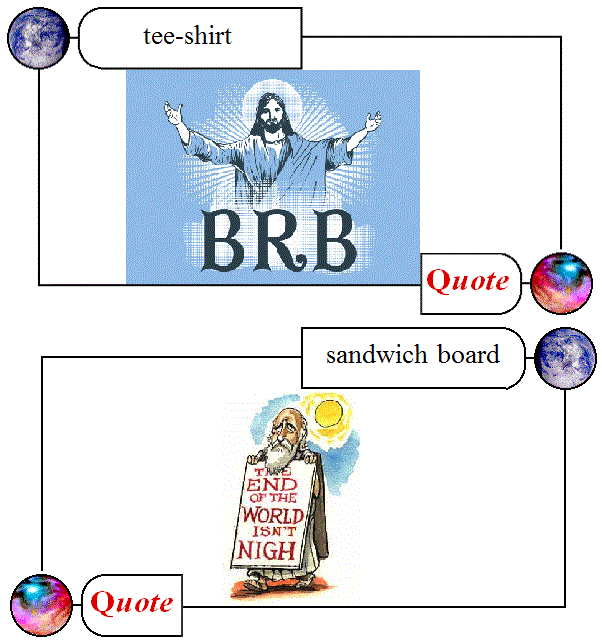
It seems to be a meme that cartoonists and satirists enjoy, too…

.

quo-end-times.gif

*

The thing is, there are two worldviews here, which we could conveniently label sacred and secular – though there’s no reason why one can’t hold a “sacred” view of the world (as I do) and not expect it to end any time soon (I don’t), or a “secular” view, and expect a new ice age or terminal global warming around the next bend in the road…

Two worldviews. And here’s where we get a “clash of cultures”.

Either there exists a definitive blueprint for the future of geopolitics – in Daniel, Ezekiel, and Revelation — or the future of geopolitics is something we’ll have to wrangle ourselves, using our best intelligence, wisdom and material resources.

On Sunday, you can go learn about the blueprint in an evangelical church – or you can kick back with the Sunday supplements and “Meet the Press”. And nobody much minds if you do one thing, and your neighbors do the other.

Things get interesting, however, when geopolitical decision times come around, and a great nation must decide what to do about the Palestinians, say, or Iran.

*

Okay.

Joel Rosenberg is a writer of popular, well-crafted thrillers – a Tom Clancy for the end times set.

Since his books are engaging, and since Glenn Beck frequently features Rosenberg on his show, his most recent novel, The Twelfth Imam, has been enjoying pretty decent sales, making it to #8 on the NYT best-seller list, #8 on Publisher’s Weekly and #10 on the WSJ hard-cover fiction lists in one week, not so long ago. And since I’m a student of comparative eschatology, I read his work with considerable interest, and follow his blog.

Today, he wrote:

As international support builds for the Palestinians to unilaterally declare their own state at the U.N. General Assembly opening session in September, I am growing increasingly concerned the President Obama is preparing to endorse such a move and even push for it. This would be a terrible mistake.Bible prophecy makes it clear that in the last days the nations of the world will divide up the land of Israel. But the Scriptures are also crystal clear that the nations will face the judgment of Almighty God for doing so. “For behold, in those days and at that time, when I restore the fortunes of Judah and Jerusalem, I will gather all the nations and bring them to the Valley of Jehoshaphat [“the Lord judges”]. Then I will enter into judgment with them there on behalf of My people and My inheritance, Israel, whom they have scattered among the nations; and they have divided up My land.” (Book of Joel 3:1-2).

Let the nations be warned by the God of Israel: they are on a dangerous and disastrous road. Let us pray they turn around before it is too late.

*

That’s actually a pitch for geopolitics by Biblical fiat — as Rosenberg explicitly points out:

One could wish the clear warning of the Bible would be enough to dissuade the President from dividing the land of Israel. I am not sure it will. Perhaps sheer politics will help.

If you believe in the sacred “Biblical blueprint” theory, and believe that the end times are very rapidly approaching, this should encourage you. If you believe in the secular “let’s hope our politicians don’t fubar this one” it might worry you – because you don’t trust some writers a couple of millennia ago to have an accurate appraisal of today’s Middle East, when even our intelligence services don’t claim to be able to predict the outcomes of various interventions in a complex situation, with unknown unknowns to boot.

And of course you might also be Israeli (and hold a sacred or secular viewpoint), Iranian (secular or sacred), or just not interested in geopolitics.

In Iran, the holders of a sacred, end times tradition are in power. In the US, the holders of a sacred, end times tradition exert some political influence. If you’re in Israel, you may hope and / or pray the Iranian end timers don’t visit their scenario on your head. If you’re a Palestinian, you may hope and / or pray the American end timers don’t visit theirs on yours.

I think it’s good to be aware of these things, but not get too excited.

*

More to follow in A two part meditation, part ii: of monks and maniacs.


Switch to our mobile site