Analogy as the Core of Cognition
Tuesday, December 28th, 2010
[ by Charles Cameron ]
We’ve been having an intriguing discussion recently in the comments here on Zenpundit about mapping / modeling complex situations in a way that leaves us humans more liable to come to nuanced understandings and less liable to unintended consequences, and one point that keeps on cropping up is the need to pare down the number of nodes in our mapping without losing sight of the subtleties…
I was thus delighted to find, as I was doing my morning trawl of usual and unusual news sources, that Glenn Beck had come out with his estimate of how many Muslim terrorists there are in the world (10% of the global Muslim population, ie 157 million), Fareed Zakaria had refuted him — and there was even a helpful Silobreaker network diagram to show me how the relevant nodes under discussion fit together:
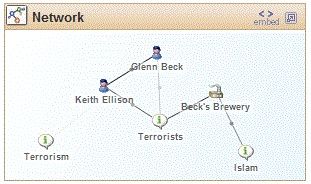
I was delighted to see that (Mormon) Glenn Beck is more closely associated with (Muslim) Rep. Keith Ellison than he is with terrorists, and sorry to note that Beck’s Brewery and Islam are somehow linked… But naturally, once I had seen this much I wanted to drill down even deeper — so I entered the appropriate keywords at Silobreaker and found this:
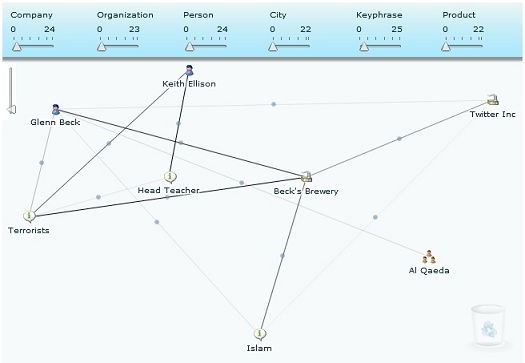
You’ll see that Beck’s link with Al Qaeda is, thankfully, a weak one. And I think you’ll agree with me that even shifting from a six node to an eight node graph considerably ups the sophistication of analysis required to fully comprehend the issues portrayed.
*
In any case, I thought it might be appropriate to post Silobuster’s more detailed map of the current situation with WikiLeaks here:
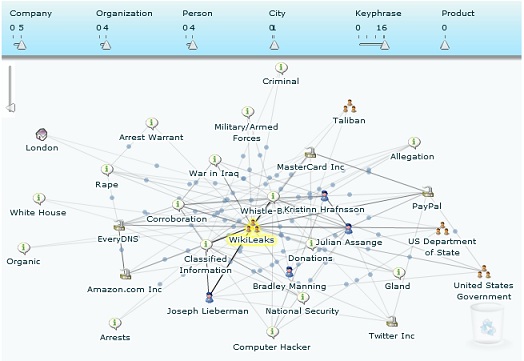
All becomes clear, eh?
I particularly like the node labeled “Gland” (it’s almost hidden but not quite, you’ll find it lower right, between PayPal and Twitter)– that might be the one I’d zero in on to get a fuller appreciation of the complexities of the situation.
And for the record, this post is an example of British “humor” — or as we prefer to call it, “dry wit”.
by Charles Cameron
[ cross-posted from ChicagoBoyz ]
I’ve been thinking…
*
Reports, overstatements and underestimates
There are factual reports of violence and threats of violence, which are within the proper province of journalism and intelligence gathering.
There are also overstatements of such reports, generally resulting from paranoia, hatred, recruitment, or the desire to increase sales of advertising or munitions.
And there are understatements of such reports, generally resulting from sheer ignorance or a desire to be diplomatic.
*
Religious sanctions for violence
Similarly, there are factual reports of sanctions for violence in the scriptures, hagiographies and histories of various religions.
There are also overstatements of such reports, attributing to entire religions the beliefs and or activities of a significant subsection or outlier group of that religion
And there are understatements of such reports, avoiding the attribution of violence to religious beliefs regardless of whether the religious correlation is a “cover” for other motives or a sanction powerfully affecting the actions of those who respond to it.
*
Proportional and disproportionate responses
There are actions which represent a balanced and proportional response to threats or acts of violence, whether they be made at home or abroad, by the military or law enforcement, for reasons of just war or of security.
There are actions which present an unbalanced and disproportionate heightened response to acts of violence, into which category I would place both over-reactive military responses and over-reactive domestic security measures.
And there are inactions which are no less unbalanced as responses to acts or threats of violence, as with political wool-gathering or appeasement, bureaucratic failures to implement realistic information sharing and dot-connection within the IC, or public aversion to factual news or intelligent, nuanced analysis.
*
Ideals, kumbaya and skepticism
There are honest statements of aspiration for peaceable outcomes to current and future conflicts.
There are versions of such aspirations which naively overlook the very real correlations between religious sanctions and violence.
And there are skeptical aversions to such aspirations, which no less naively overlook the very real differences which are present between the most angry, the most terrified, the most politically driven, the most financially interested and the most generous members of any and every religious and irreligious viewpoint.
*
Let’s talk…
It is useful to bear these distinctions of category in mind, and to make accurate appraisals of one’s information inputs in terms of which categories they fall under, and how much trust one should therefore place in them.
There: it was on my mind and I have said it.
This is, as my title indicates, a first draft. I hope it will spark some interesting conversations, and lead to further insight and refinement…
by Charles Cameron
[ cross-posted from ChicagoBoyz ]
A great many people will have seen (or designed) some variant of the “coexist” bumper-sticker / tee-shirt design:

— the first of which can be found on acsapple‘s photobucket — and hey, the “aum” sign for “oe” is a brilliant bit of graphic substitution! – while I nabbed the second here.
What with a thousand flowers blooming, the importance of preserving memetic variations, peaceful coexistence and all, it’s only natural that some will have different takes on the matter —

— the first of these comes from the blog of a gun-toting political refugee from the People’s Progressive Republic of Massachusetts, while the second is a tee-shirt design by Matt Lussier, and you can get your tee-shirt here…
*
As for myself, I have fond memories of India, and was accordingly heartened to see this on an Indian Muslim site…

which is what set me thinking about “coexistence” graphics in the first place.
*
Did I ever tell you about the sign I saw over a shop in Delhi, advertising the sale of mythelated spirits?
I frequently feel just a tad mythelated myself.

Via John Hagel, a particularly interesting NYT article on the neroscience of metaphors. I have always considered metaphors and analogies to be a “spark” or a “catalyst” to insight but they appear to be potentially structural organizers or “signal switches” of information processing:
This Is Your Brain on Metaphors
….Symbols, metaphors, analogies, parables, synecdoche, figures of speech: we understand them. We understand that a captain wants more than just hands when he orders all of them on deck. We understand that Kafka’s “Metamorphosis” isn’t really about a cockroach. If we are of a certain theological ilk, we see bread and wine intertwined with body and blood. We grasp that the right piece of cloth can represent a nation and its values, and that setting fire to such a flag is a highly charged act. We can learn that a certain combination of sounds put together by Tchaikovsky represents Napoleon getting his butt kicked just outside Moscow. And that the name “Napoleon,” in this case, represents thousands and thousands of soldiers dying cold and hungry, far from home.
And we even understand that June isn’t literally busting out all over. It would seem that doing this would be hard enough to cause a brainstorm. So where did this facility with symbolism come from? It strikes me that the human brain has evolved a necessary shortcut for doing so, and with some major implications.
….This potential to manipulate behavior by exploiting the brain’s literal-metaphorical confusions about hygiene and health is also shown in a study by Mark Landau and Daniel Sullivan of the University of Kansas and Jeff Greenberg of the University of Arizona. Subjects either did or didn’t read an article about the health risks of airborne bacteria. All then read a history article that used imagery of a nation as a living organism with statements like, “Following the Civil War, the United States underwent a growth spurt.” Those who read about scary bacteria before thinking about the U.S. as an organism were then more likely to express negative views about immigration.
Another example of how the brain links the literal and the metaphorical comes from a study by Lawrence Williams of the University of Colorado and John Bargh of Yale. Volunteers would meet one of the experimenters, believing that they would be starting the experiment shortly. In reality, the experiment began when the experimenter, seemingly struggling with an armful of folders, asks the volunteer to briefly hold their coffee. As the key experimental manipulation, the coffee was either hot or iced. Subjects then read a description of some individual, and those who had held the warmer cup tended to rate the individual as having a warmer personality, with no change in ratings of other attributes.
From this simple associative effect are the conditions from which a “eureka” moment of insight can crystallize, as it did for Archimedes in his bath:
Effect—-> Association —-> Orientation ——> Insight ——> Extrapolation/Generalization
ADDENDUM:
Curtis has commented and expanded the discussion, though his comments seem to go into my akismet spam folder. Should be fixed now:
WOODA = C(OODA) + A(OODA) / 4GW & 5GW
There is the potential not only for insight but also for deception, whether the deceivers are others in our milieu or we ourselves (and our brains) may be deceivers….
True. Metaphors and analogies can crystallize insughts but they can also become powerfully attractive distorions of reality – sort of “anti-models” or “false models”.
….As a model of what might be called metaphorization, these similarities make sense. The OODA in all its forms, including the WOODA which includes World, represents a dynamic process of cycling (although perhaps not always uniform and unidirectional cycling) of information. The focal point of the A-OODA, Observe above, is the abstract locus of observation: New information received from without comes into contact (abstractly speaking!) with previously built understandings, or Mental Constructs, and relatively newer insights, or Conditional Constructs. These diverse abstract observations have, to some extent, already prepared the mind for interpretation of new information and, these observations taken as whole create an opportunity for triangulation (of a sort.) Using Mark Safranski’s terminology, after the information is Associated, it is Oriented through analysis and synthesis, Insights may form the basis of new hypotheses which may either be conditional (re-looped into further observation w/ outside information and previous understandings) or may be accepted as finalized understandings about what one has observed (Extrapolation/Generalization).
Hmmmm…. I have read that “insight” as a neurocognitive event tends to occur in two brain regions, the lateral inferior prefrontal cortex and the anterior cingulate cortex. The associative work of insight correlates with the former region but the “combinatory play” cited by Einstein and referenced , if I recall, by Charles and leading to new hypothesis correlates with the latter. I am not a neuroscientist, so I am now wondering if insight is a distributed, parallel processing, brain function or if we are really talking about two separate cognitive effects – an “Insight 1” and “Insight 2”?
Anyone who cares to weigh in here, feel free…..

Zenpundit is a blog dedicated to exploring the intersections of foreign policy, history, military theory, national security,strategic thinking, futurism, cognition and a number of other esoteric pursuits.
Customized Web Site & Blog Design


