The Sociobiological Origins of Beauty
Sunday, March 6th, 2011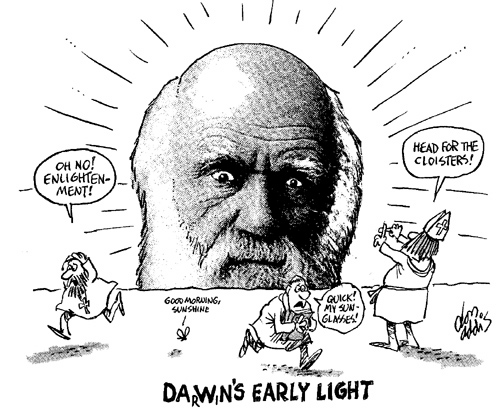
Great multidisciplinary talk by Dr. Denis Dutton on the possible evolutionary origins on culturally universal concepts of aesthetic beauty.
Great multidisciplinary talk by Dr. Denis Dutton on the possible evolutionary origins on culturally universal concepts of aesthetic beauty.
J. Scott Shipman, the owner of a boutique consulting firm in the Metro DC area that is putting Col. John Boyd’s ideas into action, is a longtime friend of this blog and an occasional guest-poster. Scott has an important report regarding the “war of ideas” against the Islamist-Takfirist enemy in Afghanistan after attending a workshop hosted by DARPA.
DARPA, STORyNet and the Fate of the War
by J. Scott Shipman
I had the opportunity to attend a DARPA workshop yesterday called STORyNet. The purpose was to survey narrative theories, to better understand the role of narrative in security contexts, and to survey the state of the art in narrative analysis and decomposition tools (see below):
This STORyNET workshop has three goals:
1. To survey narrative theories.
These empirically informed theories should tell us something about the nature of stories: what is a story? What are its moving parts? Is there a list of necessary and sufficient conditions it takes for a stimulus to be considered a story instead of something else? Does the structure and function of stories vary considerably across cultural contexts or is there a universal theory of story?
2. To better understand the role of narrative in security contexts.
What role do stories play in influencing political violence and to what extent? What function do narratives serve in the
process of political radicalization and how do theyinfluence a person or group’s choice of means (such as violence) to achieve political ends? How do stories influence bystanders’ response to conflict? Is it possible to measure how attitudes salient to security issues are shaped by stories?
3. To survey the state of the art in narrative analysis and decomposition tools.
How can we take stories and make them quantitatively analyzable in a rigorous, transparent and repeatable fashion? What analytic approaches or tools best establish a framework for the scientific study of the psychological and neurobiological impact of stories on people? Are particular approaches or tools better than others for understanding how stories propagate in a system so as to influence behavior?
I was alerted to the meeting by a member at one of my “groups” at LinkedIn and just barely made the registration cut-off. It was a good meeting, but not reassuring on our situation in Afghanistan—you’ll see why below.
As a “hobby” I’ve been tinkering with the implications of patterns with respect to language and communications. Just about every presumption I have articulated over the last several months is being pursued in one way or another—which is good news for our guys. While the on-going research is good, I do believe there is room for better and more imaginative thinking, although I didn’t say anything during the meeting for once, I kept my mouth shut and just listened.
This is exceptionally brief and decidedly non-techincal. Here are some observations of interest:
– End
COMMENTARY:
Zen here:
First, I’d like to cordially thank Scott for letting me share his insights gleaned from the workshop here with ZP readers. This is one of those fascinating events largely unavailable to those folks residing outside a reasonable driving distance from the Beltway.
Secondly, I am heartened that the brilliant folks at DARPA are taking the theological-ideological discourse of the enemy seriously in analyzing the power of narrative. Charles Cameron makes that point here with regularity. Michael Scheuer, Gilles Kepel and Olivier Roy did so even before 9/11. Our political appointees and policy makers remain steadfastly allergic to this reality, unable to process or discuss in public with coherence how religious ideas are a root for political extremism. Col. David Kilcullen, who certainly understands political Islam better than most and whose creative and analytical acheivements in structuring a framework for countering insurgency are second to none, eschews dealing with the topic in his theoretical writings on COIN where it can be avoided. That is the cost imposed by the political correctness to which our ruling elite are psychologically welded.
It comes as no surprise to me that only after “10 years of war” are we finally “getting the importance of Pashtun culture”.
Maybe at the dawn of the 22nd century we will be “old hands”.
[ by Charles Cameron ]
*
The description of Egyptian troops attacking a Christian monastery that forms the first quote in this DoubleQuote is horrifying in many ways.
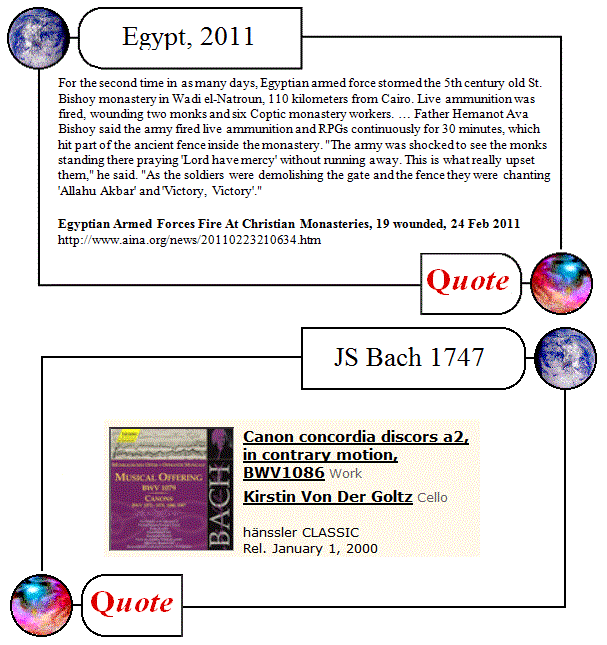
Recent events in Egypt had featured mutual support between Muslims and their Coptic Christian neighbors, each group in turn acting as human shields to protect the other while they were praying. Here, by contrast, the army – which is effectively now “ruling” Egypt in the interregnum between the fall of Mubarak and the election of a new President and government – is attacking the humans it is supposed to protect.
But what does that have to do with Bach?
*
Part I: a monastery attacked in Egypt
This is vile.
Those who are being attacked happen to be Christians and monks, no less human on either account, and just as subject to bleeding as others – so they might ask, with Shakespeare‘s Shylock speaking for the Jews:
If you prick us do we not bleed? If you tickle us do we not laugh? If you poison us do we not die? And if you wrong us, shall we not revenge?
That last question of Shylock’s is an interesting one, and gets to the heart of what I want to discuss here, as we shall see.
Specifically, these human beings were monks. Muhammad had a higher opinion of monks than of many others. In the Qur’an, we find:
The nearest to the faithful are those who say “We are Christians.” That is because there are priests and monks among them and because they are free of pride.
*
Sigh.
These “followers” of Muhammad were attacking Christian monks with live ammunition and RPGs continuously for 30 minutes, wounding 19.
They felt superior to their compatriots the monks, they cried “God is Great” and “Victory, Victory” as they did it.
In this they resemble GEN Boykin, who famously responded to a Somali warlord claiming that God would protect him, “Well, you know what? I knew that my God was bigger than his. I knew that my God was a real God and his was an idol.”
I could easily have made that my second quote here, pairing it with the description of the Egyptian army attack on the monastery, for between the two of them they raise the question of whether weaponry is stronger than belief – and while some Christians might agree with General Boykin, some Muslims might agree no less strongly with the members of the Egyptian military shouting “Allahu Akbar”.
*
I believe that taking sides here misses the point.
Which I am happy to say, Abraham Lincoln made with considerable eloquence in his Second Inaugural Address in 1865, almost a century and a half ago:
The prayers of both could not be answered. That of neither has been answered fully. The Almighty has His own purposes.
That point is one which HaShem made to his angels, according to rabbinic teaching:
The Talmud teaches us that on the night that the Egyptian army drowned in the Red Sea, the first true moment of freedom for the Jews fleeing Egypt, God refused to hear the angels sing their prayers, and said “my creations are drowning in the sea, and you will sing songs?”
So, no — revenge is not the way to go…
*
But please note that the point I am making is not one of moral equivalence.
That God which created “both sides” in any human conflict and loves each and every one of his own creations, might indeed find one creed superior to another, as he might find one scientific law more accurately describing the workings of, say, gravitational attraction than another – or the night sky at Saint-Rémy portrayed by Van Gogh more or less moving than the thunderous sky over Toledo of El Greco.
In the view I am proposing, the “God who takes neither side” in fact takes both, but with this distinction: he sides with the wounded more than with those who inflict wounds – not because one side has a better creed than the other, but because he made us to learn not to unmercifully maim and destroy one another…
…one of whose names is The Merciful, in whose scriptures it is written:
If thou dost stretch thy hand against me, to slay me, it is not for me to stretch my hand against thee to slay thee: for I do fear Allah, the cherisher of the worlds.
…one of whose names is The Lord is Peace, in whose scriptures it is written:
Love your enemies and pray for those who persecute you.
*
Part II: Bach and contrapuntal analysis
All of which brings me to the second “quote” in my DoubleQuote above: JS Bach‘s “concordia discors” canon in two voices, BWV 1086 – which you can hear or purchase here.
Bach’s mastery was in counterpoint, the play of one musical idea against another, and in this particular work, the two ideas are exact opposite: in musical terms, the melody is played here against its inversion. And the point of counterpoint, if I may put it that way, is not to provide “harmony” but to show how discord can become harmonious and concordant — or to put that in the geopolitical terms that interest me, how conflict and opposition can be resolved…
Not, you understand, that this state of affairs then leads necessarily to the singing of Kumbaya or the kind of ending in which “they all lived happily ever after”.
Concordia discors: the resolution of the present conflict, in a continuing overall “music” of great power and beauty, in which further conflicts will inevitably arise and find resolution.
*
Here’s the essence: Bach takes contrasting and at times conflicting melodic ideas and makes music.
He teaches us to hear distinct and differing voices, to allow ourselves to hear and feel both the discomfort that their disagreements raise in us, and the satisfaction that comes as those disagreements are worked out. He does this by teaching us to hear them as voices within a choir, ribbons in a complex braid, making together a greater music that any of them alone could give rise to. And in this process, their differences are neither denied nor lost, but resolved and transcended.
Edward Said, whose politics my readers may dislike or like or even perhaps be unaware of, was for years the music critic for The Nation, wrote three books (and an opus posthumous) on music, and with his friend the pianist and conductor Daniel Barenboim co-founded the West-Eastern Divan Orchestra, named for the West-östlicher Diwan, Goethe’s collection of lyric poems.
Barenboim (the Israeli) wrote of Said (the Palestinian):
In addition to being well versed in music, literature, philosophy, and the understanding of politics, he was one of those rare people who sought and recognized the connections between different and seemingly disparate disciplines. His unusual understanding of the human spirit and of the human being was perhaps a consequence of his revelatory construct that parallels between ideas, topics, and cultures can be of a paradoxical nature, not contradicting but enriching one another.
And there we have it again: Bach’s insight, this time transposed by an accomplished musician into the key of thoughts and ideas…
*
Said talks quite a bit about counterpoint, both musically:
Musically, I’m very interested in contrapuntal writing, and contrapuntal forms. The kind of complexity that is available, aesthetically, to the whole range from consonant to dissonant, the tying together of multiple voices in a kind of disciplined whole, is something that I find tremendously appealing.
.
[Said, Power, Politics and Culture, p. 99.]
and politically:
When you think about it, when you think about Jew and Palestinian not separately, but as part of a symphony, there is something magnificently imposing about it. A very rich, also very tragic, also in many ways desperate history of extremes — opposites in the Hegelian sense — that is yet to receive its due. So what you are faced with is a kind of sublime grandeur of a series of tragedies, of losses, of sacrifices, of pain that would take the brain of a Bach to figure out. It would require the imagination of someone like Edmund Burke to fathom.
.
[Said, Power, Politics and Culture, p. 447.]
*
As I commented in an earlier post that ties in with this one, the great pianist Glenn Gould was also preoccupied with counterpoint, both in Bach’s music and in conversations overheard at a truck-stop cafe or on long train journeys — he too was “working” the parallel between melodic and verbal forms of counterpoint.
And JRR Tolkien made the reconciliation of discordant musics in a greater concord the central to his creation myth in The Silmarillion, “The Music of the Ainur”, which can now be read online at the Random House site.
*
Part III: invitation
May I strongly commend to your attention the movie, Of Gods and Men, which just opened in limited release, having won the grand jury prize at Cannes…
[ by Charles Cameron — cross posted from DIME/PMESII ]
I seem to be writing some mini-essays that braid together more of the various strands of my interests and thinking than usual – geopolitics and poetics, games and reality, warfare and peacemaking.
Here’s one that I posted yesterday, on a list devoted to modeling and simulation, in a topic discussing DARPA’s STORyNET briefing tomorrow.
*
DARPA and Storytelling:
One
Sophocles, pushing the human mind to its limit, genius, wrote the Oedipus trilogy. His plays, which turn on the parallel guilt and innocence of a man who – unknowingly, the fated plaything of cruel gods — kills his father and sleeps with his own mother, were performed by the great actors of his day in the great amphitheater of Epidaurus, the sanctuary of Aesculapius to which the Greeks went for healing.
Freud, also brilliant, also concerned with the human mind and healing, reduced Sophocles’ plot to his own “Oedipus Complex” – which he would then painstakingly find in the murkiest regions of his patients’ mental processing.
Further reduced, the concept becomes a word of abuse so radical it takes two letters, one hyphen and ten asterisks to print it – and finally, it slides into song and speech as mofo, all meaning leached from the two words, let alone the complex insights of Sophocles or Freud.
Two
Story, you might say, has a trunk, limbs, branches, lesser branches, twigs…
Trees and ferns, we now know, are fractal. The mathematical “story” of a tree is arguably just one story: branching. Different trees branch differently, the yucca pushing out its limbs in 90 degree rotation, oaks and birches, beeches and cottonwoods, poplars and ferns each having their own mathematical characteristics, and each individual of each species answering to certain specifics of context – water, sunlight, wind forming clusters of trees into copses.
For the purposes of lumber, the “trunk” of a story may be enough, or trunk and limbs, mofo or m*****-f***** an adequate telling of Sophocles tale. For a winter wood supply, cords of sawn branches, for a camp fire, some branches some twigs — for Sophocles, for Ansel Adams, the one pushing the human mind to its limit, genius, only the full tree, root, stem, branch, and leaf, rich in all its detail and context, will suffice.
Three
So there are six stories, there is only one, the stories in the ocean of stories are infinite, as Salman Rushdie, another of those who pushes the human mind to its limit tells us:
… the Water Genie told Haroun about the Ocean of the Streams of Story, and even though he was full of a sense of hopelessness and failure the magic of the Ocean began to have an effect on Haroun. He looked into the water and saw that it was made up of a thousand thousand thousand and one different currents, each one a different color, weaving in and out of one another like a liquid tapestry of breathtaking complexity; and [the Water Genie] explained that these were the Streams of Story, that each colored strand represented and contained a single tale. Different parts of the Ocean contained different sorts of stories, and as all stories that had ever been told and many that were still in the process of being invented could be found here, the Ocean of the Streams of Story was in fact the biggest library in the universe. And because the stories were held here in fluid form, they retained the ability to change, to become new versions of themselves, to join up with other stories and so become yet other stories …
— and as Edward Tufte, another of the pushers of the mind, illustrates for us in his beautiful book, Visual Explanations, in a page or two of which this snapshot gives only a poor glimpse.
Four
So there is utility in the single equation, the single story line, and there is use for the outlines of the major branchings and knowing the main varieties of trees, and there is beauty and insight and pushing the mind to its limit in the whole tree, individual and splendid in all its detail, the great story, magnificently branching from its seed-story under the influence of a Shakespeare, a Kafka, a Dostoyevsky, a Borges, a Rushdie…
The full spectrum of understanding that narrative might bring us will be found when the full spectrum from “one story” through “six” or “sixteen” to Rushdie’s “infinity” is taken into account, when we weigh the insights of the great novelists and poets of all cultures – Rumi, Shakespeare, Kalidasa, the anonymous singers of the Navajo Beautyway – alongside those of the critic, the psychoanalyst, the guy who puts together the Cliff’s Notes, and the editor with a headache’s headline version of the tale.
We need the forester and the lumber baron, the watercolorist and the fellow who identifies the habitats of the Lepidopterae…
Narrative goes all the way from the obvious platitude to the work of genius. Somewhere along that scale, each one of us will have our area of interest, the place where our skill set fits and perhaps stretches. Numbers of board feet and likely return on investment can be assessed by quantitative means: the beauty of a particular oak tree in the eye of the novelist John Fowles is entirely qualitative, as is the language he must use to describe it.
Five
I suspect DARPA may be stuck at the quantitative end of the spectrum. The mind of a Musab al-Suri demands a finer level of interpretation.
A while back, I added Ribbonfarm to the blogroll, which is written by Dr. Venkat Rao, a corporate scientist type, after John Hagel featured in his twitterstream an old but amusing post by Rao analyzing sociopathology in corporate life via characters from The Office. Clever. I thought I would blogroll him and check in periodically.
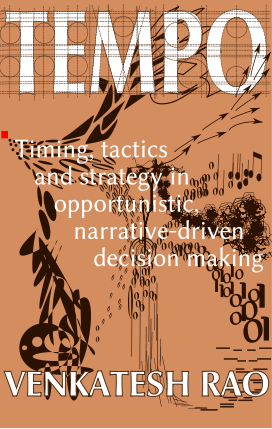
Later, I noticed that Rao makes frequent references to Clausewitz in his posts and that he is writing Tempo, a book on decision making that will be of great personal and professional interest to many readers here. At this juncture, I’m intrigued.
Then last week, Rao featured a lengthy post on metacognition where he made some excellent points. Here’s a few of them, but as I can only put up a small selection, you should go read the full post:
….To build mathematical models, you start by observing and brain-dumping everything you know about the problem, including key unknowns, onto paper. This brain-dump is basically an unstructured take on what’s going on. There’s a big word for it: phenomenology. When I do a phenomenology-dumping brainstorm, I use a mix of qualitative notes, quotes, questions, little pictures, mind maps, fragments of equations, fragments of pseudo-code, made-up graphs, and so forth.
You then sort out three types of model building blocks in the phenomenology: dynamics, constraints and boundary conditions (technically all three are varieties of constraints, but never mind that).
Dynamics refers to how things change, and the laws govern those changes. Dynamics are front and center in mathematical thought. Insights come relatively easily when you are thinking about dynamics, and sudden changes in dynamics are usually very visible. Dynamics is about things like the swinging behavior of pendulums.
Constraints are a little harder. It takes some practice and technical peripheral vision to learn to work elegantly with constraints. When constraints are created, destroyed, loosened or tightened, the changes are usually harder to notice, and the effects are often delayed or obscured. If I were to suddenly pinch the middle of the string of a swinging string-and-weight pendulum, it would start oscillating faster. But if you are paying attention only to the swinging dynamics, you may not notice that the actual noteworthy event is the introduction of a new constraint. You might start thinking, “there must be a new force that is pushing things along faster” and go hunting for that mysterious force.
This is a trivial example, but in more complex cases, you can waste a lot of time thinking unproductively about dynamics (even building whole separate dynamic models) when you should just be watching for changes in the pattern of constraints.
….Historians are a great example. The best historians tend to have an intuitive grasp of this approach to building models using these three building blocks. Here is how you can sort these three kinds of pieces out in your own thinking. It involves asking a set of questions when you begin to think about a complicated problem.
- What are the patterns of change here? What happens when I do various things? What’s the simplest explanation here? (dynamics)
- What can I not change, where are the limits? What can break if things get extreme? (constraints)
- What are the raw numbers and facts that I need to actually do some detective work to get at, and cannot simply infer from what I already know? (boundary conditions).
Besides historians, trend analysts and fashionistas also seem to think this way. Notice something? Most of the action is in the third question. That’s why historians spend so much time organizing their facts and numbers.
Nice. There’s a multitude of places here to jump off and generate further epistemic analysis, and I am sure that some of the admirers of Boyd, Polanyi, Wohlstetter, Feynman, Kahn and Clausewitz in the ZP readership might do so in the comments. Or my co-blogger Charles might weigh in from the imaginative/mythic/visual domain. We’ll see.
Regardless, I think if you are following blogs like Metamodern, Thomas P.M. Barnett, Open the Future, Global Guerrillas, John Hagel’s Edge Perspectives, Eide Neurolearning Blog or liked the old Kent’s Imperative (suddenly live again after being dormant for 2 years), you’ll want to consider adding Ribbonfarm to your RSS feed or blogroll.
ADDENDUM:
Ed at Project White Horse, another fine site for your blogroll, is also blogging on boundary conditions:
Stall, Spin, Crash, Burn and Die – Boundary Conditions for 2011
….You can’t fix things without some understanding, real understanding of the problem – nor can there be real leadership without actionable understanding. That’s where establishing boundary conditions as a vehicle to frame the problem – and therefore garner greater insight – become important.
Drilling for oil at a depth of 5000ft and in open ocean – Deepwater Horizon – should have been/should be seen as a “crisis” in waiting no matter the historical track record. Proper understanding would have meant that the National decision making level immediately recognized the high potential for the initial crisis migrating into a severely complex catastrophe after the explosion and acted, not waiting to see if BP’s response plans would work. Activities in “Blue Water”/open ocean are not a linear extrapolation from “inshore,” nor is 5000 ft a linear extrapolation from 200ft or 500ft. depths. BP’s plans might have been up to the problem, but the shear nature of the environment, if scrutinized in context of “unconventional” as described below, should have been a trigger to initiate intermediate action. Rather, the declaration of an Event of National Significance was 30+ days in coming??? A significant point, I believe, is the problem generated by not recognizing the nature or even acknowledging the existence of a different kind of problem, one potentially very complex or stochastic in nature – an “unconventional crisis.”

Zenpundit is a blog dedicated to exploring the intersections of foreign policy, history, military theory, national security,strategic thinking, futurism, cognition and a number of other esoteric pursuits.
Customized Web Site & Blog Design

