zenpundit.com » social networks

Archive for the ‘social networks’ Category

Even a Dancing Fool Can be a Leader

Monday, March 8th, 2010

A big hat tip to John Robb for finding and posting this gem. I guess Nazism, the French and Russian Revolutions, the Spartacus Revolt and several world religions could all have been ignited by an inspired moment of interpretive dance:

Reflecting on Neo-COIN and the Global Insurgency, Part I.

Saturday, February 27th, 2010

Read a very interesting theoretical paper critiquing the merits of “Neo-Classical COIN” contrasted with the concept of “Global Insurgency” by Dr. David Martin Jones and Dr. M.L.R. Smith in The Journal of Strategic Studies, which drew a sharp rebuttal from Dr.John Nagl, the president of CNAS, and Brian M. Burton in defense of a universally applicable COIN paradigm (big hat tip to Steve Pampinella). 

The papers deserve much wider circulation and I encourage you to find yourself a copy. Unfortunately, they are behind an irritating subscription wall, so we have to do this in 20th century, stone-age, fashion….

David Martin Jones* and M.L.R. Smith**. “Whose Hearts and Whose Minds? The Curious Case of Global Counter-Insurgency”. The Journal of Strategic Studies. Vol. 33, No. 1, 81-121, February 2010.

*University of Queensland, Australia. ** King’s College London, UK.

John A. Nagl and Brian M. Burton. “Thinking Globally and Acting Locally: Counterinsurgency Lessons from Modern Wars – A Reply to Jones and Smith.  The Journal of Strategic Studies. Vol. 33, No. 1, 123-138, February 2010.

Center for New American Security (CNAS), Washington, DC, USA.

Jones and Smith are dissecting “the extraordinary renaissance of counter-insurgency thinking within the U.S. military establishment” which they argue has “produced two distinctive schools of thought about counter-insurgency”; the “neo-classical” which constructs a framework for waging COIN from the historical understanding of Maoist guerrilla warfare, and “global counterinsurgency” which is “post-maoist”, conceptual and networked rather than territorial and hierarchical and centered in the ideological turmoil or radical salafist-jihadi Islamism. Together, the two schools comprise “neo-COIN” which yields an “incoherent” and “confused and contradictory understanding” of insurgency which is rooted in a hostility and miscomprehension of Clausewitzian thought.

The breezy summary above was, by the way, a gross simplification of a forty page, heavily footnoted, academic argument, which really needs to be read in its entirety.

Jones and Smith go into considerable depth investigating the intellectual orgins of “neo-COIN” and the leading personalities who shaped the doctrine, including Nagl, Sewall, McFate, Kilcullen, Hoffman and commanding generals like Petraeus and Chiarelli.

Of the two schools, the authors find greater flaws on the neo-classical approach to COIN:

….Ultimately though, excessive deference to Maoist theories of guerrilla warfare led neo-classicism into a strategic, Iraq-centric, cul-de-sac….

….Such crude reductionism, ultimately leads to a cdrude Maoist/Counter-Maoist paradigm that assumes holding on to physical territory, no matter the cost, is the ultimate goal of any combatant. This neo-classical reductionism not only implies that any withdrawal of forces from an occupied territory represents a defeat, it also risks inducing the kind of certainties that influenced the French approach to COIN during the Algerian War with manifestly disastrous consequences

But the global insurgency school, while more accurately conceptualizing the transnational nature of the enemy in the view of Smith and Jones, is not without problems either:

However, when it comews to identifying the drivers of jihadism, global COIN theorists are surprisingly coy. Significantly, global neo-COIN writing goes to great lengths to dismiss the religious and ideological motivation for Islamist activism. Instead, it focuses upon organizational characteristics, social networks, psychological profiling, and patterns of recruitment to understand the new global threat….Like the notion of a War on Terrorism, global counter-insurgency denotes an amorphous threat, conceals hidden assumptions and obfuscates the object of the war, namely militant, ideologized Islam or Islamism.

This “negation of ideological motivation” identified by Jones and Smith in global counter-insurgency, is blamed on two sources. First, Dr. David Kilcullen, the deeply influential Australian Army officer and anthropologist who has been the COIN adviser to the Departments of State and Defense and CENTCOM, who argues for the primacy of “sociological characteristics” as drivers to jihadism; secondly, on a fear of the implications of Clausewitzian theory that causes neo-COIN advocates to purposefully “misunderstand” On War:

From a political perspective, however such neo-COIN misunderstanding is not so strange at all. McFate evidently recognizes Clausewitz’s central premise that  ‘War is a continuation of political intercourse, carried on by other means’. It is this recognition though, that unsettles COIN theorists. The reluctance to attribute religious motives to jihadist action, the emphasis on post-Maoism and the dismissal of Clausewitz, all evince a profound neo-COIN discomfort with the political dimension of war. It is the politics of modern jihadi resistance that contemporary counter-insurgency theorists wish to avoid: for politics denotes complexity, particularity, ambiguity, controversy and the need to challenge or defend specific value systems.

COMMENTARY:

Smith and Jones have identified some real weaknesses in COIN theory, a useful service. However, either they commit the same error in diagnosing the inability of COIN theorists to wrestle frankly with Islamism as they accuse Kilcullen, Nagl, McFate etc. of having made and do so for the same reason, or they evince a childish understanding of politics. I lean toward the former.

The ignorance of irhabi-salafist radical religious ideas and internal debates is a very serious analytical problem for the United States. Few scholars or analysts can boast of simultaneously having fluency in critical langues, a deep understanding of Islamist theology and expertise/experience in terrorism/counter-terrorism studies. And really, to make astute judgments, you need to have a grasp on all three. Avoiding the religious ideology dimension is a serious error on the part of COIN thinkers and Smith and Jones are right to call them out on it.  It would be very helpful, if COIN theorists in crafting doctrine, would avail themselves of the deep understanding of Islamism offered by a Gilles Kepel or an Olivier Roy.

That said, the religious ferment of Islamism applies more to the “professional” and not the “accidental” guerrilla. To the recruiter, ideologists, operational planner and other senior leaders of al Qaida and the Taliban and far less to the rootless cannon fodder, idle adventurers, middle-class losers, itinerant tribals and other flotsam and jetsam who compose the foot soldiers of modern jihad. Applying social network analysis or organizational theory adds a useful perspective to understanding to the mass-movement characteristics of violent Islamist groups.

That is not why Kilcullen or Nagl de-emphasize religious motivations though. It is not that COIN gurus at CNAS do not understand or are uncomfortable with political dimensions or are mystified about Islam and Islamism. That’s an absurd assessment. To the contrary, they understand politics exceptionally well. COIN advocates downplay the religious motivations of Islamist terrorists and insurgents because emphasizing them will cost COIN strategy the political support of many liberal-left Democrats in Congress whose PC ideology cannot tolerate such arguments to be heard, the facts be damned. To make such an analysis, before a group that is not overly supportive of the war to begin with, is to be tagged an “Islamophobe” or a “racist” (even though the latter insult makes no sense whatsoever).

For the same reason, academia having its own PC fetishes to an even greater degree than politicians, Smith and Jones do not specifically identify the domestic political incentives COIN advocates have for ignoring religious ideology.

Arquilla on the New Rules of War

Thursday, February 25th, 2010

John Arqilla, along with David Ronfeldt, was the pioneering military and security theorist who forseaw the rise of networked non-state adversaries, which they detailed in their now classic book, Networks and Netwars. Below, in a Foreign Policy mag article, Arquilla expounds on the failure of the Pentagon to adapt sufficiently to leverage the power of networks or counter those opponents who have done so.

The New Rules of War

When militaries don’t keep up with the pace of change, countries suffer. In World War I, the failure to grasp the implications of mass production led not only to senseless slaughter, but also to the end of great empires and the bankruptcy of others. The inability to comprehend the meaning of mechanization at the outset of World War II handed vast tracts of territory to the Axis powers and very nearly gave them victory. The failure to grasp the true meaning of nuclear weapons led to a suicidal arms race and a barely averted apocalypse during the Cuban missile crisis.
 
Today, the signs of misunderstanding still abound. For example, in an age of supersonic anti-ship missiles, the U.S. Navy has spent countless billions of dollars on “surface warfare ships” whose aluminum superstructures will likely burn to the waterline if hit by a single missile. Yet Navy doctrine calls for them to engage missile-armed enemies at eyeball range in coastal waters.
 
The U.S. Army, meanwhile, has spent tens of billions of dollars on its “Future Combat Systems,” a grab bag of new weapons, vehicles, and communications gadgets now seen by its own proponents as almost completely unworkable for the kind of military operations that land forces will be undertaking in the years ahead. The oceans of information the systems would generate each day would clog the command circuits so that carrying out even the simplest operation would be a terrible slog.
 
And the U.S. Air Force, beyond its well-known devotion to massive bombing, remains in love with extremely advanced and extremely expensive fighter aircraft — despite losing only one fighter plane to an enemy fighter in nearly 40 years. Although the hugely costly F-22 turned out to function poorly and is being canceled after enormous investment in its production, the Air Force has by no means given up. Instead, the more advanced F-35 will be produced, at a cost running in the hundreds of billions of dollars. All this in an era in which what the United States already has is far better than anything else in the world and will remain so for many decades.
 
These developments suggest that the United States is spending huge amounts of money in ways that are actually making Americans less secure, not only against irregular insurgents, but also against smart countries building different sorts of militaries. And the problem goes well beyond weapons and other high-tech items. What’s missing most of all from the U.S. military’s arsenal is a deep understanding of networking, the loose but lively interconnection between people that creates and brings a new kind of collective intelligence, power, and purpose to bear — for good and ill…..”

Read the rest here.

It was nice to see Arquilla give some props to VADM Art Cebrowski, who is underappreciated these days as a strategic thinker and is much critricized by people who seldom bothered to read anything he actually wrote. Or who like to pretend that he had said a highly networked Naval task force is a good way to tackle an insurgency in an arid, mostly landlocked, semi-urban, middle-eastern nation.

It also occurs to me that one of the reasons that the USAF resisted drones tooth and nail is that robotics combined with swarming points to en end ( or serious diminishment) of piloted warplanes. Eliminating the design requirements implicit in human pilots makes for a smaller, faster, more maneuverable, more lethal aircraft that will probably be infinitely cheaper to make, more easily risked in combat and usable for “swarming”. Ditto attack helicopters.

Of course, nuclear bombers will probably stay in human hands. Probably.

ADDENDUM:

Contentious Small Wars Council thread on Arquilla begun by “student of war” and defense consultant Wilf Owen. I have weighed in as has Shlok Vaidya.

Robb Throws Down the Gauntlet

Sunday, January 17th, 2010

To the legacy society of the nation-state and the hierarchical transnational corporation:

MILESTONE

….It’s time to up the ante and move onto the next phase:  the birth and rapid growth of new societal networks.*  This is going to be a fun ride!

* As in, new societal networks that can outcompete (trounce evolutionarily) all existing status quo organizational forms  (this should not be confused with the diminutive form of ‘social networking,’ as in Facebook and Twitter).

Long term, I think this is correct and that Robb is, as usual,  ahead of the curve on what will become the zeitgeist in the next few decades ( I will add that this evolutionary path appears to be happening much faster than I had considered, by at least 15-20 years). The movement in the 21st century will be toward networked civilizations on one end of the spectrum that will be pretty nice places to be and on the other, a kind of emergent, hypermobile, barbarism where life is hell on Earth. 

The proper response for existing institutions is to swing their resources, their mass and their remaining legitimacy behind the triumph of the former and gracefully adapt and acclimate rather than be disintegrated by the latter. I considered this in the essay ” A Grand Strategy for a Networked Civilization” that I wrote for Threats in the Age of Obama (p.208):

….Nation-states in the 21st century will face a complex international ecosystem of players rather than just the society of states envisioned by traditional Realpolitik. If the predictions offered by serious thinkers such as Ray Kurzweill, Fred Ikle or John Robb prove true, then  technological breakthroughs will ensure the emergence of “Superempowered Individuals”[1] on a sizable scale in the near future.  At that moment, the reliance of the State on its’ punitive powers as a weapon of first resort comes to an end.  Superemepowered individuals, separatist groups, insurgents and an “opting-out” citizenry will nibble recalcitrant and unpopular states to death, hollowing them out and transferring their allegiance elsewhere.

While successful states will retain punitive powers, their primary focus will become attracting followers and clients in whom they can generate intense or at least dependable, loyalty and leverage as a networked system to pursue national interests.  This represents a  shift from worldview of enforcement  to one of empowerment, coordination and collaboration. States will be forced to narrow their scope of activity from trying to supervise everything  to  flexibly providing or facilitating core services, platforms, rule-sets and opportunities – critical public goods – that the private sector or social groups cannot easily replicate or replace.  Outside of a vital core of activity, the state becomes an arbiter among the lesser, interdependent, quasi-autonomous, powers to which it is connected.”

In other words, America and our “leaders” need a Boydian strategy and a ruthless commitment to honest clarity and sacrifice in order to weather the transition and retain some relevance. This is what makes the current cultural trend toward a political economy of oligarchy among the elite so worrisome. Their careerist self-interest and class values will push them to make all the wrong choices at critical junctures.

Five Questions: An Interview with Chief Ajmal Khan Zazai

Thursday, December 24th, 2009

Those of you who also regularly read Steven Pressfield’s site, It’s the Tribes, Stupid have come across his interview series with Ajmal Khan Zazai, elected paramount tribal chief of his home district in the Zazi valley of Paktia province in Afghanistan ( near Tora Bora and bordering Pakistani Waziristan). Chief Zazai fought in the Soviet War and at one time, was imprisoned by Pakistan’s ISI. On March 15, 2000, the Taliban assassinated Chief Zazai’s father, Chief Raiss Afzal Khan Zazai in his family house in Peshawar, Pakistan.

As paramount chief, Chief Zazai raised a Tribal Police Force that is presently working with the U.S. Army’s 10th Mountain Division to secure the Zazi valley. Chief Zazai’s force has come under attack, as insurgents have fought to stop his efforts.  His commander, Amir Muhammad, has personally survived several assassination attempts in the last several months. On two occasions in 2008, warlord-financed hit men attempted to assassinate Chief Zazai. One attack nearly succeeded, leaving several wounded and one man deadzazai.jpg
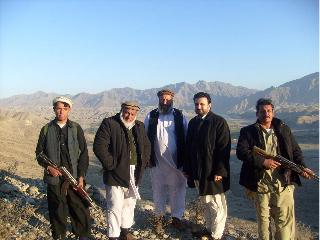
Steve cordially arranged for me to ask Chief Zazai a few questions via email regarding his perspective on the historical background of the war against the Taliban and the current situation in Afghanistan. My questions are in bold type and Chief Zazai’s answers are in normal text:

FIVE QUESTIONS: AN INTERVIEW WITH CHIEF AJMAL KHAN ZAZAI:

1.  Some American academics have argued that the day of “the tribe” is long past in Afghanistan, having been battered by governmental intrusion and war since at least 1978, and that a better understanding of Afghan identity for Americans is to look at the “Qaum” and other very local loyalties. How accurate is that description?:

“Qaum” means “Tribe” in Pashtu and also in the Dari Language. 

The 1978 coup was not the first bloody revolution Afghanistan saw, as I have said on many occasions, Afghanistan has gone through many turmoils and turbulences throughout its history and has survived as a nation and country. For one to get convinced that after the 1978 Red revolution that the tribal structure was gone for good, then one would also have to argue how this tribal structure survived till 1978 when Ghengis Khan burned almost half of Afghanistan?  What about Hulagu Khan, Tamerlane, the Persian empire, the Mughals and prior to all that Alexander the Great? [The tribes ] having seen all these bloody empires and survive untill 1978 is amazing, isn’t it?

To justify the argument simply by referring to the 1978 bloody Red revolution and claim the tribal structure was gone, is dead and has vanished in Afghanistan, would simply be ignorance and a lack of understanding of the rich Afghan culture and Afghan way of life.

The Bonn Agreement appointed Hamid Karzai for 6 months as an interim President of Afghanistan back in 2002. When 6 months passed, did the UN or US call for election? No, of course not. Who then who appointed Mr. Karzai as a President for 2nd time to be the President of the transitional government? It was the “Loya Jirga” and not through the election process. A Loya Jirga is a pure Afghan Tribal process and procedure of making things happen!

Let’s take a look at how the current Afghan Constitution was approved  and came into an effect:

The constitution of Afghanistan was not approved by the Afghan Parliament and Senate as the Parliament and Senate did not exist at the time. In fact the constitution was approved by the “Loya Jirga”; although there was a large presence of the Warlords and criminals in both those Loya Jirgas, nevertheless they served their purpose.

Now, why would one argue that the tribal structure does not exist in Afghanistan or it’s a thing of the past? Closing our eyes from the truth does not mean the truth would vanish. We have a phrase in Pashto which means “One can not hide the sun with just two fingers”.

If one believes they need to find local loyalties in Afghanistan, the locals are the tribes. Why would some go around in [semantic] circles and confuse themselves? 

2.  In your interviews with Steve Pressfield, you discussed the presence of warlords in the Afghan government of Hamid Karzai, men with very bad records.  There have also been reports in the media, from time to time, of Ex-Khalqi Communists serving the regime. Are these men a similar problem to the warlords in your view?

When the Russians withdrew their forces in 1989 and left behind the Communist regime of Dr Najibullah, many thought that the regime would collapse in just days or in weeks, but Najibullah’s government survived for five long years despite the daily rains of rocket attacks on Kabul and only collapsed in 1992. Then the so-called Mujahideen took charge of Kabul and Afghanistan, but soon we saw that these power hungry men started fighting each other over the Throne of Kabul. Their bloody civil war of lasted from 1992 untill 1996 and turned Afghanistan into a pile of rubble.

 Many Afghans were turned against these so-called Mujahideen because these leaders and their commanders became involved in killing innocent men, women and children, looted people’s livelihoods and literally turned all of Afghanistan into a war zone. We witnessed that in just five years these “Mujahideen” warlords destroyed Kabul and all other major cities in Afghanistan. People started to hate them more than they hated the old Communists, so in a way, the crimes which were initially committed by the Communists were covered up when the Afghan people witnessed the subsequent brutality of these so-called Mujahideen leaders and commanders.

I strongly believe the Afghan civil war was also orchestrated by the  KGB/FSB in order to engage these Freedom fighters in Afghanistan and prevent them from crossing over to infiltrate the [formerly Soviet] Central Asian States, and also to cover the atrocities committed by the Red Army against the Afghans in Afghanistan. The KGB/FSB calculated shrewdly that if these “Mujahideen” leaders accomplished a united Islamic government in Afghanistan, it would spill over into the entire Central Asian countries. Although many believed in the West at the time that Russia was almost finished and gone, that was a mistake Westerners made in trying to understand the Russian mind set. 

I strongly believe that the Afghan Communists are responsible for the destruction of Afghanistan. They still have the Marxist-Leninist theory in their heads and we recently have witnessed that many of these Afghan ex-Communists are keeping close ties to Moscow. I believe these Khalqis and Parchamis are now part of the problem as they are now receiving support from Russia.   

3.  Afghanis, especially Pushtuns, have a well-deserved historical reputation as fierce fighters.  Yet there is more to life than war, even in a warrior society. What does a young Afghan man in his late teens or twenties hope for?  What would he see as “progress” or better times?

Much is been said about the Afghans, Pashtuns in the media and honestly I disagree with much of it because no nation, no tribe no people wish for a war as war only brings devastation, destruction and miseries.

Yes, the Afghans are great fighters, but that does not mean they wish for a war all their life. We needed to fight against the Russian invasion and I still strongly believe we have done the right thing defending our country and nation against Communism; as I said earlier, things went wrong when these so-called Mujahideen or Freedom fighters leaders started fighting one another. I believe every Afghan wishes for peace and stability in Afghanistan. Yes there are some who will continue fighting, but we all know they are small in numbers and are not significant. The reason many young men are part of the Taliban and other insurgents is the lack of employment , lack of better life conditions and of course lack of any positive attention from their government in Kabul. At this moment if you ask me, why are these young men are turning to Taliban and are fighting the US, NATO and the Afghan government? You will hear a simple answer from me and that is lack of employment opportunity for these youth who are mostly uneducated.

I will tell you my own experience: I was only 16 when I used to go to Afghanistan from Pakistan from time to time to fight against the Russians. I knew the consequences of being killed, but I was not going to Afghanistan in order to be killed, I was going to Afghanistan to fight the Russians. Now things are opposite, many young men are brainwashed by evil men and these young men wish to die, that’s why there are many suicide attacks now. I remember very well in my days when we were busy fighting the Russians, that we never had suicide bombers. This is very new to us and it has been brought form outside Afghanistan.

I believe the Afghan government and the US/NATO should provide training programmes to all those young Afghan men at around age of 16 and above who have lost the chance to go to school and get education. By learning skilled trades, I believe they will be in a position to earn a loaf of bread for themselves and their family and in this way we will prevent many young men from falling in the trap of believing being a suicide bomber means a life in the hereafter with the 72 virgins which will await them at the corridor of heaven.

4.  You have spoken at length with Steve Pressfield about the 10th Mountain Division and your positive relationship with them.  How successful have American and NATO units been in making connections elsewhere with Afghan tribal leaders compared to the 10th Mountain Division?

I do not have any information to the regard that if the US Army has any close contacts with other Tribal leaders. In my case, I have pushed hard for this partnership, regardless of any obstacles that were created for us to even have a decent understanding, but now it seems to be working. In the entire Afghanistan, I am the first Tribal Leader who denounced the Taliban and Al Qaeda openly and more practically, by forming TPF (Tribal Police Force) from my Tribesmen to fight these evil men without any financial assistance from the US Army, US Government, NATO or the Afghan Government. My TPF programme is by the people and for the people – I think it is on the same lines of your democracy “By the people and for the people”!

5). A friend of mine, the strategist Thomas PM Barnett, has been advocating a much greater international presence in Afghanistan, including not just NATO but China, Russia and India, with direct business investment as well as providing military and civilian aid workers. Would this development be a welcome one?

I believe this is a positive step in bringing a broader coalition and the entire International community to help and be involved in Afghanistan; but although this approach might be purely for business purposes, it could pose a future problem as most of these nations are not very sure of the US and NATO policy in the long term and present intentions. Afghanistan has always maintained very good and close relations with India, and throughout this friendship, India had no political ambitions and that what made India look good until the 90’s when India supported the Northern alliance. [As a result] I believe India has lost that status of being a neutral friend of Afghanistan. Also, the growing presence of Indians in Afghanistan is sending some disturbing alarms to our immediate neighbor (Pakistan).

Things needs to be balanced and Afghanistan needs a better understanding [of FDI] and not just bringing in anyone which could only lead to disruption and anxiety in long term. As an example, the large copper mines in Logar Province were won in a biding by a Chinese company – later it was revealed that the Chinese paid large kick backs to the minister of mines. In my opinion, involving more Chinese and Russian corporations would mean more corruption in Afghanistan.

Russian firms are already involved in Afghanistan. Most of them are involved in espionage and there are Chinese corporations and I believe they are doing the same. It would be more fruitful [for Afghans] for your friend to encourage Western corporations and companies to invest in Afghanistan.

Thank you, Chief Zazai.


Switch to our mobile site